How to Bring Warmth to Your Winter Garden

Baby, it’s cold outside! Now is the time for snuggling up, hunkering down and staying in. The garden may be a little drab to look at with deciduous trees going bare and flowers and grasses fading into muted tones. It‘s a good time to put a little warmth and brightness back into the landscape.

Eye of the Day Garden Design Center|Winter Gardening planting ideas| Sticks on a Fire plant
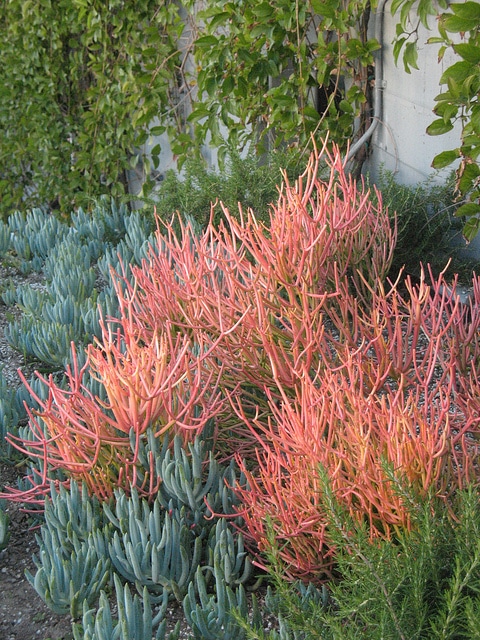
Sticks on Fire (Euphorbia tirucalli) gives a bright pop of color to a winter garden. Photo credit: Mike Boucher


One way to do that is with plants whose foliage is aflame with gold, yellow, orange and red. Here are a few eye-catching plants to add pop to a dreary corner. For an accent, or even a hedge alternative, there are several bright selections of mirror bush, Coprosma to choose from. In this case, their cultivar name often says it all. ‘Inferno’, ‘Pina Colada’, and ‘Tequila Sunrise’ give you an idea of what their creators were seeing in the variegated foliage they sport. All are medium-sized shrubs, about four feet by three feet and require only moderate water and partial shade, or as the garden guide calls it “cool sun”. There is also a low, spreading version called ‘Evening Glow’ that can act as a groundcover.

The ever-popular flax plants also have some dazzling variegations: ‘Cream Delight’ is striped with creamy yellow, ‘Jester’ has a bright pinkish-range mid-rib and green leaf margins, ‘Sunset’ sports shades of apricot, pink and green, and ‘Yellow ‘Wave’ has a sunny yellow center stripe.

For really low water use areas there are a number of succulents that will provide that sunset glow. One is a selection of euphorbia (Euphorbia tirucalli) called ‘Sticks on Fire”. As you can imagine, it is flaming yellow and orange. Keep it as a container specimen or put it in the background where it could grow into a sizeable shrub (remember that its sap is irritating!). Most everybody knows the jellybean plant, Sedum rubrotinctum, which can eventually provide unbroken cover in the planting bed or add interest at the edge of a mixed container garden. Just as colorful is Crassula capitella ‘Campfire’ whose pointed little leaves look like flames racing across the ground.

Eye of the Day Garden Desig Center|Winter Gardening Ideas|Christmas Berry
California native Christmas berry (Toyon heteromeles) is perfect for bright color in a winter garden. Photo credit: John Rusk 

One last group to consider for winter color includes those shrubs that produce red or orange fruits at the end of the season. Most will hold the berries for months (if the birds don’t get them all first). Cotoneaster horizontalis ‘Perpusillus’ grows only one or two feet high, but spreads to seven feet wide and is covered with bright red berries. Larger shrubs in the firethorn genus of Pyracantha include P. koidzumii ‘Victory’ and P. coccinea ‘Kasan’. Both may be left in a natural fountain shape, but take well to espaliering on fences or against walls. And lastly, don’t forget our native Christmas berry, Toyon heteromeles for handsome dark green foliage festooned with cheery red fruits.

Image licenses: Christmas Berry, Sticks on Fire


How It Works: Frostproof Terracotta

How It Works: Frostproof Terracotta

It’s hard to believe that it is already Fall. In California, leaves don’t change much in a drought, no matter what time of year. But as another October becomes a thing of the past, much of the country can already feel the promise of winter. So let’s talk about frostproof terracotta.

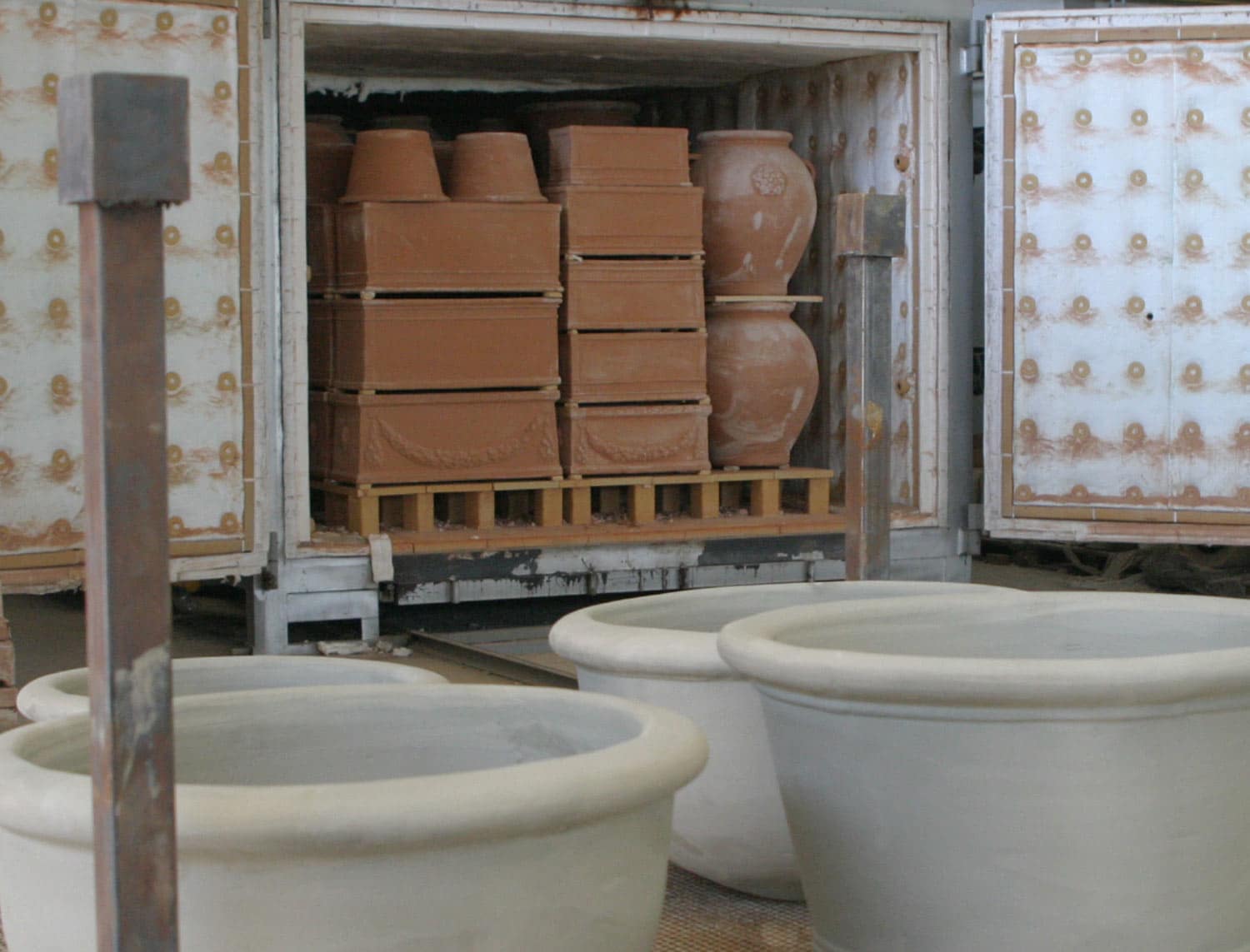
Many of you live and work in places that freeze, and much has been said, both by homeowners and garden designers about the freeze/thaw capability of ceramic plant containers. Remember that ‘clay’ is the earthen material, ‘ceramic’ is the clay when it has been fired. Terracotta is low fire red clay found all over the world. There are low fire clay bodies, and high fire clay bodies. Low fire is also referred to as earthenware, high fire is stoneware. Once clay is fired it becomes ceramic no matter what temperature it is fired to. But that doesn’t mean it is mature. I want to introduce you to two new key words: “vitrify” and “absorption.”

Every clay, whether earthenware or stoneware, has an optimum maturation point when fired. When this point is reached, the clay is “vitrified.” When clay becomes vitreous, it means that all the different ingredients in the clay have melted and bonded together to form a mature, very strong, “ceramic.” If a clay is over-fired it becomes flakey and worthless. If a clay is under-fired (like many of the pottery containers that are called “terracotta”) it is weak and porous and highly susceptible to cracking, even without being frozen. So when we talk about frostproof ceramic or terracotta, interestingly enough, we have to talk about fire first. In ceramics it always, always, always, comes back to the fire.

The key equation: the more vitrified, the less absorption. Did you catch that? Absorption yields expansion/contraction and hence cracking, during a freeze/thaw cycle. That’s basically it. You’ve got clay, you’ve got fire, you’ve got maturation/vitrification, and you’ve got frostproof ceramic. Or, more plainly put, if a ceramic vessel is not fired to its target temperature, it will die an easy death no matter what the weather is doing.  But if it will last longer than you do.  Just think about that for a moment.

Here is what you can do when you are ready to purchase frostproof ceramic containers:

1) Research the manufacturer’s credibility. If you are buying real, frostproof ware, know where it comes from and how it was fired, and get something on paper, like a warranty.

2) Protect your investment! Do not add moisture to a vessel that you know is going to freeze. And if you are going to take the time to cover the plants, take the time to cover the container too. Start to think of the ceramics as a living, breathing, expanding and contracting entity, just like the plant that it holds.

3) IMMEDIATELY call Eye of the Day. They have been selling frostproof terracotta for more than fifteen are not only knowledgeable, but relatively good looking and congenial, and carry the best frostproof terracotta on the market (guaranteed to withstand temperatures down to minus 15° F).

4) Move to California!


Winter Gardening Tips and Ideas

Holiday time is approaching, but that doesn’t mean there isn’t time to get a little gardening in between the shopping and entertaining. Since the sun is shining less brightly, the soil has started to cool. Lower light and shorter days mean less productivity for plants.

Here are some ideas for winter gardening:

1. Plant for the Coming Cool Season

Winter vegetables include everything in the cabbage family: broccoli, cauliflower, mustard greens, and everyone’s new favorite—kale. Any of these can be grown as row crops for the kitchen, but consider putting a few in a half barrel or other container for both their edible and ornamental uses. Colorful rainbow chard is another great choice.

2. Consider Color

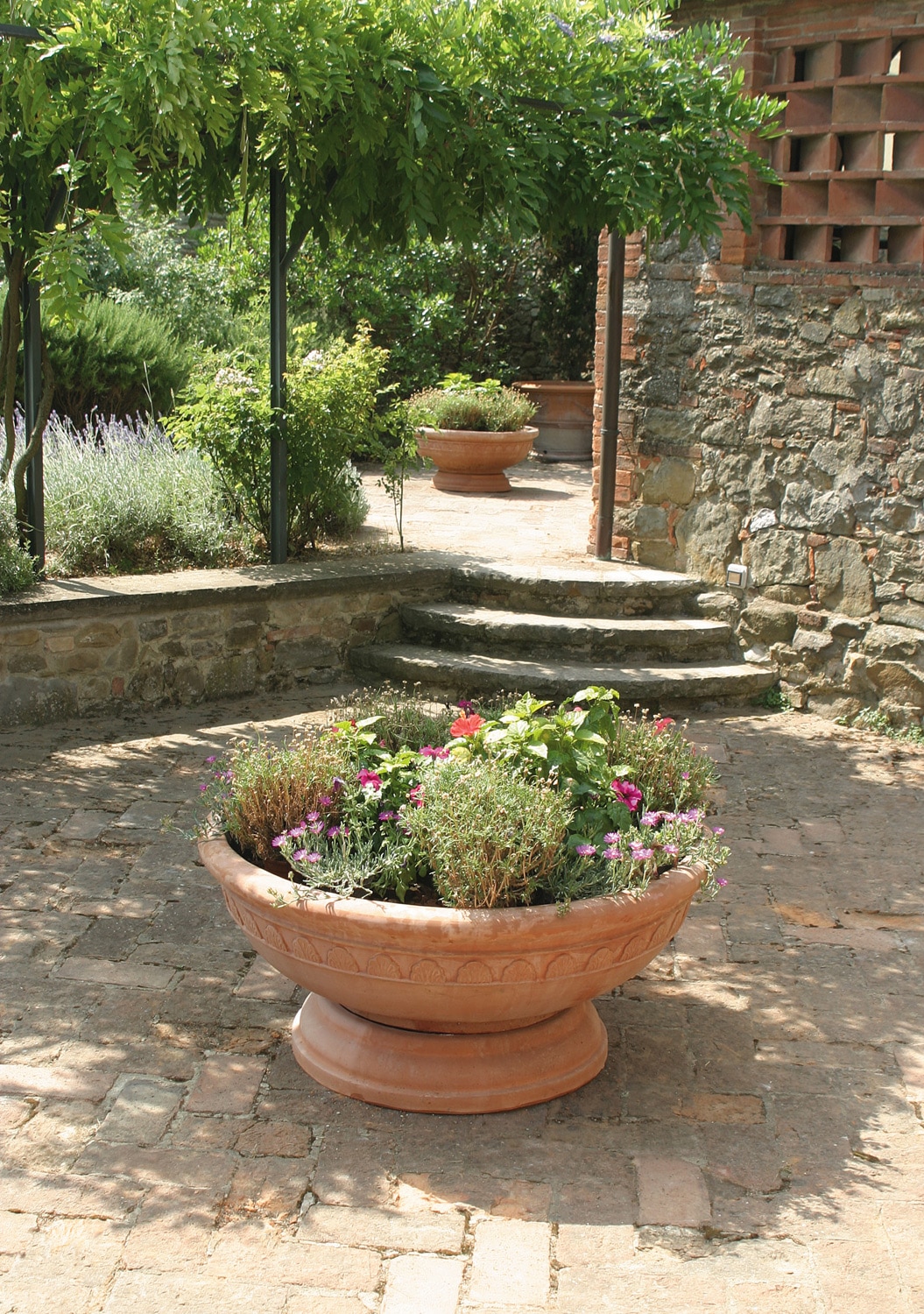
Cool season flowers like bachelor’s button, stock, sweet alyssum, calendula, foxglove, Iceland poppies, and pansies all thrive as winter approaches. Pick a color palette of similar or contrasting tones and group different types together in the container of your choice. Only one or two colorful pots will lend a festive air to your patio or deck. If you tuck in a few dormant bulbs, they will take over as the annuals wane. Narcissus and all its forms, gladiolus, lilies, tuberose, Mexican shell flower, and rain lily all fit the bill.

3. Compost in the Cold

Compost all the trimmings from your garden. Even in the cool months, bacteria and fungi will be doing their magic to produce beautiful planting amendments for spring. Use one of the patented composting bins, build your own, or just layer the materials in a corner of the garden. If you are ambitious, turn the pile once or twice (a good way to monitor the moisture level) or simply leave as is.

Mulch and water your favorite trees and shrubs. Much editing is going on because of the drought, but these are ways to nurse these larger shrubs along.

4. Gifts for the Wildlife

Don’t forget the birds and beasts, too. A shallow bowl of water will give them a welcome drink and a cleansing splash. Place the bowl in a quiet place where visitors have a view of the surroundings and potential threats. Keep filled and flushed with clean water as needed.