Baby, it’s cold outside! Now is the time for snuggling up, hunkering down and staying in. The garden may be a little drab to look at with deciduous trees going bare and flowers and grasses fading into muted tones. It‘s a good time to put a little warmth and brightness back into the landscape.
One way to do that is with plants whose foliage is aflame with gold, yellow, orange and red. Here are a few eye-catching plants to add pop to a dreary corner. For an accent, or even a hedge alternative, there are several bright selections of mirror bush, Coprosma to choose from. In this case, their cultivar name often says it all. ‘Inferno’, ‘Pina Colada’, and ‘Tequila Sunrise’ give you an idea of what their creators were seeing in the variegated foliage they sport. All are medium-sized shrubs, about four feet by three feet and require only moderate water and partial shade, or as the garden guide calls it “cool sun”. There is also a low, spreading version called ‘Evening Glow’ that can act as a groundcover.
The ever-popular flax plants also have some dazzling variegations: ‘Cream Delight’ is striped with creamy yellow, ‘Jester’ has a bright pinkish-range mid-rib and green leaf margins, ‘Sunset’ sports shades of apricot, pink and green, and ‘Yellow ‘Wave’ has a sunny yellow center stripe.
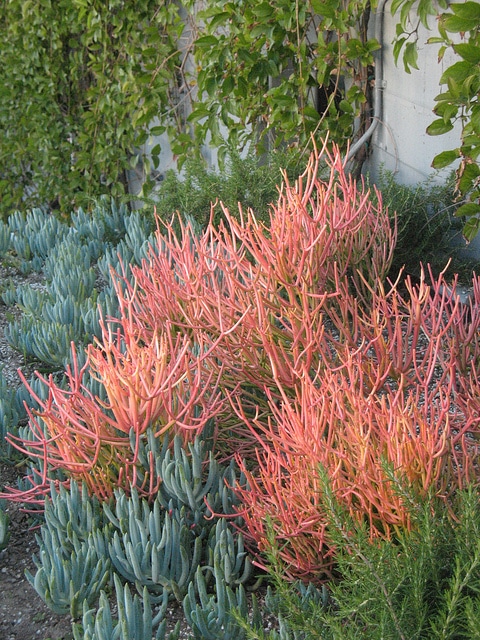
For really low water use areas there are a number of succulents that will provide that sunset glow. One is a selection of euphorbia (Euphorbia tirucalli) called ‘Sticks on Fire”. As you can imagine, it is flaming yellow and orange. Keep it as a container specimen or put it in the background where it could grow into a sizeable shrub (remember that its sap is irritating!). Most everybody knows the jellybean plant, Sedum rubrotinctum, which can eventually provide unbroken cover in the planting bed or add interest at the edge of a mixed container garden. Just as colorful is Crassula capitella ‘Campfire’ whose pointed little leaves look like flames racing across the ground.
One last group to consider for winter color includes those shrubs that produce red or orange fruits at the end of the season. Most will hold the berries for months (if the birds don’t get them all first). Cotoneaster horizontalis ‘Perpusillus’ grows only one or two feet high, but spreads to seven feet wide and is covered with bright red berries. Larger shrubs in the firethorn genus of Pyracantha include P. koidzumii ‘Victory’ and P. coccinea ‘Kasan’. Both may be left in a natural fountain shape, but take well to espaliering on fences or against walls. And lastly, don’t forget our native Christmas berry, Toyon heteromeles for handsome dark green foliage festooned with cheery red fruits.
Image licenses: Christmas Berry, Sticks on Fire