Right-Sizing Your Garden and Saving Water

Eye of the Day| Deana Rae Right Sizing Your Garden|Save Water

Right-sizing your Garden and Saving Water
By Deana Rae McMillion, Garden Enthusiast and Master Gardener

Right-sizing our gardens in order to reduce water usage is imperative. Just taking out your lawn isn’t necessarily the answer. Many people who do remove their lawns aren’t doing the necessary research and are planting water thirsty plants or invasive plants that use more water or rob their soil of nutrients.

Eye of the Day| Deana Rae Right Sizing Your Garden|Save Water
Invasive ‘Scotch Broom’ invading a hillside by the highway. Disturbed areas are prone to plant invasions.

If it seems overwhelming to remove your entire lawn, one thing you can do to save water is let it go brown. In this severe drought the most important thing to save are our valuable trees. But why not look at this as an opportunity to right-size your garden and plantings? California is a summer dry climate and that is not going to change even when the drought is over.

11 Ways to Conserve Water in Your Santa Barbara County Home Landscapes

  1. Select water-efficient plants that grow well in your climate and microclimate.
  2. Be hyper-aware of plant selection and be sure not to choose invasive plant species
  3. Hydrozones: Place plants with similar water needs together and irrigate them accordingly (high, medium, low, and very low zones).
  4. Let roots of established plants dry out between irrigations, water deeply and infrequently slightly below the root zone.
  5. If you do not use or enjoy your lawn consider replacing it with drought-tolerant plants. If you decide to keep your lawn – water it based on University of California’s “Drought Irrigation Tips”
  6. Mix soil amendments (compost, etc.) evenly and deeply into sandy and clay soils (40% or more by volume) before planting.
  7. Spread a 2-3” layer of mulch on top of the soil around garden plants and trees.
  8. Water early in the morning.
  9. Control weeds.
  10. Avoid over-fertilizing.
  11. Sweep walkways and driveways; do not hose them down with water.

Eye of the Day| Deana Rae Right Sizing Your Garden|Save Water
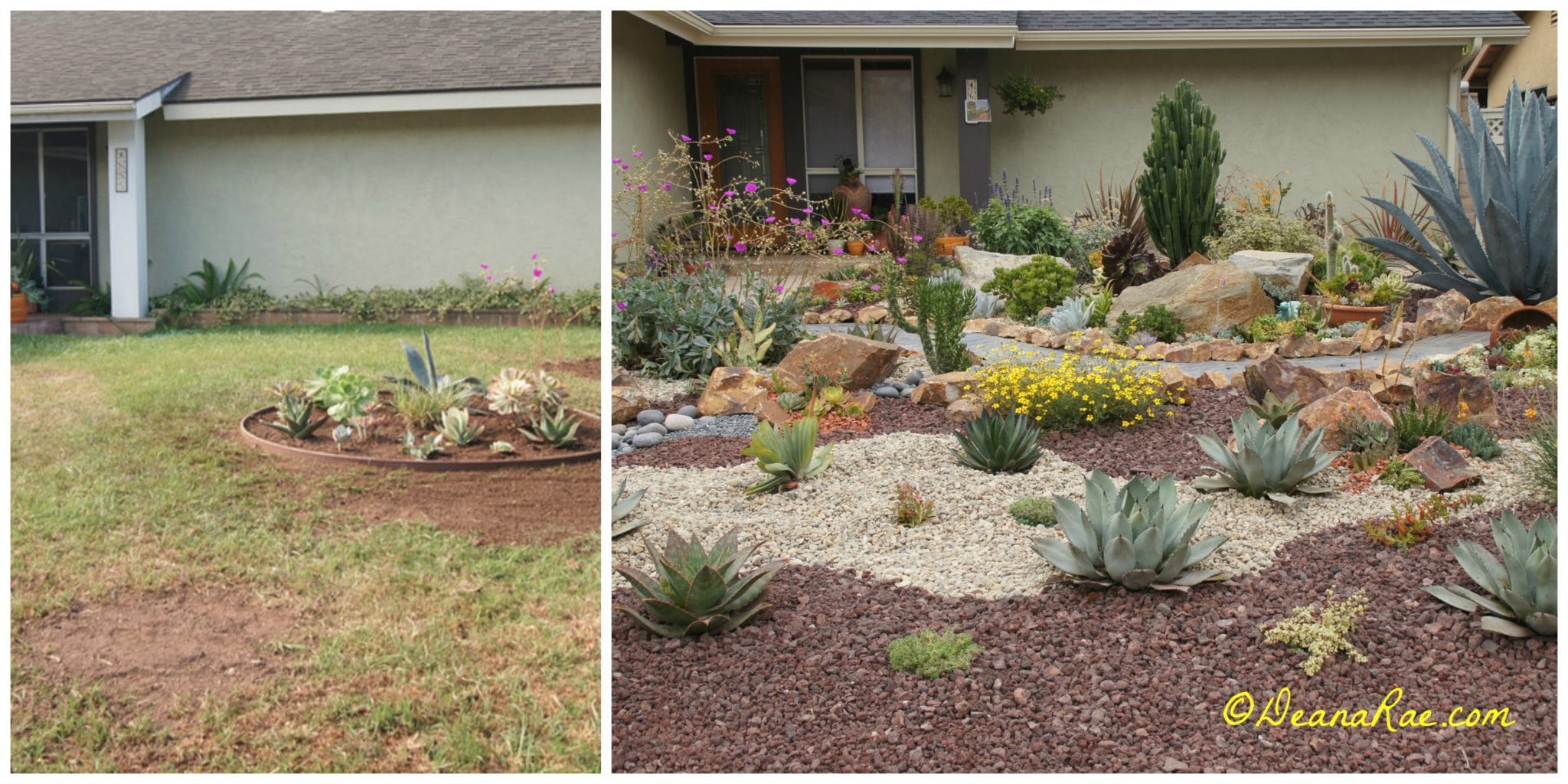
Deana’s front yard transformation – before: unsightly, water thirsty lawn and after: beautiful, sculptural waterwise landscape with only 30% of plants on drip irrigation in the summer months.

Have a home landscape or gardening question? Contact the Santa Barbara County Master Gardener Helpline at 805-893-3485 or email anrmgsb@.

Please allow 3-4 business days for a response as the Master Gardener helpline is staffed by volunteers. Please be as detailed as you can in your query when leaving a message. Photographs are also helpful in our responding to your gardening concern.
Resources:
Santa Barbara Master Gardener Program
California Garden Web: Drought Gardening Tips
Plant Right: Home Gardeners
Clay Pot Irrigation Benefits During Drought

We had a very quick winter here on the Central Coast with just a little bit of rain, spotty at best, while the rest of the country has been buried under blankets of snow. As California is technically still experiencing a severe drought, I want to address ceramics in irrigation.

Irrigation Through Clay
In the newsletter, we have covered many subjects concerning ceramics.  In irrigation, ceramics also has many uses. The Romans created an intricate system of aqueducts, which directed water throughout all parts of the empire. We see this around the world, ceramic pipe systems carrying water through towns and villages.

Clay Shards and Slow Water Release
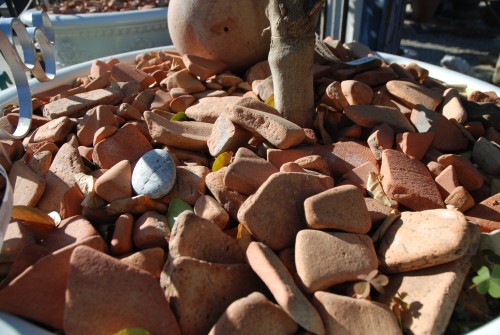
Ceramic “shards” can also be used as a soil amendment. The broken pottery has to be low fire to be absorbent.  Low fire ware may be crushed and added to the soil and as you water, the shards act as little sponges and absorb the water and release it essentially as needed below ground.

Clay Pot Irrigation

Another use I find very interesting is what is called “clay pot irrigation.” If you perform an internet search of this term and go to “Images,” you will see excellent examples of how this works.  Essentially, it is a very simple technique.  Again, a low fire vessel is made by a potter, and is then buried right next to the plants you want to irrigate; fill it with water, and because of the porosity of the low fire ceramic, it leeches through the walls of the vessel and waters the plant by slowly releasing a minimal amount of water.

Cultures around the world have been using this method forever!  Look it up, check it out, and enjoy these new yet very old techniques of gardening.  Ceramics in your garden is not just decorative, it can be very functional.


Flowers and Plants for a Drought Tolerant Garden

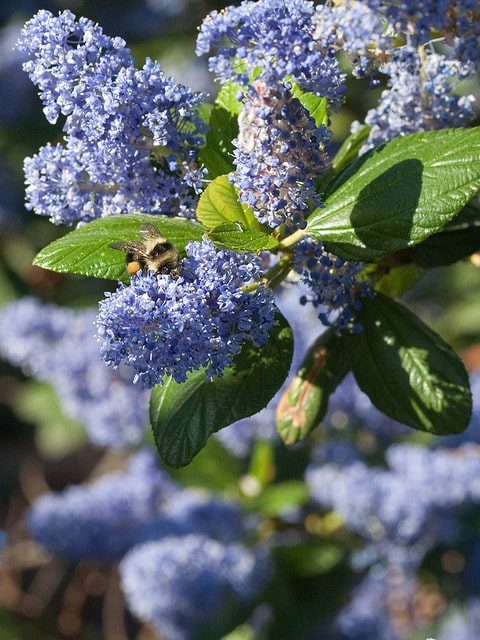
Eye of the Day|Verdure newsletter| wild lilac with bumblebee

Drought Concerns in the Garden

We are in a drought. And it may last for more than the short cycle of approximately seven years that has regularly occurred here in recent history. Some scientists are saying that this is part of a much larger cycle that could be one hundred to one hundred-fifty years in length (and let’s not even try to imagine how climate change will affect that). So, how do we keep our love of living, green things around us with much reduced water resources? One way is to look at the plants that have evolved in this habitat for many thousands of years. Native California plants are great choices for our modern gardens as are plants native to climate zones similar to ours.

Plant Options for Drought
Obvious choices for evergreen shrubs are Manzanita and Ceanothus. Both of these have been bred and selected for a variety of plant shapes and sizes. There are ground-hugging cultivars as well as tall and broad shapes to provide screening. Manzanitas have interesting bark as well as dainty, bell-shaped flowers. Ceanothus are often called California, or wild lilac, for the resemblance their flowers have to the cultivated lilacs our grandmothers grew. Consult a good garden guide or your local nursery for selections and specifics of each cultivar.

Mediterranean Plant Options for Drought
Other readily available options to replace thirsty plants during our dry spells hail from the Mediterranean region.  Some favorites include Echium candicans, Pride of Madeira, that covers itself with spires of tiny flowers in shades of blue and purple as well as Lion’s Tail, Leonotis leonuris, which bursts forth with sprays of brilliant orange blossoms from spring through fall.  And let’s not forget the many selections and species of rosemary and lavender that are ideally suited to our climate as well as their native zones.

Water for the Birds, Bees, and Bugs
One added perk for all of these native and non-natives is that they are quite attractive to bees, butterflies and other beneficial fauna that are seeking sustenance through this dry spell. So don’t be afraid to lose that thirsty garden and replace it with a verdant, more water thrifty landscape.