The Clay Authority: Protecting Terracotta

The Clay Authority: Protecting Terracotta

As a fifth generation Californian, it’s easy for me to take beautiful weather and sunny, sandy beaches for granted, I also realize that for most of the country, this time of year presents some concerns when it comes to taking care of your garden and terracotta planters

Two years ago I wrote an article for Eye of the Day entitled “How it Works: Frost Proof Terra Cotta”. The big take away from this article are the two words “vitrify” and “porosity” that are of particular interest to those of you from areas concerned with freeze/thaw issues, due to the porosity of certain clay used to make planters.

The following month I continued with “Terra Cotta Transformations”, bringing the reader into the realm of technical ceramics by explaining what exactly happens with clay during its firing cycle.

Eye of the Day| Clay Authority| Protecting Terracotta
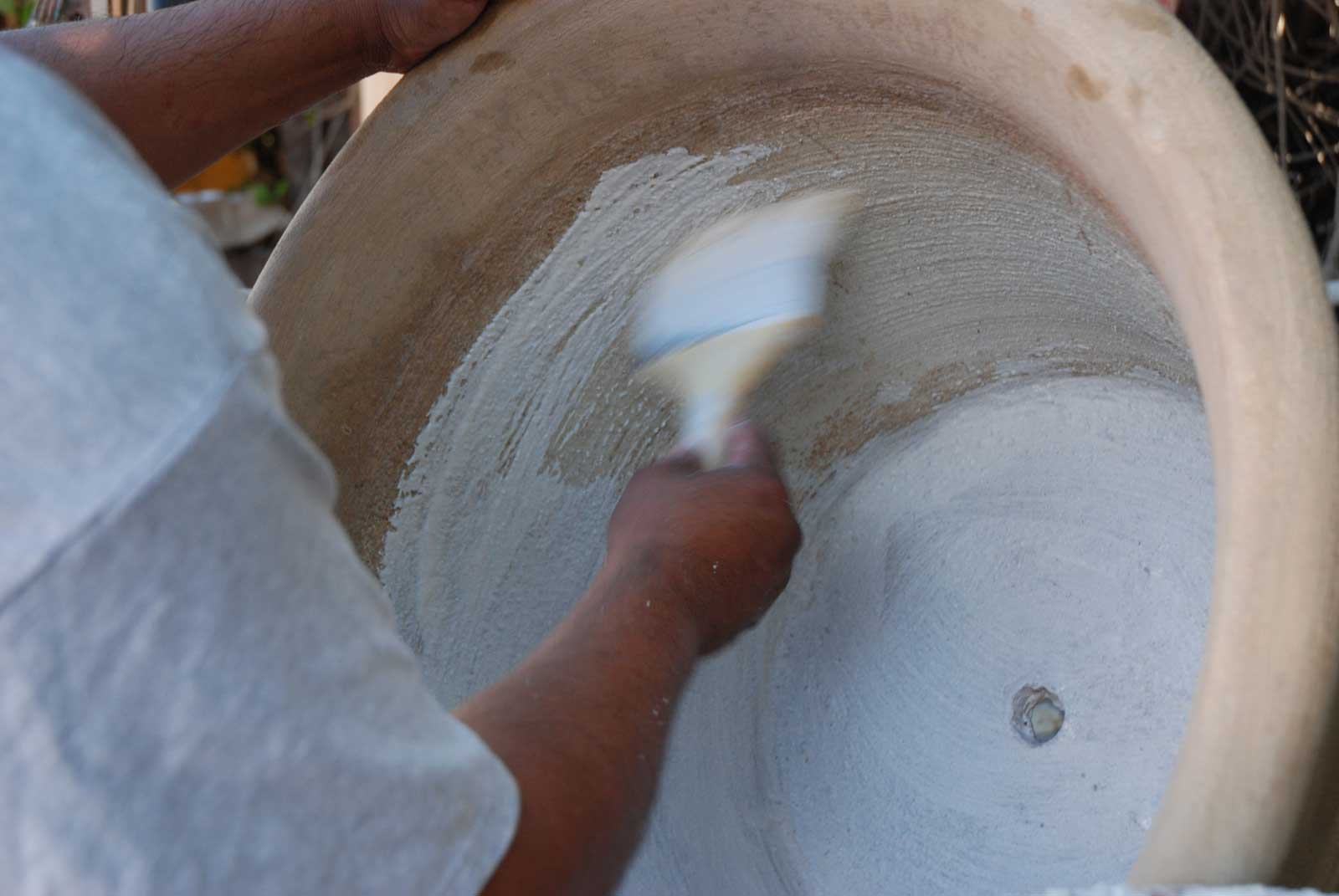
Sealing the inside of a terracotta pot.

Freeze/thaw can be viewed as synonymous with expansion/contraction. But there are also many reasons to want to waterproof pottery. Although waterproofing and frost proofing pottery both pertain to porosity, frost proofing also deals with extreme temperatures.

So as we begin to move into winter and we consider protecting our garden pottery investments, here are a few things to think about:

Protection from Frost and Cold:
If you need to protect your terra cotta from freezing, either move it inside, cover the planter (and the plants), and definitely do not over water, or if possible, don’t water at all.  A quick test for the pottery itself would be to ask the dealer where you purchased the planters if they have any pot shards. Use them to test the durability of the pottery by soaking them in water, then put them in your freezer for a day or two. If it hasn’t cracked, take it directly from the freezer and put the shard in the sun. You’ll learn about the quality of your investment.

Waterproofing Terracotta:
If your concern is waterproofing your pottery, the research is simple to find a myriad of products on the market these days to seal low fire pottery (especially for tile). If it’s high fire then you don’t have to worry about water leeching through, especially if it’s been glazed.

Let’s all settle in for what always proves to be an elegant, sometimes challenging, yet always amazing time of year—Winter!

And if you ever have any technical questions about garden pottery, feel free to consult with me through EOD.
Why Expensive Pottery for Your Garden?

Expensive pottery|Eye of the Day|garden design

Why Expensive Pottery for Your Garden?

Whether you are a garden enthusiast or if you’re like me and have gardening in your soul, no doubt you are always on the lookout for great pots—not just great shapes and styles but pottery that lasts.

English lead containers and Francesco del Re’s pure bronze pots might be the most expensive planters on the planet, but who buys plant pots made from lead or solid bronze? Guilty! Recently I wrote about Italian pottery from the commune of Impruneta and tried to debunk the myth that it is not the name of Impruneta itself which is important but the clay they use. Not all clay is equal and when the pottery you are looking at has a high price tag, don’t be afraid to ask some questions about the origin, the clay body used, the firing temperature and duration in the kiln.

Many people think we only sell expensive pottery at Eye of the Day, and we do carry high-end items, but there is the saying “You get what you pay for”.

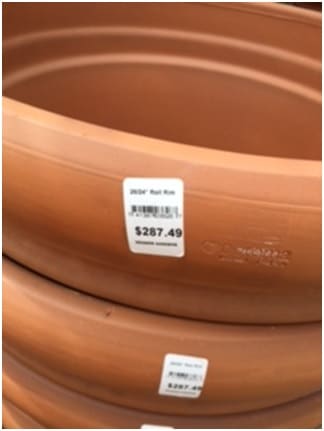
At a local nursery, a competitor of ours sells the classic Italian double rolled rim planter with a 24” diameter for $. The product is produced by one of the largest pot manufacturers in the world, Deroma of Italy. These pots are made from inferior clay and you will find that they start to break down almost immediately.

Our high quality Italian double roll rims will last for a century or more. Our price for the same size pot is $—a big difference for a pot that might last a decade opposed to one that will last for 100 years or more. The conclusion is: high quality pottery isn’t necessarily more expensive, it just depends on where you shop and what you know about the quality of the pots.

Learn more about terracotta and how terracotta pots are made at our blog.

Related Articles:
The Truth Behind the Aged Terracotta You Buy
Inside the Pieces: Why We Love Authentic Pottery


The Clay Authority – Debunking the Myth of Impruneta Clay

Impruneta|Galestro Clay|Eye of the Day

The Clay Authority – Debunking the Myth of Impruneta Clay 

If you don’t have a subscription to Garden Design magazine, you really should do yourself a favor and get one. This new issue, Spring 2016, has a beautifully presented article about the legendary pottery artisans of the small hill commune of Impruneta just outside of Florence.  If only as a travel guide to garden lovers, it reads like a NYT Travel section “36 Hours” of what to do and where to go in this tiny historic commune.  Of course, you always can pick up a copy at Eye of the Day.

For a long time I have complained that many Italian pottery manufacturers have falsely used the name “Impruneta” to sell their Italian pots, often at an inflated price. This wonderful article helps to debunk this misnomer and offers a wonderful guide to visitors and lovers of quality Italian garden pottery, abundant throughout the country. Besides, after pasta, what does one think of when Italy is mentioned but double rolled-rim planters?  Well, maybe shoes and olive oil might come up…

The essential part of the article was the brief mention of the actual terra cotta clay material found and used by these artisans in Impruneta. Many would have you think that Galestro clay can or is only found here and this is not the case as it is prevalent throughout the Sienese countryside. Francesco del Re was so adamant that his production of what many consider the finest Italian terracotta produced today be trademarked as “Terra Forte” clay so as not to be confused and wrongly named Impruneta. But the simple fact is still: All of the high quality, long lasting and frost proof terra cotta pottery found in Italy uses Galestro clay and does not have to be found within the commune of Impruneta.

At Eye of the Day, our main Italian terra cotta product is made with 100% Galestro clay manufactured for us by Colorobbia of Montelupo, Italy, and the largest Terracotta manufacturer in the world. Sounds impressive, doesn’t it?

What is really impressive is that our high quality, frost proof Italian terracotta will not only last for centuries, it is affordable when compared to similar pieces stamped with “Impruneta”. And please, don’t get me wrong, I have beautiful Impruneta pots, Francesco del Re pots as well as pots from other artisans of fine quality Italian terra cotta in my garden but all are manufactured using 100% Galestro Clay.  That’s why I’m the Clay Authority.


Baked Earth: The Truth Behind Authentic Impruneta Pottery

Eye of the Day|Impruneta clay|terracotta Baked Earth

Baked Earth: The Truth Behind Authentic Impruneta Pottery

Welcome to another edition of Baked Earth, with information about what’s happening in the world of clay, ceramics and installation pottery. This month, we would like to pop the mythical bubble concerning Impruneta pottery.

Impruneta is a commune in the province of Florence, in the Tuscany region of Italy. It has been famous for many centuries as the producer of the region’s finest terracotta, everything from tiles to garden art, to large terracotta planters. Along with the handmade nature and unparalleled craftsmanship of Impruneta terracotta lies the real secret of its success: the clay body.

It has been known for countless generations that Galestro clay is the superior material of the region. Galestro clay is extremely high in subsoil minerals, has an excellent plasticity, and due to its unusually high granitic content, can withstand sub freezing temperatures. Galestro clay yields a high quality product with great versatility and many ceramic manufacturers in the Tuscany region use Galestro, including Terrecotte San Rocco, Eye of the Day’s premier terracotta source.

Only a handful of factories produce wares actually in the commune of Impruneta and therein lies the problem. Because the potteries in the outlying communities are also using Galestro clay, or part Galestro and part local material, some producers will stamp their work with the word “Impruneta,” which can lead to retailers here in the US (either unknowingly or complicit in the process) to sell merchandise as “Impruneta terracotta,” when in fact it was not made within the boundaries of the Impruneta commune.

It’s akin to wearing a Timex and calling it a Rolex. Both are well made watches, but one has the reputation of distinct craftsmanship and is branded as such, so you are paying for the brand. It is the same with Impruneta—it has been branded by generations of superb craftsmanship and these days it is not uncommon for people in this business to use the branding of “Impruneta” to their advantage by calling it something that it is not.

So garden designers, homeowners, and landscape architects alike, be forewarned! There are only a handful of families producing authentic Impruneta terracotta in that commune, so if someone claims to be selling or installing Impruneta wares made with Galestro clay, be sure to ask them who the manufacturer is, and cross check their references. But as I have said countless times, it all comes back to the clay. And anything made with Galestro clay from the foothills of Tuscany is a sure bet as the highest quality pottery for your home.

By the way, I’m wearing a Timex…
Know your terracotta!


5 Tips for Winterizing Your Terracotta Pottery

Eye of the Day|How To Winterize Your Terracotta Pots

5 Tips for Winterizing Your Terracotta Pottery

To many people winterizing terra cotta pottery may seem like a completely irrelevant subject for discourse, but consider that you can add this information to your knowledge just IN CASE it ever gets cold enough to freeze. This is an actual problem for people with terracotta pots in parts of the US , which is why you don’t see great pottery everywhere.

There ARE steps that can be taken to help prevent your pots from cracking when old man winter whips through your garden. The goal is to eliminate the possibility of water being absorbed, frozen and thus causing the pot to crack.

  1. Lift the pot from the ground by placing it on pot feet, wooden blocks or pieces of stone. This will allow air to circulate beneath the pot.
  2. Seal the pot with a penetrating sealer, such as one used to seal slate floors and swimming pools
  3. Remove plants and soil from the pot, as the soil will absorb water, freeze, expand and can cause cracking
  4. Cover the pot with plastic sheeting to avoid contact with water
  5. Most fool-proof: move it inside

Much depends on the quality of the terra cotta as well.  Eye of the Day’s is the highest quality, high fired Italian terracotta, made from Galestro clay. Our pots, manufactured by Terrecotte San Rocco, are guaranteed frost proof to minus 15 degrees. It helps to know that if a pot is high-fired, the absorption rate is lower, and so the risk of cracking in freezing weather is reduced.

You may need this information some day. Maybe.

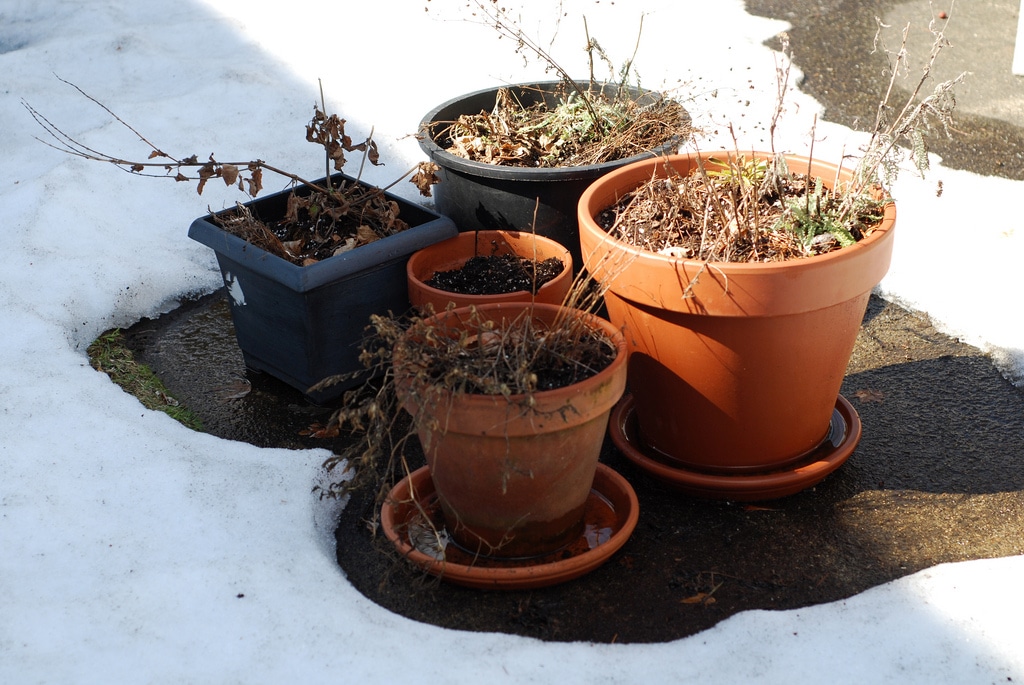
Photo Credit: Terracotta Pots, Creative Commons, My Container Garden After Winter by Rachel James is licensed under CC BY-NC-ND 2.0


The Art of Building Large Terracotta Pottery

Eye of the Day|Baked Earth|Scott Semple Large Terracotta

The Art of Building Large Terracotta Pottery

In all my days of fascination with clay, there is one tool that I would call my tool of choice: the wheel. But the two things that have influenced me most are my teachers and my travels.
Eye of the Day|Baked Earth|Scott Semple Large Terracotta

Over the past thirty years or so I have had the great fortune of traveling throughout the world.  My interest in large format pottery began in the early 90s and quickly became one of the key purposes of my explorations.

There are many ways to build a large, ceramic container.  In Thailand, I watched two assistant potters feed a rope of clay the size of my leg and 20’ long, over their shoulders to a master potter, who would very slowly spin a crude wheel and pinch the coils on top of each other.   This seems to be the most common way cultures build large terra cotta containers.
Eye of the Day|Baked Earth|Scott Semple Large Terracotta

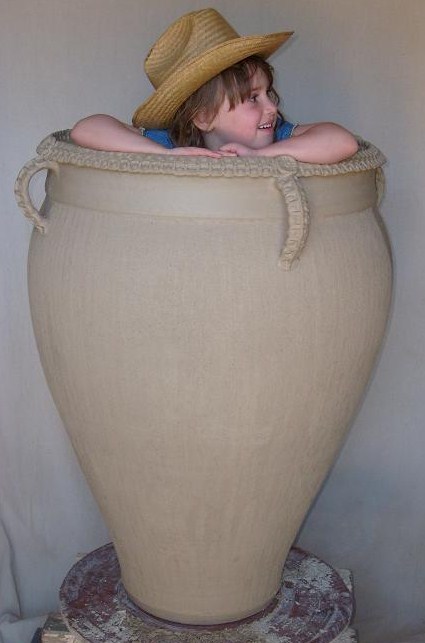
Recently I was a guest artist at a conference where, over the course of three days I made a 7’ Amphora using two wheels. I was positioned next to next to a family of Koreans who were making traditional Kimchi fermentation jars. These things were huge! They used the same coil/pinch method, but paddled the shapes into the forms.   In Georgia (Eastern Europe), they have been fermenting red wine for thousands of years in enormous ceramic vases called Qvervi; they use the same method. Spain probably has the largest pots I’ve ever seen called Tinajas. These absolutely spectacular containers are also used for fermentation,  as well as storing water.

Throughout my travels I have found that around the world, large terracotta forms are still produced for a great variety of uses.