Debunking the Terracotta Mythos

Debunking the Terracotta Mythos

The sun has yet to awaken, the moon just rose as a wink on the horizon, and the roosters are making that heinous sound only roosters can make, disturbing my first cup of coffee. Excuse me while I get that cup…

Baked Earth Image 4
Terracotta pot showing wear

Baked Earth Image 3
Lower quality clay will damage quicker


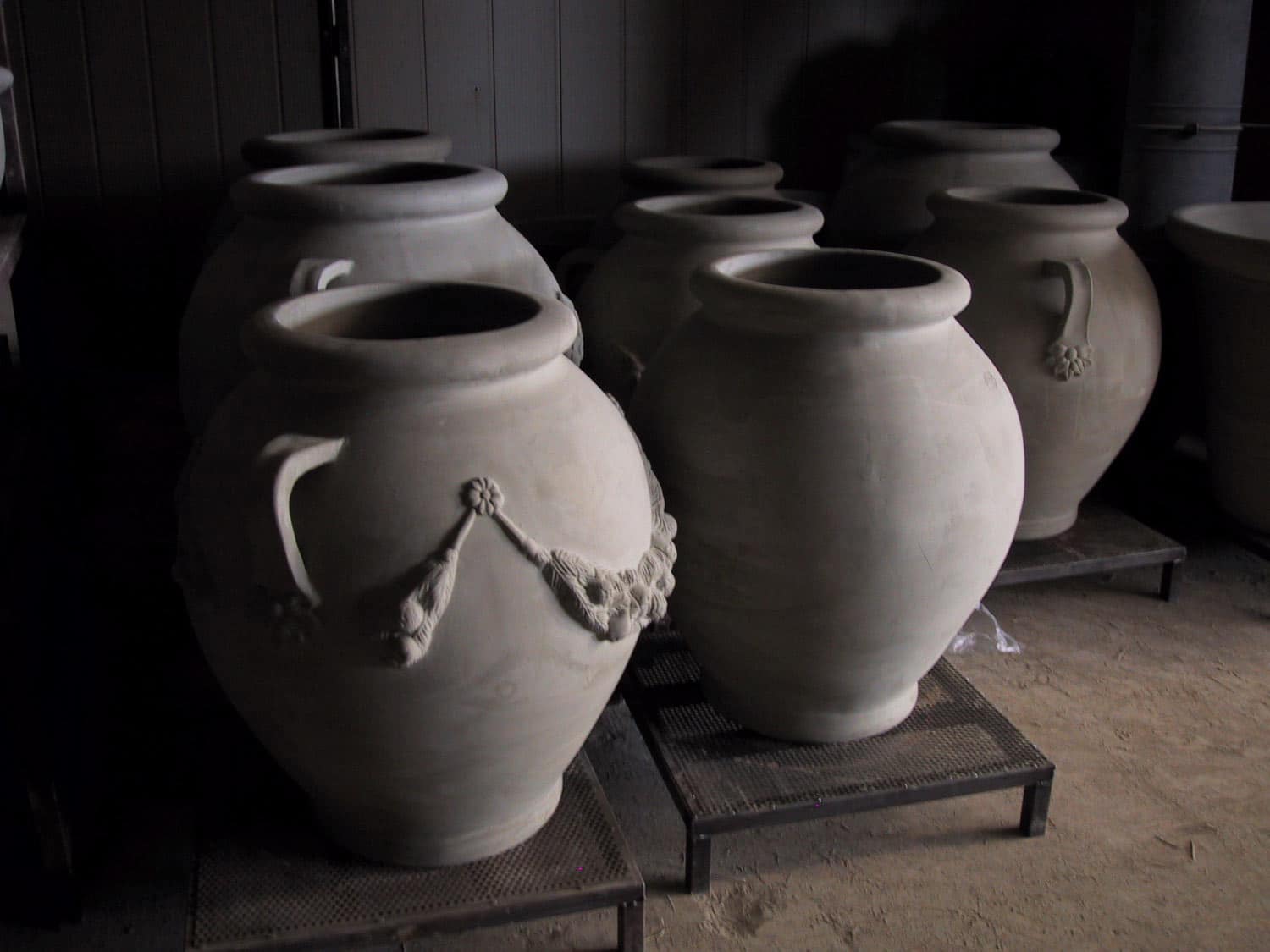
I want to talk about terracotta and it’s classification as an earthenware clay body. In ceramics we have hundreds of clays available to us, but all of them fit into one of two categories; earthenware, or stoneware. The difference between earthenware and stoneware is the maturation temperature, more easily termed as low or high fire clay. Low fire clays, having been fired to their maximum temperature (anywhere from 1800-2100°F) remain porous, while high fire clays vitrify when fired to higher temperatures ( 2200-2500° F). Since clays have many “ingredients” that are specific to their particular region, all clays have a different temperature range, but all can be classified as either low fire or high fire clay. Terracotta is technically a red earthenware, a low fire clay containing between 5 and 10% iron.

Baked Earth Image 2
Water can wear down inferior terracotta faster

Baked Earth Image 1
Slight damage on the lip of the terracotta saucer


The meaning of “terracotta” is “baked earth” in Italian. Many people mistakenly use the words “terracotta” to describe anything made of clay from anywhere in the world, whether it is low or high fired. But as we are beginning to understand, terracotta is an actual clay body itself. It is abundant and utilitarian, can be found on every continent, and has been used for millennia to create irrigation piping, garden pots, and roof tile. It is best to speak of terracotta regionally, for example Mexican terracotta is essentially the same as Italian, but fired at a lower temperature. Another mistake about terracotta is that it is weak. In many places in the world it is hard to find even enough fuel to bring the fire up to the maturation temperature of the clay. If the temperature that matures (hardens, strengthens) the red clay is 1980°F, but the fire only reaches 1800°F, what happens? You have immature, under-baked pottery that is susceptible to cracking and doesn’t last very long. This happens all over the places simply don’t have the wood to do the firings, so they will use whatever they can to heat up their pots, resulting in a market in which one terracotta pot will last only two years and the one next to it will last two hundred… it just depends on the fire and country of origin.

Baked Earth Image 5
This Italian terracotta pottery made from Galestro clay and fired at high temperatures is unique in its quality and durability.

The next time someone says to you that terracotta is junk and won’t stand the test of time, tell them in all confidence that it depends on where it is from and how it was fired. Then you can say that Eye of the Day garden design center only sells authentic Italian Galestro terracotta, mined for five generations from the same clay deposit, and fired to perfection. You can always depend on Eye of the Day for the highest quality in garden design products.

Hope this was informative. See you all next month!


Elements of Style: The Classic Mediterranean Garden

Elements of Style: The Classic Mediterranean Garden

A classic Mediterranean style garden is typically low-maintenance, drought tolerant and perfect for a climate dry and hot in Summer and warm and moist in Winter. For those of us living in California, this seems a perfect fit. Traveling throughout the Mediterranean region, focused on the landscape and gardens, reminders of California are constant.

The defining characteristics of the Mediterranean style are:

  • Focus on hardscapes, with very little or no lawn
  • Citrus, olive trees, rosemary and lavender often planted in terracotta pots
  • Fountains and water features are key. Water features became popular in the gardens of the Italian Renaissance. They reflect the garden and provide the relaxing elements of sight and sound.  Because of the scarcity of water in the Mediterranean,  many water elements offer a relief from the heat.
  • Large and small terracotta pots and urns and statuary. Pottery in many forms has been a part of Mediterranean gardens since their origins in ancient Roman households. From intricate bas-relief to simple and plain, they are quintessential for a European garden.  Statues, urns and planters provide focal points and because their footprints are small, they are particularly useful in a small garden. The Greeks and Romans filled their pots with flowers to add color to their courtyards and pathways without depleting the water supply, or they used them to grow fruit trees that could be moved about  according to the outside temperature.  But pots were also used as beautiful objects on their own – a classic oil jar at the end of an allee, a row of terracotta pots topping a balustrade, or an urn crowning a pedestal.

You don’t have to live in Spain, Greece or Italy to reflect the siren call of the Mediterranean classic garden.  A few carefully chosen garden elements… an antique Greek pithari, a scattering of large terracotta pots and urns and a simple water feature will create your classic otium.  Being water conscious and embracing a rustic, muted look will go a long way toward making your space the place to be.


Lisa Cox Design | Los Olivos Tasting Room Gets Design Update

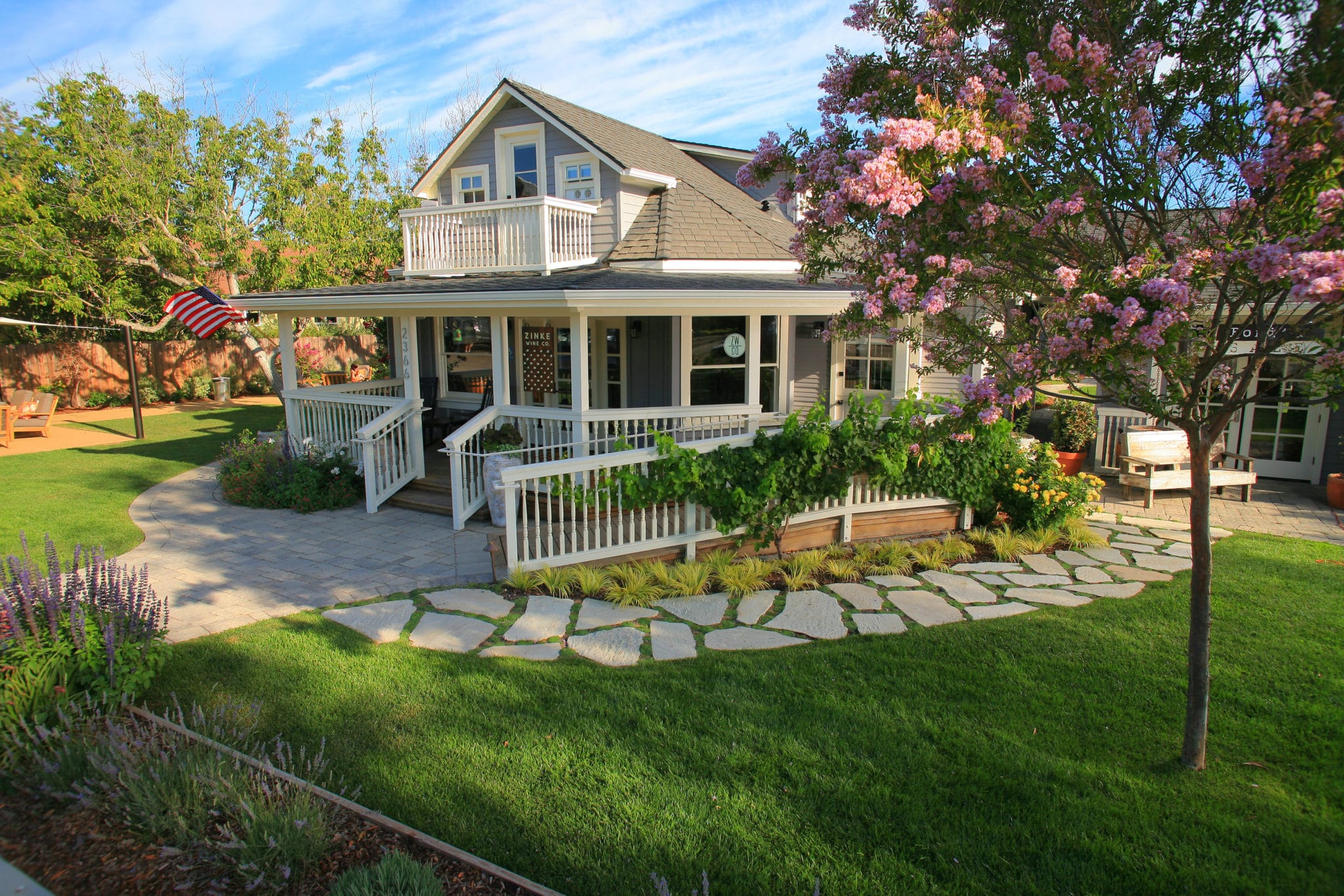
In the relatively short time Lisa Cox Landscape Design has been working in the Santa Barbara area and Santa Ynez Valley, she has become the go-to for anyone wanting clean and sharp designs with a focused point of view. This is clearly evident in her design for the brand new Zinke Wine Co. tasting room. Lisa says she can’t take complete credit for the beautiful design as she worked closely with Thierry Fraye of Paysage Landscape and the Zinkes who have impeccable taste and a clear vision for their brand.

Michael and Ashley Zinke are Zinke Wines. Michael Zinke is a self-taught winemaker that apprenticed at Girouard and Sans Liege wineries before venturing out on his own. They opened their state-of-the-art tasting facility in the wine country township of Los Olivos, CA this past May. They create single vineyard Rhone varietal wines sourced from a handful of Central Coast vineyards. They needed a venue befitting their precious creations and Lisa was the one to deliver.

Lisa incorporated Eye of the Day products throughout her design. As you approach the building you are greeted by two ‘aged’ Greek Bottle pots customized by Eye of the Day standing guard aside the main entrance. Each pot is planted with drought tolerant growth. While enjoying your first taste of Viognier you overlook an impressive Asian carved granite trough bursting with colorful succulents. You can also admire the lovely Italian San Rocco Giara Liscia pot that flanks the bocce court while waiting for your next throw. Zinke Winery Blueprint OverheadAfter taking it all in, we had some questions for Lisa:  

What was your inspiration for the design?
My Inspiration came from a few sources.  First and foremost, the owners, Michael and Ashley Zinke have distinct, incredible taste.  They were looking for a look that felt something with a rustic/industrial look and a warm welcoming feeling from the street that would draw in customers who were looking for something a little different.  Also, with the existing Cape Cod style structure of the Tasting Room, we wanted to keep that charm, but infuse it with a bit of modern charm!

Did the Zinkes have strong opinions on what they wanted or did they leave it up to you?
I would say they gave me a direction as stated above, but pretty much let me design what I felt would present both function and form to the space.

What were the particular challenges with this project?
We needed an area that would allow furniture placement which I accomplished with the DG cutouts that are surrounded with lush green grass. There was some existing hardscape that we “improved” with either widening pathways or substituting new flagstone stepping stones. With a mixed plant palette of natives, lush perennials and color, the end product turned out quite pleasing to the eye…and of course the succulent filled planters are incredible!

What do you most like about designing in the ‘Valley’?
I can honestly say, what I like most about designing in the valley are the people! Since my husband and I have only been here for 1½ years, we can honestly say we are overwhelmed with the warm, friendly and caring SYV community!  And of course, how can you beat our gorgeous natural landscape of rolling hills, oak trees and vineyards…it’s hard to beat! A special thanks to Rich Cox Photography for the images!


APLD San Diego Visits Eye of the Day

Eye of the Day Garden Design Center recently welcomed some members of the San Diego district of the Association of Professional Landscape Designers. Headed by Koby Hall of Koby’s Garden Alchemy, Inc., the group of landscape designers hit the road for a weekend of visits to major garden influencers throughout the Santa Barbara area.

They stopped by EOTD here in Carpinteria for some tea and tours by owner, Brent Freitas, and sales rep, Mitch Walker who were happy to share information about our company history and an in-depth overview of our various product lines. This included our Italian terracotta from Terrecotte San Rocco and American pottery from Gladding McBean. The APLD group walked our showroom to see our extensive collection of fountains, statuary, and containers. Brent also spoke about our customization services including coloring, aging, and fountain conversions.

We were happy to see some EOTD items find new homes in future San Diego APLD designs. Special thanks to you guys and we’re happy you could visit!

If your group would like a tour of Eye of the Day, please contact us at: trade@

Click the slideshow for more of the San Diego APLD visit at Eye of the Day:


On the Road Again…

…from the Travel Journal of Brent Freitas, CEO/Owner of Eye of the Day
 

Over the last few years we have focused on survival and have been importing only products that have become our staples: Italian terracotta, French Anduze pottery and hand-thrown Greek terracotta pots.   Pre-Recession, Eye of the Day traveled throughout the world and brought back some amazing things for our customers.  These one-of-a-kind items coupled with our large inventory of antique oil jars from Italy, Greece, Spain and France have helped see us through slow times.  We often hear that our customers are amazed with our large inventory and what a pleasure it is to be able to find items for their projects.

Many of our special finds have been sold so now it is time to begin exploring the shops and fairs throughout Europe looking for old jars, pieces of stone, architectural iron and funk that just seems to work in a garden.  I look forward to keeping you updated with my wanderings and great finds over the next few weeks, and hope that you may find something to tickle your fancy that you just can’t live without.

Many who know about my wanderings comment that I am lucky to travel around the world and that you wish it were you.   I sometimes wish it were you too and that I could just stay home, read, give Suzi a wish list for each meal and try to burn through a cord or two of oak in our fireplace.  But reality is different, and I find myself with an emptiness in my stomach, feeling homesick before I ever leave.

The ambivalence of arriving in Rome with a cold and my luggage still somewhere at Heathrow keeps me from going to my favorite dive in the ghetto for baby artichokes fried in olive oil.  Instead, I sleep for eight hours and have a marginally decent pizza in the hotel bar (how bad can a pizza be in Rome?).

Finally I catch the last train to Chiusi and meet up with Marcello, owner of Terrecotte San Rocco.  We drive to his home in the hills of Siena where his wife and mother, Nona, have a pot of pesto al Genovese ready and tonight a platter full of prosciutto and a variety of salumi.  It could definitely be worse.  After dinner Nona brings out a small bottle of deep amber liquid, a Christmas gift from an old friend.  There are no labels or foil and it looks to be hand-corked.  My mouth begins to water.  I hope it is a local Vin Santo.  The pruny, sherry-like liquid makes me almost forget the three dozen oysters and magnum of champagne we had with our daughter in Brooklyn on Christmas morning.  Almost.

New Years Eve day we are off to a nearby town for a big antique fair.  It is sparsely attended which gives me a little breathing room to adjust to my antiquing personality.  Walking up and down the steep cobblestone streets of the ancient Tuscan hill town is hard work and makes me hungry.  There is not time to sit down to the wonderful food in a local restaurant, but I find a nice salumeria and a sandwich of excellent prosciutto, pecorino and to my friend’s surprise, a few thin slices of lardo.  A glass of local vino rosso in a plastic cup and I’m back pounding the cobbles.  I find many interesting, but highly priced items, and then find a dealer who wants to bargain…

Below are some photos of some beautiful antiques that I found during my trip to the antique fair.  More to come!


On New Year’s Day I wake up late but I’m glad that the house is quiet.  It allows me to organize my week ahead at the factory.  My partner, Marcello, is the most progressive manufacturer in Italy.  In the afternoon he shows me a new factory he just started with a partner to produce quality terracotta for large garden centers.  While older, traditional terracotta manufacturers are going out of business, Marcello is buying their factories and their molds and working to develop new items.  Our association with this man and his business is becoming to be the backbone of Eye of the Day.

Next week:

Bologna and a little spaghetti.  After that I’m off to France to pick up a special order for a new landscape architecture firm wanting pots from Anduze that we don’t have in stock.  It will be an experiment renting a truck in Italy, driving to France for the pots and take them back to Italy to put on the container.  We are about to find out if this will be less expensive, faster and more productive than shipping by truck from France to Italy or shipping by pallet from Marseille.


Couleurs d’Anduze

Green.  We all know green.  And blue and honey-hued.  Even red.  But these new colors are just begging for description.  How about “the color of an early morning Spring sky”? Or “the color of the Pacific Ocean as it meets the sky on a Summer evening”.  There’s also “moody sky before a rainfall”.  As you have learned while reading past posts, we have recently received a container of the exquisite pottery from Anduze, France and walking through Eye of the Day MANY times during each day, each of us has moments to stop and take in the pallette of colors pulled from nature.  The green of a cool forest, the blue in a child’s painting of the ocean, the honey of a field of wheat and the ivory of a butter-rich cream. The red of Marilyn Monroe’s lips?

Anyway… the colors are just the introduction to the story.  The pottery results from a popular legend that an Anduze potter attended a fair in 1610 and fell in love with a Medici vase.  Inspired, he created the first Anduze planter, combining Italian exuberance depicted by the garland decoration and the austerity of the Cevennes region of France shown in the stocky, practical build of the planter.  There is no design style that would not embrace the Anduze Vase.  The shape and style (not to mention the colors) are timeless.  Eye of the Day is the place to find your little corner of French history, your piece of French pottery.