Baked Earth: The Making of a Greek Pot

Eye of the Day|How to Make a Greek Pot| design

The Making of a Greek Pot

This month I’m going to discuss a tool that has captured my imagination for nearly 40 years: THE POTTER’S WHEEL. It started for me in Orange County California in 1976 at Irvine High School. For my P.E. class I was taking surfing and the instructor also taught Ceramics. It didn’t take me long to figure out that all the cool kids not only took surfing, but took Ceramics for second period, so if the waves were particularly good, the surf class would just stay and surf all the way through second period!

Thirty years later, I am still doing ceramics, primarily because of my fascination with the potter’s wheel, which is a relatively new invention in the history of pottery making. Originally functional vessels made of clay were constructed using a coiling technique. The artist would roll out “ropes” of clay and slowly, methodically, hand turn a small form by placing the coils on top of each other and pinching each coil into the one beneath it. Although this time honored method can be very slow and tedious in terms of production, there are still many cultures in the world that use this technique to create functional ceramic containers.

Eye of the Day|How to Make a Greek Pot| design
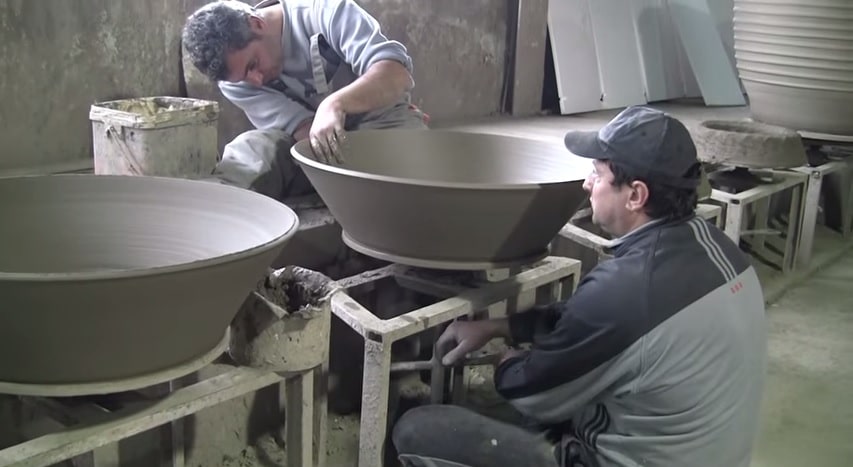
The potter starts to form the base of the pot on a hand-turned wheel.

The potter’s wheel was born out of necessity. There are many theories, but all agree it was a matter of industrialization that brought about its creation. Recently I found a few video clips in my inbox that Brent (owner of Eye of the Day) had shot on the Island of Crete. They are an intimate look at the processes used in the production of the authentic Greek vessels Eye of the Day sells. The pieces are wheel thrown but on a wheel that is hand cranked by a potter’s assistant. The clay is made into fat coils, and added to the clay beneath it by pinching. Then the assistant spins the wheel faster and the potter begins to lift the clay into a form. It is particularly fascinating that Greece employs both old and new world techniques. They start with a slab of clay for the bottom, and work their way up by coiling, and pinching, and finally throwing the clay into shape. In the videos you see that there are multiple wheels working at once with vessels on each, in different stages of completion. When the clay needs to rest on one wheel,, the potters move in succession to each wheel down the line, until returning to the beginning to continue working toward a finished piece. These pieces are then fired and shipped directly to Eye of the Day.

We are very lucky to have this direct connection to handmade vessels for our garden design needs. The next time you are at Eye of the Day, remember what it takes for the artisans who build these vessels to deliver such an authentic and timeless piece of history for our own daily aesthetic.
Eye of the Day|How to Make a Greek Pot| design
Greek pots at different stages of creation.


Clay Pot Irrigation Benefits During Drought

We had a very quick winter here on the Central Coast with just a little bit of rain, spotty at best, while the rest of the country has been buried under blankets of snow. As California is technically still experiencing a severe drought, I want to address ceramics in irrigation.

Irrigation Through Clay
In the newsletter, we have covered many subjects concerning ceramics.  In irrigation, ceramics also has many uses. The Romans created an intricate system of aqueducts, which directed water throughout all parts of the empire. We see this around the world, ceramic pipe systems carrying water through towns and villages.

Clay Shards and Slow Water Release
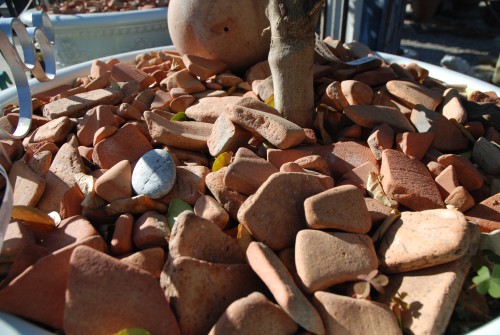
Ceramic “shards” can also be used as a soil amendment. The broken pottery has to be low fire to be absorbent.  Low fire ware may be crushed and added to the soil and as you water, the shards act as little sponges and absorb the water and release it essentially as needed below ground.

Clay Pot Irrigation

Another use I find very interesting is what is called “clay pot irrigation.” If you perform an internet search of this term and go to “Images,” you will see excellent examples of how this works.  Essentially, it is a very simple technique.  Again, a low fire vessel is made by a potter, and is then buried right next to the plants you want to irrigate; fill it with water, and because of the porosity of the low fire ceramic, it leeches through the walls of the vessel and waters the plant by slowly releasing a minimal amount of water.

Cultures around the world have been using this method forever!  Look it up, check it out, and enjoy these new yet very old techniques of gardening.  Ceramics in your garden is not just decorative, it can be very functional.


Eco Friendly Landscape Design by Lisa Cox for Hacienda Style Home

Lisa Cox, of Lisa Cox Landscape Design has happily designed landscapes ranging from simple tract homes to vast estates.  As she plans an outdoor environment, she envisions a transformation that communicates the lifestyle and personal taste of the client, while incorporating her own style. Each garden is designed and built with all materials including stone, plants, trees, water features, and garden art selected by Lisa using local, top qualified growers and suppliers.

Commitment to sustainability, the use of drought tolerant plants and trees, including California natives, has been an integral part of her design process, allowing a more “naturalistic” result that mimics the local terrain.

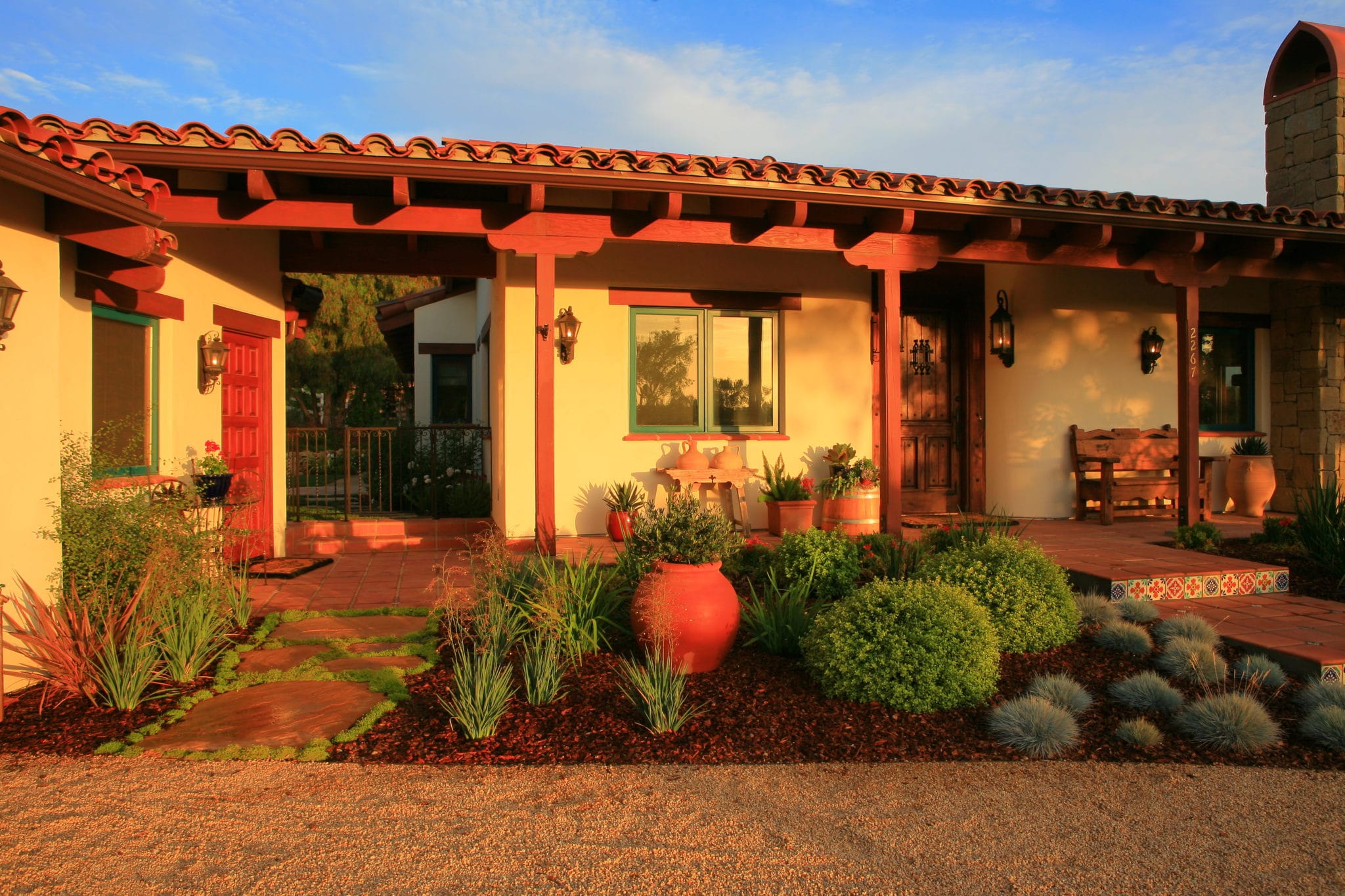
When Lisa met with her new clients in the Santa Ynez Valley, they requested that the newly constructed home not have any sod in the front area, and that she use drought tolerant plants including grasses and succulents. Working with a blank slate, except four nice sized olive trees at the entrance, she was free to design the space, including selection of a plant palette that complimented the Hacienda style of the home. With the use of local sandstone boulders, salvias and phormiums as her base, she also incorporated deciduous trees and perennials for color in the Spring and Summer, and a few rows of grape vines because after all, it’s the Santa Ynez Valley!

Choosing Greek terracotta pots from Eye of the Day, filled with “Blue Glow” Agaves gave the clean, rustic look she was looking for on the front porch and the traditional Terrecotte San Rocco terracotta pot in front worked perfectly to show off the “Little Ollie.”

It seems everything progressed perfectly for Lisa and her clients, but there WERE a few important challenges:

  1. The need to place a gopher basket for every plant as the local area is inundated with gophers that would quickly destroy the plantings, and
  2. The necessity of paying close attention to selecting plants that can stand the heat as well as the sometimes frigid nights where temperatures can go into the low 20’s or below.

As Lisa’s work on the project came to a close, she felt deep satisfaction; in fact she felt this was a home environment she could inhabit herself.  The project was a dream to work on and the end result was exactly what the homeowner envisioned.

Visit Lisa Cox Landscape Design to view more of her work.