Rosette Succulents for the Garden

Succulents are all the rage and for several good reasons: many have a unique make-up that puts them ahead of the game in extreme heat. Succulents are composed of spongy tissue capable of storing water in dry times. And they maintain their good looks without a lot of maintenance.

Succulents 2
Succulent rosettes can also provide color without requiring as much water as other flowers.

Some of my favorite succulents are in the plant family known as the houseleek family. Many form rosettes of leaves, giving them a floral quality, but without the need for deadheading and other pruning. The other great part about this family is that there are a variety of shapes and forms to choose from. Their main requirement is a bright sunny spot, though some will even take a spell of shade if they have to.

The stone crops are all in the genus Sedum and most are low-growing perennials. Sedum acre is grayish with leaves that form small, whorled rosettes. Two other diminutive species are S. brevifolium and S. dasyphyllum.

“Live Forever” is just an English translation of the botanical Latin Sempervivum. All form densely star-like rosettes composed of many pointed leaves. Two commonly available species are S. tectorum and its many varieties and S. arachnoideum, called the cobweb houseleek because of the white filaments that cross from leaf tip to leaf tip.

Processed with VSCOcam with t1 preset
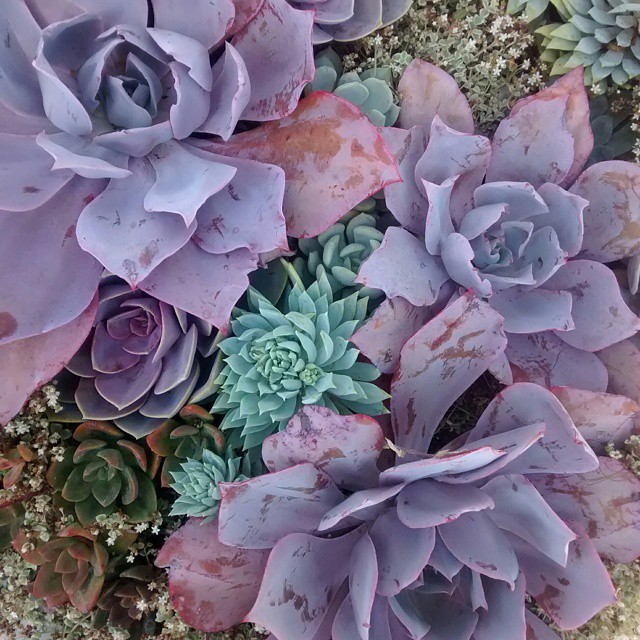
This arrangement of succulent rosettes shows the various size options.

Another group of ground-hugging plants are in the genus Echeveria and many are commonly called hens and chicks. Their leaves come in simple or densely whorled bunches that look like fleshy roses and the colors and forms are mind-boggling. From pale whitish green through bluish, to purple, bronze, red, and even yellowish tones, collectors can go wild accumulating them all. Then, there are the leaf shapes and textures; edges may be smooth to wavy to elaborately crimped and top surfaces may be cupped and smooth or bowed and covered with warty bumps (or both!).

Last are the many forms of Aeonium. From flattened dinner plate sized A. tabuliforme to the more tree-like forms such as the nearly black A. ‘Zwartkop’ and colorfully variegated A.‘Sunburst’, there are many selections for bold color and form.

Tough, sculptural, colorful—what more could you ask for in a plant family?

Right Plant, Right Place: The What and Where of Drought Tolerant Planting

My client was happy; she’d just completed installation of major landscape improvements designed by an award-winning designer. I was not so happy. Some of the plants the designer had chosen were simply not suited for the area where they’d been planted and it was my job to make them look good.

Landscape architects, designers, and maintenance crews are largely trained in the nuts and bolts of building landscape: walls, paths, site lines, and the mechanics of irrigation systems, but may not be as versed in the fine art of plant selection. The lusty plants at the nursery look fantastic in their pots, but growing information is scanty.

The tag says full sun to partial shade. Were the conditions it was tested in similar to your site? The tag says drought tolerant. What kind of soil would provide the support the plant needs to actually survive a drought? And for how long?

Especially in water-challenged Southern California, consider the following as essential to a successful landscape:

Soil

Test the soil. Is it heavy clay, loamy or sandy? Each different type requires specific treatments or careful plant selection. Match plant requirements to what is available (or achievable).

Plant Grouping

Group plants by water and exposure requirements. Even the Cadillac of irrigation systems will support plants only if all of them in the area being watered require the same amount at the same application rate. In our climate it should always be the primary principle to reduce the amount of water required for any given garden zone.

Environment

We shouldn’t have to relinquish every lush-looking palm, fern or ginger, just make sure they are placed where their water requirements don’t conflict with those of the more drought-tolerant ones.

Professional botanists and horticulturists have taken these questions to heart and provide more complete information in books, magazines and websites. Call on their expertise and experience to create a successful, beautiful garden.

See more of my writing on sustainable landscaping here.