The Rogue Garden

Eye of the Day|Rogue Garden| Container Garden

Brent’s Rogue Garden

People often ask me what my garden at home looks like.  I laugh and reply it looks like a psychedelic trip to a botanic garden gone rogue with cracked pots.  Then they laugh, not sure if I’m being honest or just outrageous, and they’re right, my garden is outrageous and honestly, it is a trip. While we sell volumes of the best and most authentic pottery and garden statuary around, we get our share of damage. Handling heavy pottery, moving it, merchandising it and delivering it involves some mistakes. So I have plenty of opportunities to take beautiful Italian terracotta pots home, albeit with chips and cracks (we epoxy the cracks so they will last just as long as the first quality ones). The problem is what to do with over twenty years’ worth of damaged pots.

Eye of the Day|Rogue Garden| Container Garden
A collection of potted plants in the patio area.

Eye of the Day|Rogue Garden| Container Garden
It all starts with good soil.

Eye of the Day|Rogue Garden| Container Garden
Another assortment of pottery with drought tolerant plantings.

Welcome to my test kitchen where I try different plants in different pots to learn what works. Just like a cook’s test kitchen, I have learned what works when potting different plants, hence my belief that the first thing to growing healthy container plants is the drainage.  No matter the plant, it must have freedom to drain continuously.

Eye of the Day|Rogue Garden| Container Garden
Triage on a bowl of succulents that weren’t doing well at the store.

Eye of the Day|Rogue Garden| Container Garden

Second is the soil. If you match the plant’s root system with the proper soil mixture you will have a healthy plant growing in a beautiful pot. I am a strong believer that perlite added to any soil mixture helps to grow healthy container plants.  Why do I spend more on organic soil amendments? Because I’ve learned that chemical fertilizers work fast and make container plants grow and look healthy initially, but down the road, your container plants will suffer the toxicity of chemical salts which build up in the soil. Using products like “SuperThrive”, soap, Epsom salts, wood ash from my pizza oven and most of all, composted soils amendments from the great composter I got from .

Eye of the Day|Rogue Garden| Container Garden
Flowers bloom beautifully in this mini Greek pot.

Eye of the Day|Rogue Garden| Container Garden
A grouping of Italian terracotta pots right outside the bedroom.

I have pots everywhere, hence the “garden gone rogue.” I have created patio areas on all sides of my house to accommodate all of the pots and plants. If a planted pot at Eye of the Day begins to look shabby, I’ll will take the plant home and perform triage by restarting it in an appropriate looking pot. I learn from doing this what looks good from a design point of view and I can share what works in containers that clients may not have considered before. I have been able to grow and pair plants with our products to help market Eye of the Day while making my “test garden” a realistic place to prove that container gardening is the best way to create “Paradise at Home”!
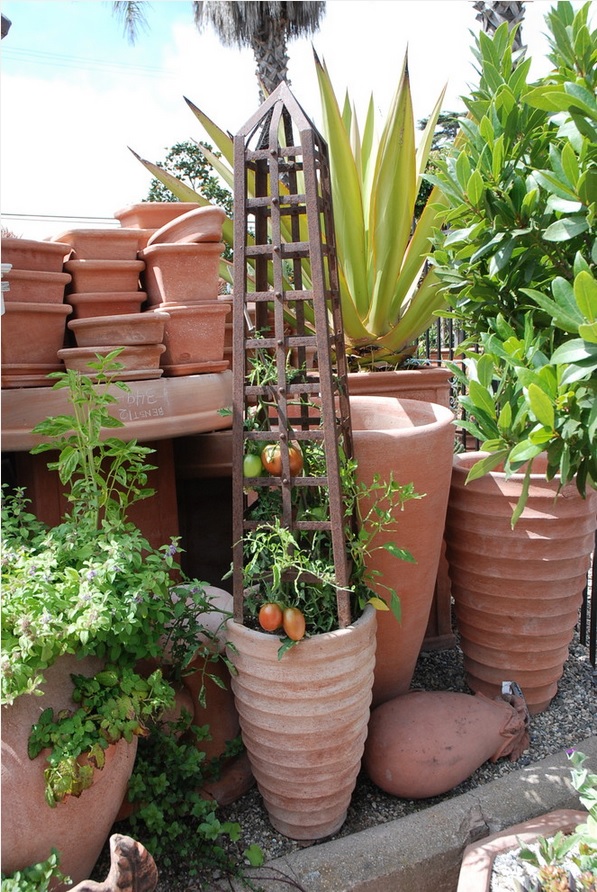
Edible Container Gardening 101

Eye of the Day Garden Design Center|Edible Container Garden| Oscar Carmona

Edible Container Gardening 101

Edible container gardening is a great way to grow vegetables especially when there is no space for a traditional garden. If you live in a condominium or an apartment, containers can provide valuable growing options. A container on casters gives you the ability to move your vegetables to sun or shade, depending on what you want to grow and the time of year. With good, fertile potting soil and a topping of protective mulch you can get by with minimal water.

If you have never tried growing edibles in a container or have not had much success, here are five key considerations  that will greatly enhance your efforts.

POT SIZE

It is important to match the size of your pot to the types of vegetables you want to grow. Bowl shaped pots that are somewhat shallow, approximately 8 to 10 inches, can be great for growing lettuces and other leafy greens. Peppers, cucumbers, beans and larger growing herbs need a deeper pot, 12- 18 inches. Tomatoes like pots that are 18-24 inches deep and about 12-14 inches in diameter.

POTTING SOIL

I recommend choosing an organic potting soil that includes lots of good compost, organic nutrients and important beneficial soil microbiology. EB Stone’s 420 blend has all of these ingredients. Plants grow well in pots when they have a rich growing medium and regular watering. Purchasing top quality potting soil is key to growing healthy, productive plants in containers.

WHERE TO LOCATE YOUR EDIBLE GARDEN

Sunlight and favorable temperatures are also important to growing healthy plants.  Observe how much sun exposure your selected area gets.  Morning sun with shade in the afternoon is good for growing leafy greens such as lettuces, arugula or kale. Sun all day is great for tomatoes and peppers. Shade loving plants like the ambient temperature range of 56-75 degrees. Full sun loving plants are comfortable in the temperature range  of 60 to the mid to upper 80’s. You may find that you have spots in and around your home to grow a bit of both. Remember that the sunlight and temperature will vary throughout the year. So you may need to make adjustments to what you want to grow and/or move containers from season to season.

PLANT NUTRITION

Good organic potting soil will contain necessary organic nutrients. These nutrients not only provide an important food source for your plants, but also for the beneficial microorganisms in the soil. Beneficial soil microbiology will help plants grow strong, nutrient dense and more disease resistant. I also recommend an all-purpose fish/kelp liquid fertilizer applied once weekly throughout the growing season to ensure that your edibles have access to a full range of organic nutrients.

WATERING

Plants in pots need regular, efficient watering as they can become dry more quickly than when planted in the ground. Water until you see it coming out of the drain hole at the bottom of the pot. This means that you have watered completely through the root zone. Fertile potting soil and a layer of mulch will help retain moisture. As you get to know your growing environment you will be able to fine-tune your watering schedule.

Once you have experienced success  with your container garden, you can take growing to the next level by planting your favorite crops in succession over the course of the growing season, which is all year in our neck of the woods!   So don’t plant everything all at once. Start a little at a time with strategic new plantings at  four, eight and twelve week intervals. Leafy greens can be successively grown every four to six weeks. Longer growing crops can be planted every eight to twelve weeks.

Now you are ready to get started or advance your edible container gardening efforts. With some good observation for growing potential in and around your home and care to provide your edibles with a good growing environment you will enjoy successful harvests well into the future.

Oscar Carmona, Healing Grounds Nursery 

Special Event: Eye of the Day will be hosting a special Edible Container Gardening Workshop with Oscar Carmona on Saturday, June 27th. For more information and to reserve your spot, please visit the event page.


Planting in the Edges and Cracks of a Garden

Eye of the Day| succulents rock wall garden |garden

Planting in the Edges and Cracks of a Garden

For several years I tried to get a lovely, drought tolerant plant established in my garden. Lychnis coronaria is a perennial that forms low-growing rosettes of gray-green leaves that in late spring and summer sends up glorious stalks of dark magenta flowers. It just refused to grow in my nice fertile beds, but it is now flourishing, all on its own, between the cracks of my brick path. Like many plants, it apparently doesn’t want coddling and can find the moisture and nurture it needs at the edges of the more cultivated part of the garden. Even the Gaillardia seems to do just as well in the gravel terrace outside of the confines of the bed I originally planted it in.

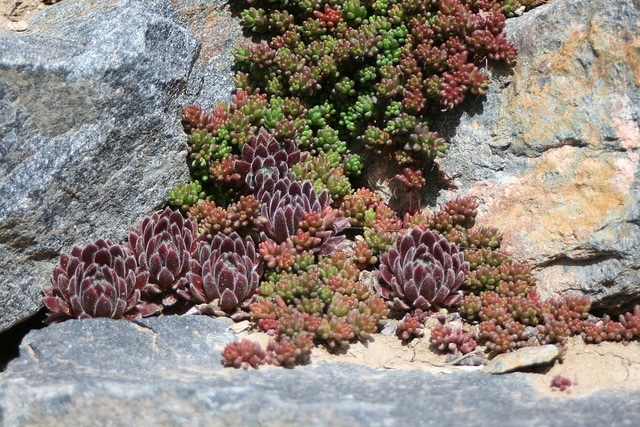
There are plenty of other species that also seem to thrive on the margins. Many succulents, for example, will multiply in the cracks of a wall or at the edge of the walkway. The stones provide a heat sink as well as a barrier to evaporation so that the root zone of these castaways is protected. Succulents such as sedums, sempervivums, and portulacas are particularly suited for this lifestyle. But other, tough plants like the herbs rosemary, oregano, creeping thyme, and even sage can fend for themselves in these microzones.

You may already have a dry-laid stone wall, or a flagstone or brick path that can accommodate a few plants tucked in the crevices. But, if you are planning such a feature, imagine leaving a wider gap in a few places. Some landscape material suppliers even have broken concrete or tile that has been salvaged from former gardens that make ideal patterns to include a few hardy plants to complete the patio, path or wall with the re-used paving.

And if some plant escapes the confines of your established garden bed, give it a chance and see if it is one of the hardy survivors that can lend softness and charm to the margin.


Image Credits:
Rose Campion – Creative Commons, Rose campion by Ruth Hartnup is licensed under CC by 2.0
Herb Garden- Creative Commons, Herb Garden1 by theoldpanther is licensed under CC by 2.0
Rock Wall Garden – Creative Commons, Rock Wall Garden by Patrick Standish is licensed under CC by 2.0


Clay Pot Irrigation Benefits During Drought

We had a very quick winter here on the Central Coast with just a little bit of rain, spotty at best, while the rest of the country has been buried under blankets of snow. As California is technically still experiencing a severe drought, I want to address ceramics in irrigation.

Irrigation Through Clay
In the newsletter, we have covered many subjects concerning ceramics.  In irrigation, ceramics also has many uses. The Romans created an intricate system of aqueducts, which directed water throughout all parts of the empire. We see this around the world, ceramic pipe systems carrying water through towns and villages.

Clay Shards and Slow Water Release
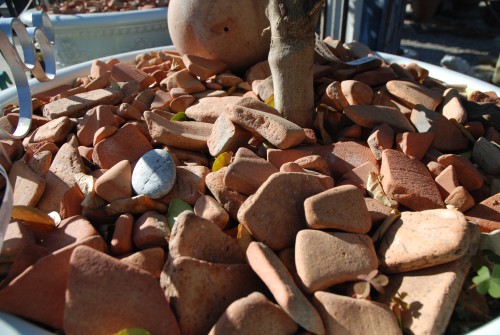
Ceramic “shards” can also be used as a soil amendment. The broken pottery has to be low fire to be absorbent.  Low fire ware may be crushed and added to the soil and as you water, the shards act as little sponges and absorb the water and release it essentially as needed below ground.

Clay Pot Irrigation

Another use I find very interesting is what is called “clay pot irrigation.” If you perform an internet search of this term and go to “Images,” you will see excellent examples of how this works.  Essentially, it is a very simple technique.  Again, a low fire vessel is made by a potter, and is then buried right next to the plants you want to irrigate; fill it with water, and because of the porosity of the low fire ceramic, it leeches through the walls of the vessel and waters the plant by slowly releasing a minimal amount of water.

Cultures around the world have been using this method forever!  Look it up, check it out, and enjoy these new yet very old techniques of gardening.  Ceramics in your garden is not just decorative, it can be very functional.


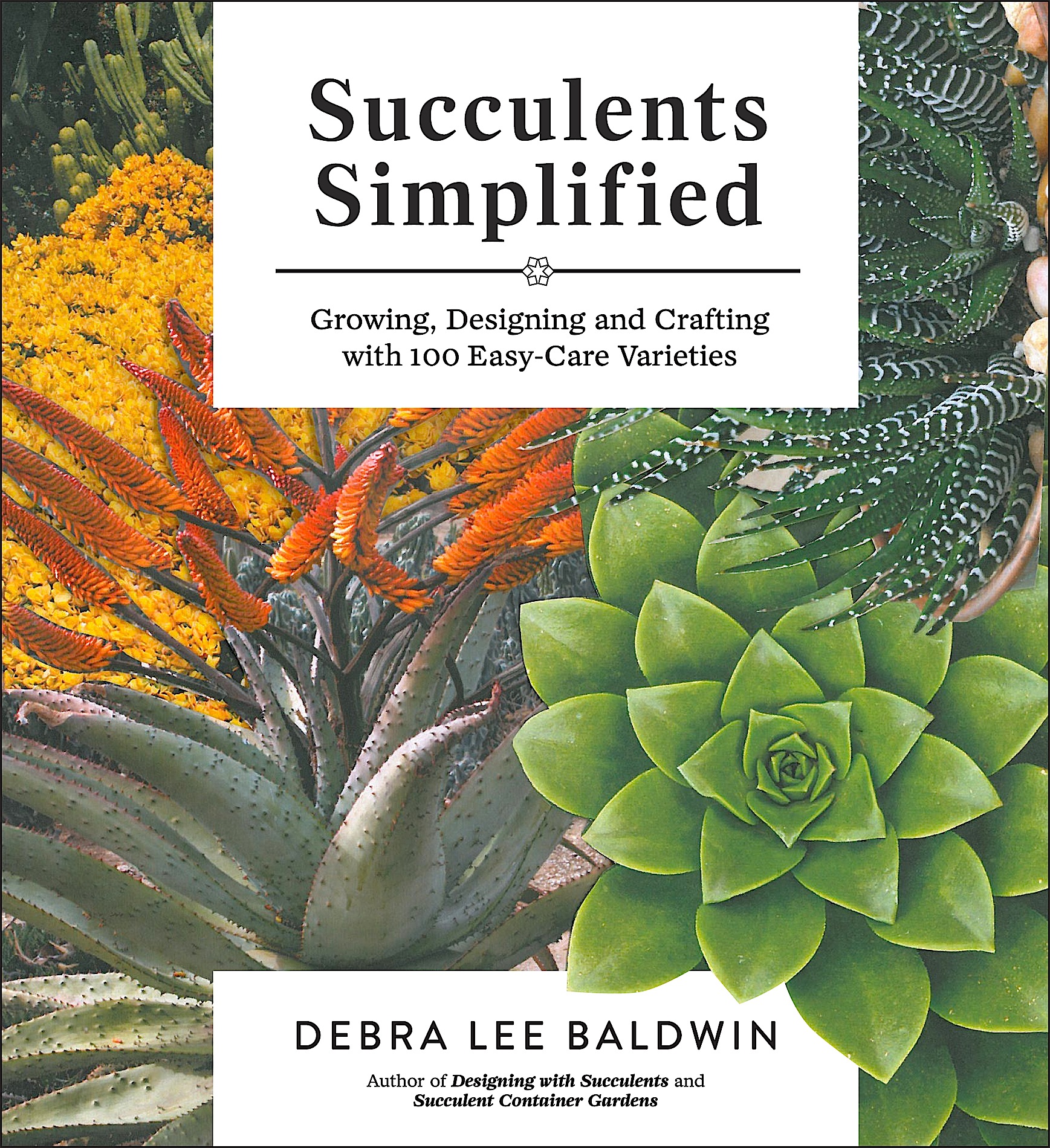
Book Review: Succulents Simplified by Debra Lee Baldwin

Eye of the Day|Succulents Simplified| Debra Lee Baldwin book review

SUCCULENTS SIMPLIFIED, Debra Lee Baldwin

I think we can all agree that succulents are hot. In California, hot can translate to Dry and Dry to Drought.  Which we have.  I also think that we all want green, living things around us and that in our present dry state, succulents and cacti can fill an ever-widening void for both landscape professionals and every day green lovers.

Debra Lee Baldwin is a notable expert on succulents and succulent gardening.  In her book, Succulents Simplified, Debra keeps it easy enough for someone taking their first stab at succulent gardening but interesting for any landscape professional.  With plenty of photographs and simple care instructions including recommendations for no water and low water plants, I can’t imagine why anyone wouldn’t need and want to take a long hard, look at this book and a long, hard look at the slowly browning lawn in front of their home.

In a perfectly friendly tone, Baldwin has included a page entitled “Good Riddance to Your Lawn”; we should all read this and begin to implement her ideas.  Succulents Simplified has inspiring sections like “Surreal Shapes, Testures and Patterns,” and “100 Easy Care Succulents” along with container and landscape projects, but my favorite section is entitled “Edible, Herbal and Illegal Succulents.”

About the Author:Eye of the Day|Debra Lee Baldwin| Succulents simplified book review
Debra Lee Baldwin specializes in showing how top floral and garden designers use dynamic, sculptural succulents in a wide variety of eye-catching applications. See more of her work at her website:

 Photo Credit: Debra Lee Baldwin and Timber Press (profile)


Rosette Succulents for the Garden

Succulents are all the rage and for several good reasons: many have a unique make-up that puts them ahead of the game in extreme heat. Succulents are composed of spongy tissue capable of storing water in dry times. And they maintain their good looks without a lot of maintenance.

Some of my favorite succulents are in the plant family known as the houseleek family. Many form rosettes of leaves, giving them a floral quality, but without the need for deadheading and other pruning. The other great part about this family is that there are a variety of shapes and forms to choose from. Their main requirement is a bright sunny spot, though some will even take a spell of shade if they have to.

The stone crops are all in the genus Sedum and most are low-growing perennials. Sedum acre is grayish with leaves that form small, whorled rosettes. Two other diminutive species are S. brevifolium and S. dasyphyllum.

“Live Forever” is just an English translation of the botanical Latin Sempervivum. All form densely star-like rosettes composed of many pointed leaves. Two commonly available species are S. tectorum and its many varieties and S. arachnoideum, called the cobweb houseleek because of the white filaments that cross from leaf tip to leaf tip.

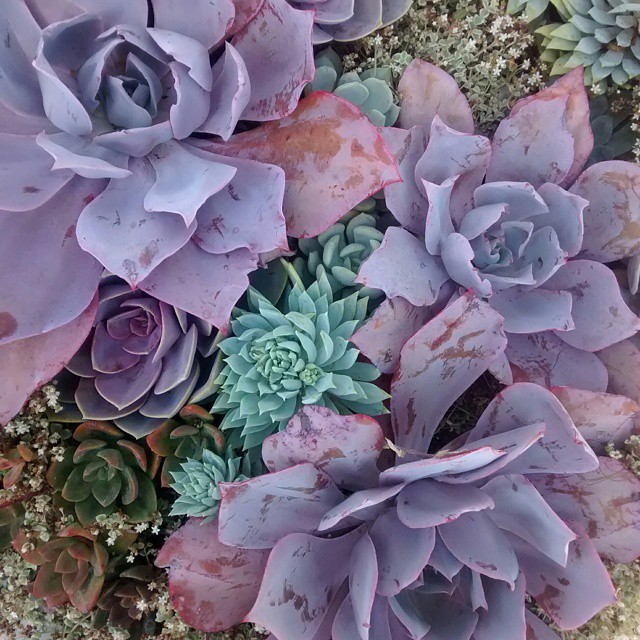
Another group of ground-hugging plants are in the genus Echeveria and many are commonly called hens and chicks. Their leaves come in simple or densely whorled bunches that look like fleshy roses and the colors and forms are mind-boggling. From pale whitish green through bluish, to purple, bronze, red, and even yellowish tones, collectors can go wild accumulating them all. Then, there are the leaf shapes and textures; edges may be smooth to wavy to elaborately crimped and top surfaces may be cupped and smooth or bowed and covered with warty bumps (or both!).

Last are the many forms of Aeonium. From flattened dinner plate sized A. tabuliforme to the more tree-like forms such as the nearly black A. ‘Zwartkop’ and colorfully variegated A.‘Sunburst’, there are many selections for bold color and form.

Tough, sculptural, colorful—what more could you ask for in a plant family?