Lisa Cox Landscape Design: Before and After European Farmhouse Garden

Today, Eye of the Day interviews Lisa Cox of Lisa Cox Landscape Design on a recent project in Los Olivos, California. Lisa is a designer we love to work with and it’s always a joy when she stops by the showroom sourcing decor for her designs. As the season slowly transitions into Fall here in California, this Before and After project is a sign of good change to come.

Eye of the Day|Lisa Cox Landscape Design|Before and After European Farmhouse Eye of the Day: Tell us a little about yourself and this project.

Lisa Cox:  My company, Lisa Cox Landscape Design, tackles residential projects exclusively in the Santa Ynez Valley. After moving here 3 years ago, I could see there was most definitely a need for Landscape Designers in our area.  Since I was the new gal in town, I started slowly with residences in my area and a few Tasting Rooms in Los Olivos, and then that was a great boost for my business.

Eye of the Day|Lisa Cox Landscape Design|Before and After European Farmhouse
Before

Eye of the Day|Lisa Cox Landscape Design|Before and After European Farmhouse
After

This particular project in Los Olivos was a European Farmhouse that needed a face lift. Considering the property was already a stunner, it was a delight to tackle the project.

EOTD: What was your client’s goal for this particular garden?
LC: The client wanted to completely rework the front garden to create a more traditional plant palette of roses and boxwood in tandem with drought tolerant plants that do well in the Santa Ynez Valley such as rosemary, lavender and olive trees. We think the outcome was very pleasant, and works well with her charming residence.

Eye of the Day|Lisa Cox Landscape Design|Before and After European Farmhouse
Before

Eye of the Day|Lisa Cox Landscape Design|Before and After European Farmhouse
After

EOTD: What was your initial vision for this garden? 

LC: My initial vision was to recreate something you would see in Provence, France. Since the homeowner considers France their second home, it was even more of an inspiration to help with that “look.”

After removing most of the original planters, we created areas of interest such as a rose garden, shade garden, and sun drenched beauty garden!

Eye of the Day|Lisa Cox Landscape Design|Before and After European Farmhouse
Before

Eye of the Day|Lisa Cox Landscape Design|Before and After European Farmhouse
After

EOTD: Were there any unique problems that came up during the design or installation?

LC: I think the biggest challenge was correctly reworking the existing irrigation system for the newly planted areas, and using good sized plants to create an “Instant yard.” The design phase was easy since the homeowner is a very gifted interior designer with a good eye. A great collaboration.

Eye of the Day|Lisa Cox Landscape Design|Before and After European Farmhouse
EOTD: What would you describe as your garden design aesthetic and how do you work with your client’s own vision for the landscape?

LC: Each project I tackle starts with the needs and wants of the client. Sometimes, their input is great, and other times, I am allowed complete freedom to create what I think will work for not only the style of their home, but function, flow and of course, aesthetics. As I start to design, it all seems to come together with time.

Before I start a design, I send out a list of questions for the client to answer that entails how they will use the space being created, substrate choices, and plant choices that appeal to them. This usually guarantees I can design freely knowing I am in line with their vision for their home.

Eye of the Day|Lisa Cox Landscape Design|Before and After European Farmhouse
EOTD: For the pottery, why these particular pieces? 

LC: The vintage Greek oil jar was a perfect fit to blend both a traditional and Mediterranean look with a touch of rustic created by the aging finishes Eye of the Day offers.

Eye of the Day|Lisa Cox Landscape Design|Before and After European Farmhouse
A vintage Greek oil jar from Eye of the Day is a focal point in this section of the garden.

EOTD: What was your favorite part of this project and design?

LC: Most definitely working with the homeowner and creating a vision that not only gave her a little piece of France, but also how the end result screams Santa Ynez Valley and all our glory here in wine country.

To view more of Lisa’s work, visit Lisa Cox Landscape Design or her Facebook page.

Photo Credits: Rich Cox Photography

Book Review – Sun Drenched Gardens: The Mediterranean Style

Eye of the Day|Sun Drenched Gardens Book Cover|Mediterranean style garden

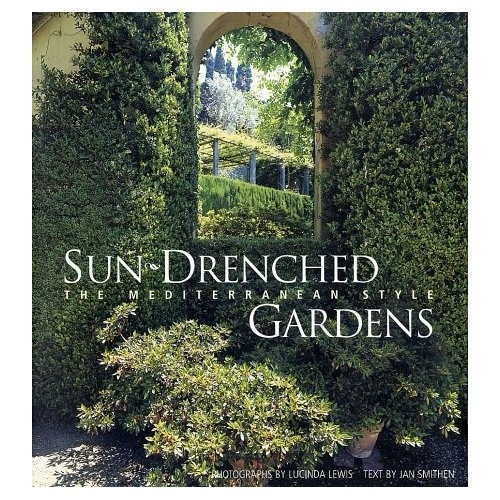
Sun Drenched Gardens: The Mediterranean Style by Jan Smithen 

 Author Jan Smithen and photographer Lucinda Lewis have put together a beautiful and pertinent book that is even more noteworthy today than it was when it was published in 2002. Mediterranean-style gardens offer easy maintenance as well as water-saving planting that is environmentally sound and enormously appealing.

Sun-Drenched Gardens; the Mediterranean Style features gardens from France, Italy, Spain and California that employ drought-tolerant plants such as agaves and other succulents, wisteria, lavenders, geraniums and even some roses. Design features such as terraces, arbors, hedges, pergolas, topiary, statuary, decorative tile, and terracotta containers are used in the gardens.

While paging through the book, Californians and especially those familiar with Santa Barbara will recognize landscape designs and terracotta containers so familiar that it seems the photos were taken in our backyards, or even at Eye of the Day. The eight chapters include one entitled “Endless Sunshine – Precious Water” which has great information and design ideas.  Another entitled “Living Outdoors” highlights our need to be in the open air and how to plan and enjoy our gardens even during a drought.

If you have difficulty finding this amazing book, the next time you visit Eye of the Day, ask to see our house copy, it’s truly worth seeing.


Stylish and Sustainable Garden Design

Stylish and Sustainable Garden Design

Living and designing in California, the ongoing and severe drought we’re experiencing is on everyone’s minds. And as such, drought-tolerant gardens are rapidly replacing outdated water-thirsty landscapes. While everyone is on board with the concept of a drought-tolerant garden I inevitably hear the same hesitation from clients – they don’t want their low-water garden to look like their neighbor’s new garden down the street. They want to make sure their new garden still reflects their personality and individual style.

This is a valid concern as it seems many drought-tolerant gardens seem to focus on the same twenty plants over and over again, with the end result being one of uninspired predictability. Luckily, there are a few simple ways to avoid this common trap.

For my clients who want a more traditional East Coast feeling in their garden, color is key. It’s important that I include low-water plants that contain a higher proportion of greens, maroons, blues and purples to mix along with the more common gray tones. The effect will be the same – a reduction in water use – but the garden will appear cool and lush.

For my clients who prefer a Mediterranean feel in their gardens, I tend to use a larger amount of warm colors, such as oranges, golds and reds mixed in with the greens and grays. The result is a garden that appears to glow in our perpetually sunny days.

But just because I’m reducing the use of water in these gardens doesn’t mean I’m eliminating it all together. On the contrary, it’s important to include a source of water in the garden as the sight and sound of it not only reinforces that we’re not living in the Sahara Desert but it also provides a much-needed source of water for wildlife during these thirsty times.

And depending on the style chosen, the fountain is one more way to help further define the character of the garden. For my East Coast inspired gardens, a traditional, stately three-tiered fountain is right at home, nestled among the Corsican hellebore, lavender and native penstemon.

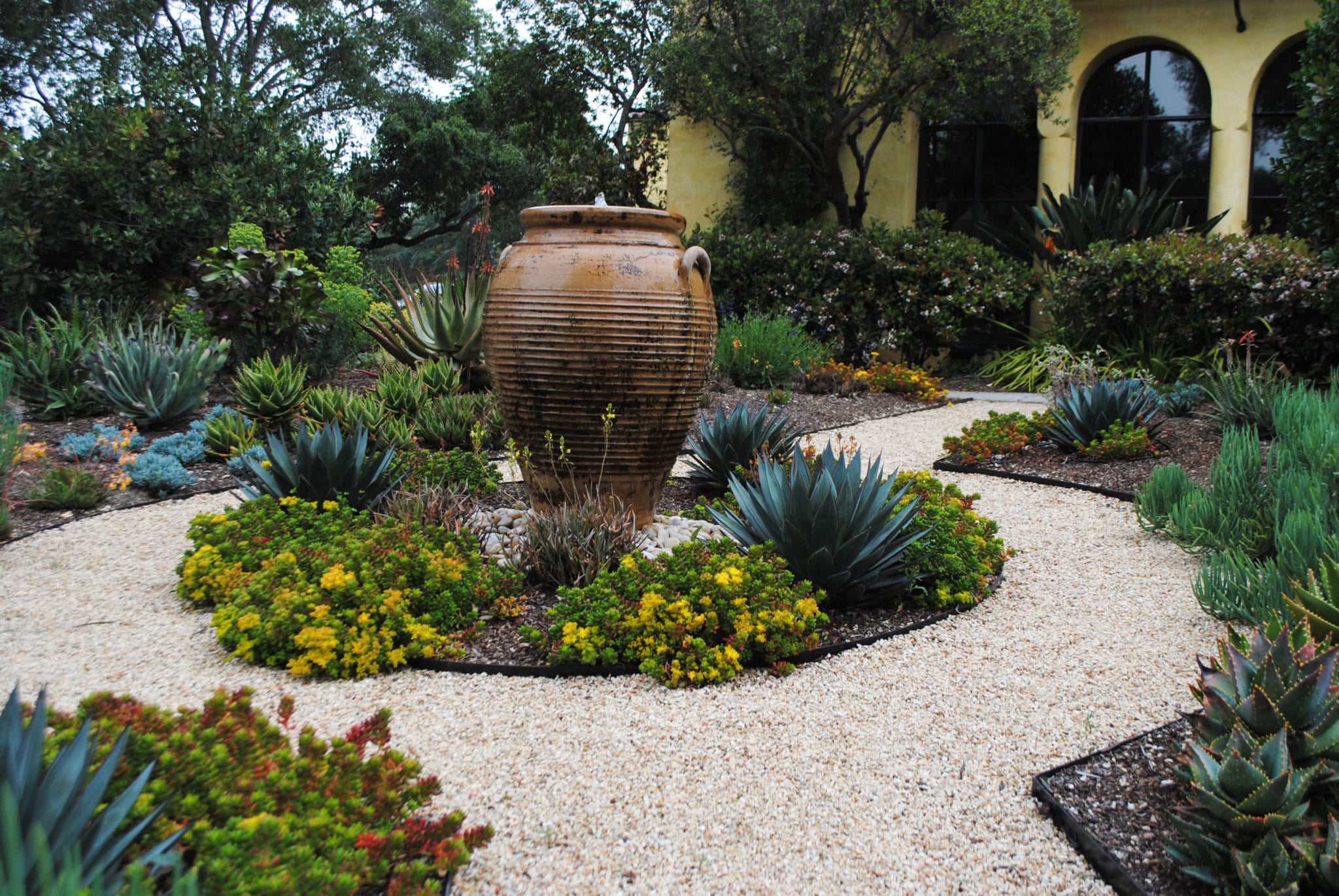
And for my Mediterranean-inspired gardens, a simple antique olive jar blends seamlessly into the surrounding garden filled with succulents, salvias and grasses.


Elements of Style: The Classic Mediterranean Garden

Elements of Style: The Classic Mediterranean Garden

A classic Mediterranean style garden is typically low-maintenance, drought tolerant and perfect for a climate dry and hot in Summer and warm and moist in Winter. For those of us living in California, this seems a perfect fit. Traveling throughout the Mediterranean region, focused on the landscape and gardens, reminders of California are constant.

The defining characteristics of the Mediterranean style are:

  • Focus on hardscapes, with very little or no lawn
  • Citrus, olive trees, rosemary and lavender often planted in terracotta pots
  • Fountains and water features are key. Water features became popular in the gardens of the Italian Renaissance. They reflect the garden and provide the relaxing elements of sight and sound.  Because of the scarcity of water in the Mediterranean,  many water elements offer a relief from the heat.
  • Large and small terracotta pots and urns and statuary. Pottery in many forms has been a part of Mediterranean gardens since their origins in ancient Roman households. From intricate bas-relief to simple and plain, they are quintessential for a European garden.  Statues, urns and planters provide focal points and because their footprints are small, they are particularly useful in a small garden. The Greeks and Romans filled their pots with flowers to add color to their courtyards and pathways without depleting the water supply, or they used them to grow fruit trees that could be moved about  according to the outside temperature.  But pots were also used as beautiful objects on their own – a classic oil jar at the end of an allee, a row of terracotta pots topping a balustrade, or an urn crowning a pedestal.

You don’t have to live in Spain, Greece or Italy to reflect the siren call of the Mediterranean classic garden.  A few carefully chosen garden elements… an antique Greek pithari, a scattering of large terracotta pots and urns and a simple water feature will create your classic otium.  Being water conscious and embracing a rustic, muted look will go a long way toward making your space the place to be.