One of my favorite gardens that I designed a few years ago is a great example of how you can replace a water-thirsty lawn with lush looking, and less thirsty, plants. One of the most successful strategies we used was to swap out the turf lawn and install a drought-tolerant Dymondia margaratea ‘lawn’ in its place. But first, a little background and a few before & afters:
My client’s home is located on a busy corner within a stone’s throw of two nearby schools, has giant picture windows throughout the house and has a 4-foot high wall that surrounds most of the garden (a Lookiloo’s fantasy!) What this translates into is the homeowners were on constant display to traffic and pedestrians alike and felt like they were living in a fishbowl, for all to see.
The lack of privacy would tempt many to build a fortress-like wall to surround the garden, but staying true to their welcoming personalities, they decided to create a garden that others might equally enjoy (after all, if they’re going to peek over the wall they might as well have something nice to look at, right?)
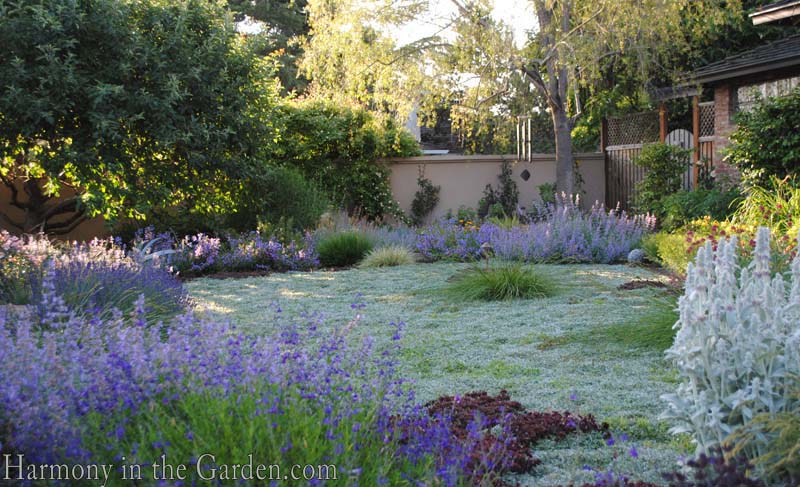
Tired of their threadbare, un-used, water-thirsty lawn and random mishmash of plantings, they wished for a more responsible, fun, and ‘livable’ garden that used less water and incorporated plenty of native plants to encourage wildlife to visit. Our first step was to rip out the lawn and reinterpret a newer, smaller version using Dymondia. I chose Dymondia because it’s extremely tough, drought-tolerant, evergreen and can withstand a fair amount of foot traffic. Plus, it’s just so darnned pretty.
Their concern, however, was that using such an expansive amount of the color gray in the garden would have a blinding, bright and parched effect. This is a perfectly valid concern, and one that I’ve often heard from other clients who have experienced the unintended ‘glare’ in their gardens as a result of an overuse of gray plants. To help avoid this common pitfall of using gray in the garden, here are a few tricks I’ve used to help tone down the brightness while still enjoying this beautiful color.
Shades of Gray
First, it’s important to realize that there are different shades of gray ranging from light & bright, to mid-level gray all the way to dark, charcoal-like foliage. And because of this range, it’s important to understand that not all grays are alike. It’s perfectly okay to use plenty of gray plants in the garden, as long as you vary the shading. No one wants to look at one bright gray plant after another without a place for the eye to rest, so remember to use plenty of mid-level and dark gray plants sprinkled throughout.
Keeping it Lush
In order to prevent gray colors from creating a ‘pass the sunglasses’ effect in your garden, it’s also important to include plenty of nearby plants that have deep, rich colors, such as burgundy, green and purple. In this garden, the plants chosen included the brilliant blue flowers of our native ‘Blue Springs’ Penstemon, vibrant purple Lavender and the deep burgundy Stonecrop that creeps throughout the edges of the Dymondia lawn.
Lambs Ear is used sparingly throughout the garden, as it’s a really bright shade of gray, almost bordering on white, and could easily cause the Dymondia to appear brighter than it actually is.
In fact, each Dymondia leaf consists of two colors – green on the bottom and silvery gray on top. And once the Dymondia begins to grow and fill out (forming a soft and inviting 3-inch spongy mat), its slender leaves will begin to twist gently, revealing its different colors.
To further emphasize the green in the bi-colored foliage, I’ve included plenty of other surrounding plants with green colors to help strengthen the color echo.
For example, I’ve interspersed our native Carex divulsa (Berkeley Sedge) and Calamagrostis foliosa (Feather Reed Grass) throughout the lawn, as well as lots of perennials with green foliage.
It’s not just Dymondia that has hefty amounts of green in its coloring – take a look at a lot of other gray plants and you’ll notice green beneath the gray ‘fuzz’ (ie: many lavenders, senecios and hostas). To emphasize the blue tones of the gray Dymondia colors, I also included plenty of blue plants in the garden, as well – like this ‘Beyond Blue’ fescue, various succulents, and many blue-flowered perennials.
My goal was to emphasize the tones and colors that I want while minimizing the tones that I don’t want. Can you imagine how bright the garden would be if I had used an overabundance of white flowers and foliage?
Hardscaping
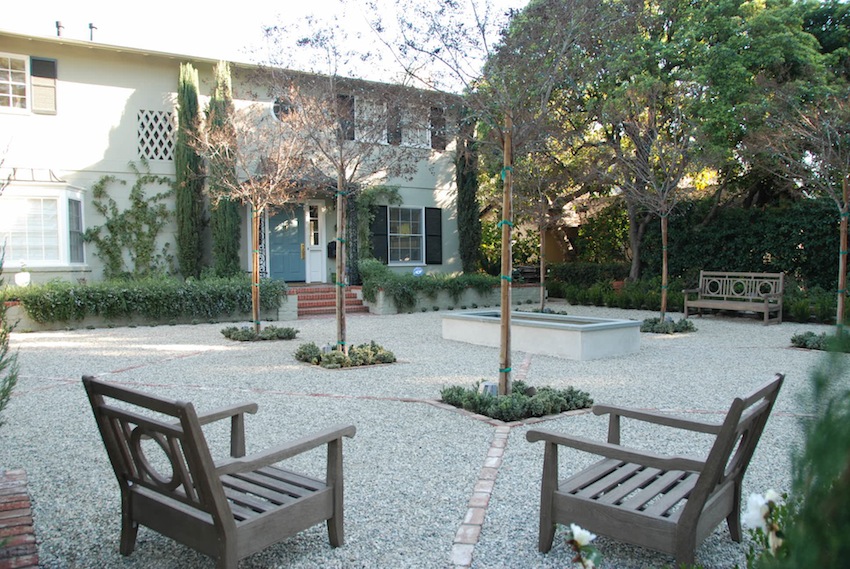
Hardscaping (such as nearby flagstones, patios and sidewalks) plays an important role when placed near gray plants as it, too, can serve to either tone down the brightness or amp it up to blinding proportions.
For this garden, we chose flagstones with slightly creamy-pink tones to them. Again, the reason was to de-emphasize the bright gray colors by introducing softer muted shades to tone things down.
I’ve seen plenty of instances where a drift of bright gray plants, such as Lamb’s Ear or Artemesia, have been placed directly adjacent to a bright white cement walkway. And 9 times out of 10, that’s the area the homeowner is referring to when they say they don’t like the color gray.
To eliminate this blinding effect, just remember to use hardscaping ( as well as plants) with softer tones and/or darker colors.
A year after this garden was installed, we compared water bills – the result was amazing! Compared to the wall-to-wall ‘carpeting’ of lawn from before, the new garden uses 40% less water, even though there is a ton of plants in this garden! This shows that with creative and careful plant selection, and water-efficient drip irrigation, the result can be breathtaking while using much less water.