How a Landscape Architect Approaches Garden Design During California Drought

Eye of the Day|Sally Farnum Landscape Architect|garden design drought

Having a sister with a long, successful career as a landscape architect has made it easy to have an ongoing conversation with Sally Farnum about design, client concerns and current issues. We are all especially interested in California’s water problem and wanted to find out how Sally is helping her clients address the issue.

Suzi: What have your clients have been asking about when it comes to water and their gardens?
Sally: Most of my clients are trying to be responsible when it comes to water usage in their landscape. They want to know if they need to take out their lawns, replace their flowering plants with desert plants and if it will still look pretty.

Eye of the Day|Sally Farnum Landscape Architect|garden design drought
This garden limits the lawn and uses a water feature and sculpture as main elements.

Suzi: How do you approach designing a plan that reflects water-consciousness but is still pretty?
Sally: I really work to combine good elements of design in all my plans: scale, balance, variety, form, line, texture and color. I like to use California natives, salvias, lavenders along with containers, sculpture and fountains.  I suggest using decomposed granite and gravel and, really important, an extra-efficient irrigation system.

Eye of the Day|Sally Farnum Landscape Architect|garden design drought
Water friendly designs can still have beautiful flowers and plantings.

Suzi: How do you convince them that a huge, green lawn isn’t the best plan anymore
Sally: Most people are visually oriented, so to describe an idea in words alone doesn’t always convince them. I show them photos or have them visit other projects I have completed.  But I don’t feel that it’s necessary to remove ALL lawn. Only 5% of residential water is used to keep lawns green and it contributes to cooling an area, cleaning the air and reduces noise. Grass in a front yard, used to fill space, should be eliminated.

Eye of the Day|Sally Farnum Landscape Architect|garden design drought
Hardscape, pottery, and water wise plantings are all used in this design

Suzi: Do you have a favorite or most challenging project which incorporated water-wise elements?

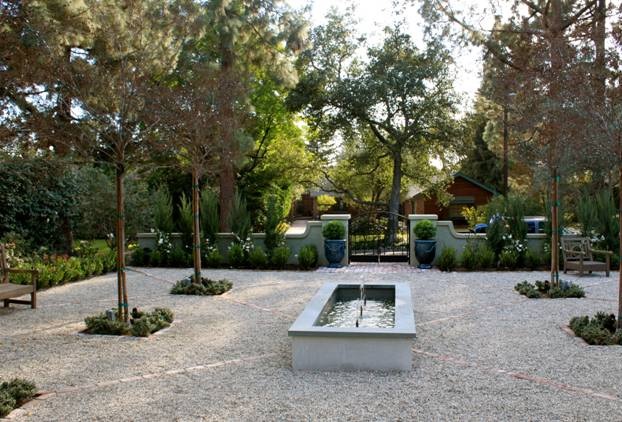
Sally: One of my favorite and most challenging designs is right across the street from my own home.  Challenging because the home belongs to a friend and because I look at it most every day. My favorite because of the transformation from a front yard with a large asphalt driveway and lawn, to a garden with a walled-in gravel courtyard with a fountain and pots planted with flowering plants on the street side of the wall.

Eye of the Day|Sally Farnum Landscape Architect|garden design drought
This design removed the lawn and replaced it with a gravel courtyard and central water feature.

Suzi: How have you managed to change the way you designed in the past to meet the new challenges presented by the drought?
Sally:  The challenges are mainly in working with my clients and helping them accept new plants and watering habits.  Most plants will adapt to using less water, but people tend to water more than necessary.  I haven’t changed the way I design, but I have changed the materials and plants I use.

Eye of the Day|Sally Farnum Landscape Architect|garden design drought
This backyard combines hardcape and drought friendly plantings.


Suzi: Thanks, Sal.  You’re always such a wealth of information, and a fine sister, too.
Sally: You’re not so bad yourself.
Book Review – Sun Drenched Gardens: The Mediterranean Style

Eye of the Day|Sun Drenched Gardens Book Cover|Mediterranean style garden

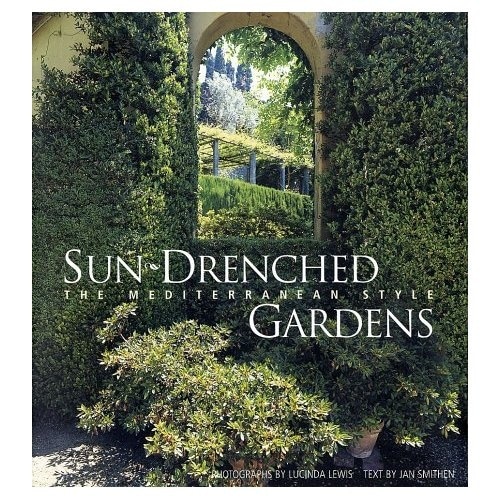
Sun Drenched Gardens: The Mediterranean Style by Jan Smithen 

 Author Jan Smithen and photographer Lucinda Lewis have put together a beautiful and pertinent book that is even more noteworthy today than it was when it was published in 2002. Mediterranean-style gardens offer easy maintenance as well as water-saving planting that is environmentally sound and enormously appealing.

Sun-Drenched Gardens; the Mediterranean Style features gardens from France, Italy, Spain and California that employ drought-tolerant plants such as agaves and other succulents, wisteria, lavenders, geraniums and even some roses. Design features such as terraces, arbors, hedges, pergolas, topiary, statuary, decorative tile, and terracotta containers are used in the gardens.

While paging through the book, Californians and especially those familiar with Santa Barbara will recognize landscape designs and terracotta containers so familiar that it seems the photos were taken in our backyards, or even at Eye of the Day. The eight chapters include one entitled “Endless Sunshine – Precious Water” which has great information and design ideas.  Another entitled “Living Outdoors” highlights our need to be in the open air and how to plan and enjoy our gardens even during a drought.

If you have difficulty finding this amazing book, the next time you visit Eye of the Day, ask to see our house copy, it’s truly worth seeing.


Eco Friendly Landscape Design by Lisa Cox for Hacienda Style Home

Lisa Cox, of Lisa Cox Landscape Design has happily designed landscapes ranging from simple tract homes to vast estates.  As she plans an outdoor environment, she envisions a transformation that communicates the lifestyle and personal taste of the client, while incorporating her own style. Each garden is designed and built with all materials including stone, plants, trees, water features, and garden art selected by Lisa using local, top qualified growers and suppliers.

Commitment to sustainability, the use of drought tolerant plants and trees, including California natives, has been an integral part of her design process, allowing a more “naturalistic” result that mimics the local terrain.

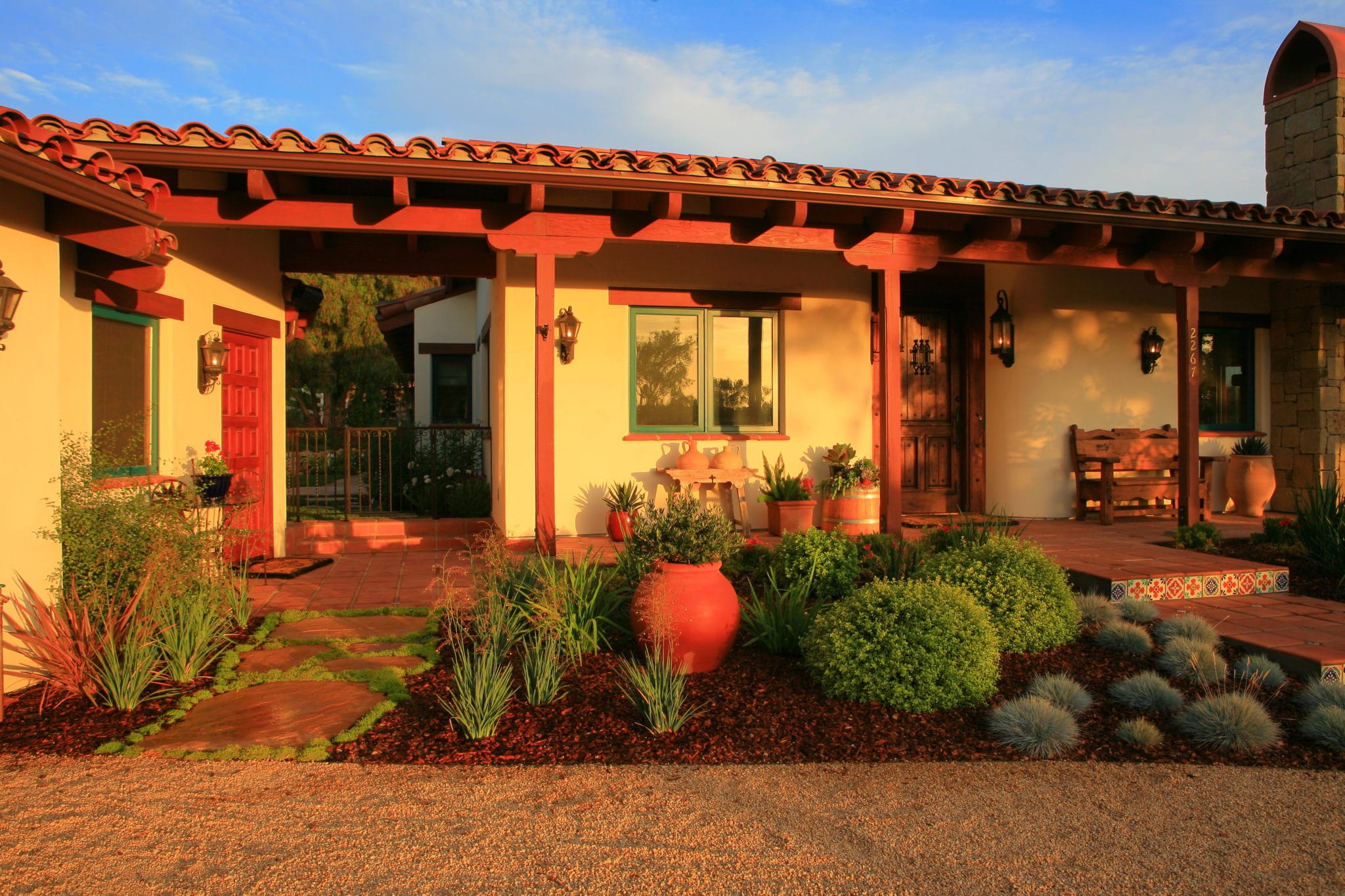
When Lisa met with her new clients in the Santa Ynez Valley, they requested that the newly constructed home not have any sod in the front area, and that she use drought tolerant plants including grasses and succulents. Working with a blank slate, except four nice sized olive trees at the entrance, she was free to design the space, including selection of a plant palette that complimented the Hacienda style of the home. With the use of local sandstone boulders, salvias and phormiums as her base, she also incorporated deciduous trees and perennials for color in the Spring and Summer, and a few rows of grape vines because after all, it’s the Santa Ynez Valley!

Choosing Greek terracotta pots from Eye of the Day, filled with “Blue Glow” Agaves gave the clean, rustic look she was looking for on the front porch and the traditional Terrecotte San Rocco terracotta pot in front worked perfectly to show off the “Little Ollie.”

It seems everything progressed perfectly for Lisa and her clients, but there WERE a few important challenges:

  1. The need to place a gopher basket for every plant as the local area is inundated with gophers that would quickly destroy the plantings, and
  2. The necessity of paying close attention to selecting plants that can stand the heat as well as the sometimes frigid nights where temperatures can go into the low 20’s or below.

As Lisa’s work on the project came to a close, she felt deep satisfaction; in fact she felt this was a home environment she could inhabit herself.  The project was a dream to work on and the end result was exactly what the homeowner envisioned.

Visit Lisa Cox Landscape Design to view more of her work.


Party at the Fire Bowl

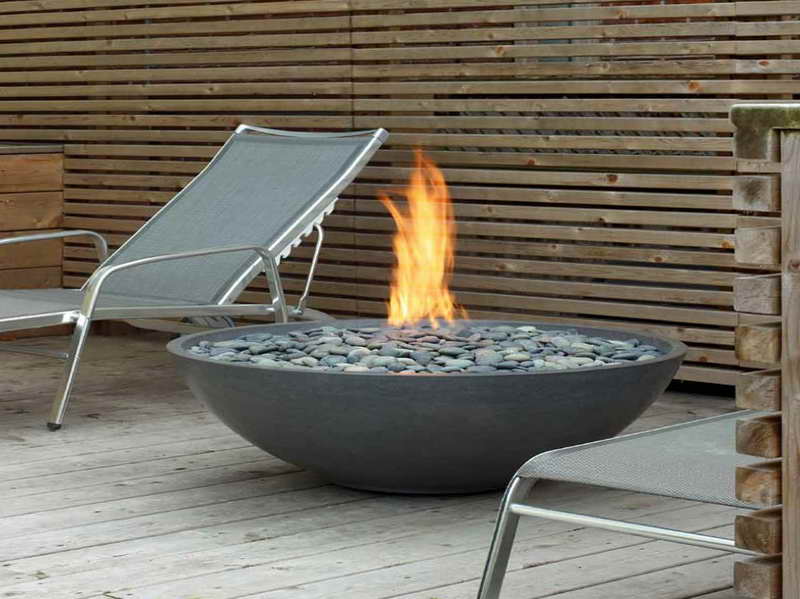
Throughout the summer and into the fall, sitting outside near a fire evokes summer camp, a perfect ending to a long day enjoying nature, bee stings and muscle strain. A song around the campfire, s’mores and stick-roasted sausages perform a prelude to a night sleeping under the stars. But why stop when the trees are bare and cold night air nips the nose? Gathering around a fire forges friendship. Time spent at the computer, scanning Facebook, watching movies or shopping online should be cast aside for a warm fire, friends, a mug of spiked hot chocolate and ok, stick-roasted sausages.

Fire pits were originally used by nomadic people to cook and to provide heat. Pits were dug in the ground (an option today, too), and when it was time to move on, the pit was closed and sealed. As time progressed, the communal fire also became a social focal point. Today a typical home fire pit, or fire bowl, is constructed from metal, stone, brick, clay or concrete.

According to Landscape Architect and Eye of the Day newsletter contributor Sally Farnum, in the early days of her career during the 70s and 80s, fire pits were out of fashion and most all of her clients wanted them removed. Now and for the last several years, almost every one of her clients has requested either a fire pit or an outdoor fireplace be included in the landscape design.

As the weather begins to chill, we have more and more customers asking about fire bowls. Low, round concrete planters are available in a number of sizes and can be easily converted to a gas-flamed or wood-fired fire bowl. The same is true for terracotta planters, especially low bowls. For both, some precautions must be taken to prepare them for life as a fire bowl. A large “bonfire” will most likely crack the bowl, so it is best to start with a small fire, at least the first few times, to temper the bowl. It is also important to have a bed of sand in the bottom of the bowl to absorb some of the heat. Smooth stones or glass rock (available in a multitude of colors) can also be placed in the bowl for a decorative effect and to diffuse the heat.

Don’t spend your winter at your indoor fireplace, or glued to a screen, treat yourself and your family and friends to a party around your outdoor fire enjoying the nip of the air layered clothing, hot drinks, and those sausages.


Landscaping to Keep Your Friends: An Outdoor Makeover

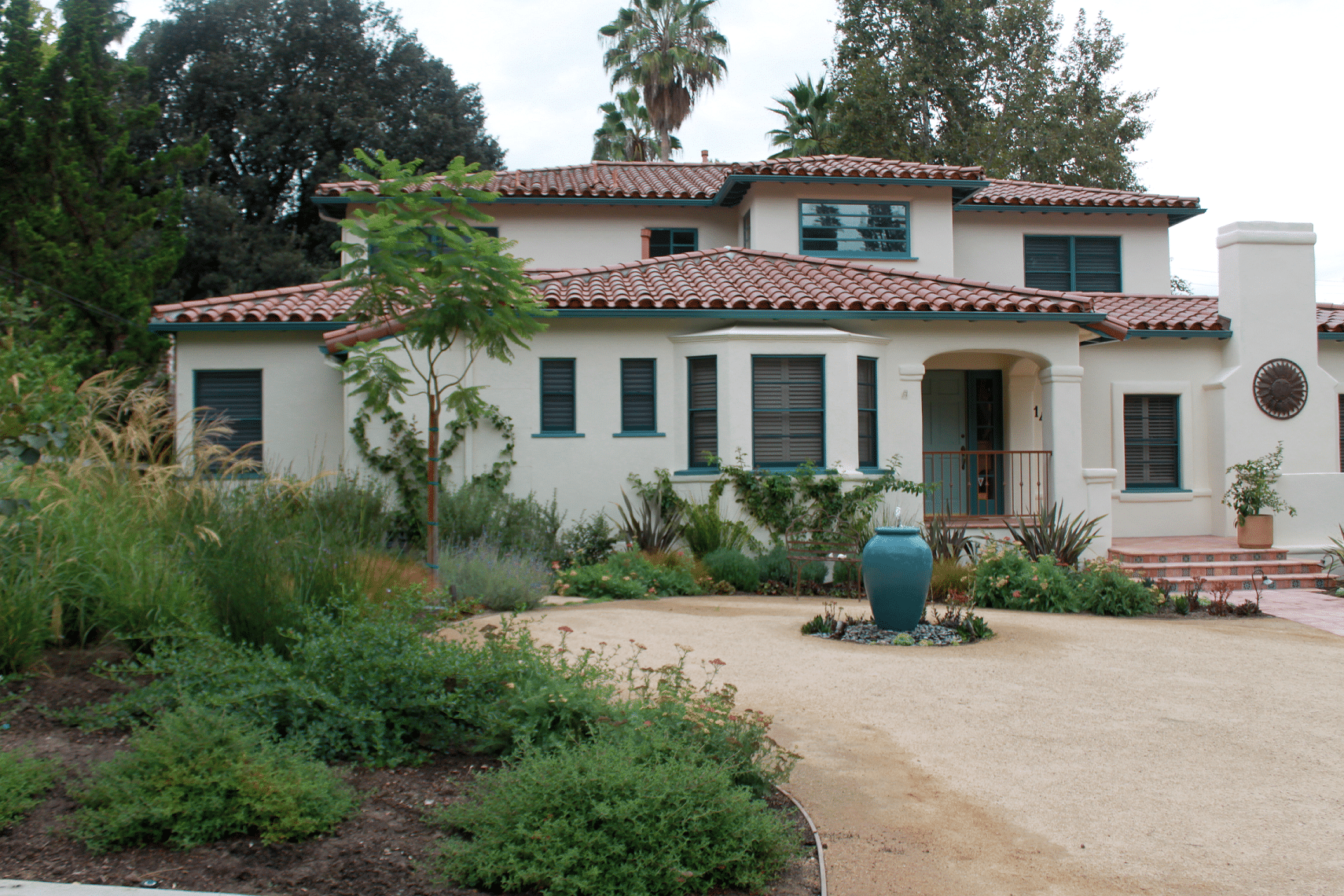
The owners of this classic Mediterranean home in Glendale, California contacted Sally Farnum of SE Farnum Associates in Altadena for a new front yard design requiring minimal maintenance and low water use. Her design included a Gladding McBean Oil Jar fountain conversion in Caribbean, as well as two Gladding McBean planters flanking the front entrance.

The neighborhood in Glendale, California, a suburb of Los Angeles, was lined with houses showing off well-manicured lawns and lush plantings. But like most streets, it had ”that one house.” You know the house. Dried and dying lawn, gopher holes dotting the landscape, and essentially an eyesore to a neighborhood that otherwise boasts its curb appeal.  Before their neighbors stopped talking to them, my clients contacted me to revamp the landscape in front of their home. These were busy clients who just work, work, work, leaving very little time for yard work. They were leaving the digging and turning of the soil to the gophers and the trimming to the deer. They even spent a few hours a week unsuccessfully trying to combat rodents with traps, flooding, and varmint bombs.


Change did not come easily to these clients, but they knew they needed to do something. They requested a garden design that would require minimal maintenance and low water but still incorporate beautiful plantings, as well as being deer and gopher proof. I discussed the beauty of replacing their lawn with a composition of decomposed granite, new and colorful water-wise plantings, hardscape using saltillo concrete tiles and a new fountain.

Initially the clients’ three colors of choice were beige, dark beige, and white, but I was able to convince them that a lively color palette can be beautiful, energizing, and attractive not only to them, but to desirable visitors like butterflies, bees, and birds. The plantings include colorful sages, ceanothus, lantana, and achillea that not only drink little but the deer and pesky gophers don’t find them to their culinary liking.  It’s been almost a year and they haven’t lost any plants to the wildlife, what a success!


The colors of the Malibu tiles that we used in the hardscape were definitely an influence on my desire to use a Gladding, McBean oil jar for a fountain. I was thrilled that my clients selected the Caribbean blue over a more subtle color and love the fountain conversion done by Eye of the Day. The clients are so happy with their colorful garden that they recently asked me to help select the palette for the re-painting of their house and of course the selections are very close to the color of the Gladding McBean fountain.


Home Outside Palette App: Landscape Design Made Easy and On the Go

Could it be time to add your mobile device to your set of gardening tools? There really is an app for everything. Bring out your inner designer to create the dream landscape you always imagined with the Home Outside Palette app. Move, resize, and even undo with over 280 available elements (trees, paths, enclosures, and more) to an existing or new landscape before even stepping outside. Design on the go has never been easier for novice and experienced designers.

“We created the Home Outside Palette app to help homeowners design their properties,” says Julie Moir Messervy, owner of landscape architecture and design firm JMMDS and creator of the app and the Home Outside online landscape design service. Using any iOS or Android smartphone or tablet, users can upload a property survey and use it as a background, or select a grid or colored background, and mock up their landscape by tapping and dragging hundreds of elements into place. The grouping feature lets you lock permanent elements together (such as the house, garage, and driveway), and the layers tool gives you the ability to play with different versions of a design.

An in-app purchase offers additional elements as well as a measuring tool that lets you input rectangular measurements or “walk-and-click” a GPS-based outline of your space. A drawing tool allows you to sketch free-form garden beds and other features. “From the start we knew that we wanted to include all the green features that today’s homeowners need: laundry lines, greenroofs, chicken coops, veggie gardens, compost bins, greenhouses, solar panels, and more,” says Messervy. “It is possible to have a functional, sustainable yard that’s also beautiful—and this app helps you get the design right before ever picking up a shovel.” When you’re finished, get important feedback before committing to any design element. You can share designs from the app on social media or email them to friends. For additional help with your landscape, the Ask an Expert feature lets you send a design from the app to JMMDS’s award-winning designers for their expert suggestions. The app is designed to be practical and user-friendly for the imaginative homeowner to the professional designer. Messervy adds, “Our mission is to make beautiful design available to anyone, anywhere.”


By Jennifer Silver, Marketing and Special Projects Manager of Julie Moir Messervy Design Studio

Jennifer has held a variety of teaching, writing and editing positions. When she moved to Vermont 12 years ago, she discovered her true passion: sustainable agriculture. She is never happier than when writing or gardening. At JMMDS, she gets to write about gardens—what could be better?