Designer Recommendations for the California Garden

Eye of the Day| California Plant recommendations|Aristida Purpurea

What to Plant? The California Garden Checklist

Many of the landscape architects, designers and trade professionals  that have been frequenting Eye of the Day over the years are now friends and we asked a few of them what plants they like to use and why when designing for their clients.

Eye of the Day| California Plant recommendations| carex praegracilis
Consider clustered field sedge instead of water-thirsty grass lawns.

Rick Button of Rick Button Landscaping

Some of Rick’s favorites:

  • OLIVES – They are simply beautiful in leaf, form and symbolism. I can make a case for them matching up with any vernacular of architecture.  They belong here.
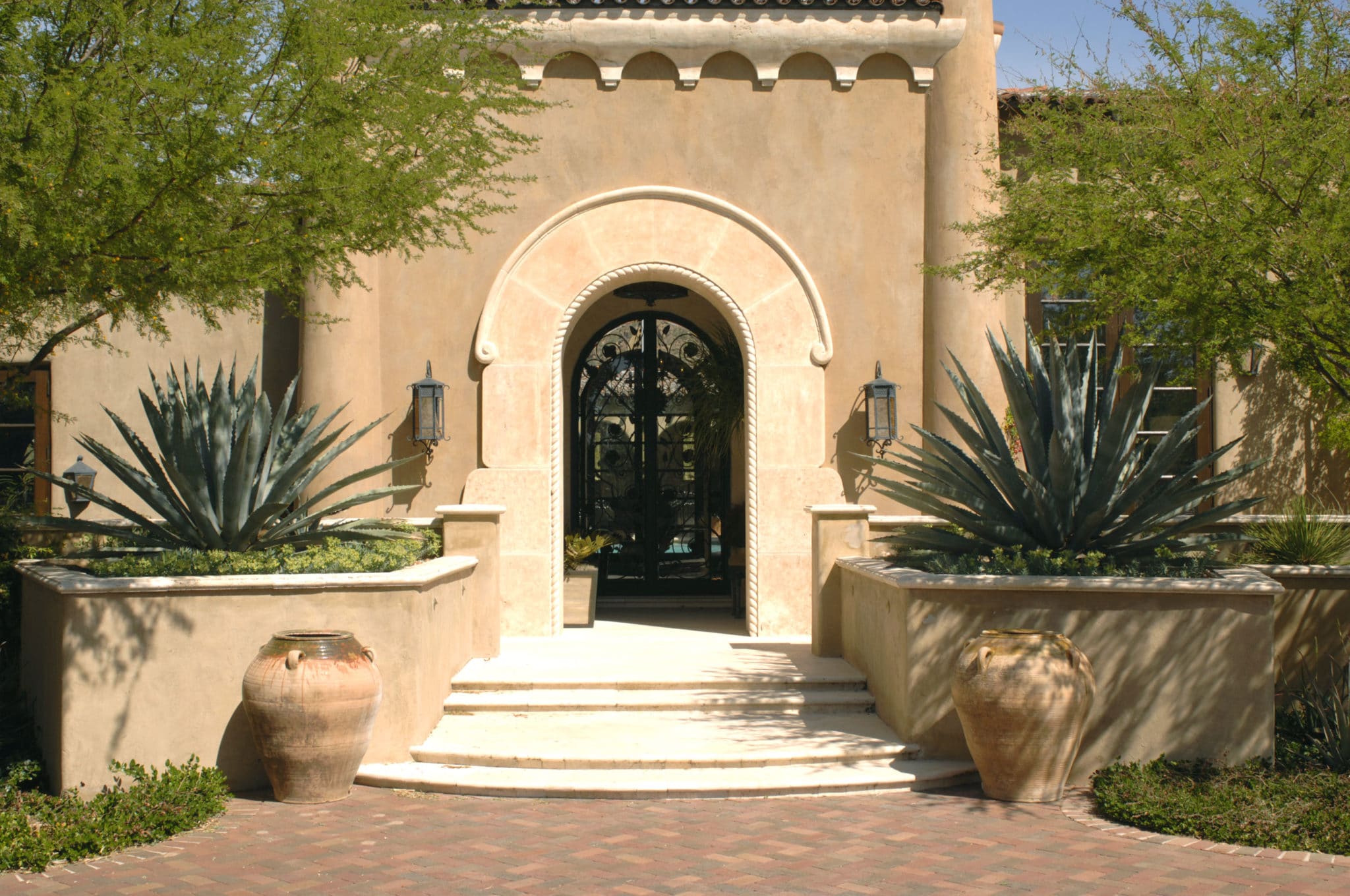
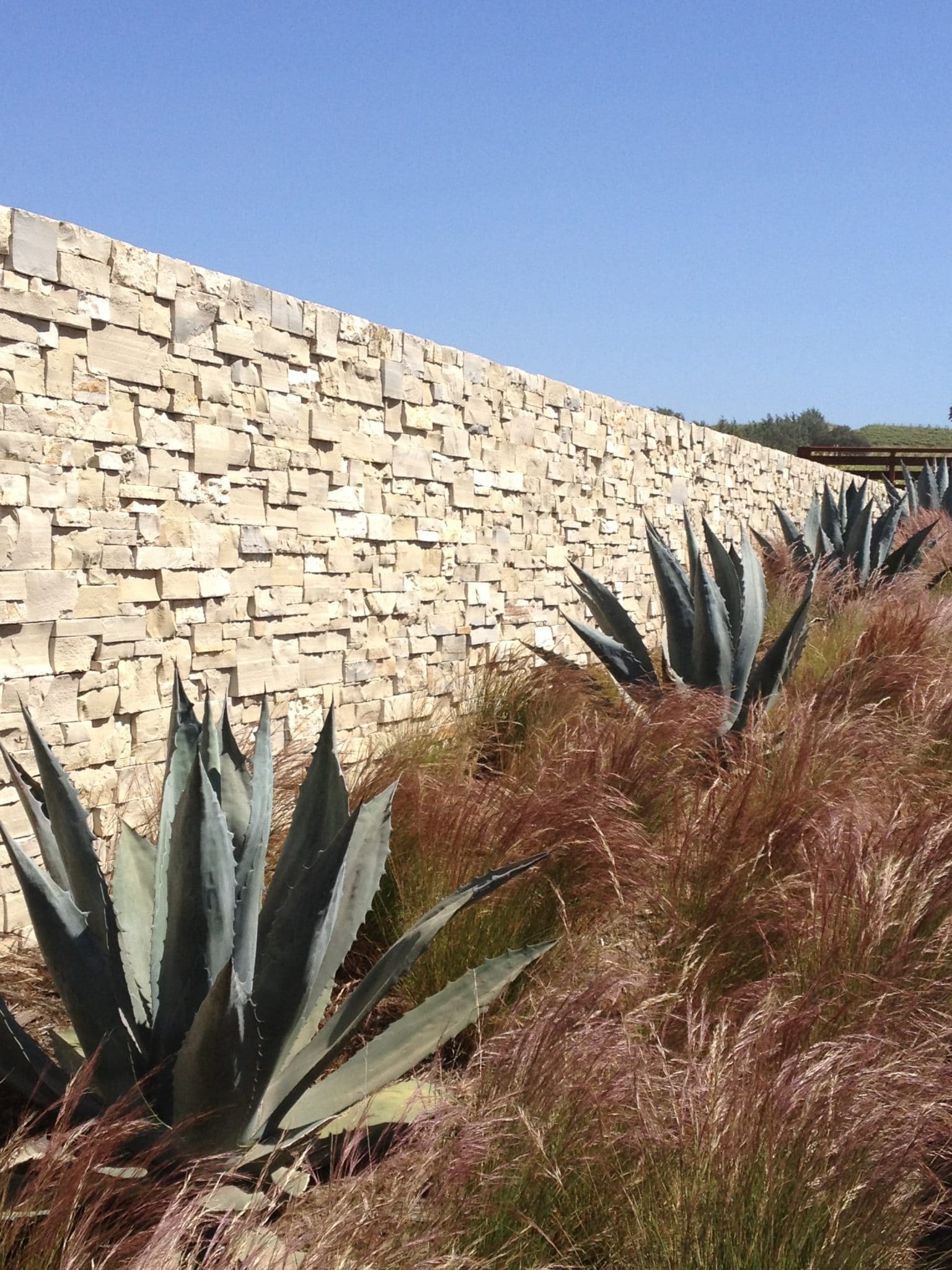
  • AGAVES – Where I am allowed to include them, I am always pleased. They are pure sculpture. Beautiful color. Put them with anything.  They steal the show.
  • CURRY – That gorgeous little shot of silver. Put it right next to a vibrant yellow green and you do not need another color in the garden. I keep them cut close without ever blooming and they become big billowy mounds.
  • ROSES – Always.
  • BOUGAINVILLEA – Always.
  • CITRUS – Always.

Eye of the Day| California Plant recommendations|Aristida Purpurea
Purple three-awn is a great alternative for a California garden to the popular, but invasive Mexican feather grass.

Eye of the Day| Plant recommendations| Olive Tree
The fruitless olive tree is a low water option that can be planted a variety of ways.

Puck Erickson of Arcadia Studio

I am going for Aristida purpurea.

  • PURPLE THREE-AWN – One of my favorite California grasses, it is worth the weight as it settles into the landscape. A great substitute for the invasive Mexican Feather Grass which should never be planted. Its delicate texture and subtle color picks up our afternoon light and it moves easily in the wind.

Eye of the Day| California Plant recommendations| Leucospermum
Leucospermum or “Flame Giant” add a spot of bright color great for  your California garden.

Bridget Walker of Arcadia Studios

Bridget also asked some of her colleagues for their favorites:

  • FRUITLESS OLIVE – A beautiful evergreen tree with silver green foliage. Olives are a great choice for drought tolerant landscapes; they are low water usage, love full sun and can be planted in many forms.
  • CLUSTERED FIELD SEDGE – A low-growing native grass commonly used as a drought tolerant lawn alternative. Perfect for informal lawns and meadow gardening
  • GIANT ORANGE NODDING PINCUSHION. A low mounding South African Native with course green foliage. Spring brings spectacular orange blooms 4-6″ wide.  Great in the green or for cut flowers for the home.

Eye of the Day| California plant recommendations| Salvia apiana
The Salvia Apiana, better known as “White Sage” is perfect for your California Natives only garden.

Eye of the Day| California plant recommendations| Leucadendron safari Gold
Leucadendron ‘Safari Goldstrike’ or Yellow Conebush is another plant with low-water needs.

Sally Farnum of S E Farnum Associates

Sally gave me a list so long I had to make my own choices from her list:

  • CEANOTHUS “RAY HARTMAN”. Pale blue, fragrant blooms, it requires little water, no soil disturbance, no fertilizing, no drip and no application of soil amendment.
  • LANTANA “CONFETTI”. A shrub-type Lantana that loves the sunshine, it produces masses of flower clusters in yellow, pink, purple and wine-colored hues, it is drought and deer-resistant.
  • Many roses are cultivated for low water use, such as Meidiland, drift roses, knockout roses and some David Austins

If you are interested in more suggestions for drought-tolerant plants, please let me know: I have more recommendations for our friends.

Photo Credit: Courtesy of Arcadia Studio 


Musings On Design: Jeffrey Gordon Smith Landscape Architecture Part 2

Eye of the Day | Jeffrey Gordon Smith Landscape Architect

This is Part 2 of our interview with Jeffrey Gordon Smith Landscape Architecture with the principal architect himself. To read the first part, please visit here.

EOD: Based on your portfolio that definitely seems to be a case. It can be difficult to make sure all work in harmony, but your clients must know who you are and seek you out for those specific reasons.

JGS: Right, I don’t think I want to be the landscape architect for everyone. I tend to be a pleaser, but I’ve realized you can’t make everyone happy (laughs). I’ve been very fortunate, I feel, that we created this signature or style that people gravitate towards. I’m sure there are people who know they don’t like this style and I’ve learned this is okay. It’s kind of a Buddhist approach that hey, there’s always going to be change and not everyone is going to like you. So, looking back the one thing that has tied a lot of our work—that three-prong approach—is really hard to put a finger on. One of the things we are fortunate in the area we are working in is these amazing sites and getting to derive power from those places and turn that volume up. It’s almost like place making and tuning into the site. Being sensitive to the offsite: the colors, environment, and extract out and almost paint with plants and materials that feel that are of the place where it doesn’t feel contrived.

We had a project in Garden Design magazine and someone from Minnesota emailed me who were inspired by my work and wanted to make their backyard like the one in the magazine. They ended up having to bring most of it inside for the winter and I felt it missed the point. That’s what’s difficult with print; you only get a small sliver of the whole project. So much of the true nature and heart of project gets stripped out and they lose what’s really behind the project. They lost the whole impact of what the project was about: Using what you got, living where you are and celebrate where you are. I love the idea of a regionalism philosophy like that. The whole idea is to celebrate where you are even if you like a Mediterranean climate and landscape and you live in Minnesota. You can celebrate Minnesota.

EOD: That’s really about respect of location. You’re based in California and drought has been a concern the last few years. But based on your work, the projects continue to still feel lush. There’s water features, flowers, trees. How do you keep designs sustainable and still incorporate all these features despite the California drought.

JGS: I’m not a big sustainable, green flag waver. I’ve always believed we should tread on the Earth with the smallest footprint possible. I’ve kind of always done that in my work by playing up where you live and work with what you’re given. Paying homage to understanding the soil, climate, sun and wind exposure and work within those parameters rather than shoving something that doesn’t quite belong. We’re always trying to pay attention to the soil and guess what would be the happier plant environment. First understand the soil then the water you’re given. Most of our landscapes are drought tolerant just by working off with what we’re given. Sometimes we get requests for a tropical garden in an oak woodland. How would that work? We really try to open up their appreciation for where they’re at and try to get them to celebrate their location. We definitely have conflicts and I do tell them I’m not a “Yes person” but I’m not a “No person”. I’ll give them what they want but at least tell them what I think. And hopefully through that I hope we’ve educated clients, or at least pushed them outside their comfort level. I think again, it’s about becoming more sensitive to what’s around you.

With the drought, I’ve had lots of clients request water features and what not, but I’m not a big default water feature person. If a client requests it, we try to design something unique. The big thing I’m worried about is, Is this just a blip or will this be the next environment that California will be? I try to forecast it, looking at new plants and pushing the next edge. I’m always looking for plant material that works here and we can use as a new medium to transition into. I’m looking at Arizona for a lot of plants and similar areas that require almost no water and trying to push further out from the current environment.

We’re constantly probing and testing new plants to see how successful they are in certain projects.


EOD: When you do designs outside of California do you bring some of that sensitivity to the environment or do you judge each space on its own?

JGS: It really is trying to tie into place. We’re not always using strictly native—the cat’s out of the bag on that one. The true California landscape was let out when invasive European species were introduced. It would be unrealistic at this point to create a true California landscape. But I do like to rely on natives. I did a golf course in China and met a botanist there. The only common language we shared was Latin and we could discuss plants with Latin descriptors. They essentially had to create a nursery for the golf course. I suggested they use a roadside weed and they probably thought I was nuts. They saw it as a weed where I saw it as a native plant that grew very well and looked like it was at home. They thought I was completely crazed for wanting to use that weed but it could have propagated well. Working in another climate can be a challenge, even within California with all the different zones. If I were to work somewhere else I’d put the time in researching plant material and who is growing it. It’s not an easy profession to do well in many locations (laughs). If I was an architect I could grab a window, a door, or roofing material from any place and ship it across the globe it would be fine. But the plant material is the thing that could make or break it.


EOD: Are there any personal favorite projects of yours? And finally, what is your hope for the future of Jeffrey Gordon Smith Landscape Architecture?

JGS: I sometimes fear, how are we going to do better than what we’ve done in the past? But each year I look back there’s always another project that one ups one of the last ones. But it’s not really about one upping but there are qualities of that project that resonate and hold for itself. There was a perfect poetry of this project that connects to that space. Then you get another project and wonder how you’re going to pull that off in this one but you find some other element or other aspect to it that you can pull that kind of power as well.

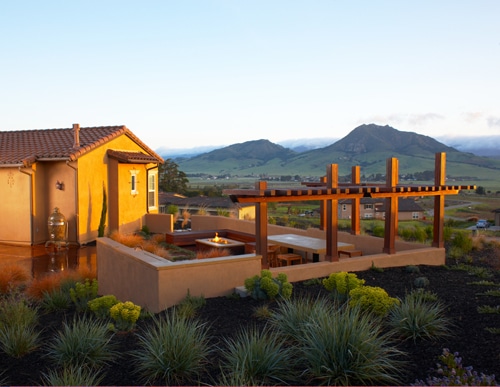
A lot of projects we’re looking at we’re trying to develop a narrative. An example is Seven Sisters. There are geologic features that surround this area called the Seven Sisters which are volcanic plugs. They’re two mountains that are part of the chain of mountains—they say seven but there’s technically eleven—that are in the background of the project. That’s where we got the different heights for the seven posts in the pergola. They’re sort of talking to place and kind of telling the story of the Seven Sisters. There’s a spa area just beyond here with another four which would be the missing sisters. One of the sisters is more of a rock, Morro Rock which is out to sea, but beyond that is the Davidson Seamount which sits about a mile out underwater and they’re smaller mounts along the chain which aren’t as well know. It is a little tongue in cheek story, but it’s how we create these unique spaces by trying to come up with a narrative or purpose for how things are made.

It’s a story the client might not even know about. What I love about this project, it’s kind of poking you in the side. Neighbors and friends who come to see the fabulous backyard might wonder what happened with the carpenter today, like what happened? Everyone wants to cut them off to the same level. But that’s the thing that makes the garden unique to this place and is celebrating the place. Someone could have torn this image out of a magazine and built it somewhere but it wouldn’t relate to that place.

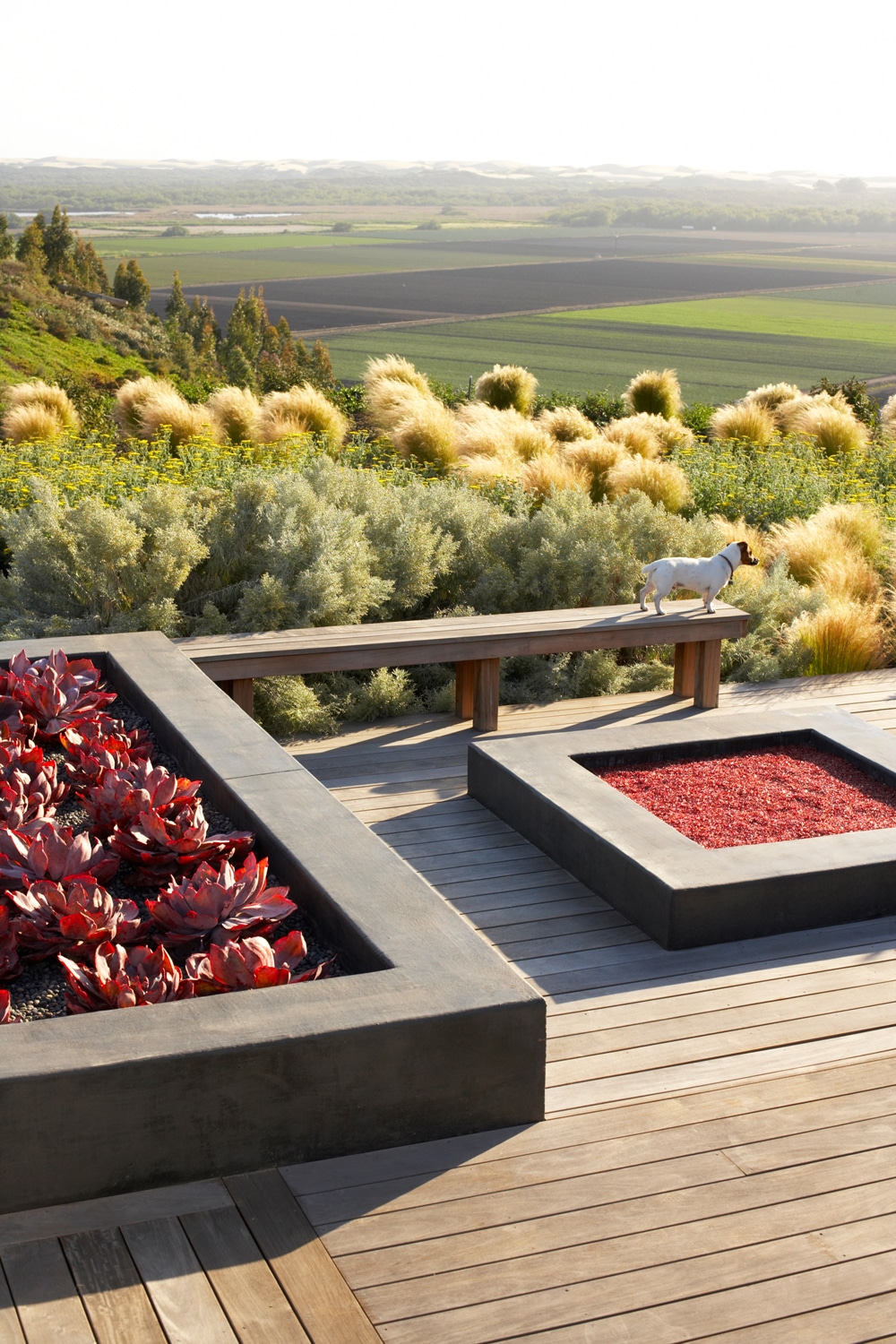
Another project, Pacific Rim, the client wanted a Japanese garden. I had studied Japanese gardens but to avoid the kitsch aspects we instead try to reflect back on Japan from California. The idea was to use plants that work in this coastal stress with salt laden air that goes in this dune area with the nearby Pacific Ocean. One amazing thing about Japanese gardens is the borrowed landscape and how they create a reflection of their surroundings. Like a rock garden that represents Mt. Fuji. So here we are painting the landscape beyond. That deck is done in a parquet pattern which reflects the farm fields below. We designed raised planters which I call bonsai planters and are planted in crop rows like the farm fields. This landscape is reflecting and has references. There’s even a spirit walk which you would see in a typical Japanese garden, but not so kitschy. We’re still celebrating and having a nod towards Japanese style in some details.

Finally, there’s Backbay Retreat, which I kid around that we could have taken a Yahtzee cup and thrown plants out there and anywhere they landed would have been perfect. It was a really amazing setting. The client bought an empty property next to theirs and instead of building another house extended their garden. We spent a lot of time out at this site. It’s pretty sacred and we wanted to understand what the space wanted to be. We borrowed this curve of the bay’s shoreline and designed the deck around this curve—it’s kind of mimicking it. For the deck we used polished concrete so we could get a really glassy, super reflective quality because it relates to the water. The client had requested a fence for their dog so we disguised that fence as backing for the bench which is also designed with a nautical theme to connect back to the water.

We used Mexican pebble between the stone because it’s the same color of the dunes. The estuaries which are like fingers feeding into the bay match the stone and pebbles. Connections are being made with the side including the selection of materials. Even the rock that terminates the bench is a small version of Morro Rock. I don’t think anyone is going to the site saying this means this and that but you can leave a site or place with an experience that it just feels good or right and you’re not analyzing why that is, but it just feels like it is. We’re hoping as designers we’re evoking and tapping into those feelings to make connections to place. That’s what I’m trying to do when working on a project.


EOD: And what was your hope for the future?

JGS: World domination (laughs.)

EOD: That would require a lot of research.


To view more of the work of Jeffrey Gordon Smith Landscape Architecture, please visit their site here.
Musings On Design: Jeffrey Gordon Smith Landscape Architecture Part 1

Eye of the Day|Jeffrey Gordon Smith Landscape Architecture

Jeffrey Gordon Smith Landscape Architecture and the Spirit of Place

The spirit of a place. This concept comes up throughout our interview with Jeffrey Gordon Smith, principal architect of Jeffrey Gordon Smith Landscape Architecture based in Baywood-Los Osos, CA. There is a respect and celebration of space throughout the work of Smith and his firm. They encourage clients to celebrate where they live and do so by connecting the designs of their projects to the existing natural landscape. From a chain of volcanic plugs corresponding to an outdoor space’s pergola design to a Japanese garden in the Pacific Rim evoking neighboring farm fields, site and architecture speak to each other and create a cohesive landscape.

Eye of the Day: What lead to you becoming a landscape architect and starting your own firm?

Jeffrey Gordon Smith: I was always interested in design. Basically, I wanted to go to school for architecture but the program at Cal Poly was impacted. So, I consulted my father and he directed me to a similar profession — Civil Engineering. I got into Civil Engineering only to find out later it was just impacted as Architecture. I think they made a mistake letting me in because my grades weren’t all that great. I spent a year in Civil Engineering taking all the calculus, physics, all the brutal courses and found out it wasn’t really my gig. Not only from a professional standpoint, but it just didn’t have enough of an artistic side to it I think.

I basically fell into Landscape Architecture. I started looking back into the school’s environmental design, landscape architecture, regional planning, architecture, and architectural engineering. I found Landscape Architecture almost by accident. I was really interested in the curriculum and what it potentially had to offer. I’m not really religious, but when I started taking courses, it was like I was a born-again Landscape Architect –that was it for me.

My father suggested I start an internship with a Landscape Architect. A firm was working for his company so he helped me get an internship with Emmett Wemple and Associates—one of the most important landscape architects in the Los Angeles area 50 years back. He did the Malibu Getty and other important projects. I did a summer internship and got more of a sense of what the field was about.

EOD: So you’ve been involved with Landscape Architecture since college. When did you start Jeffrey Gordon Smith Landscape Architecture?

JGS: God… I don’t know. I actually don’t know. I’ve probably been practicing for 15 years. I worked for several big firms before. Out of college, I worked for Peridian down in Irvine and they were one of the largest firms at the time. I was hired to work on a Spanish theme park in Japan. I got to be one of the head designers on a 172-acre Spanish theme park in Japan. I got to be involved at a high level in design right out of school. This was right before the great recession in the 90s. I thought I was such a rock star, but they started to get more into residential housing that wasn’t very creative. So I left and landed a job at Schwartz, Smith, Meyer with Martha Schwartz, this rock star of landscape architects at the time, very controversial. She was married to Peter Walker, who’s probably the landscape architect of our time right now. She splintered off and created her own design team with two others. We were doing high profile projects around the world. We worked for Rem Koolhaas, Isozaki, Frank Gehry. Then the recession hit and I was going from job to job and the profession was suffering. It was really tough to run a business in this economy. So I got kind of disenchanted with the profession because everyone was so unhappy at the time financially. It was really a tough time to be starting out.

I started doing side work with models—specifically model trees for one of the finest model tree makers in the world. I’ve worked on models from all over from Disney Concert Hall, to Richard Meyer, to Guggenheim Museum. I started moonlighting and doing my own stuff, a couple of outside projects and started doing a lot of production work for a house designer. The economy started swinging back on high end homes in Portola Valley and Bay Area. I was doing a lot of work and never decided to open my own office but I was doing so much that I needed all my work together, a title block, business cards…had I needed to open up my own office it would have been a daunting task, but it just kind of happened over a couple of years where I realized I needed to do this and my own work ended up keeping me going.

EOD: This is essentially where you branch off and start your own company. Your firm focuses on high end landscape design for a range of clients in residential and commercial projects. What design philosophy do you personally bring to each project? Is it important that you complete a design with a certain goal in mind? 

JGS: When I started out on my own I was working on these cookie-cutter, McMansion stuff that wasn’t very creative or innovative. I was always trying to push the edge but really to also pay the bills. I was fortunate enough in the real estate market  to buy property in San Francisco and sell it at the right time during the height of the tech industry—right place, right time. I was able to look at what I was doing and step back. I think we make decisions too often on money. Since I had a little breathing room from the house sale I looked in the mirror and asked myself what do I want to be when I grow up. I wanted to do much more interesting work and that got me into this present-day philosophy that I have.

I never set out to do a mission statement about what I needed to do. It was really trying to find a little bit more soul into what we’re working with and trying to find—sometimes I hate to use the word– the genus loci or the “spirit of the place.” It was something we always talked about in school and I felt like how could I dare to say that I could conjure up the spirit of a place or the power to call that. But I’ve been doing this so long that I think we have a fairly good tact and understanding in what’s going on in the process of the space or place and trying to extract out the greatest elements of that place. It’s almost as if you were to take a volume knob and crank it up and ask what this place wants to be, what is this place talking about, and really trying to put feelers out and be sensitive to what’s going on.

Eye of the Day|Jeffrey Gordon Smith Landscape Architecture

We came up with that idea of regionalism and looking back at my work over ten years that I kind of changed what I wanted to do and people started to follow my work and request work that wasn’t that McMansion type but the uniqueness of site. I started getting work because of this versus just working for someone who was trying to sell a house. It was more of the art side coming out and exploring that and pushing it in each project.

Not every project has that but I try to use a three-prong approach: site, architecture and client in trying to explore and unite it. You’re marrying the site to the architecture and back to the client. That’s basically been the formula of what we try to draw on each project. Sometimes you get an amazing site or neighbors on all sides, but you’re always given typically architecture which sometimes can be “architorture”, or it could be nondescript, bastardized architecture that you’re playing a smoke and mirrors game of don’t look at the architecture but look at the site. The other component of client is going in and interjecting into the architecture how the client lives, what they’re interior is about, and relate interior to the exterior. So that three element approach has been a foundation for what we do and springboard from.


Stay tuned next month for Part 2 of this interview!


A LANDSCAPE ARCHITECT DESIGNS FOR THE DROUGHT

Eye of the Day Garden Design Center|Sally Farnum Before and After garden design|drought

A LANDSCAPE ARCHITECT DESIGNS FOR THE DROUGHT

While landscape architect Sally Farnum of SE Farnum Associates has been taking the time to educate her clients about how to deal with their outdated, thirsty landscapes—especially rolling, green lawns—she has designed and implemented an outside environment for her own home that is water-considerate and still lush, inviting and peaceful.

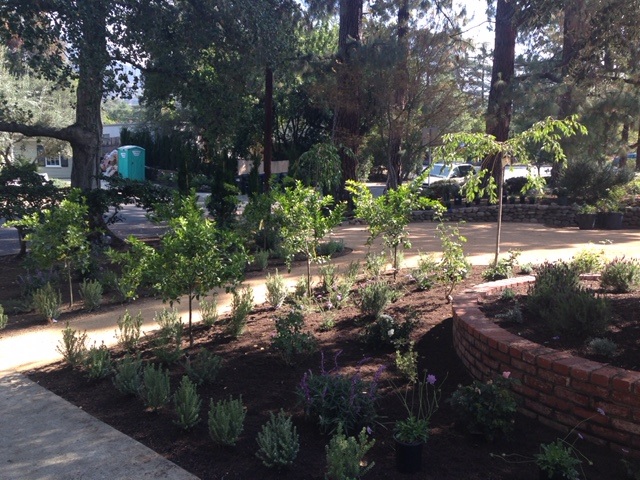
The first task was to remove a large front lawn and some accompanying flower beds.

BEFORE: Water-thirsty lawn

DURING: Removing lawn and introducing granite

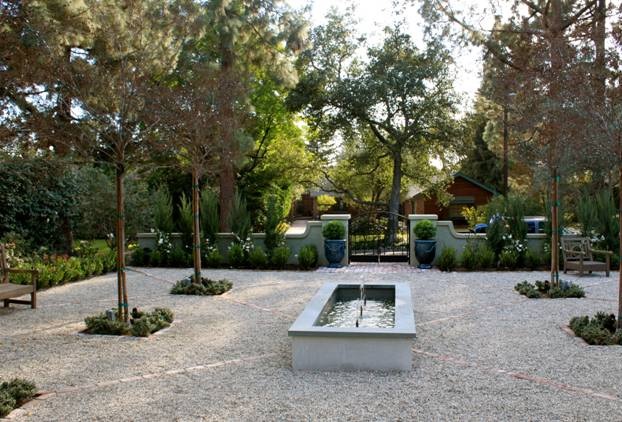
Next, grading, drainage and landscape plan was translated to the area. Decomposed granite was used as the base of the pathway from the driveway, culminating in a keyhole design, at the end of which a dry-stacked rock wall would serve as a retaining wall as well as the background for a Gladding McBean fountain conversion.


ALMOST FINISHED!
Flanking each side of the pathway are two Antique Green Gladding McBean Oil Jars, preparing the eye for the fountain.  Planting on the perimeter of the path area includes a variety of water-friendly plants and trees.


STAY TUNED
Check back next month on Sally’s design in progress for photos of the finished project.


How a Landscape Architect Approaches Garden Design During California Drought

Eye of the Day|Sally Farnum Landscape Architect|garden design drought

Having a sister with a long, successful career as a landscape architect has made it easy to have an ongoing conversation with Sally Farnum about design, client concerns and current issues. We are all especially interested in California’s water problem and wanted to find out how Sally is helping her clients address the issue.

Suzi: What have your clients have been asking about when it comes to water and their gardens?
Sally: Most of my clients are trying to be responsible when it comes to water usage in their landscape. They want to know if they need to take out their lawns, replace their flowering plants with desert plants and if it will still look pretty.

Suzi: How do you approach designing a plan that reflects water-consciousness but is still pretty?
Sally: I really work to combine good elements of design in all my plans: scale, balance, variety, form, line, texture and color. I like to use California natives, salvias, lavenders along with containers, sculpture and fountains.  I suggest using decomposed granite and gravel and, really important, an extra-efficient irrigation system.

Suzi: How do you convince them that a huge, green lawn isn’t the best plan anymore
Sally: Most people are visually oriented, so to describe an idea in words alone doesn’t always convince them. I show them photos or have them visit other projects I have completed.  But I don’t feel that it’s necessary to remove ALL lawn. Only 5% of residential water is used to keep lawns green and it contributes to cooling an area, cleaning the air and reduces noise. Grass in a front yard, used to fill space, should be eliminated.

Suzi: Do you have a favorite or most challenging project which incorporated water-wise elements?

Sally: One of my favorite and most challenging designs is right across the street from my own home.  Challenging because the home belongs to a friend and because I look at it most every day. My favorite because of the transformation from a front yard with a large asphalt driveway and lawn, to a garden with a walled-in gravel courtyard with a fountain and pots planted with flowering plants on the street side of the wall.

Suzi: How have you managed to change the way you designed in the past to meet the new challenges presented by the drought?
Sally:  The challenges are mainly in working with my clients and helping them accept new plants and watering habits.  Most plants will adapt to using less water, but people tend to water more than necessary.  I haven’t changed the way I design, but I have changed the materials and plants I use.


Suzi: Thanks, Sal.  You’re always such a wealth of information, and a fine sister, too.
Sally: You’re not so bad yourself.


The Landscape Professional and Client Relationship Part 2

Eye of the Day|Puck Erickson|garden design architect

The Landscape Professional and Client Relationship, Part II

Principal at Arcadia Studio in Santa Barbara and a resident of Los Olivos, Carol Puck Erickson, ASLA,  has an extensive portfolio of residences and arid gardens in Arizona and beautiful installations throughout California, Puck was initially educated in the visual arts, which still informs her work. She is an avid bi-coastal hiker and amateur botanist who is intrigued by the relationships between the cultural and agrarian landscapes and the native environment.

Puck is also committed to the therapeutic value of gardens, as a founding member of the Santa Ynez Valley Botanic Garden and pro bono consultant for many school and community gardens.  She has worked with Eye of the Day on a large variety of projects over the last two decades and is one of our favorite landscape professionals.

EOD: How has your design relationship evolved over time with any particular client?

I have enjoyed working with clients on multiple projects, sometimes over decades as the gardens reflect an evolution in their owners’ perspectives on the twists and turns of their own lives. Working together, we gain an understanding of the role time plays in a garden and in our own lives.  Often, with their second or third gardens, people are willing to plant a bit smaller and also to simplify their approach to garden designs.  While others, coaxed into the out-of-doors by their first garden, become avid collectors and gardening enthusiasts.

EOD: How do you accommodate the client’s changing tastes over a span of time and still allow your own accumulated professional experience to show through?

I listen closely, very closely!! As the years have flown by, I find that often I am simply a translator and steward as my client churns out ideas with unbridled enthusiasm, often without recognizing their own insight into a space, or an observation gleaned from their travels. It is through my experience and design discipline that we can take these wonderful ideas and marry them to the environment of the new garden.

I am often surprised at how easily some designers seem to let go of their gardens and the evolution of those spaces, from both a horticultural and aesthetic perspective. When we work with clients we are not creating a garden image, frozen in time. Once the garden is completed, the real fun begins. The garden begins to build its own rhythm and dynamic as it flows from season to season and we are committed to continue that dialogue with our clients and their gardens over years, if not decades!  I think responding to the drought is a perfect example of how an on-going relationship with the client and their garden can make a real difference.

To view more of Puck’s work, visit Arcadia Studio.