California Garden Designer Jennifer Voss of Gardefacts

Jennifer Voss|Gardefacts|California Garden Design

Jennifer Voss of Gardefacts Designs Thoughtful and Practical California Gardens

In our continued series, Blueprint, that covers the work and projects of landscape and garden professionals, we are happy to count Jennifer Voss of Gardefacts in Santa Barbara, California as one of our most loyal designers. She has been using Eye of the Day as a primary resource for over a decade and she uses our products to highlight and enhance her California garden designs.

Jennifer’s love of horticulture began with visits to the Los Angeles County Arboretum with her grandparents, where they wandered through the garden and bamboo forests, feeding the plentiful peacocks and learning the names of the plants.

Jennifer Voss|Gardefacts|California Garden Design
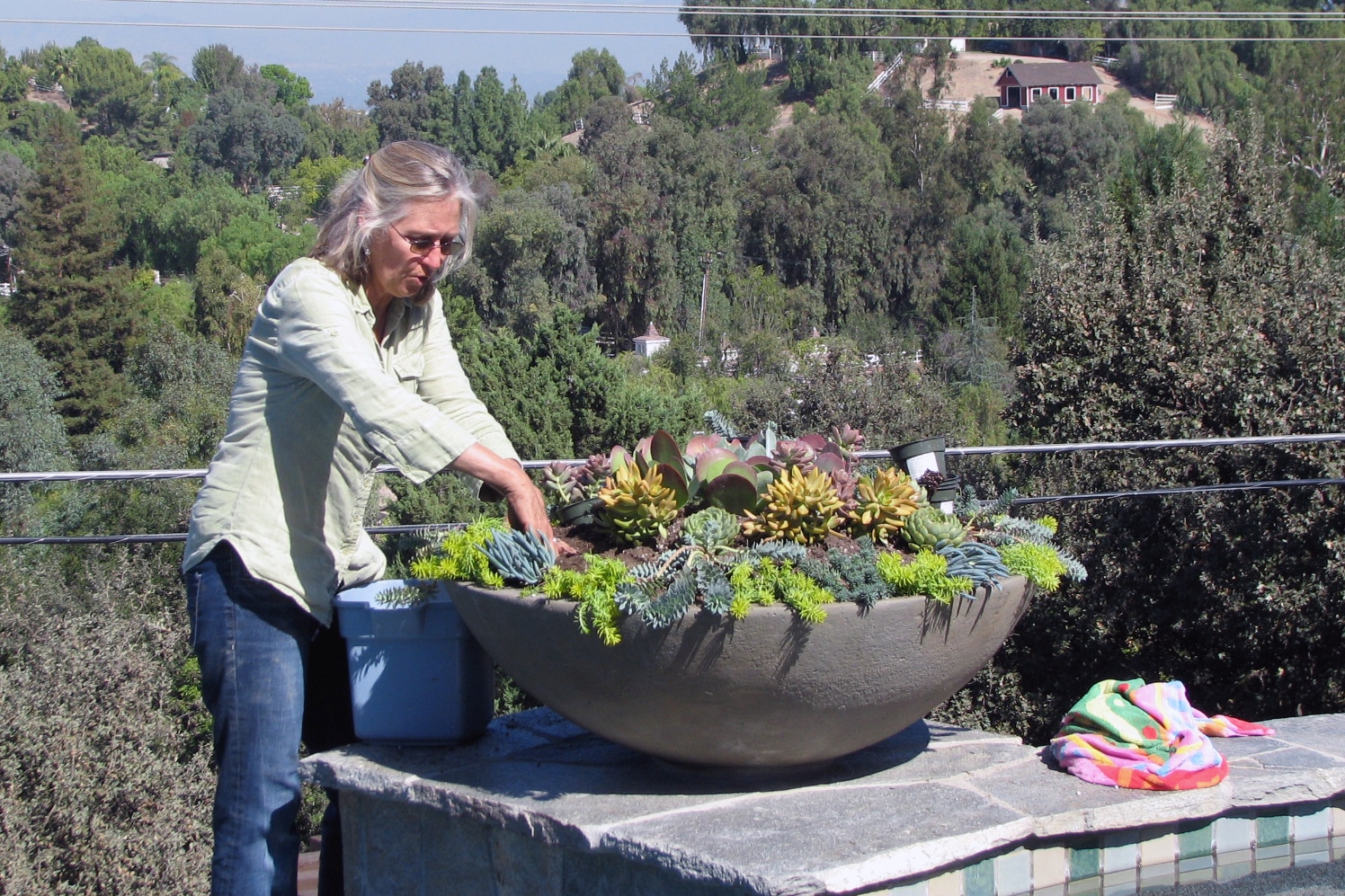
Jennifer Voss starts planting in one of Eye of the Day’s concrete low bowls.

Jennifer Voss|Gardefacts|California Garden Design
The finished design for this concrete low bowl uses water wise succulents.

With Jennifer’s knowledge of plants, she became interested in design and plant care and studied botany in college and Landscape Design at UCLA.  She has visited hundreds of gardens throughout England, France, Italy and the United States and these influences help guide her in her designs.

Jennifer Voss|Gardefacts|California Garden Design
This design uses Eye of the Day’s own Italian terracotta Jar Aubagne pots.

Jennifer Voss|Gardefacts|California Garden Design
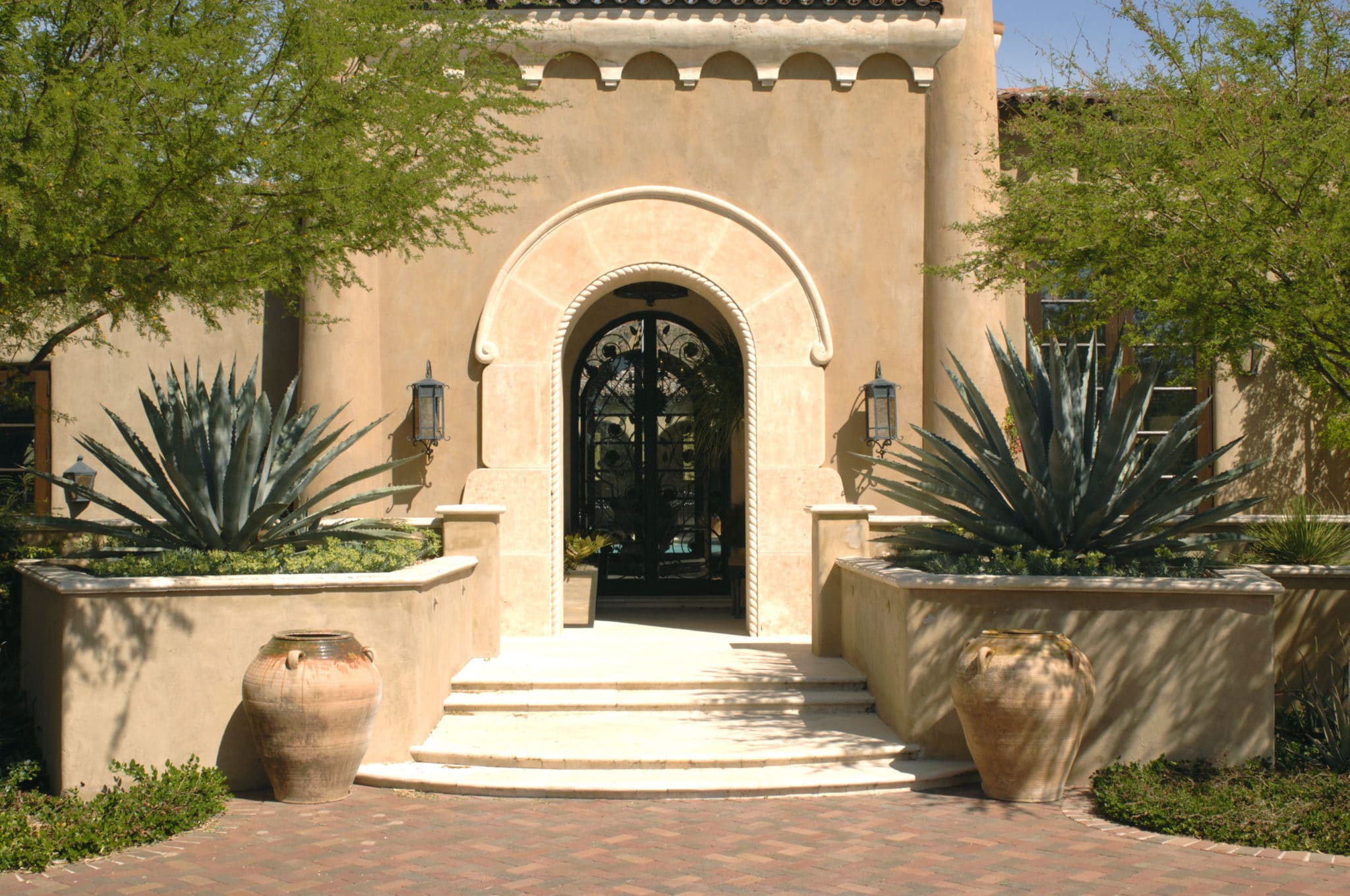
An Eye of the Day American concrete planter flanks this California home’s entrance.

Jennifer finds that the best method for working with a new client is to listen closely to how they describe their vision for their space and translate that to a design that is both beautiful and practical.  Check out the photos and you’ll see how Jennifer seamlessly incorporates Eye of the Day pots into her designs.

Jennifer Voss|Gardefacts|California Garden Design
More Eye of the Day concrete low bowls throughout this design.

See more of Jennifer’s work at Gardefacts including more container gardens, design projects, and even edibles!


Q&A with Pinky Lark Farnum of Lark Farnum Floral Design

Eye of the Day|Floral Design|Pinky Lark Farnum

Q&A with Pinky Lark Farnum of Lark Farnum Floral Design

A native Angeleno with stints in Philadelphia and Rome, Lark Farnum, better known to friends and family as Pinky, has always tried to bring a calming, creative touch to the world around her.  She studied Art History at Bryn Mawr College, designed window displays at Anthropologie and started her own fashion accessories business before delving into the florist world by working with highly respected, eco-friendly Wisteria Lane.

Before leaving to start Lark Farnum Design, Pinky worked as an Event Manager at one of the most renowned event spaces in Los Angeles, Vibiana.  Pinky’s varied design and event background and warm personality make her the perfect fit for any client who wants their flowers to tell an artistic and personal story.

Suzi sits with the up-and-coming floral designer about her career and vision for the future.

SUZI:  Well.  Pinky… how did you decide on pursuing your career as a floral designer?

PINKY:   Glad you I tell people who have known me for a long time that I now work as a floral designer, they don’t seem to be surprised at all. Most say they always knew I would end up here.  They must have known something I didn’t. It’s a profession I seem to have fallen into after a few different design and event jobs.

Now, four years after starting my first floral job with Wisteria Lane Floral Design and almost two years after starting my own business full-time, I am excited to have found a way to combine my love of design and nature, while helping clients create a visual identity for what is in many cases, one of the most important days in their lives.

SUZI:  How do you stay excited about doing floral design and how do you translate your excitement into your designs?

PINKY: I try to blend my knowledge of plants, flowers, events, and design to focus a client’s vision into something that will be realistic, impactful, unique, and beautiful. In my garden-style arrangements, I like to combine fan favorites, such as peonies and English-style garden roses, with interesting foliage and unique accents like scabiosa, vegetables and fruit. I consider each event as a completely separate entity in order to make sure that I keep each one fresh and tailored to the individual client.

When you are hiring a floral designer, you are hiring someone to spend time brainstorming unique arrangements, pick flowers and plants that bring a distinctive vision to life, and create an ambiance that sets the tone of your entire event.

SUZI:  Do you find that the drought is having an impact on the way you design?

PINKY: I love that this profession allows me to constantly learn and strengthen my craft as well as change with the times.  I often think about the looming reality of climate change in terms of the future of my profession. Instead of feeling threatened, I try to think of it as an opportunity to evolve with our evolving environment.  In order to be as ecologically friendly as possible, I use locally and sustainably grown elements whenever possible. With the popularity of succulents and other water-wise flora dominating a lot of floral and event design, we can already see that things are shifting.

In years to come, I look forward to using other plants and flowers that come out of the woodwork as unique options for floral design.

SUZI:  Thanks for the insight, Pinky!

PINKY: Thanks for the questions, Suzi!

See more of Pinky’s work at Lark Farnum Floral Design and follow her on Instagram


Musings On Design: Jeffrey Gordon Smith Landscape Architecture Part 2

Eye of the Day | Jeffrey Gordon Smith Landscape Architect

This is Part 2 of our interview with Jeffrey Gordon Smith Landscape Architecture with the principal architect himself. To read the first part, please visit here.

EOD: Based on your portfolio that definitely seems to be a case. It can be difficult to make sure all work in harmony, but your clients must know who you are and seek you out for those specific reasons.

JGS: Right, I don’t think I want to be the landscape architect for everyone. I tend to be a pleaser, but I’ve realized you can’t make everyone happy (laughs). I’ve been very fortunate, I feel, that we created this signature or style that people gravitate towards. I’m sure there are people who know they don’t like this style and I’ve learned this is okay. It’s kind of a Buddhist approach that hey, there’s always going to be change and not everyone is going to like you. So, looking back the one thing that has tied a lot of our work—that three-prong approach—is really hard to put a finger on. One of the things we are fortunate in the area we are working in is these amazing sites and getting to derive power from those places and turn that volume up. It’s almost like place making and tuning into the site. Being sensitive to the offsite: the colors, environment, and extract out and almost paint with plants and materials that feel that are of the place where it doesn’t feel contrived.

We had a project in Garden Design magazine and someone from Minnesota emailed me who were inspired by my work and wanted to make their backyard like the one in the magazine. They ended up having to bring most of it inside for the winter and I felt it missed the point. That’s what’s difficult with print; you only get a small sliver of the whole project. So much of the true nature and heart of project gets stripped out and they lose what’s really behind the project. They lost the whole impact of what the project was about: Using what you got, living where you are and celebrate where you are. I love the idea of a regionalism philosophy like that. The whole idea is to celebrate where you are even if you like a Mediterranean climate and landscape and you live in Minnesota. You can celebrate Minnesota.

EOD: That’s really about respect of location. You’re based in California and drought has been a concern the last few years. But based on your work, the projects continue to still feel lush. There’s water features, flowers, trees. How do you keep designs sustainable and still incorporate all these features despite the California drought.

JGS: I’m not a big sustainable, green flag waver. I’ve always believed we should tread on the Earth with the smallest footprint possible. I’ve kind of always done that in my work by playing up where you live and work with what you’re given. Paying homage to understanding the soil, climate, sun and wind exposure and work within those parameters rather than shoving something that doesn’t quite belong. We’re always trying to pay attention to the soil and guess what would be the happier plant environment. First understand the soil then the water you’re given. Most of our landscapes are drought tolerant just by working off with what we’re given. Sometimes we get requests for a tropical garden in an oak woodland. How would that work? We really try to open up their appreciation for where they’re at and try to get them to celebrate their location. We definitely have conflicts and I do tell them I’m not a “Yes person” but I’m not a “No person”. I’ll give them what they want but at least tell them what I think. And hopefully through that I hope we’ve educated clients, or at least pushed them outside their comfort level. I think again, it’s about becoming more sensitive to what’s around you.

With the drought, I’ve had lots of clients request water features and what not, but I’m not a big default water feature person. If a client requests it, we try to design something unique. The big thing I’m worried about is, Is this just a blip or will this be the next environment that California will be? I try to forecast it, looking at new plants and pushing the next edge. I’m always looking for plant material that works here and we can use as a new medium to transition into. I’m looking at Arizona for a lot of plants and similar areas that require almost no water and trying to push further out from the current environment.

We’re constantly probing and testing new plants to see how successful they are in certain projects.


EOD: When you do designs outside of California do you bring some of that sensitivity to the environment or do you judge each space on its own?

JGS: It really is trying to tie into place. We’re not always using strictly native—the cat’s out of the bag on that one. The true California landscape was let out when invasive European species were introduced. It would be unrealistic at this point to create a true California landscape. But I do like to rely on natives. I did a golf course in China and met a botanist there. The only common language we shared was Latin and we could discuss plants with Latin descriptors. They essentially had to create a nursery for the golf course. I suggested they use a roadside weed and they probably thought I was nuts. They saw it as a weed where I saw it as a native plant that grew very well and looked like it was at home. They thought I was completely crazed for wanting to use that weed but it could have propagated well. Working in another climate can be a challenge, even within California with all the different zones. If I were to work somewhere else I’d put the time in researching plant material and who is growing it. It’s not an easy profession to do well in many locations (laughs). If I was an architect I could grab a window, a door, or roofing material from any place and ship it across the globe it would be fine. But the plant material is the thing that could make or break it.


EOD: Are there any personal favorite projects of yours? And finally, what is your hope for the future of Jeffrey Gordon Smith Landscape Architecture?

JGS: I sometimes fear, how are we going to do better than what we’ve done in the past? But each year I look back there’s always another project that one ups one of the last ones. But it’s not really about one upping but there are qualities of that project that resonate and hold for itself. There was a perfect poetry of this project that connects to that space. Then you get another project and wonder how you’re going to pull that off in this one but you find some other element or other aspect to it that you can pull that kind of power as well.

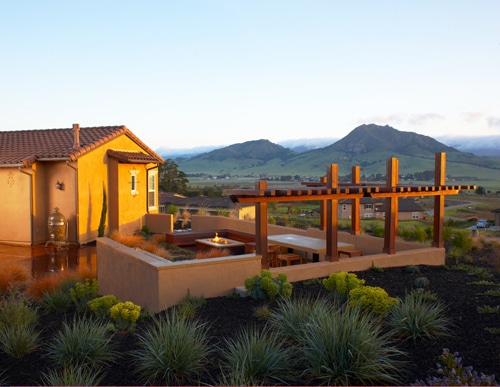
A lot of projects we’re looking at we’re trying to develop a narrative. An example is Seven Sisters. There are geologic features that surround this area called the Seven Sisters which are volcanic plugs. They’re two mountains that are part of the chain of mountains—they say seven but there’s technically eleven—that are in the background of the project. That’s where we got the different heights for the seven posts in the pergola. They’re sort of talking to place and kind of telling the story of the Seven Sisters. There’s a spa area just beyond here with another four which would be the missing sisters. One of the sisters is more of a rock, Morro Rock which is out to sea, but beyond that is the Davidson Seamount which sits about a mile out underwater and they’re smaller mounts along the chain which aren’t as well know. It is a little tongue in cheek story, but it’s how we create these unique spaces by trying to come up with a narrative or purpose for how things are made.

It’s a story the client might not even know about. What I love about this project, it’s kind of poking you in the side. Neighbors and friends who come to see the fabulous backyard might wonder what happened with the carpenter today, like what happened? Everyone wants to cut them off to the same level. But that’s the thing that makes the garden unique to this place and is celebrating the place. Someone could have torn this image out of a magazine and built it somewhere but it wouldn’t relate to that place.

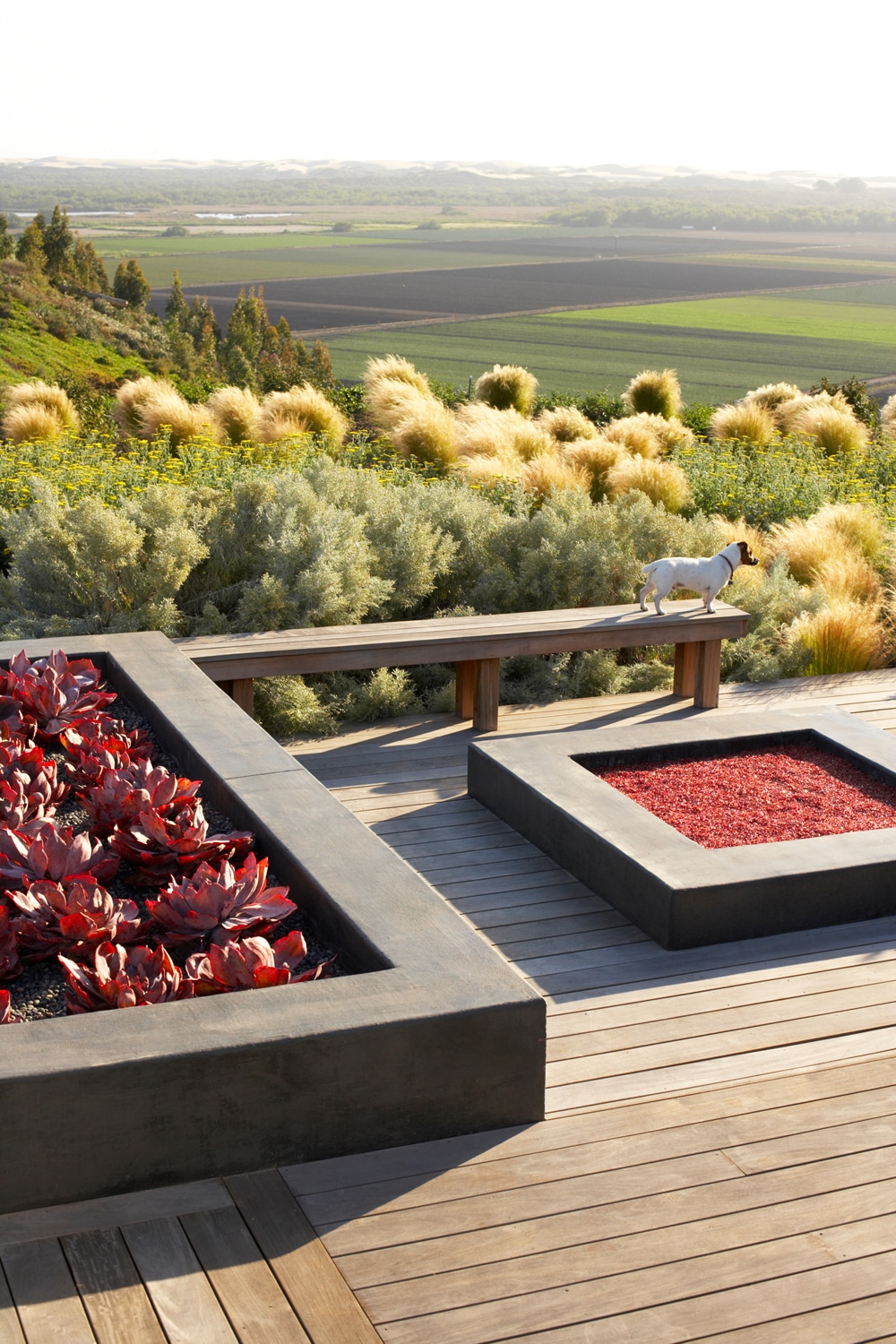
Another project, Pacific Rim, the client wanted a Japanese garden. I had studied Japanese gardens but to avoid the kitsch aspects we instead try to reflect back on Japan from California. The idea was to use plants that work in this coastal stress with salt laden air that goes in this dune area with the nearby Pacific Ocean. One amazing thing about Japanese gardens is the borrowed landscape and how they create a reflection of their surroundings. Like a rock garden that represents Mt. Fuji. So here we are painting the landscape beyond. That deck is done in a parquet pattern which reflects the farm fields below. We designed raised planters which I call bonsai planters and are planted in crop rows like the farm fields. This landscape is reflecting and has references. There’s even a spirit walk which you would see in a typical Japanese garden, but not so kitschy. We’re still celebrating and having a nod towards Japanese style in some details.

Finally, there’s Backbay Retreat, which I kid around that we could have taken a Yahtzee cup and thrown plants out there and anywhere they landed would have been perfect. It was a really amazing setting. The client bought an empty property next to theirs and instead of building another house extended their garden. We spent a lot of time out at this site. It’s pretty sacred and we wanted to understand what the space wanted to be. We borrowed this curve of the bay’s shoreline and designed the deck around this curve—it’s kind of mimicking it. For the deck we used polished concrete so we could get a really glassy, super reflective quality because it relates to the water. The client had requested a fence for their dog so we disguised that fence as backing for the bench which is also designed with a nautical theme to connect back to the water.

We used Mexican pebble between the stone because it’s the same color of the dunes. The estuaries which are like fingers feeding into the bay match the stone and pebbles. Connections are being made with the side including the selection of materials. Even the rock that terminates the bench is a small version of Morro Rock. I don’t think anyone is going to the site saying this means this and that but you can leave a site or place with an experience that it just feels good or right and you’re not analyzing why that is, but it just feels like it is. We’re hoping as designers we’re evoking and tapping into those feelings to make connections to place. That’s what I’m trying to do when working on a project.


EOD: And what was your hope for the future?

JGS: World domination (laughs.)

EOD: That would require a lot of research.


To view more of the work of Jeffrey Gordon Smith Landscape Architecture, please visit their site here.


Musings On Design: Jeffrey Gordon Smith Landscape Architecture Part 1

Eye of the Day|Jeffrey Gordon Smith Landscape Architecture

Jeffrey Gordon Smith Landscape Architecture and the Spirit of Place

The spirit of a place. This concept comes up throughout our interview with Jeffrey Gordon Smith, principal architect of Jeffrey Gordon Smith Landscape Architecture based in Baywood-Los Osos, CA. There is a respect and celebration of space throughout the work of Smith and his firm. They encourage clients to celebrate where they live and do so by connecting the designs of their projects to the existing natural landscape. From a chain of volcanic plugs corresponding to an outdoor space’s pergola design to a Japanese garden in the Pacific Rim evoking neighboring farm fields, site and architecture speak to each other and create a cohesive landscape.

Eye of the Day: What lead to you becoming a landscape architect and starting your own firm?

Jeffrey Gordon Smith: I was always interested in design. Basically, I wanted to go to school for architecture but the program at Cal Poly was impacted. So, I consulted my father and he directed me to a similar profession — Civil Engineering. I got into Civil Engineering only to find out later it was just impacted as Architecture. I think they made a mistake letting me in because my grades weren’t all that great. I spent a year in Civil Engineering taking all the calculus, physics, all the brutal courses and found out it wasn’t really my gig. Not only from a professional standpoint, but it just didn’t have enough of an artistic side to it I think.

I basically fell into Landscape Architecture. I started looking back into the school’s environmental design, landscape architecture, regional planning, architecture, and architectural engineering. I found Landscape Architecture almost by accident. I was really interested in the curriculum and what it potentially had to offer. I’m not really religious, but when I started taking courses, it was like I was a born-again Landscape Architect –that was it for me.

My father suggested I start an internship with a Landscape Architect. A firm was working for his company so he helped me get an internship with Emmett Wemple and Associates—one of the most important landscape architects in the Los Angeles area 50 years back. He did the Malibu Getty and other important projects. I did a summer internship and got more of a sense of what the field was about.

EOD: So you’ve been involved with Landscape Architecture since college. When did you start Jeffrey Gordon Smith Landscape Architecture?

JGS: God… I don’t know. I actually don’t know. I’ve probably been practicing for 15 years. I worked for several big firms before. Out of college, I worked for Peridian down in Irvine and they were one of the largest firms at the time. I was hired to work on a Spanish theme park in Japan. I got to be one of the head designers on a 172-acre Spanish theme park in Japan. I got to be involved at a high level in design right out of school. This was right before the great recession in the 90s. I thought I was such a rock star, but they started to get more into residential housing that wasn’t very creative. So I left and landed a job at Schwartz, Smith, Meyer with Martha Schwartz, this rock star of landscape architects at the time, very controversial. She was married to Peter Walker, who’s probably the landscape architect of our time right now. She splintered off and created her own design team with two others. We were doing high profile projects around the world. We worked for Rem Koolhaas, Isozaki, Frank Gehry. Then the recession hit and I was going from job to job and the profession was suffering. It was really tough to run a business in this economy. So I got kind of disenchanted with the profession because everyone was so unhappy at the time financially. It was really a tough time to be starting out.

I started doing side work with models—specifically model trees for one of the finest model tree makers in the world. I’ve worked on models from all over from Disney Concert Hall, to Richard Meyer, to Guggenheim Museum. I started moonlighting and doing my own stuff, a couple of outside projects and started doing a lot of production work for a house designer. The economy started swinging back on high end homes in Portola Valley and Bay Area. I was doing a lot of work and never decided to open my own office but I was doing so much that I needed all my work together, a title block, business cards…had I needed to open up my own office it would have been a daunting task, but it just kind of happened over a couple of years where I realized I needed to do this and my own work ended up keeping me going.

EOD: This is essentially where you branch off and start your own company. Your firm focuses on high end landscape design for a range of clients in residential and commercial projects. What design philosophy do you personally bring to each project? Is it important that you complete a design with a certain goal in mind? 

JGS: When I started out on my own I was working on these cookie-cutter, McMansion stuff that wasn’t very creative or innovative. I was always trying to push the edge but really to also pay the bills. I was fortunate enough in the real estate market  to buy property in San Francisco and sell it at the right time during the height of the tech industry—right place, right time. I was able to look at what I was doing and step back. I think we make decisions too often on money. Since I had a little breathing room from the house sale I looked in the mirror and asked myself what do I want to be when I grow up. I wanted to do much more interesting work and that got me into this present-day philosophy that I have.

I never set out to do a mission statement about what I needed to do. It was really trying to find a little bit more soul into what we’re working with and trying to find—sometimes I hate to use the word– the genus loci or the “spirit of the place.” It was something we always talked about in school and I felt like how could I dare to say that I could conjure up the spirit of a place or the power to call that. But I’ve been doing this so long that I think we have a fairly good tact and understanding in what’s going on in the process of the space or place and trying to extract out the greatest elements of that place. It’s almost as if you were to take a volume knob and crank it up and ask what this place wants to be, what is this place talking about, and really trying to put feelers out and be sensitive to what’s going on.

Eye of the Day|Jeffrey Gordon Smith Landscape Architecture

We came up with that idea of regionalism and looking back at my work over ten years that I kind of changed what I wanted to do and people started to follow my work and request work that wasn’t that McMansion type but the uniqueness of site. I started getting work because of this versus just working for someone who was trying to sell a house. It was more of the art side coming out and exploring that and pushing it in each project.

Not every project has that but I try to use a three-prong approach: site, architecture and client in trying to explore and unite it. You’re marrying the site to the architecture and back to the client. That’s basically been the formula of what we try to draw on each project. Sometimes you get an amazing site or neighbors on all sides, but you’re always given typically architecture which sometimes can be “architorture”, or it could be nondescript, bastardized architecture that you’re playing a smoke and mirrors game of don’t look at the architecture but look at the site. The other component of client is going in and interjecting into the architecture how the client lives, what they’re interior is about, and relate interior to the exterior. So that three element approach has been a foundation for what we do and springboard from.


Stay tuned next month for Part 2 of this interview!


The Landscape Professional and Client Relationship Part 2

Eye of the Day|Puck Erickson|garden design architect

The Landscape Professional and Client Relationship, Part II

Principal at Arcadia Studio in Santa Barbara and a resident of Los Olivos, Carol Puck Erickson, ASLA,  has an extensive portfolio of residences and arid gardens in Arizona and beautiful installations throughout California, Puck was initially educated in the visual arts, which still informs her work. She is an avid bi-coastal hiker and amateur botanist who is intrigued by the relationships between the cultural and agrarian landscapes and the native environment.

Puck is also committed to the therapeutic value of gardens, as a founding member of the Santa Ynez Valley Botanic Garden and pro bono consultant for many school and community gardens.  She has worked with Eye of the Day on a large variety of projects over the last two decades and is one of our favorite landscape professionals.

EOD: How has your design relationship evolved over time with any particular client?

I have enjoyed working with clients on multiple projects, sometimes over decades as the gardens reflect an evolution in their owners’ perspectives on the twists and turns of their own lives. Working together, we gain an understanding of the role time plays in a garden and in our own lives.  Often, with their second or third gardens, people are willing to plant a bit smaller and also to simplify their approach to garden designs.  While others, coaxed into the out-of-doors by their first garden, become avid collectors and gardening enthusiasts.

EOD: How do you accommodate the client’s changing tastes over a span of time and still allow your own accumulated professional experience to show through?

I listen closely, very closely!! As the years have flown by, I find that often I am simply a translator and steward as my client churns out ideas with unbridled enthusiasm, often without recognizing their own insight into a space, or an observation gleaned from their travels. It is through my experience and design discipline that we can take these wonderful ideas and marry them to the environment of the new garden.

I am often surprised at how easily some designers seem to let go of their gardens and the evolution of those spaces, from both a horticultural and aesthetic perspective. When we work with clients we are not creating a garden image, frozen in time. Once the garden is completed, the real fun begins. The garden begins to build its own rhythm and dynamic as it flows from season to season and we are committed to continue that dialogue with our clients and their gardens over years, if not decades!  I think responding to the drought is a perfect example of how an on-going relationship with the client and their garden can make a real difference.

To view more of Puck’s work, visit Arcadia Studio.


Design and Los Angeles Love: Interview with Mark Rios of RCH Studios

Design and Los Angeles Love: Interview with Mark Rios of Rios Clementi Hale Studios

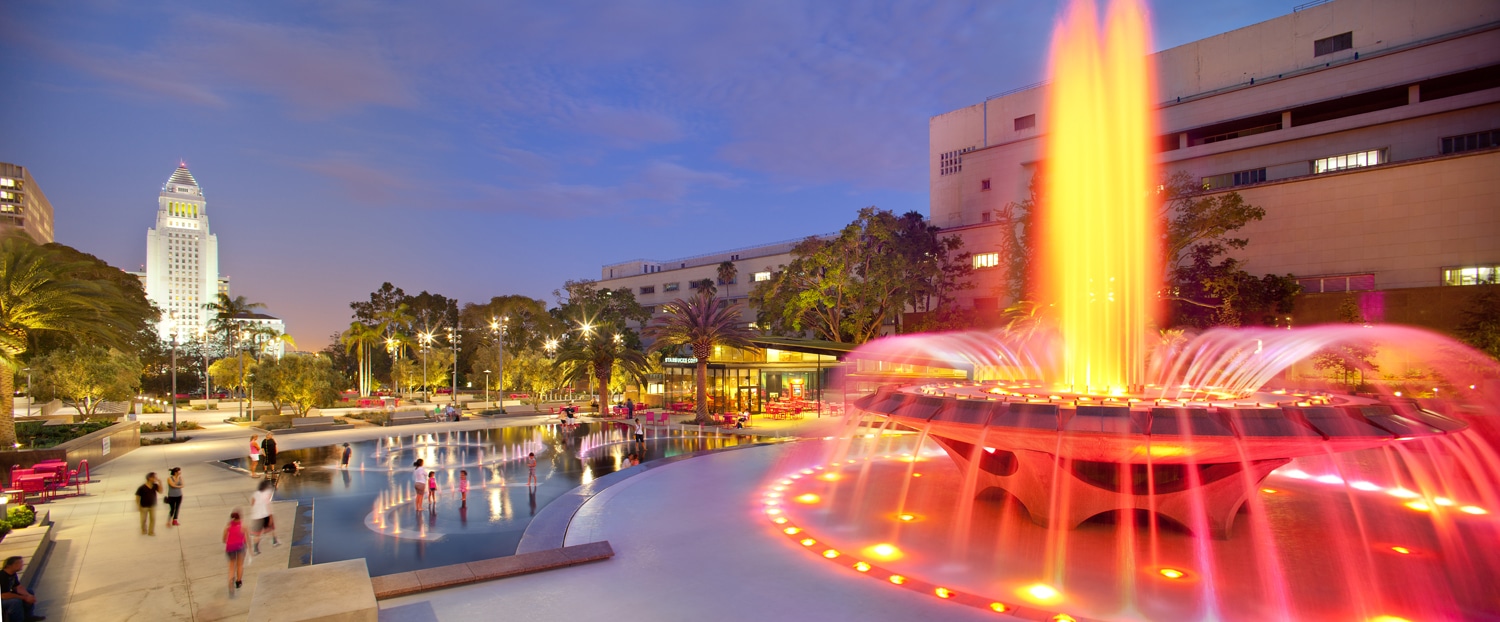
The easiest way to the heart of a native Angeleno is to give accolades about their beloved, but often maligned, city. Mark Rios, FASLA, FAIA, Founding Principal of the award-winning and admired design firm Rios Clementi Hale Studios in Los Angeles, is ten minutes into our interview when he says, “LA is this amazing melting pot,” before rattling off LA neighborhoods like a seasoned Metro driver. That regional knowledge would be a necessity at this point as RCH Studios has made their mark in elevating the Los Angeles landscape with high-profile designs as large as Grand Park in downtown and as small as Sunset Plaza in Silverlake, which was the prototype for a now citywide parklet program.

In much of the work in their portfolio there is a balance of the city’s cultural heritage, sustainability efforts, and an evolving and limitless design process. The firm plans to introduce the first living green wall to Sunset Boulevard. The dramatic six-story sculptural lattice of native plantings and an accompanying public plaza “will provide a breath of fresh air for further build a sense of community.”

With over 75 design awards and a fine educational pedigree, it would be easy to sit back, but Rios insists on being challenged by, and having fun with, design and the city’s rich mix of cultures. Rios and his firm don’t just praise the uniqueness of LA, but seem to be making this a long-term love story.

Eye of the Day: Your firm takes on a diverse mix of projects, from traditional houses and gardens, to campuses, public parks, and even furniture. What design philosophy do you personally bring to each project? Is it important that you finish a design with a certain goal in mind?

Mark Rios: I really believe that having a diverse body of work inspires…one project inspires another in a non-linear way. There are really great architects and really great landscape architects that focus on a particular work type, whether it’s residential, healing gardens, or tall buildings or something. And we try to do the exact opposite. And maybe it’s because we get bored quickly. (laughs) But I think the idea of learning about a problem you’re trying to solve is really fundamental to how we work. And so, I’m just passionate about the research that goes behind each project. So doing something you’ve never done before, or haven’t designed before, is really exhilarating because you have to go through all this detective work and find out about all the things that go on in making decisions about it. So a broad practice is definitely harder to achieve and it’s kind of harder from a business model. But I think for us as designers it’s more satisfying.

EOTD: I think that’s important. It must be hard to balance the business model, but to also stay true to what you want as a designer and get what you want out of that project.

MR: (laughs) It is complicated. I think that we try to establish really high aspirations for each project and that sometimes those goals or concepts evolve as you learn more about the project and more about what its needs are, what the client is about, and what the design is about. You always want to end up with a solution that solves all the issues, works really well, is on budget, and is really beautiful. But on top of that, it has to address a higher concept of nature, it has to have an idea, it has to be memorable. You want it to be provocative in some way, and so I think good work has to tell a story—it has to have a big idea behind it.

EOTD: You’re a Los Angeles-based design firm that’s changing the landscape of the city. I can play a game of chess in a pocket park in Glendale under glowing abstract chess pieces that tower over me or celebrate the Fourth of July in Grand Park—you’ve got Angelenos ditching their beloved cars to walk around downtown LA. In many of your projects there seems to be a drive to revive the city in a modern and fresh way. What about Los Angeles and its people inspire your projects? Do you think LA doesn’t get enough credit as a place for great architecture?

MR: You know, I think that LA is this amazing melting pot. And what I love about it, what I’m really inspired by, is the cultural diversity. And I think it’s the most diverse American city. And diverse in a really authentic way, not in a Disneyland way. You have all these different, really rich communities. They’re really vibrant; they have their own sort of villages within this bigger city. And there are all these facts we’ve learned, like LAUSD recognizes 95 different languages, and, you know, there’s just this amazing spread of people. So I think our work is always trying to understand all these different cultures we are operating with and what the heritages and traditions of these different people are, and how you mix them up—this mash up of culture which is Los Angeles—so that the design is contemporary and it’s about our present-day inhabitants, yet somehow it connects people unexpectedly.

EOTD: Are there any LA spots you really like?

MR: The arts district in downtown Los Angeles is pretty amazing. It’s really transforming very, very fast. People are living there, there’s great…you know…

EOTD: Bars?

MR: (laughs) Bars and great restaurants, and people are having all sorts of new creative office space. It’s a really quickly changing community, but there are all these other enclaves. I think it’s really amazing to drive through Beverly Blvd., from the Westside all the way through Beverly Hills, West Hollywood, Koreatown, and as you go through downtown Los Angeles, it turns into First Street and you go through Mariachi Plaza. And Beverly through to First street is kind of nice—it cuts culturally through all of Los Angeles. So I think those are the really great things about our city. We are in our cars a lot and so I’m always looking at the signs when I’m in my car. What language are they in? What kind of food are they serving? (laughs) You see, you go through all these precincts of different cultures. It’s fun.

EOTD: I think taking someone new to LA through Beverly is a good way to show how our city is, in a lot of ways.

MR: Yes. And it takes all the bad stuff about LA—the traffic, the car culture—and all of a sudden makes you reexamine it in a new way. Your car is your vehicle to be a cultural explorer. It’s like this little space capsule that lets you go and see all these different things. Other cities don’t have that as much.

EOTD: Because you’re based in California, drought is an issue that must come up in your design projects. To keep designs sustainable, how do you still incorporate features that one would traditionally expect in a garden or landscape, like trees, lush plants, or fountains, while in drought-conscious California?

MR: I think it’s really our responsibility as architects, landscape architects, and designers, to really push forward, to get off the grid. Sustainability really deals with all different aspects. It deals with water, power, and energy. And it’s really about trying to make everyone less dependent on and not wasting natural resources. So we’re trying to make all of our work more sustainable as far as taking less water, as far as planting areas. It’s about recycling and reusing and filtering water, as far as water drain-off, before we put it back into the ground through the storm drain system. We’re always looking at ways of generating and powering our projects and how they can be more off the grid. And there are all these living building challenges. And the AIA has a 2030 Challenge [to reduce fossil fuel usage in the building industries to attain carbon-neutral status by 2030]. And architects and landscape architects are really pushing hard to change our physical environment to make it more balanced.

EOTD: Do you have any recent projects that speak to that philosophy?

MR: One project that’s kind of fun is on Sunset Blvd. We’re doing a renovation of a big office building on the corner of Holloway and Sunset for IAC, Barry Diller’s company. And we’re putting this huge, new planted façade on the building that’s about six stories tall. It’s this big huge, moving, kind of curved awning that hangs out. It’s all planted with these plants from the Santa Monica Mountains—so all the plants are native plants. It’s sort of built like a big billboard, so it feels like one of the billboards on Sunset Blvd., but only it’s a plants billboard. I think what’s interesting about it is there is a very high water table under the building and so they are always taking water, pumping water out from underneath the building, and adding it to the water of the sewer system. So we’re basically capturing that water. All the water that we’re using to water this thing is basically from under the building. So we’re reusing the water table water to irrigate it. And it’s all sensor controlled so it only gets a drop of water when it needs it. What’s nice about it is that it’s not potable water. It is water that’s basically discharged water from under the building. So that’s a very sustainable story. People might ask, Why are you putting all these plantings on this building on Sunset during a drought? But we’re actually reusing all this water that’s getting thrown away to do it. And by doing it, it also helps with air purification and all sorts of things. I hope everybody looks at it and goes, That’s really beautiful, that’s cool and I really love it. They won’t realize it, but it has all these layers of research behind it.

EOTD: You have degrees in architecture from USC and Harvard and your designs are known for their clean and modern lines. You have formal training, but your projects go beyond traditional explorations as you’ve ventured into product and graphic design. Can you tell us more about your and RCH Studio’s multi-disciplinary approach to design?

MR: You know, I like to think of the office as this design think tank and that we are a group of designers that do research, and we evolve ideas, and those ideas get built or manufactured, and made into lots of different things. An idea can be realized through a building, can be realized through a sign, or it can be realized through a plate. But it’s the same process, analysis, research, and inspiration that goes into that. Whatever the final craft you are making is, it’s kind of the same design process. We really think of ourselves foremost as designers, and not sort of limited by a traditional discipline. We think of ourselves as interpreters of culture, just like someone who is making a movie or writing a book, trying to tell stories about our culture—and we are using a variety of methodologies to elaborate on and tell those stories.

EOTD: Are there any projects you’re currently working on that you likeparticularly that are outside of the box of what we think landscape architects typically do?

MR: We’re starting to experiment with fashion. Most landscape architects may think about it, you know, but it’s kind of a hard new thing to be learning. We’re starting with small pieces, like bags, scarves, and pocket squares, and things like that. We’re starting to think about other stuff, but I think that we’ll continue to evolve and hopefully try new things. I don’t want to know what I’ll be doing in three years! I want to see what happens—surprise myself.

EOTD: Container gardening is an easy way to control water consumption and is a popular form of gardening in drought-stricken California. In residential design, containers are often one of the last components added to a garden or home. How do you incorporate pottery, containers, or planters in your overall design?

MR: I think container gardens are fantastic for all the sustainability issues we’ve mentioned, and as far as limited means that give you great results. Containers are also really popular for another set of practical reasons. They’re like raised gardens, they’re easier to get to; they’re great for kids, the elderly. There’re a lot of practical things about container gardens. I think of container gardens as accessories. You think of your house, you have your favorite things around that animate the house, those things that bring your personality to a particular room. And people don’t think of outdoor spaces as being accessorized in any sort of way. So the first advice I’d give to everybody is don’t worry if all the containers match. (laughs) Don’t get caught up with buying containers that all look alike, you know. Just buy things you love. If you love something a lot, or this thing a lot, or that thing, then all those pieces will go together because, as artistic people, our taste comes through. I think it’s pretty impossible that if somebody loves five different things that those things aren’t going to all work together.

EOTD: So going back to school, you went to USC but also served as faculty at UCLA. One of your partners, Bob Hale, got his degree at UCLA. The schools play each other next month at the Rose Bowl. So when you go into work that day are you sporting Trojan or Bruin colors?

MR: (without pausing) I think it’s probably going to be the Trojans. (laughs) I have a long affiliation with USC and I think they have a great school of landscape architecture now and their art history department is fantastic. UCLA is terrific. I love the faculty there and they’re doing a really amazing job, but I think I’d be on the Trojans side.

EOTD: So no pranking Bob Hale? 

MR: No…we’ll be nice to each other, but you know we’ll each be rooting for our own team.

See the RCH Studio design portfolio here.