What’s Behind Eye of the Day’s Logo?

Eye of the Day|Logo history| Day's Eye

What’s Behind Eye of the Day’s Logo?

DAISY. DAY’S EYE. EYE OF THE DAY.

Eye of the Day|Logo history| Day's Eye
The logo in its first rendition created in 1994.

When Brent and I began daydreaming about a name for our business, our daughter Daisy was seven and our lives revolved around her (THAT hasn’t changed).  We wanted to incorporate “Daisy” into the name and decided to go for the old English meaning: Day’s Eye, for the resemblance of the flower to a stylized sun.  And as Daisy was the eye of our lives, Eye of the Day was born.

Eye of the Day|Logo history| Day's Eye
Slight change in the logo by moving the company name towards the bottom.

An overnight with our best friends, Robin, Cassidy and Heidi, found us talking about a logo for Eye of the Day. The evening grew late as we sipped our wine and played with ideas and soon graphic designer Robin had come up with a circular logo featuring the top half as a sun and the lower half as a daisy, split horizontally in the middle with the words “Eye of the Day” bisecting the halves. Without question, this was perfect for us.

Eye of the Day|Logo history| Day's Eye
The logo in its current form.

Eye of the Day|Logo history| Day's Eye
The logo stamped on our current business cards.

Our logo has undergone a few changes in the past seventeen years; a few different graphic designers have tweaked it here and there.  The newest evolution is used on our Look Book, embossed on the cover and on the back and graces our new business cards as well.  In fact, we are using it everywhere!   We started our new business with a basic, interesting design and over time it has morphed into a more complex mixture of words and graphics, but its simple and meaningful heart remains true: the eye of the day still remains our Day’s Eye.


Musings On Design: Jeffrey Gordon Smith Landscape Architecture Part 1

Eye of the Day|Jeffrey Gordon Smith Landscape Architecture

Jeffrey Gordon Smith Landscape Architecture and the Spirit of Place

The spirit of a place. This concept comes up throughout our interview with Jeffrey Gordon Smith, principal architect of Jeffrey Gordon Smith Landscape Architecture based in Baywood-Los Osos, CA. There is a respect and celebration of space throughout the work of Smith and his firm. They encourage clients to celebrate where they live and do so by connecting the designs of their projects to the existing natural landscape. From a chain of volcanic plugs corresponding to an outdoor space’s pergola design to a Japanese garden in the Pacific Rim evoking neighboring farm fields, site and architecture speak to each other and create a cohesive landscape.

Eye of the Day: What lead to you becoming a landscape architect and starting your own firm?

Jeffrey Gordon Smith: I was always interested in design. Basically, I wanted to go to school for architecture but the program at Cal Poly was impacted. So, I consulted my father and he directed me to a similar profession — Civil Engineering. I got into Civil Engineering only to find out later it was just impacted as Architecture. I think they made a mistake letting me in because my grades weren’t all that great. I spent a year in Civil Engineering taking all the calculus, physics, all the brutal courses and found out it wasn’t really my gig. Not only from a professional standpoint, but it just didn’t have enough of an artistic side to it I think.

I basically fell into Landscape Architecture. I started looking back into the school’s environmental design, landscape architecture, regional planning, architecture, and architectural engineering. I found Landscape Architecture almost by accident. I was really interested in the curriculum and what it potentially had to offer. I’m not really religious, but when I started taking courses, it was like I was a born-again Landscape Architect –that was it for me.

My father suggested I start an internship with a Landscape Architect. A firm was working for his company so he helped me get an internship with Emmett Wemple and Associates—one of the most important landscape architects in the Los Angeles area 50 years back. He did the Malibu Getty and other important projects. I did a summer internship and got more of a sense of what the field was about.

EOD: So you’ve been involved with Landscape Architecture since college. When did you start Jeffrey Gordon Smith Landscape Architecture?

JGS: God… I don’t know. I actually don’t know. I’ve probably been practicing for 15 years. I worked for several big firms before. Out of college, I worked for Peridian down in Irvine and they were one of the largest firms at the time. I was hired to work on a Spanish theme park in Japan. I got to be one of the head designers on a 172-acre Spanish theme park in Japan. I got to be involved at a high level in design right out of school. This was right before the great recession in the 90s. I thought I was such a rock star, but they started to get more into residential housing that wasn’t very creative. So I left and landed a job at Schwartz, Smith, Meyer with Martha Schwartz, this rock star of landscape architects at the time, very controversial. She was married to Peter Walker, who’s probably the landscape architect of our time right now. She splintered off and created her own design team with two others. We were doing high profile projects around the world. We worked for Rem Koolhaas, Isozaki, Frank Gehry. Then the recession hit and I was going from job to job and the profession was suffering. It was really tough to run a business in this economy. So I got kind of disenchanted with the profession because everyone was so unhappy at the time financially. It was really a tough time to be starting out.

I started doing side work with models—specifically model trees for one of the finest model tree makers in the world. I’ve worked on models from all over from Disney Concert Hall, to Richard Meyer, to Guggenheim Museum. I started moonlighting and doing my own stuff, a couple of outside projects and started doing a lot of production work for a house designer. The economy started swinging back on high end homes in Portola Valley and Bay Area. I was doing a lot of work and never decided to open my own office but I was doing so much that I needed all my work together, a title block, business cards…had I needed to open up my own office it would have been a daunting task, but it just kind of happened over a couple of years where I realized I needed to do this and my own work ended up keeping me going.

EOD: This is essentially where you branch off and start your own company. Your firm focuses on high end landscape design for a range of clients in residential and commercial projects. What design philosophy do you personally bring to each project? Is it important that you complete a design with a certain goal in mind? 

JGS: When I started out on my own I was working on these cookie-cutter, McMansion stuff that wasn’t very creative or innovative. I was always trying to push the edge but really to also pay the bills. I was fortunate enough in the real estate market  to buy property in San Francisco and sell it at the right time during the height of the tech industry—right place, right time. I was able to look at what I was doing and step back. I think we make decisions too often on money. Since I had a little breathing room from the house sale I looked in the mirror and asked myself what do I want to be when I grow up. I wanted to do much more interesting work and that got me into this present-day philosophy that I have.

I never set out to do a mission statement about what I needed to do. It was really trying to find a little bit more soul into what we’re working with and trying to find—sometimes I hate to use the word– the genus loci or the “spirit of the place.” It was something we always talked about in school and I felt like how could I dare to say that I could conjure up the spirit of a place or the power to call that. But I’ve been doing this so long that I think we have a fairly good tact and understanding in what’s going on in the process of the space or place and trying to extract out the greatest elements of that place. It’s almost as if you were to take a volume knob and crank it up and ask what this place wants to be, what is this place talking about, and really trying to put feelers out and be sensitive to what’s going on.

Eye of the Day|Jeffrey Gordon Smith Landscape Architecture

We came up with that idea of regionalism and looking back at my work over ten years that I kind of changed what I wanted to do and people started to follow my work and request work that wasn’t that McMansion type but the uniqueness of site. I started getting work because of this versus just working for someone who was trying to sell a house. It was more of the art side coming out and exploring that and pushing it in each project.

Not every project has that but I try to use a three-prong approach: site, architecture and client in trying to explore and unite it. You’re marrying the site to the architecture and back to the client. That’s basically been the formula of what we try to draw on each project. Sometimes you get an amazing site or neighbors on all sides, but you’re always given typically architecture which sometimes can be “architorture”, or it could be nondescript, bastardized architecture that you’re playing a smoke and mirrors game of don’t look at the architecture but look at the site. The other component of client is going in and interjecting into the architecture how the client lives, what they’re interior is about, and relate interior to the exterior. So that three element approach has been a foundation for what we do and springboard from.


Stay tuned next month for Part 2 of this interview!


Book Review: Fountains – Splash and Spectacle

Eye of the Day Garden Design Center| Fountains Splash and Spectacle| Fountains

FOUNTAIN AS MUSE

Sunday morning.  Outside the bank of our bedroom windows, the fountain’s splash and play completely encompass the peacefulness of home.  Our shy friend, a tiny iridescent green hummingbird is curiously eyeing the droplets arcing into the air. Especially while we are all thinking about water problems in California, enjoying a few moments with the sound, sight and spray of our fountain is almost intoxicating.

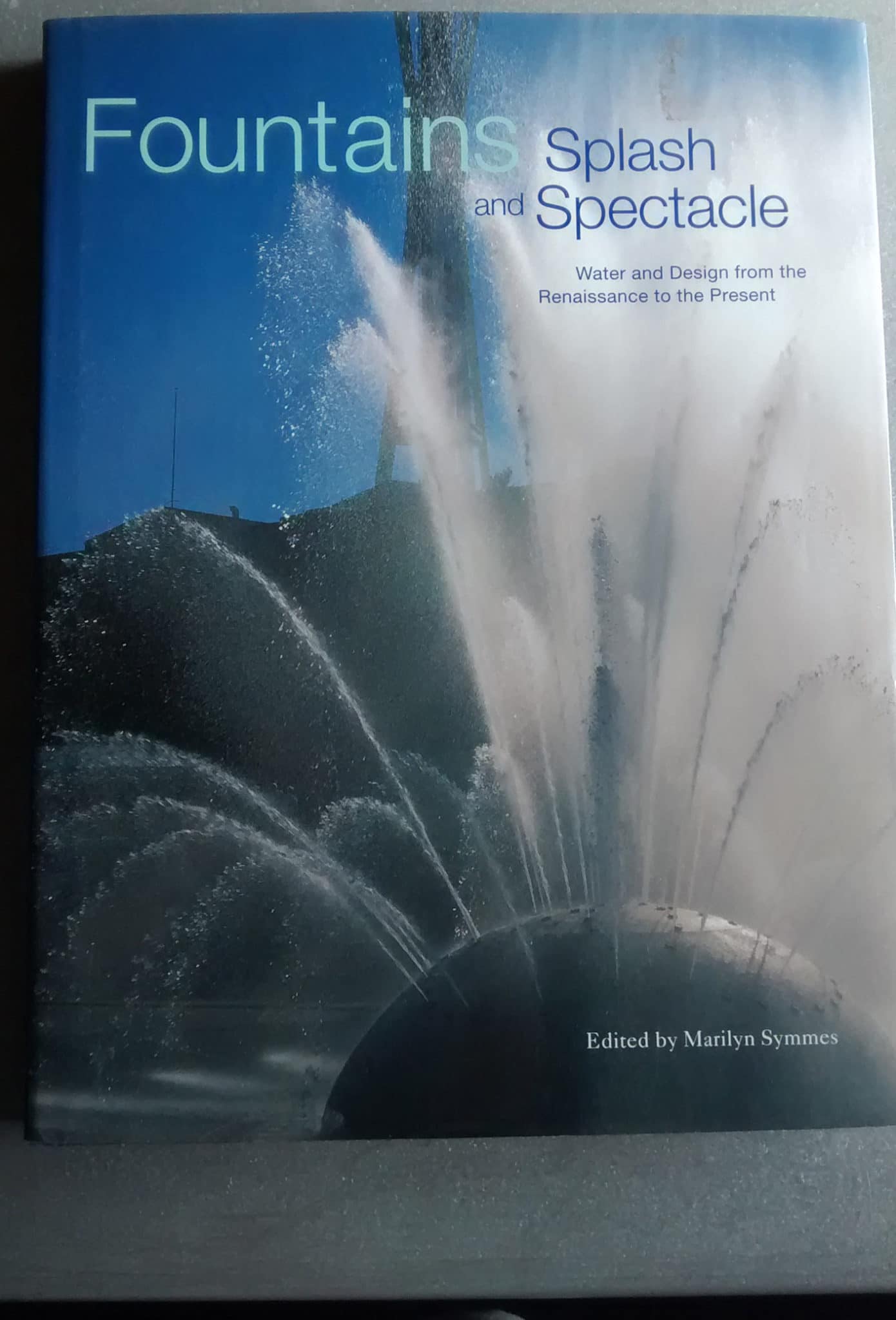
Throughout the years we have consistently added to Eye of the Day’s library of books pertaining to gardening, fountains, pottery, terracotta and European antiques. While I was mesmerized by the muse of my fountain, I remembered a book I found for Brent a few years ago:  Fountains Splash and spectacle: Water and Design from the Renaissance to the Present edited by Marilyn Symmes. The book traces the history of fountains throughout the world from the renovations of ancient Roman aqueducts to choreographed, computer controlled displays combining light, music, and fireworks.

Photographs, paintings, illustrations, etchings and drawings are so plentiful and varied that even if you only pick up the book to see them you’ll be drawn into reading a few paragraphs like this one:

Water possesses almost magical qualities.  A spraying fire hydrant can transform a sweltering city street into a temporary oasis, offering neighborhood children a showery playground as welcome relief—from the dry, hard pavement…the sound of moving water—sometimes a roar, at other times a whisper–breaks the stillness and can provide an aural refreshment on a warm day.

The last photo in the book is the best possible illustration of this paragraph.

Though our water problems have no foreseeable end and we may need to regulate the use of our fountains, the birds, bees and butterflies not only enjoy, but need water to survive and even a few hours a day provide a magical quality.  And that’s not just for animals, but for those of us staring out the window on a Sunday morning as well.


Fountains: Splash and Spectacle – Water and Design from the Renaissance to the Present. Edited by Marilyn Symmes. The Smithsonian Institution, 1998.


Detour to Europe: How El Nino Led Us to Francesco del Re

In February of 1998 our lives were changed forever by El Niño. Eye of the Day was in its infancy, just two and a half years old and we became a statistic as the worst damaged business in Santa Barbara County. The federal government declared a disaster area and we lost nearly everything. But…what we didn’t know was that our journey was about to take us on a brilliant detour.

From its inception, the Eye of the Day plan was to sell pottery, fountains, statuary and other garden products. There were a lot of nurseries but not many focusing on accouterments for the garden. We began by selling wine barrel planters, Mexican pottery, American made concrete fountains, benches, bird baths and lots of colorful pots. At Christmas we sold only the Noble Fir. But then the forces of nature randomly decided to take us out.

There is a saying that when a door closes a window opens; I was looking for a window and it turned out to be FEMA. With a new FEMA loan and a lot of help from friends, Eye of the Day quickly found a new home in a bigger market, picked ourselves up off the very wet pavement and began again.

After we opened our doors in our new (and current) location in the small beach town of Carpinteria, we sensed a great opportunity to grow in a way that the pre-disaster Eye of the Day would not have been able to fulfill. Our business model was limited and we needed to think bigger, so we decided that the gift shows in Los Angeles, San Francisco and Atlanta just didn’t provide what we needed anymore. It makes me laugh when I remember how quickly my wife, Suzi, agreed that we needed to go to Paris and check out the gift show there. We didn’t realize at the time just how prescient we were.

The first day of the show was the ultimate shopping experience but only if you were buying at least ten of everything. Included was an area for outdoor garden decor and when we walked into Francesco del Re’s booth, I knew I had found something special:  the finest handmade terracotta pottery on planet Earth. His containers were classics and many were models of forms and shapes still in service after hundreds of years, including pots or “vasi”, urns and amphorae adorning villas and palaces throughout Europe. Francesco’s display screamed CLASSIC ITALIAN TERRACOTTA to me. I vowed right then that Eye of the Day would sell Francesco del Re, just as soon as I figured out how I could afford a container.

The following year we returned to Europe, this time to Italy. Something drives me to wander and explore and I knew Francesco del Re was somewhere around Florence and I knew I would find him. I scoured the small, famous hill town of Impruneta, walking into some fabulous artisan workshops. No one knew who and where FDR was, but I learned later that in Italy, few are willing to promote someone else and everyone in that famous commune was challenged by him. The hunt was on. I didn’t travel in order to give up. It was hard work, but over our excellent lunch in Greve, the proprietor of the restaurant told me how to find the factory. By the way, we selected the restaurant for lunch because there was a pair of classic Francesco del Re Vaso Lessona urns at the front door.

I have returned to the FDR factory every year for the last sixteen years. This May I flew there for three days to help load a forty-foot container and to see Signora Elettra Brancollini, Francesco’s partner and sculptor. Sadly, our friend Signore del Re passed away two years ago, but his classics will live on for centuries in our gardens.