
Garden Recipes: Fresh Basil Ice Cream

basil ice cream-garden recipe-gardens

Garden Recipes: Fresh Basil Ice Cream

How can you NOT want to eat this all summer? Walk out to your herb garden and grab a handful of that basil. The only thing that could make this better would be some fresh basil ice cream to go with it.

basil ice cream-garden recipe-gardensFRESH BASIL ICE CREAM

2 cups whole milk

3 tablespoons chopped fresh basil

1/2 cup sugar

4 large egg yolks

1/2 cup well-chilled heavy cream


Bring milk, basil, 1/4 c sugar and a pinch of salt to a boil in a heavy saucepan. Remove from the heat and let it steep for 1/2 hour. Transfer to a blender and blend for 1 minute.

Beat egg yolks and remaining 1/4 c sugar with an electric mixer until thick and pale, about 1 minute. Add milk mixture in a stream and mix well. Pour into saucepan and cook over moderate heat, stirring constantly until temperature reaches 175 and coats the back of a spoon (do not let it boil). Immediately remove from heat and strain the mixture into a metal bowl. Place the bowl in a larger bowl filled with ice water and stir until cold, about 10 minutes.

Stir in cream and freeze in an ice cream maker. Transfer ice cream to an airtight container and put in freezer to harden, at least 2 hours.

YUM.

Photo Credit: Fresh Basil Ice Cream, Creative Commons, Basil Ice Cream by Eugene Kim is licensed under CC by 2.0 
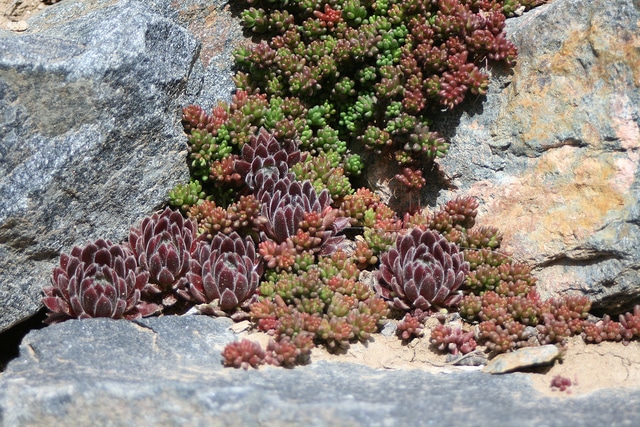

Planting in the Edges and Cracks of a Garden

Eye of the Day| succulents rock wall garden |garden

Planting in the Edges and Cracks of a Garden

For several years I tried to get a lovely, drought tolerant plant established in my garden. Lychnis coronaria is a perennial that forms low-growing rosettes of gray-green leaves that in late spring and summer sends up glorious stalks of dark magenta flowers. It just refused to grow in my nice fertile beds, but it is now flourishing, all on its own, between the cracks of my brick path. Like many plants, it apparently doesn’t want coddling and can find the moisture and nurture it needs at the edges of the more cultivated part of the garden. Even the Gaillardia seems to do just as well in the gravel terrace outside of the confines of the bed I originally planted it in.

There are plenty of other species that also seem to thrive on the margins. Many succulents, for example, will multiply in the cracks of a wall or at the edge of the walkway. The stones provide a heat sink as well as a barrier to evaporation so that the root zone of these castaways is protected. Succulents such as sedums, sempervivums, and portulacas are particularly suited for this lifestyle. But other, tough plants like the herbs rosemary, oregano, creeping thyme, and even sage can fend for themselves in these microzones.

You may already have a dry-laid stone wall, or a flagstone or brick path that can accommodate a few plants tucked in the crevices. But, if you are planning such a feature, imagine leaving a wider gap in a few places. Some landscape material suppliers even have broken concrete or tile that has been salvaged from former gardens that make ideal patterns to include a few hardy plants to complete the patio, path or wall with the re-used paving.

And if some plant escapes the confines of your established garden bed, give it a chance and see if it is one of the hardy survivors that can lend softness and charm to the margin.


Image Credits:
Rose Campion – Creative Commons, Rose campion by Ruth Hartnup is licensed under CC by 2.0
Herb Garden- Creative Commons, Herb Garden1 by theoldpanther is licensed under CC by 2.0
Rock Wall Garden – Creative Commons, Rock Wall Garden by Patrick Standish is licensed under CC by 2.0