How a Landscape Architect Approaches Garden Design During California Drought

Eye of the Day|Sally Farnum Landscape Architect|garden design drought

Having a sister with a long, successful career as a landscape architect has made it easy to have an ongoing conversation with Sally Farnum about design, client concerns and current issues. We are all especially interested in California’s water problem and wanted to find out how Sally is helping her clients address the issue.

Suzi: What have your clients have been asking about when it comes to water and their gardens?
Sally: Most of my clients are trying to be responsible when it comes to water usage in their landscape. They want to know if they need to take out their lawns, replace their flowering plants with desert plants and if it will still look pretty.

Eye of the Day|Sally Farnum Landscape Architect|garden design drought
This garden limits the lawn and uses a water feature and sculpture as main elements.

Suzi: How do you approach designing a plan that reflects water-consciousness but is still pretty?
Sally: I really work to combine good elements of design in all my plans: scale, balance, variety, form, line, texture and color. I like to use California natives, salvias, lavenders along with containers, sculpture and fountains.  I suggest using decomposed granite and gravel and, really important, an extra-efficient irrigation system.

Eye of the Day|Sally Farnum Landscape Architect|garden design drought
Water friendly designs can still have beautiful flowers and plantings.

Suzi: How do you convince them that a huge, green lawn isn’t the best plan anymore
Sally: Most people are visually oriented, so to describe an idea in words alone doesn’t always convince them. I show them photos or have them visit other projects I have completed.  But I don’t feel that it’s necessary to remove ALL lawn. Only 5% of residential water is used to keep lawns green and it contributes to cooling an area, cleaning the air and reduces noise. Grass in a front yard, used to fill space, should be eliminated.

Eye of the Day|Sally Farnum Landscape Architect|garden design drought
Hardscape, pottery, and water wise plantings are all used in this design

Suzi: Do you have a favorite or most challenging project which incorporated water-wise elements?

Sally: One of my favorite and most challenging designs is right across the street from my own home.  Challenging because the home belongs to a friend and because I look at it most every day. My favorite because of the transformation from a front yard with a large asphalt driveway and lawn, to a garden with a walled-in gravel courtyard with a fountain and pots planted with flowering plants on the street side of the wall.

Eye of the Day|Sally Farnum Landscape Architect|garden design drought
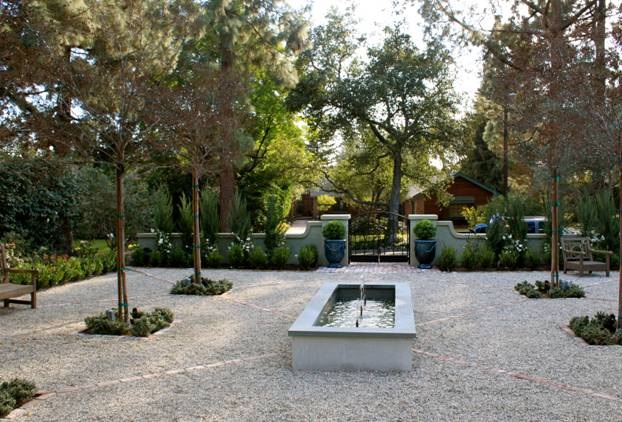
This design removed the lawn and replaced it with a gravel courtyard and central water feature.

Suzi: How have you managed to change the way you designed in the past to meet the new challenges presented by the drought?
Sally:  The challenges are mainly in working with my clients and helping them accept new plants and watering habits.  Most plants will adapt to using less water, but people tend to water more than necessary.  I haven’t changed the way I design, but I have changed the materials and plants I use.

Eye of the Day|Sally Farnum Landscape Architect|garden design drought
This backyard combines hardcape and drought friendly plantings.


Suzi: Thanks, Sal.  You’re always such a wealth of information, and a fine sister, too.
Sally: You’re not so bad yourself.

Planting in the Edges and Cracks of a Garden

Eye of the Day| succulents rock wall garden |garden

Planting in the Edges and Cracks of a Garden

For several years I tried to get a lovely, drought tolerant plant established in my garden. Lychnis coronaria is a perennial that forms low-growing rosettes of gray-green leaves that in late spring and summer sends up glorious stalks of dark magenta flowers. It just refused to grow in my nice fertile beds, but it is now flourishing, all on its own, between the cracks of my brick path. Like many plants, it apparently doesn’t want coddling and can find the moisture and nurture it needs at the edges of the more cultivated part of the garden. Even the Gaillardia seems to do just as well in the gravel terrace outside of the confines of the bed I originally planted it in.

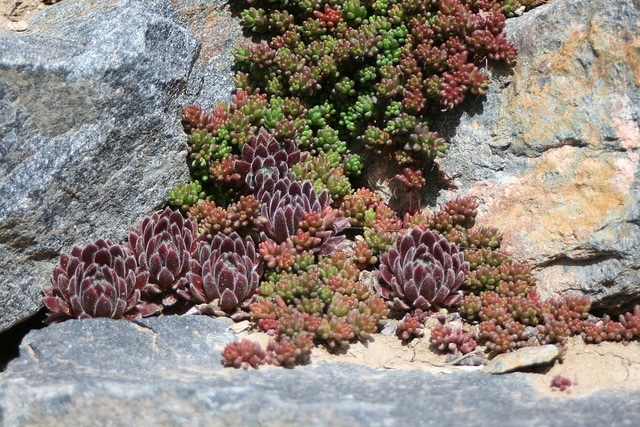
There are plenty of other species that also seem to thrive on the margins. Many succulents, for example, will multiply in the cracks of a wall or at the edge of the walkway. The stones provide a heat sink as well as a barrier to evaporation so that the root zone of these castaways is protected. Succulents such as sedums, sempervivums, and portulacas are particularly suited for this lifestyle. But other, tough plants like the herbs rosemary, oregano, creeping thyme, and even sage can fend for themselves in these microzones.

You may already have a dry-laid stone wall, or a flagstone or brick path that can accommodate a few plants tucked in the crevices. But, if you are planning such a feature, imagine leaving a wider gap in a few places. Some landscape material suppliers even have broken concrete or tile that has been salvaged from former gardens that make ideal patterns to include a few hardy plants to complete the patio, path or wall with the re-used paving.

And if some plant escapes the confines of your established garden bed, give it a chance and see if it is one of the hardy survivors that can lend softness and charm to the margin.


Image Credits:
Rose Campion – Creative Commons, Rose campion by Ruth Hartnup is licensed under CC by 2.0
Herb Garden- Creative Commons, Herb Garden1 by theoldpanther is licensed under CC by 2.0
Rock Wall Garden – Creative Commons, Rock Wall Garden by Patrick Standish is licensed under CC by 2.0


Elements of Style: The Classic Mediterranean Garden

Elements of Style: The Classic Mediterranean Garden

A classic Mediterranean style garden is typically low-maintenance, drought tolerant and perfect for a climate dry and hot in Summer and warm and moist in Winter. For those of us living in California, this seems a perfect fit. Traveling throughout the Mediterranean region, focused on the landscape and gardens, reminders of California are constant.

The defining characteristics of the Mediterranean style are:

  • Focus on hardscapes, with very little or no lawn
  • Citrus, olive trees, rosemary and lavender often planted in terracotta pots
  • Fountains and water features are key. Water features became popular in the gardens of the Italian Renaissance. They reflect the garden and provide the relaxing elements of sight and sound.  Because of the scarcity of water in the Mediterranean,  many water elements offer a relief from the heat.
  • Large and small terracotta pots and urns and statuary. Pottery in many forms has been a part of Mediterranean gardens since their origins in ancient Roman households. From intricate bas-relief to simple and plain, they are quintessential for a European garden.  Statues, urns and planters provide focal points and because their footprints are small, they are particularly useful in a small garden. The Greeks and Romans filled their pots with flowers to add color to their courtyards and pathways without depleting the water supply, or they used them to grow fruit trees that could be moved about  according to the outside temperature.  But pots were also used as beautiful objects on their own – a classic oil jar at the end of an allee, a row of terracotta pots topping a balustrade, or an urn crowning a pedestal.

You don’t have to live in Spain, Greece or Italy to reflect the siren call of the Mediterranean classic garden.  A few carefully chosen garden elements… an antique Greek pithari, a scattering of large terracotta pots and urns and a simple water feature will create your classic otium.  Being water conscious and embracing a rustic, muted look will go a long way toward making your space the place to be.