Eye of the Day Holiday Gift Guide 2016

eod-holiday-gift-guide-2016
Eye of the Day Holiday Gift Guide 2016 (Click to Enlarge)

Are you looking for something unique or special this holiday season?  The Eye of the Day Holiday Gift Guide for 2016 has you covered. These gifts come from all around the world and are sure to be statement pieces in the home or garden.

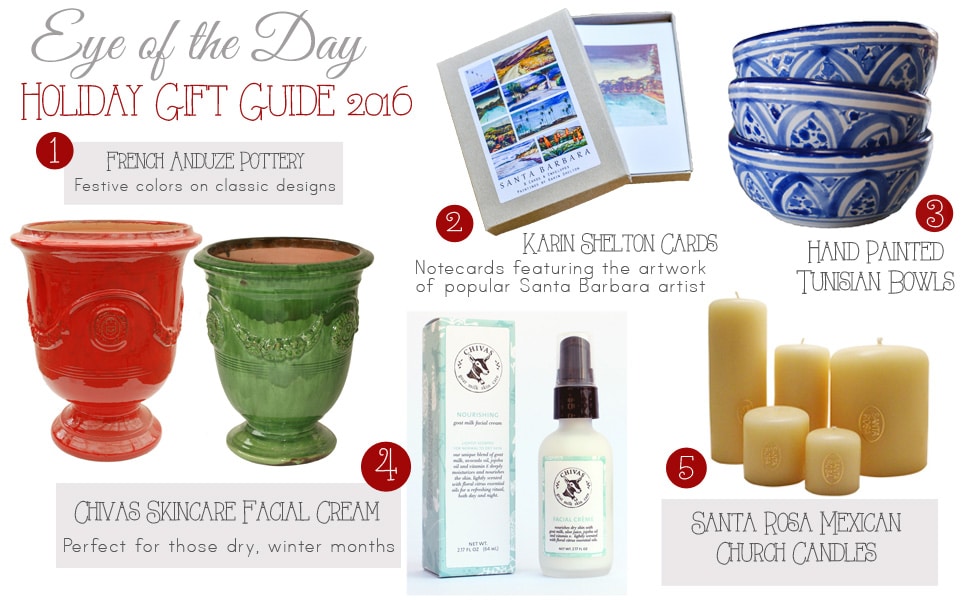
1. French Anduze Pottery

Our handmade French terracotta Pottery from Anduze region in festive green and red make great decor not just for the holidays, but the whole year.

2. Karin Shelton Cards
Notecards featuring paintings by Santa Barbara Artist Karin Shelton. Her artwork subject matter ranges from abstract to botanical to landscape. 

3. Hand painted Tunisian Bowls
Crafted and hand painted from Tunisia, these bowls are food safe and lead free.

4. Chivas Skincare Facial Cream
From Filmore based skin care company and goat farm, this facial cream features a unique blend of goat milk, avocado oil, jojoba oil and vitamin E that deeply moisturizes and nourishes the skin.

5. Santa Rosa Mexican Church Candles
Our most popular Gift Shop item for a reason. These creamy candles are made with layers of paraffin and cotton wicks. Perfect for those cozy nights at home.

Visit our Eye of the Day showroom for more gift ideas or call 805-566-6500 regarding questions and availability on our gift guide products. Cheers!

Baked Earth: The Making of a Greek Pot

Eye of the Day|How to Make a Greek Pot| design

The Making of a Greek Pot

This month I’m going to discuss a tool that has captured my imagination for nearly 40 years: THE POTTER’S WHEEL. It started for me in Orange County California in 1976 at Irvine High School. For my P.E. class I was taking surfing and the instructor also taught Ceramics. It didn’t take me long to figure out that all the cool kids not only took surfing, but took Ceramics for second period, so if the waves were particularly good, the surf class would just stay and surf all the way through second period!

Thirty years later, I am still doing ceramics, primarily because of my fascination with the potter’s wheel, which is a relatively new invention in the history of pottery making. Originally functional vessels made of clay were constructed using a coiling technique. The artist would roll out “ropes” of clay and slowly, methodically, hand turn a small form by placing the coils on top of each other and pinching each coil into the one beneath it. Although this time honored method can be very slow and tedious in terms of production, there are still many cultures in the world that use this technique to create functional ceramic containers.

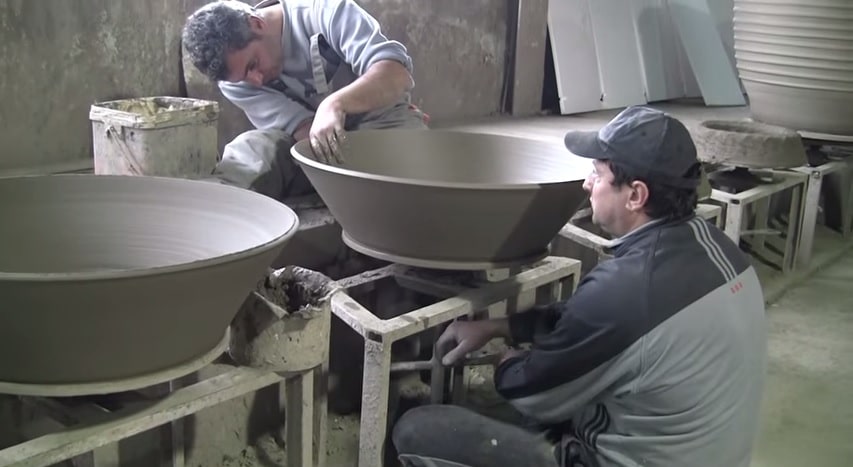
The potter’s wheel was born out of necessity. There are many theories, but all agree it was a matter of industrialization that brought about its creation. Recently I found a few video clips in my inbox that Brent (owner of Eye of the Day) had shot on the Island of Crete. They are an intimate look at the processes used in the production of the authentic Greek vessels Eye of the Day sells. The pieces are wheel thrown but on a wheel that is hand cranked by a potter’s assistant. The clay is made into fat coils, and added to the clay beneath it by pinching. Then the assistant spins the wheel faster and the potter begins to lift the clay into a form. It is particularly fascinating that Greece employs both old and new world techniques. They start with a slab of clay for the bottom, and work their way up by coiling, and pinching, and finally throwing the clay into shape. In the videos you see that there are multiple wheels working at once with vessels on each, in different stages of completion. When the clay needs to rest on one wheel,, the potters move in succession to each wheel down the line, until returning to the beginning to continue working toward a finished piece. These pieces are then fired and shipped directly to Eye of the Day.

We are very lucky to have this direct connection to handmade vessels for our garden design needs. The next time you are at Eye of the Day, remember what it takes for the artisans who build these vessels to deliver such an authentic and timeless piece of history for our own daily aesthetic.


Terracotta Incognito: The Method Behind the Form

Terra Incognito: The Method Behind the Form

There are various forming methods than can be used when working with clay.  As a self-proclaimed clay nerd, I can tell you that one of my favorite parts of the journey is actually forming the piece. There is a “form” and there is a “surface” and if you learn to treat the two as separate aspects of the same whole, you will have a successful composition. In ceramics, there are many ways to form something from clay. For example, a piece  of clay can be thrown on a potter’s wheel, press molded, slump molded, pinched into shape, coiled, built with slabs or extruded.

For this article I want to focus on just three forming methods: Throwing, Press Molding, and Coiling.

Throwing
To “throw” is to form clay using a potter’s wheel.  As the clay spins on the wheel it is then “lifted” into shape. This is a very popular method, usually used to fashion functional or utilitarian pieces, such as plates, cups, bowls, teapots, or containers.

The word “throw” comes from the old English meaning to twist, turn, or propel—a perfectly apt definition. The potter’s wheel is a relatively new invention in the 30,000 year history of ceramics, and not used by all clay cultures. Much of the Greek pottery at Eye of the Day is wheel thrown.

Press Molding

Press Molding is when a piece of clay is actually pressed into a mold or form. The mold is made from an original form which is made from clay, then reproduced in Plaster of Paris, which becomes the mold so the shape can be replicated over and over again. This is a particularly helpful method when forming large pieces that would otherwise be hard to reproduce. The Italian terracotta carried at Eye of the Day is traditionally press molded.

Coiling

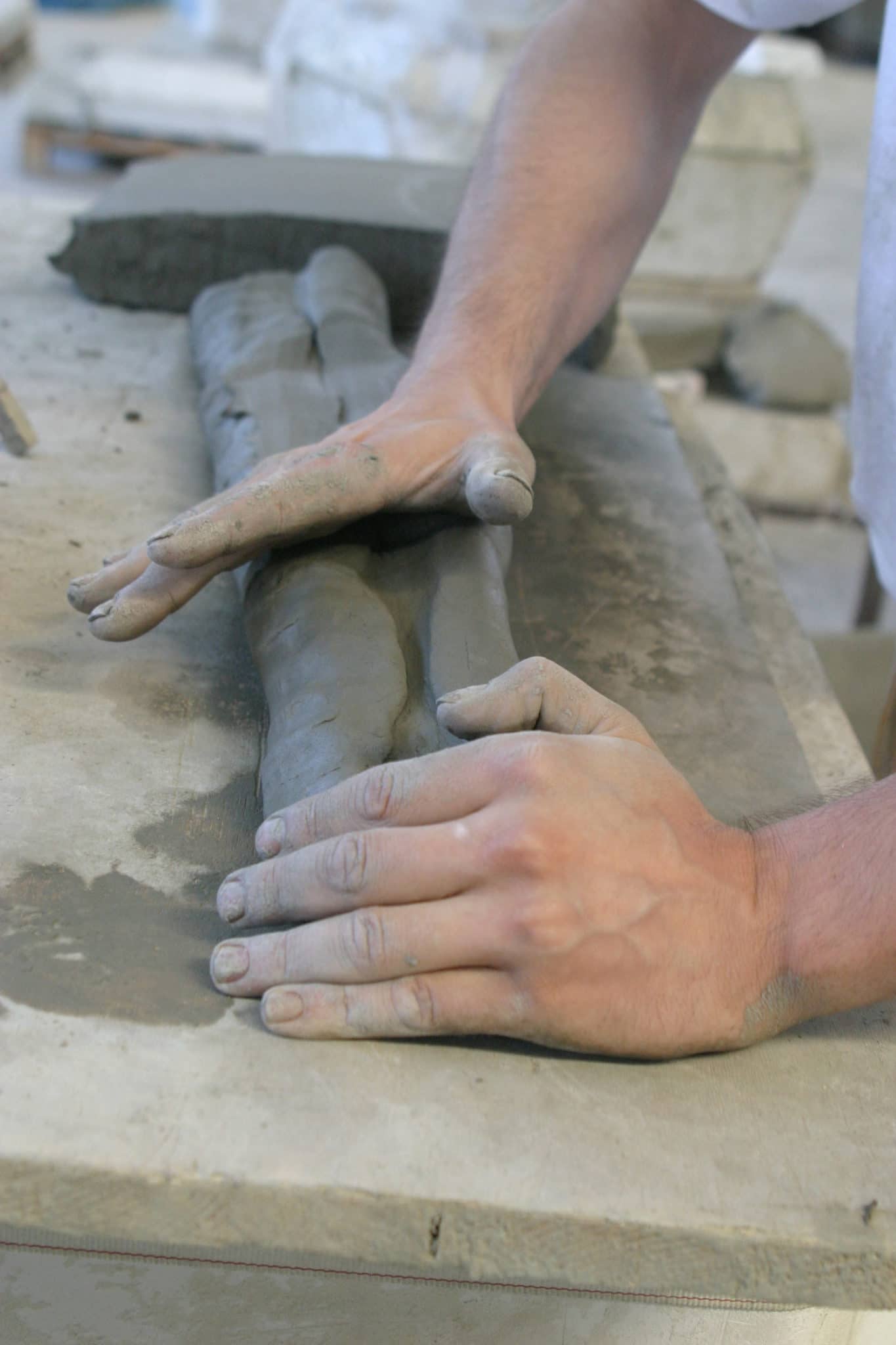
Coiling is one of the oldest methods for forming clay. The material is rolled back and forth until it looks like a “rope” of clay. You begin with a shape in mind, then the coils are placed on top of each other until the desired shape is formed. This is a particularly slow method, the clay needs to harden a bit before more coils can be stacked, so a potter will begin one piece and then move to another to begin, then move to another, and so on. By the time he has begun say the fourth or fifth shape, the first one will be stiff enough to continue the next phase of the shape.

Eye of the Day has an array of vessels produced using each of these traditional methods, authentically manufactured and imported directly from the very best potteries of the world.