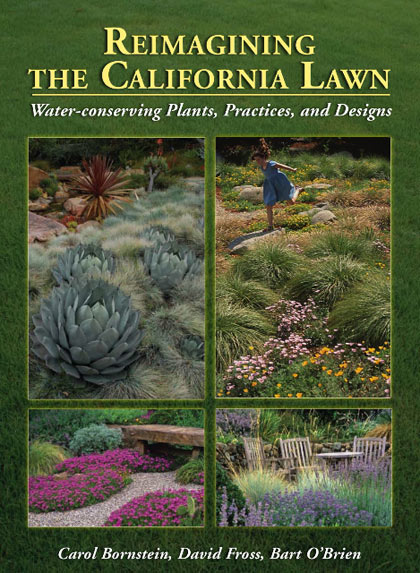
Book Review: Reimagining the California Lawn

Eye of the Day|Reimagining the California Lawn|drought garden

Book Review – Reimagining the California Lawn: Water-conserving Plants, Practices, and Designs

Continuing on a road we have just begun to travel, this month’s book,  Reimagining the California Lawn: Water-conserving Plants, Practices and Designs gives us another look at drought tolerant plants from around the world and offers design ideas and practical solutions to complement our Mediterranean climate.

From greenswards and meadows to succulent and kitchen gardens, this book presents alternatives to the traditional lawn that can reduce water use, beautify the landscape, and attract birds and butterflies. The horticulturist authors of Reimagining the California Lawn, Carol Bornstein, David Fross, and Bart O Brien, wrote the award-winning book California Native Plants for the Garden.

Eye of the Day|Reimagining the California Lawn|drought garden
“After considering the resources and maintenance that most California lawns demand – from heavy irrigation to regular applications of fertilizer to frequent mowing with power equipment – one conclusion becomes inescapable: we need to find alternatives to turf grass that are more environmentally sound.”

When you’re ready to remove or down-size your lawn, this inspiring book will be the perfect companion to help with the process. Reimagining the California Lawn is illustrated with more than 300 color photographs and offers a variety of plant palettes to choose from as you begin to create a more sustainable landscape.

The book’s publisher, Cachuma Press was founded by John Evarts and Marjorie Popper and has been a California corporation since 1991. Cachuma is a place name in the Santa Ynez Valley, where Cachuma Press is located. “Cachuma” comes from the name of a Chumash village on the Santa Ynez River which the Spanish spelled Aquitsumu. The Chumash word for the village, ‘Aqitsu’m, means “Constant Sign.”

For an interesting and cool plus, John and Marjorie were some of our first friends in the Santa Ynez Valley when our family moved there in 1991 and their daughter, Naomi went to school with, and was great friends with our daughter, Daisy.

Photo Credit: Image via Cachuma Press

The Outlier’s Garden

Eye of the Day|Outlier's Garden| garden design

THE OUTLIER’S GARDEN

Outlier: something that lies outside the main body or group that it is a part of; “different” than the rest, not better, not trying to fit in, just different.

This is how I describe my garden when I’m asked.

Eye of the Day|Outlier's Garden| garden design Even when big-time designers visit Eye of the Day, their jaws drop. We often hear, “I’ve never seen anything like this.” We are proud of our store and business. Most people assume our home must be some magnificent park or arboretum. We just laugh and smile and say it more resembles a garden on LSD, it’s definitely a trip.

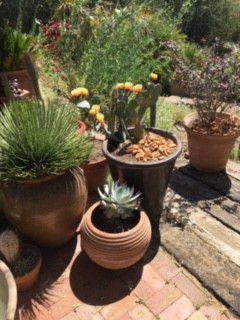
Eye of the Day|Outlier's Garden| garden design Eye of the Day|Outlier's Garden| garden designMy garden is truly my sanctuary, my go-to place; it is where I want to be all of the time. It is my laboratory, my test kitchen and I love every recipe I try. I learn about the plants, I learn how they function in different pots and soils. I propagate, I mix, I simply play all day.  I’m fortunate to have access to so many beautiful containers; yes, most are broken and rescued from the dumpster but I don’t care. I get to experiment and when the results are spectacular, I bring them back to Eye of the Day to share them.

Eye of the Day|Outlier's Garden| garden design Take a look at this Greek Pithari I planted five years ago with a miniature rose, spectacular if I say so myself.  Even landscape designers comment on it and we know how critical they can be. They make winemakers look good.

Eye of the Day|Outlier's Garden| garden design My garden is an outlier when it comes to design but I think it is far more interesting and it is definitely more alive than most.

Eye of the Day|Outlier's Garden| garden design I will be posting pictures of my private garden here on the Blog ongoing for those who are interested to see just how unarboretum-like my wonderful garden really is.


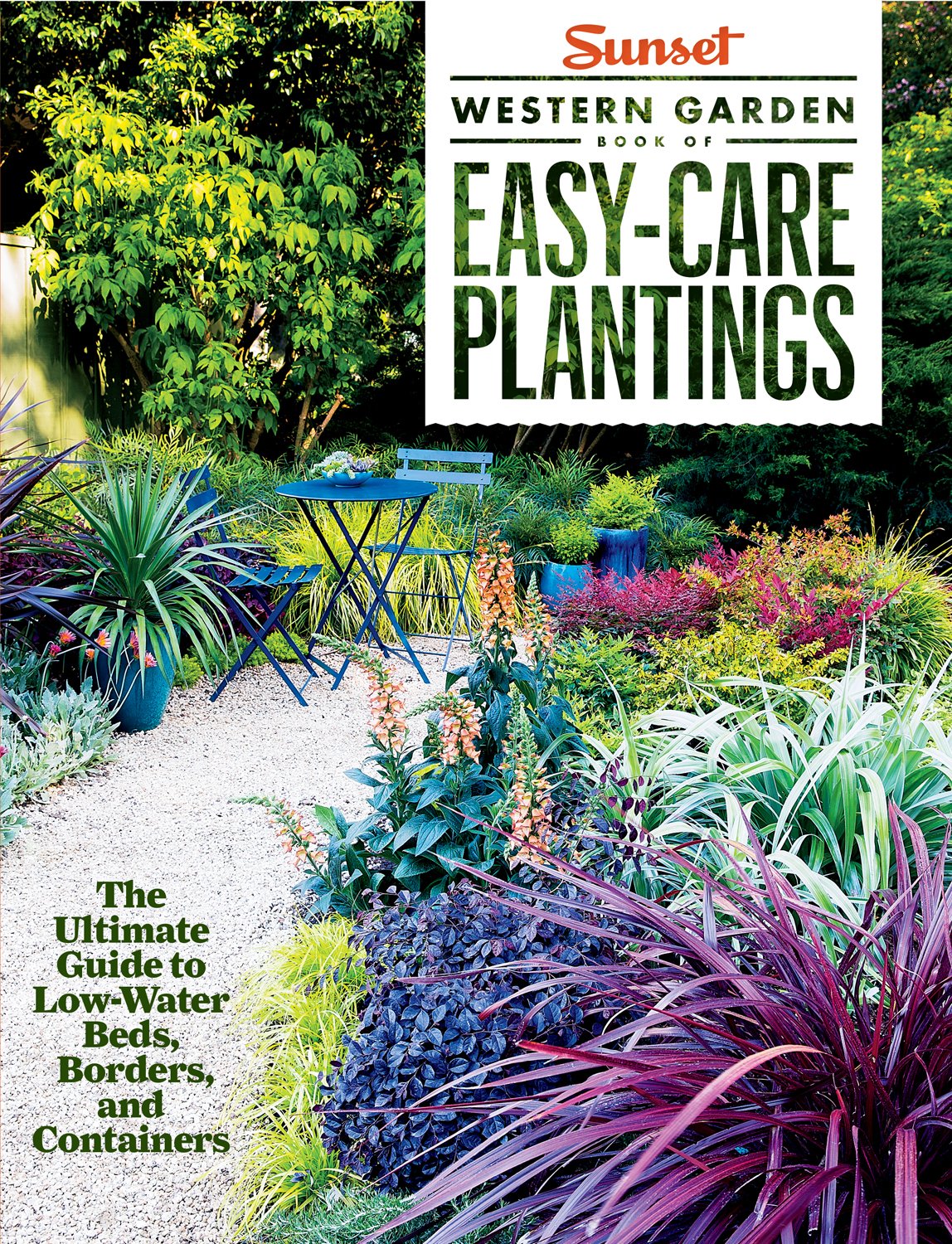
Book Review: Sunset Western Garden Book of Easy-Care Planting

Eye of the Day|Book Review| Sunset Western Garden Book of Easy Care Plantings

Book Review: Sunset Western Garden Book of Easy-Care Planting  

We never seem to stop talking about gardening during the drought and are always looking for ideas to help maintain or introduce new plants and methods into our own personal Shangri-la.  An especially helpful book can be just what you need to get rolling to some new ways.

Eye of the Day|Book Review|Sunset Western Garden Book Cover


Sunset Western Garden Book of Easy-Care Plantings: The Ultimate Guide to Low-Water Beds, Borders and Containers
truly serves as encouragement to gardeners of all levels to rethink their gardens, especially their lawns.  The book emphasizes drought-tolerant ground covers, permeable paving, succulents, native grasses and containers, and has lots of images for inspiration.

It offers suggestions on combining plants in interesting ways to display color, pattern, texture and fragrance while illustrating how few plants are needed to create a beautiful outdoor environment.  There are chapters full of plant charts with photos, descriptions and care advice to help make your garden easy to care for and easy on the eyes.

Since it wasn’t in the cards for Southern and Central California to reap the water rewards of the much touted El Nino this year, gardeners are continuing to struggle with how to use our water as efficiently as possible.  This new Sunset Western Garden Book will help all of us to see possibilities of new ways to garden that will benefit our senses and our environment.

Image via Sunset Magazine 


Paul Hendershot Design and Outdoor Living

Eye of the Day|Garden design| Paul Hendershot

In our continuing series of conversations with our favorite landscape architects, designers and contractors, we were really happy to talk to Paul Hendershot of Paul Hendershot Design, Inc. in Ojai, California.  All of us look forward to seeing Paul and his big, beautiful dog, Chief, walking through Eye of the Day.  Here are some things we found out when we talked to Paul.

Paul: I have great passion for landscaping.  I listen closely to what the clients want for their outside space and I am committed to creating a landscape that fits the style of the house. I have had great success with all my clients because I work to make their dreams come true and be sure the design fits the property

Eye of the Day|Garden design| Paul HendershotEye of the Day: What do you consider your signature style?
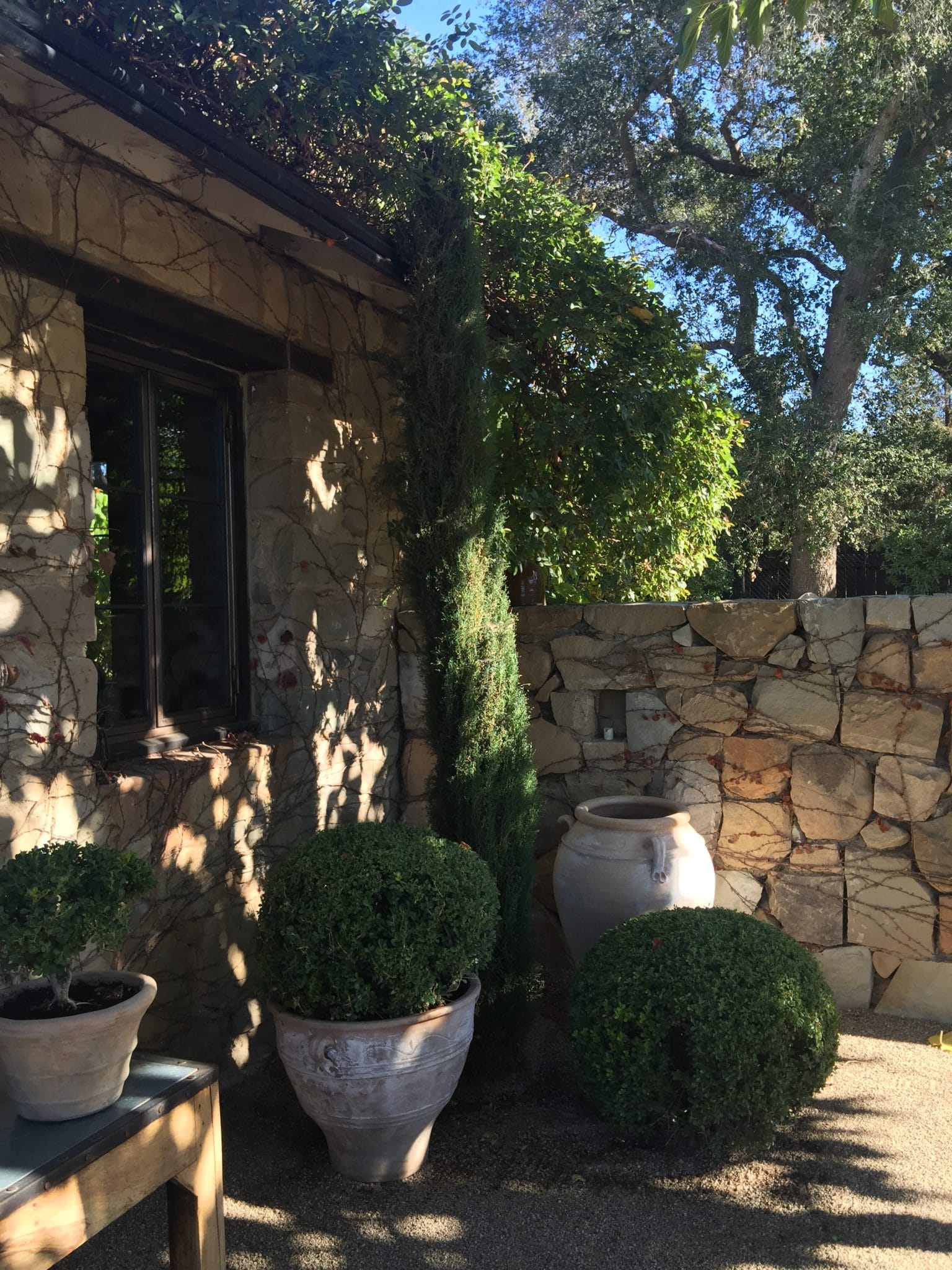
Paul: I am very fond of courtyards; rooms and spaces that are meant to be lived in as opposed to spaces that are simply decorative and consequently unusable. I have been using permeable elements such as pea gravel for many years.

Eye of the Day|Garden design| Paul HendershotEOD:  Has there been anything in particular that has inspired your style?
Paul: I was inspired while traveling mainly in Europe where I saw courtyard settings that had a recurring use of the same and similar plants that I use now. This creates that lush look with very low watering and a permeable ground.

Eye of the Day|Garden design| Paul HendershotEOD: Have you encountered any obstacles with your clients during the drought?
Paul: My main obstacle with clients has been convincing them to give up their lawns.  But I show my clients many of the gardens that we have done throughout the years that have no lawn to help them recognize what it could be like to give up their lawn.  After they feel the lushness and peacefulness of these gardens, they are convinced that they can live without a lawn.

EOD: What do you see for the future in the world of California landscape design?
Paul: The next developments I hope to see is more courtyards, patios, tree plantings, and permeable grounds. In other words: spaces to live in outside.

Eye of the Day|Garden design| Paul HendershotEOD: What are your short and long term goals for your business?
Paul: We intend to continue to work closely with our clients and focus on their dream gardens.  During this process, we will continue working with the clients with lots of fun in mind. We want to continue to design gardens, courtyards, and patios that use very little water, keeping abreast of the latest permeable options. We are full of gratitude for the great clients that we get to work with.

…and we’re full of gratitude for Paul and Chief.  To contact Paul, see his website: Paul Hendershot Design


The Rogue Garden: Brent’s Test Kitchen

Eye of the Day|Brent's Rogue Garden|The Test Kitchen

THE ROGUE GARDEN: Brent’s Test Kitchen

Hey! All you hoity toity landscape designers—this blog’s for you!

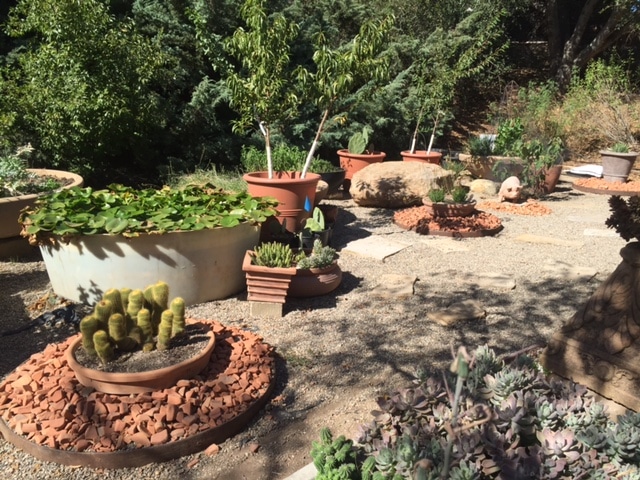
When my professional landscape design friends come to my home garden for the first time, they are usually thrown off balance by what they see: there are pots and containers everywhere.  I constantly rescue or buy plants to try out in our pots to show how they work together in the landscape and also to see how a plant performs in a container versus the ground.

While my garden is a “test kitchen”, it serves as inspiration for Eye of the Day as well as for the genetic sequence I received from my Portuguese great grandfather. He was a truck farmer who indentured himself in 1868 to the Campbell Estate in Hawaii to grow sugarcane. I love putting my hands in the dirt.
Eye of the Day|Brent's Rogue Garden|The Test Kitchen

My garden at home has helped us at Eye of the Day in many ways. We have learned that French Anduze pottery must be sealed or the glazing starts to fall off almost immediately. So, we tell everyone that if you purchase French Anduze, you must have it sealed to protect the glazing.

Something that every design professional should know about is how to properly plant pots and especially large pots. Pots that have diameters larger than 30” usually have plant material that starts big or will grow large due to the space for more root ball. But after a period of years and sometime climate conditions, a large plant needs to be removed from its container and trimmed and replaced. By replicating these situations in my own garden, I have formulated successful service practices for performing operations which allow clients to benefit by getting the most from their purchase of our products.

Also in my garden, there are odd experimental items like “vertical wall” planters and terra cotta shelf units for the patio. 25 years of business has resulted in a new product. Whether damaged in the container coming from Italy or through rough handling here at Eye of the Day, we take the broken pieces of pottery and produce Tumbled Terra Cotta.

Yes, my garden at home looks like a madman’s landscape but, I love it and I love spending time in this intimate setting surrounded by the products, plants and ideas that fuel my life.

Let me know if you’d like to visit.

Brent, the Rogue Gardener


Book Review: The American Meadow Garden by John Greenlee

Eye of the Day|American meadow|John Greenlee

“We’ve reached a stage where we can no longer follow past practices unthinkingly, particularly when those practices are wasteful and injurious to the environment. It’s time to get rid of the old-fashioned lawn and embrace a sane and healthy future: the designed meadow.” – John Greenlee

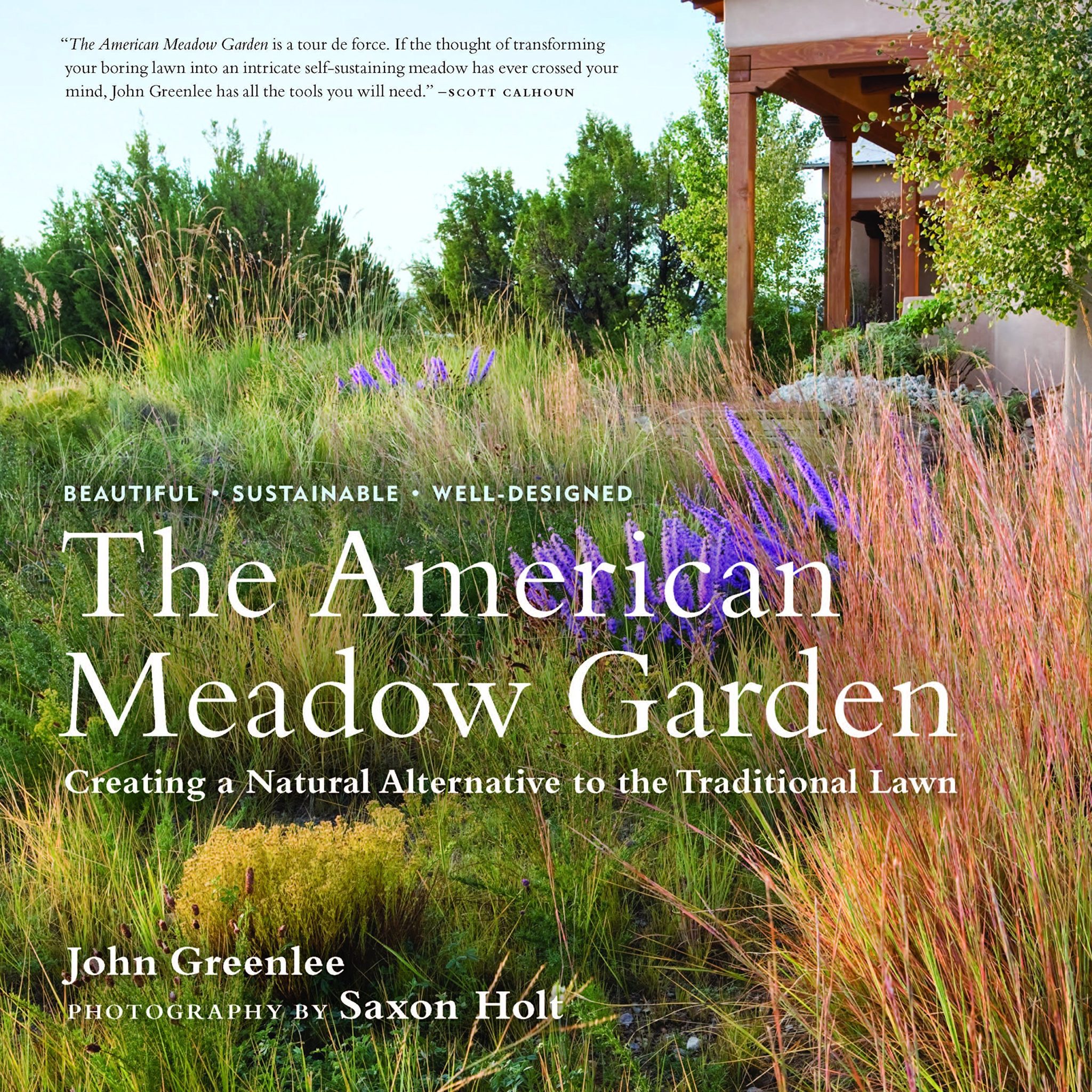
In The American Meadow Garden: Creating a Natural Alternative to the Traditional Lawn, “grass guru” John Greenlee leads us into a new way of thinking about grass.  He uses the words “glade,” “grassland,” “mead,” “savanna,” “pasture,” “sod,” and “meadow” among other terms, to describe areas around the world that are largely treeless, grass-covered landscapes.

These words paint an image of golden or green grassy carpets, rippling in a breeze. In this beautiful book, we are given a portfolio of meadow gardens and a guide to grasses for meadows and how to maintain them.

We’re constantly looking for ways in which to cope with our water-challenged world in California and Greenlee offers alternatives to our lawn habit. In many areas, aquifers are dwindling and water is increasingly scarce. There is no longer enough of it to supply lawns. Growing populations and dwindling supply is our scary future and our landscapes must change with the times. The American Meadow Garden was published in 2009, but the relevance of the information and ideas within its covers increases every year.

The American Meadow Garden: Creating a Natural Alternative to the Traditional Lawn, by John Greenlee, Timber Press 2009