Detour to Europe: How El Nino Led Us to Francesco del Re

In February of 1998 our lives were changed forever by El Niño. Eye of the Day was in its infancy, just two and a half years old and we became a statistic as the worst damaged business in Santa Barbara County. The federal government declared a disaster area and we lost nearly everything. But…what we didn’t know was that our journey was about to take us on a brilliant detour.

From its inception, the Eye of the Day plan was to sell pottery, fountains, statuary and other garden products. There were a lot of nurseries but not many focusing on accouterments for the garden. We began by selling wine barrel planters, Mexican pottery, American made concrete fountains, benches, bird baths and lots of colorful pots. At Christmas we sold only the Noble Fir. But then the forces of nature randomly decided to take us out.

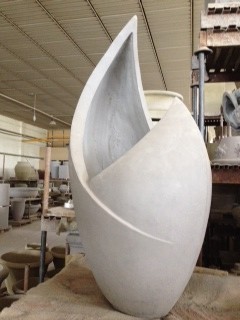
Francesco del Re Ruhka container
Ruhka vase by Francesco del Re

There is a saying that when a door closes a window opens; I was looking for a window and it turned out to be FEMA. With a new FEMA loan and a lot of help from friends, Eye of the Day quickly found a new home in a bigger market, picked ourselves up off the very wet pavement and began again.

After we opened our doors in our new (and current) location in the small beach town of Carpinteria, we sensed a great opportunity to grow in a way that the pre-disaster Eye of the Day would not have been able to fulfill. Our business model was limited and we needed to think bigger, so we decided that the gift shows in Los Angeles, San Francisco and Atlanta just didn’t provide what we needed anymore. It makes me laugh when I remember how quickly my wife, Suzi, agreed that we needed to go to Paris and check out the gift show there. We didn’t realize at the time just how prescient we were.

Groundskeeping Image 3
Francesco del Re container gets loaded up

The first day of the show was the ultimate shopping experience but only if you were buying at least ten of everything. Included was an area for outdoor garden decor and when we walked into Francesco del Re’s booth, I knew I had found something special:  the finest handmade terracotta pottery on planet Earth. His containers were classics and many were models of forms and shapes still in service after hundreds of years, including pots or “vasi”, urns and amphorae adorning villas and palaces throughout Europe. Francesco’s display screamed CLASSIC ITALIAN TERRACOTTA to me. I vowed right then that Eye of the Day would sell Francesco del Re, just as soon as I figured out how I could afford a container.

A showroom of fine European wares at the Maison & Objet Paris

The following year we returned to Europe, this time to Italy. Something drives me to wander and explore and I knew Francesco del Re was somewhere around Florence and I knew I would find him. I scoured the small, famous hill town of Impruneta, walking into some fabulous artisan workshops. No one knew who and where FDR was, but I learned later that in Italy, few are willing to promote someone else and everyone in that famous commune was challenged by him. The hunt was on. I didn’t travel in order to give up. It was hard work, but over our excellent lunch in Greve, the proprietor of the restaurant told me how to find the factory. By the way, we selected the restaurant for lunch because there was a pair of classic Francesco del Re Vaso Lessona urns at the front door.

Groundskeeping Image 1
Francesco del Re getting fired in the kiln

I have returned to the FDR factory every year for the last sixteen years. This May I flew there for three days to help load a forty-foot container and to see Signora Elettra Brancollini, Francesco’s partner and sculptor. Sadly, our friend Signore del Re passed away two years ago, but his classics will live on for centuries in our gardens.

Stylish and Sustainable Garden Design

Stylish and Sustainable Garden Design

Living and designing in California, the ongoing and severe drought we’re experiencing is on everyone’s minds. And as such, drought-tolerant gardens are rapidly replacing outdated water-thirsty landscapes. While everyone is on board with the concept of a drought-tolerant garden I inevitably hear the same hesitation from clients – they don’t want their low-water garden to look like their neighbor’s new garden down the street. They want to make sure their new garden still reflects their personality and individual style.

This is a valid concern as it seems many drought-tolerant gardens seem to focus on the same twenty plants over and over again, with the end result being one of uninspired predictability. Luckily, there are a few simple ways to avoid this common trap.

For my clients who want a more traditional East Coast feeling in their garden, color is key. It’s important that I include low-water plants that contain a higher proportion of greens, maroons, blues and purples to mix along with the more common gray tones. The effect will be the same – a reduction in water use – but the garden will appear cool and lush.

For my clients who prefer a Mediterranean feel in their gardens, I tend to use a larger amount of warm colors, such as oranges, golds and reds mixed in with the greens and grays. The result is a garden that appears to glow in our perpetually sunny days.

But just because I’m reducing the use of water in these gardens doesn’t mean I’m eliminating it all together. On the contrary, it’s important to include a source of water in the garden as the sight and sound of it not only reinforces that we’re not living in the Sahara Desert but it also provides a much-needed source of water for wildlife during these thirsty times.

And depending on the style chosen, the fountain is one more way to help further define the character of the garden. For my East Coast inspired gardens, a traditional, stately three-tiered fountain is right at home, nestled among the Corsican hellebore, lavender and native penstemon.

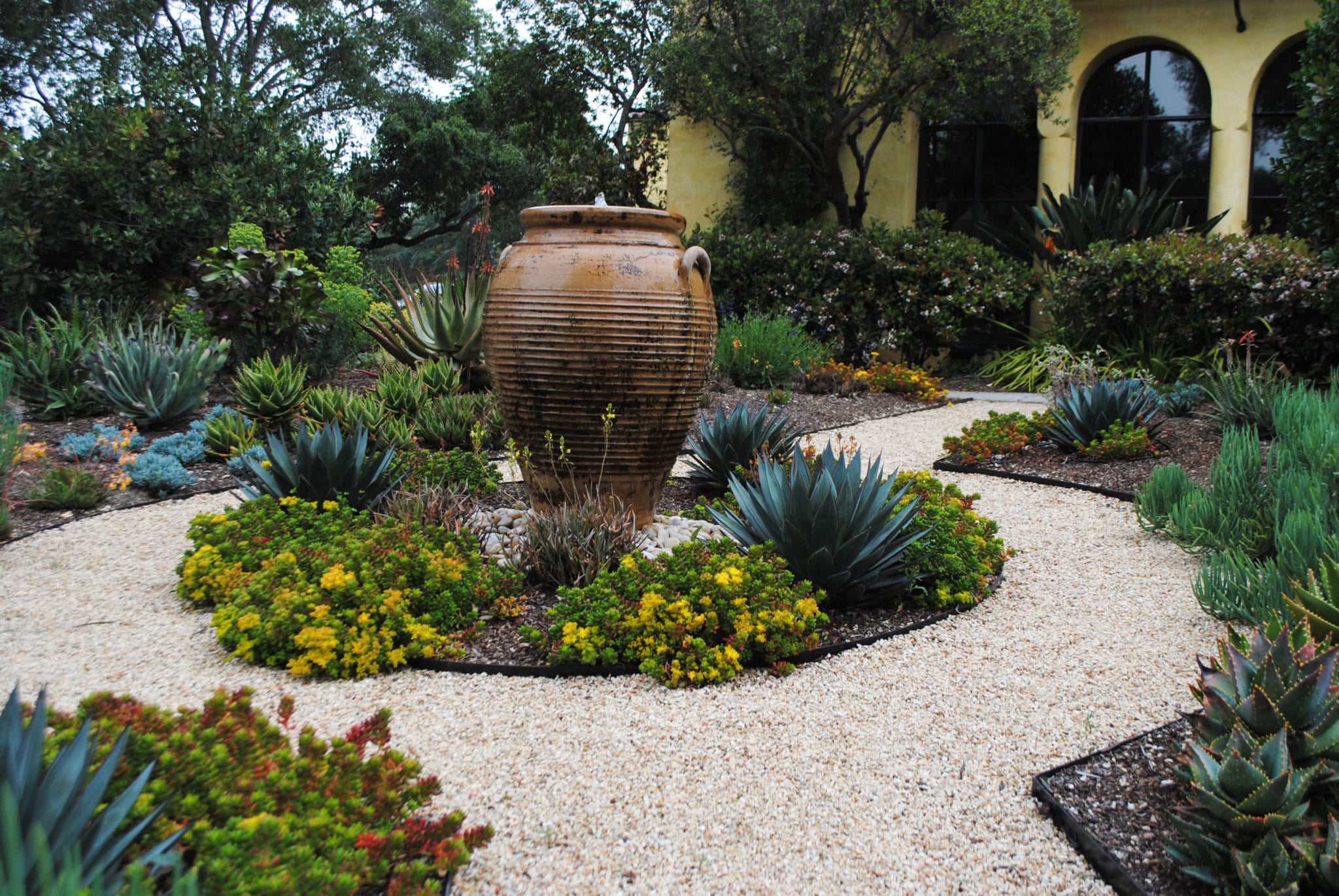
And for my Mediterranean-inspired gardens, a simple antique olive jar blends seamlessly into the surrounding garden filled with succulents, salvias and grasses.


Home Outside Palette App: Landscape Design Made Easy and On the Go

Could it be time to add your mobile device to your set of gardening tools? There really is an app for everything. Bring out your inner designer to create the dream landscape you always imagined with the Home Outside Palette app. Move, resize, and even undo with over 280 available elements (trees, paths, enclosures, and more) to an existing or new landscape before even stepping outside. Design on the go has never been easier for novice and experienced designers.

“We created the Home Outside Palette app to help homeowners design their properties,” says Julie Moir Messervy, owner of landscape architecture and design firm JMMDS and creator of the app and the Home Outside online landscape design service. Using any iOS or Android smartphone or tablet, users can upload a property survey and use it as a background, or select a grid or colored background, and mock up their landscape by tapping and dragging hundreds of elements into place. The grouping feature lets you lock permanent elements together (such as the house, garage, and driveway), and the layers tool gives you the ability to play with different versions of a design.

An in-app purchase offers additional elements as well as a measuring tool that lets you input rectangular measurements or “walk-and-click” a GPS-based outline of your space. A drawing tool allows you to sketch free-form garden beds and other features. “From the start we knew that we wanted to include all the green features that today’s homeowners need: laundry lines, greenroofs, chicken coops, veggie gardens, compost bins, greenhouses, solar panels, and more,” says Messervy. “It is possible to have a functional, sustainable yard that’s also beautiful—and this app helps you get the design right before ever picking up a shovel.” When you’re finished, get important feedback before committing to any design element. You can share designs from the app on social media or email them to friends. For additional help with your landscape, the Ask an Expert feature lets you send a design from the app to JMMDS’s award-winning designers for their expert suggestions. The app is designed to be practical and user-friendly for the imaginative homeowner to the professional designer. Messervy adds, “Our mission is to make beautiful design available to anyone, anywhere.”


By Jennifer Silver, Marketing and Special Projects Manager of Julie Moir Messervy Design Studio

Jennifer has held a variety of teaching, writing and editing positions. When she moved to Vermont 12 years ago, she discovered her true passion: sustainable agriculture. She is never happier than when writing or gardening. At JMMDS, she gets to write about gardens—what could be better?


Lisa Cox Design | Los Olivos Tasting Room Gets Design Update

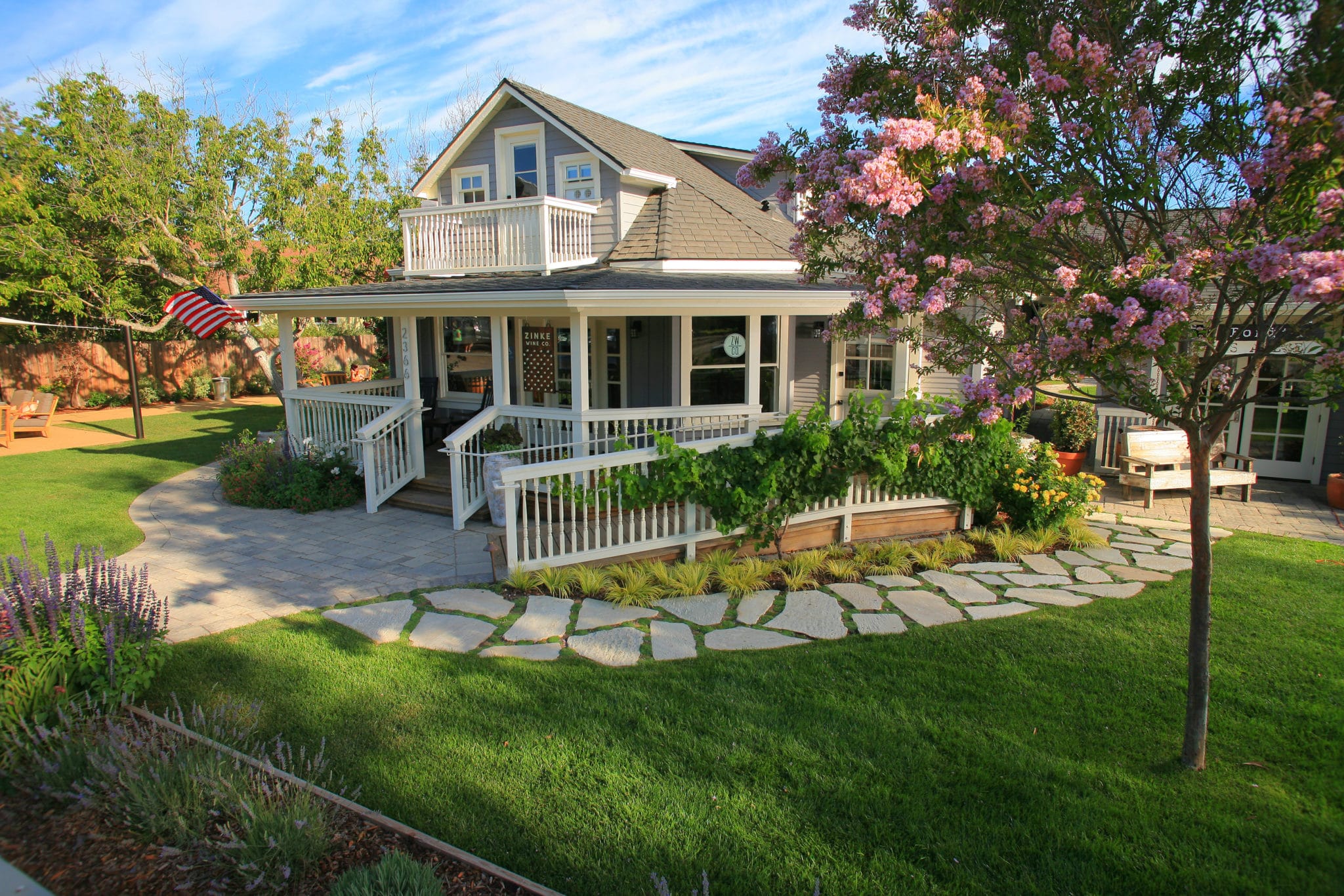
In the relatively short time Lisa Cox Landscape Design has been working in the Santa Barbara area and Santa Ynez Valley, she has become the go-to for anyone wanting clean and sharp designs with a focused point of view. This is clearly evident in her design for the brand new Zinke Wine Co. tasting room. Lisa says she can’t take complete credit for the beautiful design as she worked closely with Thierry Fraye of Paysage Landscape and the Zinkes who have impeccable taste and a clear vision for their brand.

Michael and Ashley Zinke are Zinke Wines. Michael Zinke is a self-taught winemaker that apprenticed at Girouard and Sans Liege wineries before venturing out on his own. They opened their state-of-the-art tasting facility in the wine country township of Los Olivos, CA this past May. They create single vineyard Rhone varietal wines sourced from a handful of Central Coast vineyards. They needed a venue befitting their precious creations and Lisa was the one to deliver.

Lisa incorporated Eye of the Day products throughout her design. As you approach the building you are greeted by two ‘aged’ Greek Bottle pots customized by Eye of the Day standing guard aside the main entrance. Each pot is planted with drought tolerant growth. While enjoying your first taste of Viognier you overlook an impressive Asian carved granite trough bursting with colorful succulents. You can also admire the lovely Italian San Rocco Giara Liscia pot that flanks the bocce court while waiting for your next throw. Zinke Winery Blueprint OverheadAfter taking it all in, we had some questions for Lisa:  

What was your inspiration for the design?
My Inspiration came from a few sources.  First and foremost, the owners, Michael and Ashley Zinke have distinct, incredible taste.  They were looking for a look that felt something with a rustic/industrial look and a warm welcoming feeling from the street that would draw in customers who were looking for something a little different.  Also, with the existing Cape Cod style structure of the Tasting Room, we wanted to keep that charm, but infuse it with a bit of modern charm!

Did the Zinkes have strong opinions on what they wanted or did they leave it up to you?
I would say they gave me a direction as stated above, but pretty much let me design what I felt would present both function and form to the space.

What were the particular challenges with this project?
We needed an area that would allow furniture placement which I accomplished with the DG cutouts that are surrounded with lush green grass. There was some existing hardscape that we “improved” with either widening pathways or substituting new flagstone stepping stones. With a mixed plant palette of natives, lush perennials and color, the end product turned out quite pleasing to the eye…and of course the succulent filled planters are incredible!

What do you most like about designing in the ‘Valley’?
I can honestly say, what I like most about designing in the valley are the people! Since my husband and I have only been here for 1½ years, we can honestly say we are overwhelmed with the warm, friendly and caring SYV community!  And of course, how can you beat our gorgeous natural landscape of rolling hills, oak trees and vineyards…it’s hard to beat! A special thanks to Rich Cox Photography for the images!


The Importance of Sustainable Gardening

The word of the day is sustainability. The United Nations World Commission for the Environment defines sustainability as “meeting the needs of the present without compromising the ability of future generations to meet their own needs.”

The other word that makes headlines is “green.” What that means for gardeners and landscape designers: We must pay attention to the materials we use in our landscapes. Hardscape materials should be renewable. Plants should not require major input of chemicals (fertilizers, pesticides, fungicides) to keep them healthy. Water needs should be easily fulfilled by the local climatic regime. 2014-01-10 We can also invite in native sources of nutrients and pest control agents. In an ideal natural ecosystem, there are no major inputs from outside sources. Think about an old-growth forest. Seeds sprout, trees and herbs grow and die. Their elements are recycled by decomposing fungi and bacteria to feed the roots of the remaining members of the forest. The model for us to emulate is to recycle all of the organic material produced either on site or by directing it to the local recycling program. We are used to calling it green waste, but it is really a green resource. 2014-01-18 Caring for our landscapes, whether we have a small city lot or manage a golf course, should mean thinking about sustainable practices. We must begin to see our personal green spaces as little pieces of a much larger urban ecosystem. What are the integral parts of that ecosystem? Who or what are the major players in this cycle? What are their needs? What practices will we need to adopt to encourage this natural process? And, just as important, what practices must we abandon?

The goal of sustainable gardening is to have a complete cycling of nutrients and maximum health of the soil and plants.


One Hundred Years in the Garden

Eye of the Day Garden Design Center

Who doesn’t dream about living to a hundred? With all of the wonder in this world, the multitude of invention, the quality of our existence and the amazing number of fabulous cook books available, who wouldn’t want to live forever, especially in the garden?

Eye of the Day Garden Design CenterI have friends who live to play golf, crash mountains on boards, get dragged behind a boat going a hundred mph and torture themselves in a myriad of ways they call pleasure. Not me. I dream of being in my garden. Gardening increases your lifespan, according to Dr. Mao Shing Ni, a 38th generation doctor of Chinese medicine. In his book Secrets of Longevity Cookbook, he says: “Centenarians around the world come from many different backgrounds and professions, but one of the most common hobbies among them is gardening. As exercise, gardening strengthens the muscles, as a discipline it requires patience and cultivates fortitude; and in the end it brings rewards and joy to its practitioners. Studies show that gardeners have a lower incidence of heart disease and osteoporosis than non-gardeners.”

I doubt I’ll make it to a hundred but I’m not too worried nor is it the point, I only want more time in my garden to relax, get dirty and breath. I’m waiting for the chives to bloom so I can sprinkle them on salads and eggs. I’m looking forward to warmer weather so the basil will grow (I love fresh pesto!). I may live to one hundred but I’m looking forward to “this” spring, to my garden, to the prospect of vine-ripened tomatoes in just a couple of more months, to the trees blooming. One day at a time in spring is what I’m dreaming of right now.