Your Garden In A Window Box

When you see images of homes that feature window boxes overflowing with color, herbs and bees and butterfly-friendly plants, doesn’t it make you want to create a little garden under your window?

Eye of the Day|Boston Window Box|Travel garden design
A trio of window boxes for this home in Boston

Eye of the Day|Boston Window Box|Travel, garden, design
With little yard space, window boxes solves the garden problem

During an East Coast trip, Brent was walking the streets of Boston’s Beacon Hill neighborhood and.. looked up.  He noticed them near doorways as well: window boxes overflowing with color, herbs, and seasonal gourds.  Beacon Hill is famous for the flower boxes gracing the windows of most homes.  Their legacy comes from a time when homes were built on the edge of the street and there was little area to garden.  In the late nineteenth and early twentieth century, most homes had a central courtyard where there might have been an outhouse, wood shed and animals, so the logical place to grow a small kitchen garden would be in planter boxes hung just outside the window in order to save space.

Eye of the Day|Boston Window Box|Travel, garden, design
Window boxes are easy to change up according to season.

Eye of the Day|Boston Window Box|Travel, garden, design
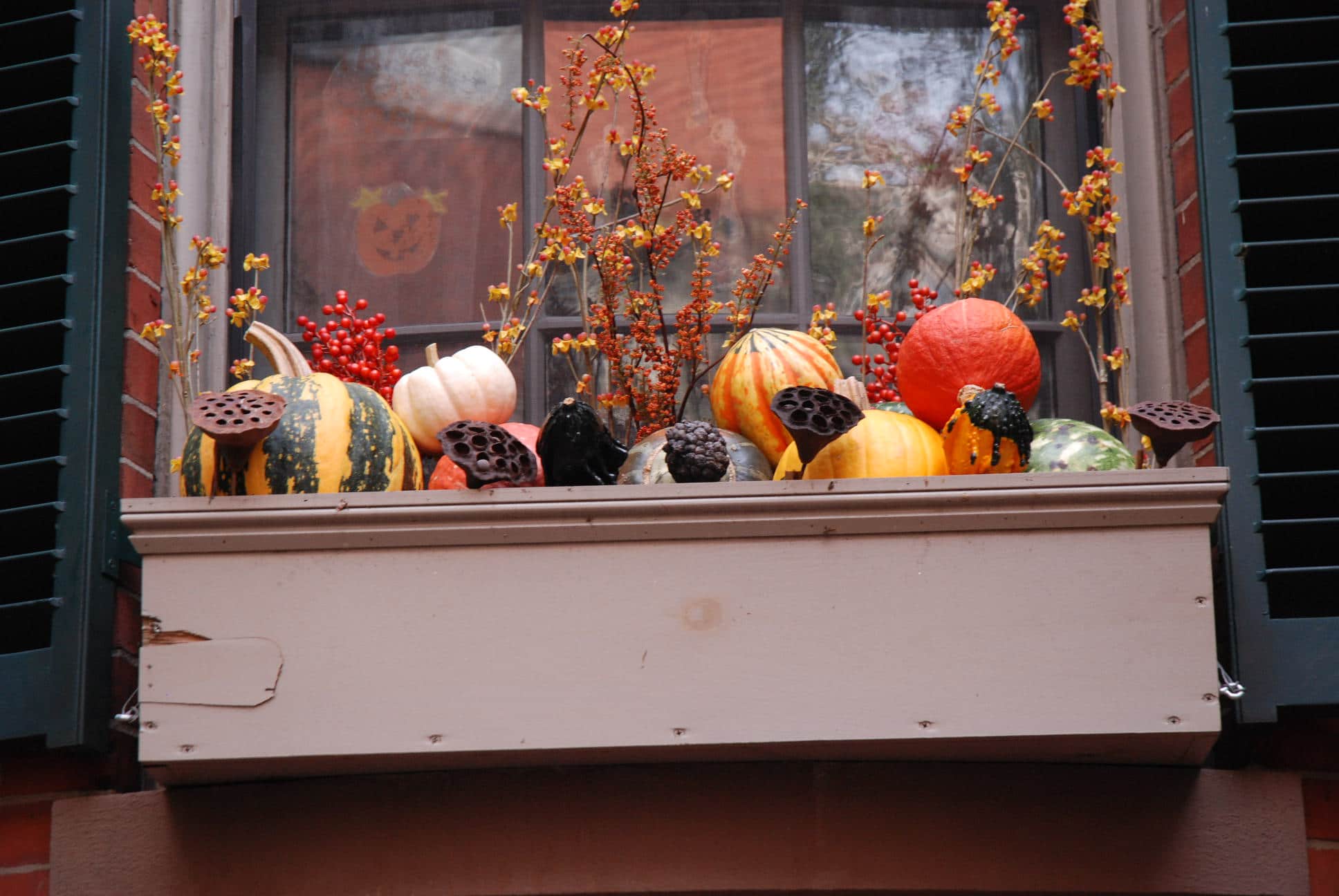
Festive Fall gourds line this window box in Beacon Hill

Eye of the Day|Boston Window Box|Travel, garden, design
Dramatic take on vertical gardening with window boxes in the Boston Beacon Hill neighborhood.

Eye of the Day|Boston Window Box|Travel, garden, design
Having fun with window box design.

Eye of the Day|Boston Window Box|Travel, garden, design
Despite all the brick, you can still incorporate greenery to your home design

Window boxes have a long history beginning in Europe and then traveling to America with the early settlers.  Terra cotta planter boxes date back to early Rome where it was common practice to cultivate cottage gardens for food, medicine and religious uses.  Eventually window boxes were planted with decorative flowers.

Eye of the Day|Boston Window Box|Travel, garden, design
Window boxes add a little color to this home exterior

Eye of the Day|Boston Window Box|Travel, garden, design
Lovely arrangement of colorful flowers for this window box design

Eye of the Day|Boston Window Box|Travel, garden, design
Grow your garden in a window box

Historically, planters placed below the window have been made from wire hay frames, wrought iron, wood and terra cotta.  And that brings us to Eye of the Day’s Italian terracotta clay window box or “Cassetta Balcone.”  These sturdy window boxes, made from Galestro clay by Terracotte San Rocco, are available in five sizes and can be used as regular rectangular planters, placed on the ground, but WHY NOT use them as the Beacon Hill Brahmins and hang them beneath your windows, filled with succulents,  herbs, and vegetables?

Eye of the Day|Window Box|Cassetta Balcone Liscia
The Cassetta Balcone Liscia

Eye of the Day|Boston Window Box|Travel, garden, design
You can even place your window boxes along your balcony or yard deck enclosure.

Eye of the Day|Boston Window Box|Travel, garden, design
Window boxes–great for every season.


Preview Spring Garden Design Magazine

Eye of the Day|Spring Garden Design |


Garden Design magazine is bringing back their always-popular collection of Way Hot Plants–perennials, shrubs, and grasses plant aficionados love. See them all plus much more stunning photography, gardens, plants, and products in their current issue Early Spring, on sale now. Preview the issue and subscribe today: .


Eco Friendly Landscape Design by Lisa Cox for Hacienda Style Home

Lisa Cox, of Lisa Cox Landscape Design has happily designed landscapes ranging from simple tract homes to vast estates.  As she plans an outdoor environment, she envisions a transformation that communicates the lifestyle and personal taste of the client, while incorporating her own style. Each garden is designed and built with all materials including stone, plants, trees, water features, and garden art selected by Lisa using local, top qualified growers and suppliers.

Commitment to sustainability, the use of drought tolerant plants and trees, including California natives, has been an integral part of her design process, allowing a more “naturalistic” result that mimics the local terrain.

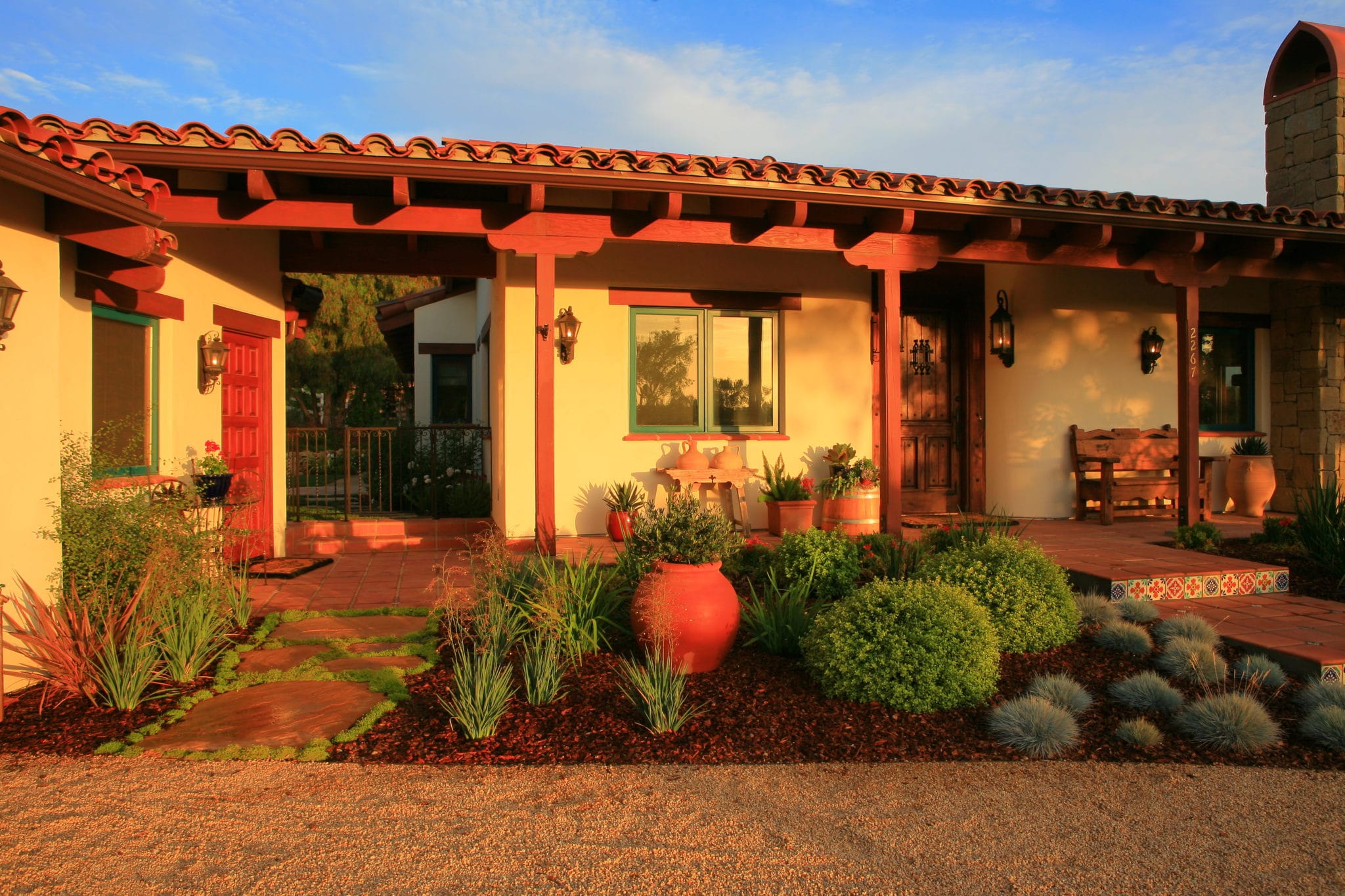
When Lisa met with her new clients in the Santa Ynez Valley, they requested that the newly constructed home not have any sod in the front area, and that she use drought tolerant plants including grasses and succulents. Working with a blank slate, except four nice sized olive trees at the entrance, she was free to design the space, including selection of a plant palette that complimented the Hacienda style of the home. With the use of local sandstone boulders, salvias and phormiums as her base, she also incorporated deciduous trees and perennials for color in the Spring and Summer, and a few rows of grape vines because after all, it’s the Santa Ynez Valley!

Choosing Greek terracotta pots from Eye of the Day, filled with “Blue Glow” Agaves gave the clean, rustic look she was looking for on the front porch and the traditional Terrecotte San Rocco terracotta pot in front worked perfectly to show off the “Little Ollie.”

It seems everything progressed perfectly for Lisa and her clients, but there WERE a few important challenges:

  1. The need to place a gopher basket for every plant as the local area is inundated with gophers that would quickly destroy the plantings, and
  2. The necessity of paying close attention to selecting plants that can stand the heat as well as the sometimes frigid nights where temperatures can go into the low 20’s or below.

As Lisa’s work on the project came to a close, she felt deep satisfaction; in fact she felt this was a home environment she could inhabit herself.  The project was a dream to work on and the end result was exactly what the homeowner envisioned.

Visit Lisa Cox Landscape Design to view more of her work.


Italian Terracotta Pottery Adds Elegance to Your Outdoor Areas

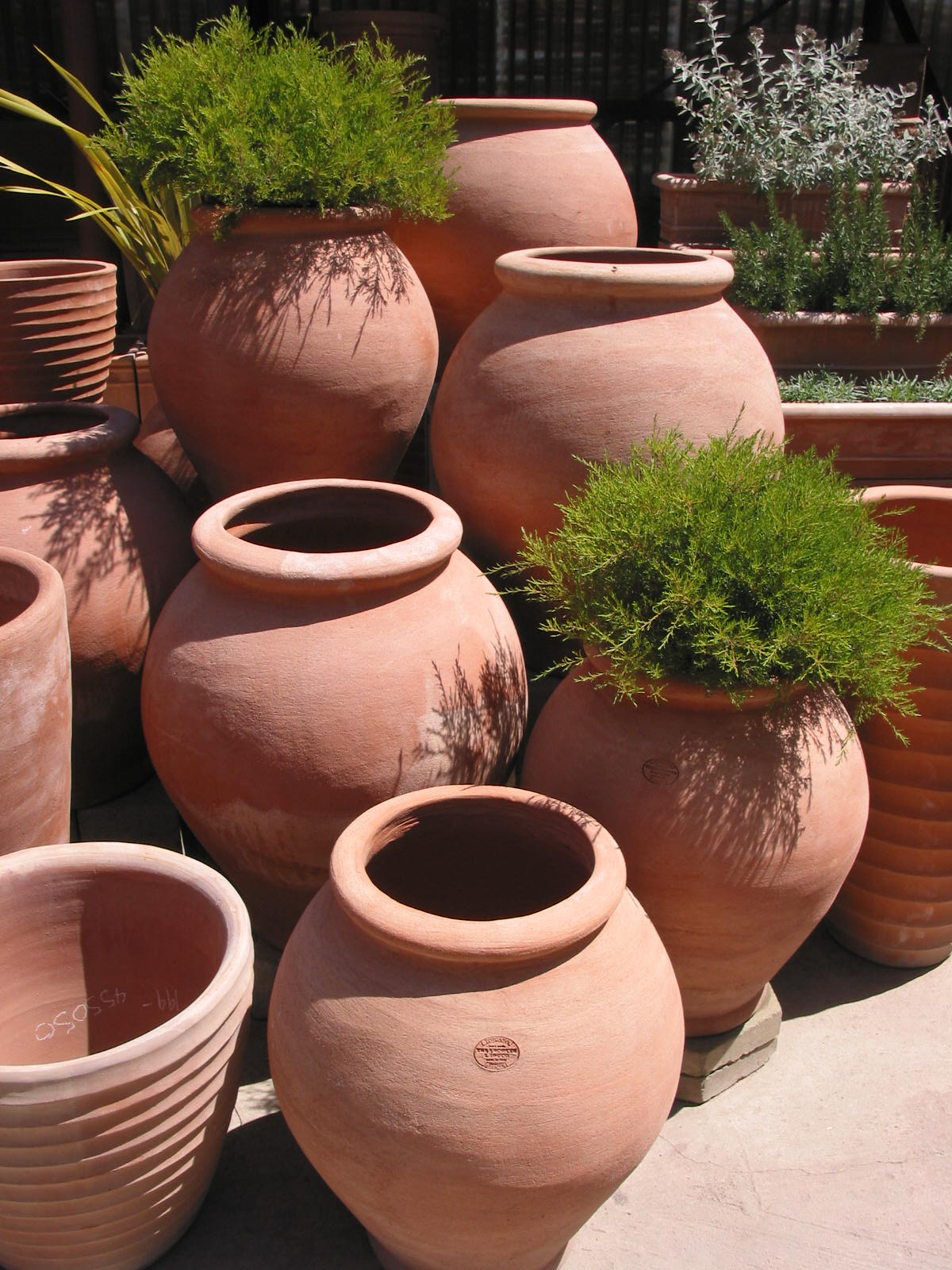
Planted pots and containers add color and visual interest to your landscape design, garden and outdoor living areas. Choosing the right pots can be a challenge with the wide variety of options available today. Consider adding beautiful Italian terracotta pottery, created to handle the elements and last for decades.

What is Galestro Clay?
Eye of the Day’s Italian terracotta pottery is fabricated from Galestro clay, fired at an extremely high temperature. It is a high-quality, dense clay known for creating particularly durable pots, frost resistant to -15 degrees Fahrenheit. Galestro clay is found in Tuscany, near the borders of Grosseto, Arezzo and Siena. Pots made from this clay are created by hand and air-dried before firing. If conscientiously maintained, this pottery will last decades.

Terracotta Pottery: Style
In addition to customary classic pottery like the beloved double roll rim, more ornate Italianate styles featuring details such as garland, rosette and leaf motifs, are available to infuse your home with old-world design. Eye of the Day’s Terre Colorate line brings clean, modern Italian design to contemporary garden style.

Whatever your garden style, with Eye of the Day’s help you can add a clear visual appeal using Italian terracotta pots.

Eye of the Day Garden Design Center provides high quality pots for decoration and for planting. Learn more about our Italian terra cotta pottery.


Party at the Fire Bowl

Throughout the summer and into the fall, sitting outside near a fire evokes summer camp, a perfect ending to a long day enjoying nature, bee stings and muscle strain. A song around the campfire, s’mores and stick-roasted sausages perform a prelude to a night sleeping under the stars. But why stop when the trees are bare and cold night air nips the nose? Gathering around a fire forges friendship. Time spent at the computer, scanning Facebook, watching movies or shopping online should be cast aside for a warm fire, friends, a mug of spiked hot chocolate and ok, stick-roasted sausages.

Fire pits were originally used by nomadic people to cook and to provide heat. Pits were dug in the ground (an option today, too), and when it was time to move on, the pit was closed and sealed. As time progressed, the communal fire also became a social focal point. Today a typical home fire pit, or fire bowl, is constructed from metal, stone, brick, clay or concrete.

According to Landscape Architect and Eye of the Day newsletter contributor Sally Farnum, in the early days of her career during the 70s and 80s, fire pits were out of fashion and most all of her clients wanted them removed. Now and for the last several years, almost every one of her clients has requested either a fire pit or an outdoor fireplace be included in the landscape design.

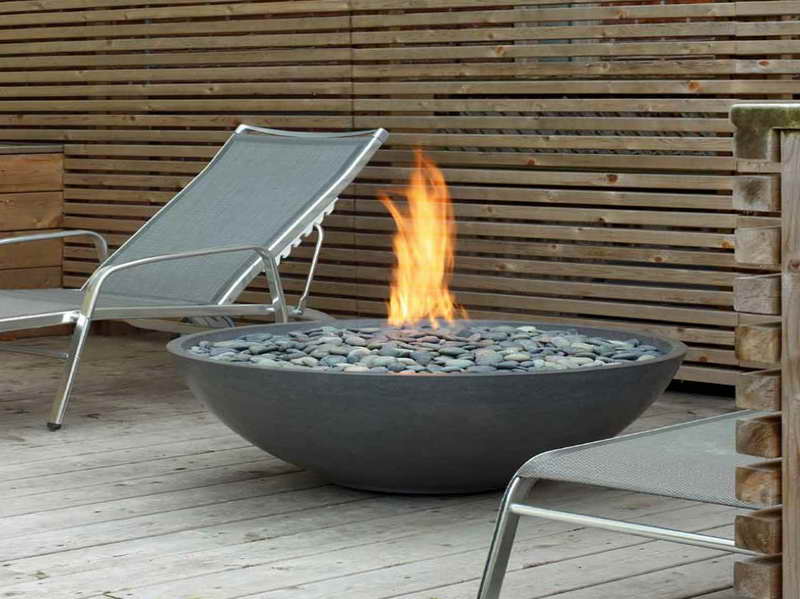
As the weather begins to chill, we have more and more customers asking about fire bowls. Low, round concrete planters are available in a number of sizes and can be easily converted to a gas-flamed or wood-fired fire bowl. The same is true for terracotta planters, especially low bowls. For both, some precautions must be taken to prepare them for life as a fire bowl. A large “bonfire” will most likely crack the bowl, so it is best to start with a small fire, at least the first few times, to temper the bowl. It is also important to have a bed of sand in the bottom of the bowl to absorb some of the heat. Smooth stones or glass rock (available in a multitude of colors) can also be placed in the bowl for a decorative effect and to diffuse the heat.

Don’t spend your winter at your indoor fireplace, or glued to a screen, treat yourself and your family and friends to a party around your outdoor fire enjoying the nip of the air layered clothing, hot drinks, and those sausages.


Stylish and Sustainable Garden Design

Stylish and Sustainable Garden Design

Living and designing in California, the ongoing and severe drought we’re experiencing is on everyone’s minds. And as such, drought-tolerant gardens are rapidly replacing outdated water-thirsty landscapes. While everyone is on board with the concept of a drought-tolerant garden I inevitably hear the same hesitation from clients – they don’t want their low-water garden to look like their neighbor’s new garden down the street. They want to make sure their new garden still reflects their personality and individual style.

This is a valid concern as it seems many drought-tolerant gardens seem to focus on the same twenty plants over and over again, with the end result being one of uninspired predictability. Luckily, there are a few simple ways to avoid this common trap.

For my clients who want a more traditional East Coast feeling in their garden, color is key. It’s important that I include low-water plants that contain a higher proportion of greens, maroons, blues and purples to mix along with the more common gray tones. The effect will be the same – a reduction in water use – but the garden will appear cool and lush.

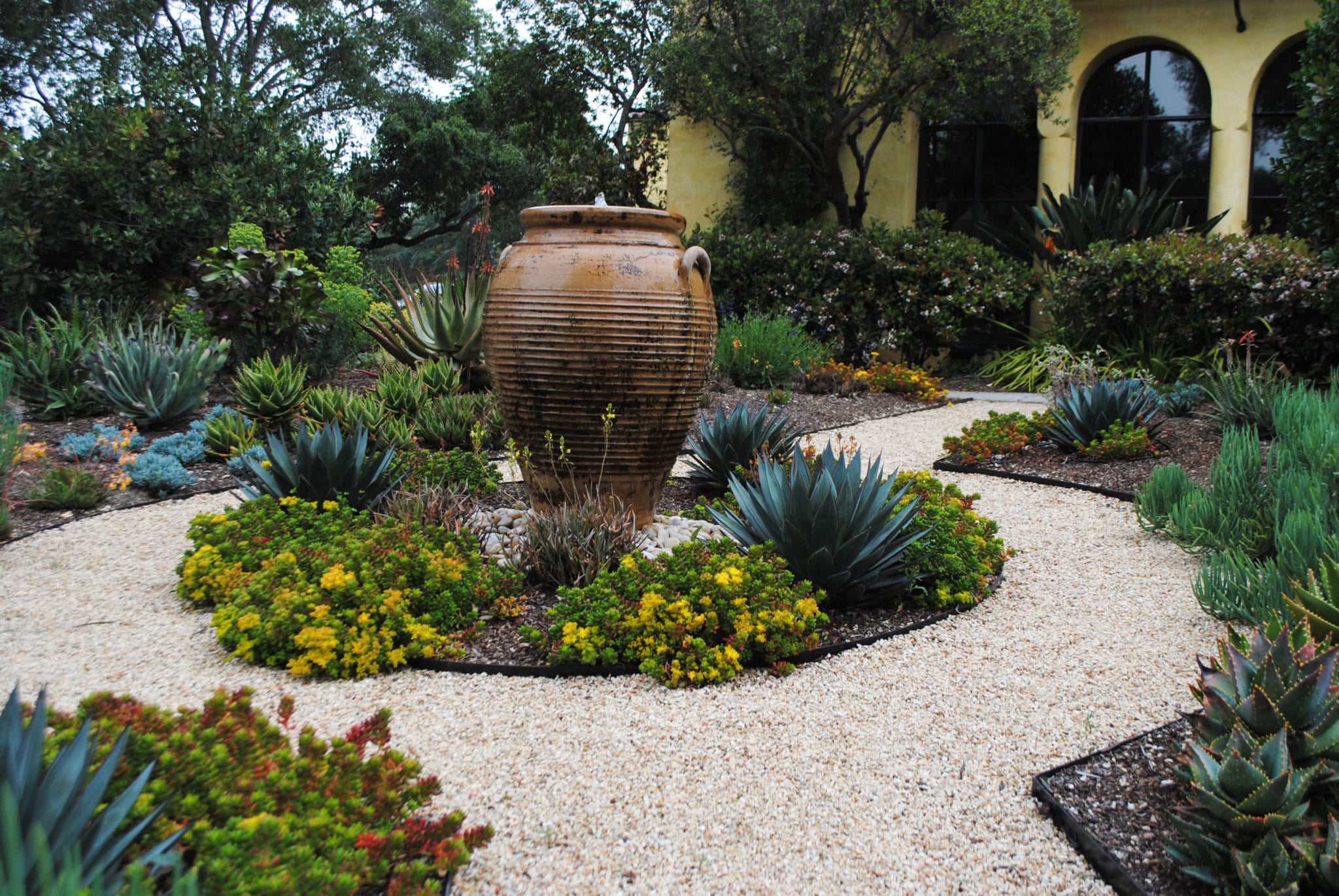
For my clients who prefer a Mediterranean feel in their gardens, I tend to use a larger amount of warm colors, such as oranges, golds and reds mixed in with the greens and grays. The result is a garden that appears to glow in our perpetually sunny days.

But just because I’m reducing the use of water in these gardens doesn’t mean I’m eliminating it all together. On the contrary, it’s important to include a source of water in the garden as the sight and sound of it not only reinforces that we’re not living in the Sahara Desert but it also provides a much-needed source of water for wildlife during these thirsty times.

And depending on the style chosen, the fountain is one more way to help further define the character of the garden. For my East Coast inspired gardens, a traditional, stately three-tiered fountain is right at home, nestled among the Corsican hellebore, lavender and native penstemon.

And for my Mediterranean-inspired gardens, a simple antique olive jar blends seamlessly into the surrounding garden filled with succulents, salvias and grasses.