How It Works: Frostproof Terracotta
It’s hard to believe that it is already Fall. In California, leaves don’t change much in a drought, no matter what time of year. But as another October becomes a thing of the past, much of the country can already feel the promise of winter. So let’s talk about frostproof terracotta.
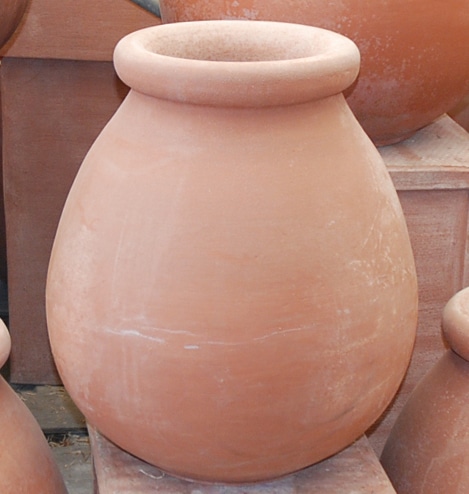
Many of you live and work in places that freeze, and much has been said, both by homeowners and garden designers about the freeze/thaw capability of ceramic plant containers. Remember that ‘clay’ is the earthen material, ‘ceramic’ is the clay when it has been fired. Terracotta is low fire red clay found all over the world. There are low fire clay bodies, and high fire clay bodies. Low fire is also referred to as earthenware, high fire is stoneware. Once clay is fired it becomes ceramic no matter what temperature it is fired to. But that doesn’t mean it is mature. I want to introduce you to two new key words: “vitrify” and “absorption.”
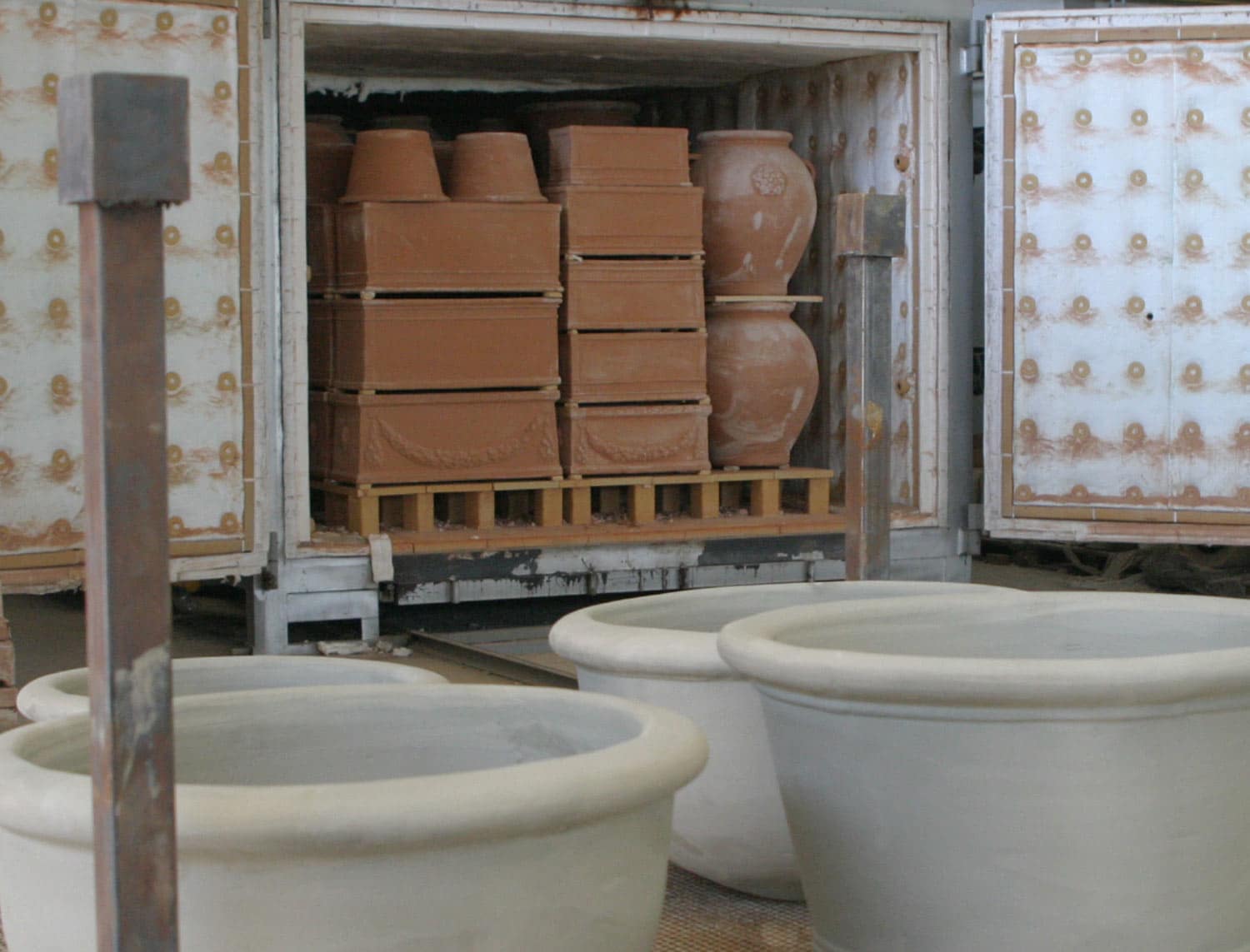
Every clay, whether earthenware or stoneware, has an optimum maturation point when fired. When this point is reached, the clay is “vitrified.” When clay becomes vitreous, it means that all the different ingredients in the clay have melted and bonded together to form a mature, very strong, “ceramic.” If a clay is over-fired it becomes flakey and worthless. If a clay is under-fired (like many of the pottery containers that are called “terracotta”) it is weak and porous and highly susceptible to cracking, even without being frozen. So when we talk about frostproof ceramic or terracotta, interestingly enough, we have to talk about fire first. In ceramics it always, always, always, comes back to the fire.
The key equation: the more vitrified, the less absorption. Did you catch that? Absorption yields expansion/contraction and hence cracking, during a freeze/thaw cycle. That’s basically it. You’ve got clay, you’ve got fire, you’ve got maturation/vitrification, and you’ve got frostproof ceramic. Or, more plainly put, if a ceramic vessel is not fired to its target temperature, it will die an easy death no matter what the weather is doing. But if it will last longer than you do. Just think about that for a moment.
Here is what you can do when you are ready to purchase frostproof ceramic containers:
1) Research the manufacturer’s credibility. If you are buying real, frostproof ware, know where it comes from and how it was fired, and get something on paper, like a warranty.
2) Protect your investment! Do not add moisture to a vessel that you know is going to freeze. And if you are going to take the time to cover the plants, take the time to cover the container too. Start to think of the ceramics as a living, breathing, expanding and contracting entity, just like the plant that it holds.
3) IMMEDIATELY call Eye of the Day. They have been selling frostproof terracotta for more than fifteen are not only knowledgeable, but relatively good looking and congenial, and carry the best frostproof terracotta on the market (guaranteed to withstand temperatures down to minus 15° F).
4) Move to California!