Montecito Landscape Refine a Santa Barbara Garden

Eye of the Day|Montecito Landscape|Garden Carpinteria Design
Blueprint: Montecito Landscape Refine a Santa Barbara Garden

Chris Cullen, the founder of Montecito Landscape, began landscaping at the tender age of eight at his family home in Los Altos Hills, CA. He got his contractor’s license in 1970 and moved to Montecito and named his company after his new home town.

Eye of the Day|Montecito Landscape|Garden Carpinteria Design
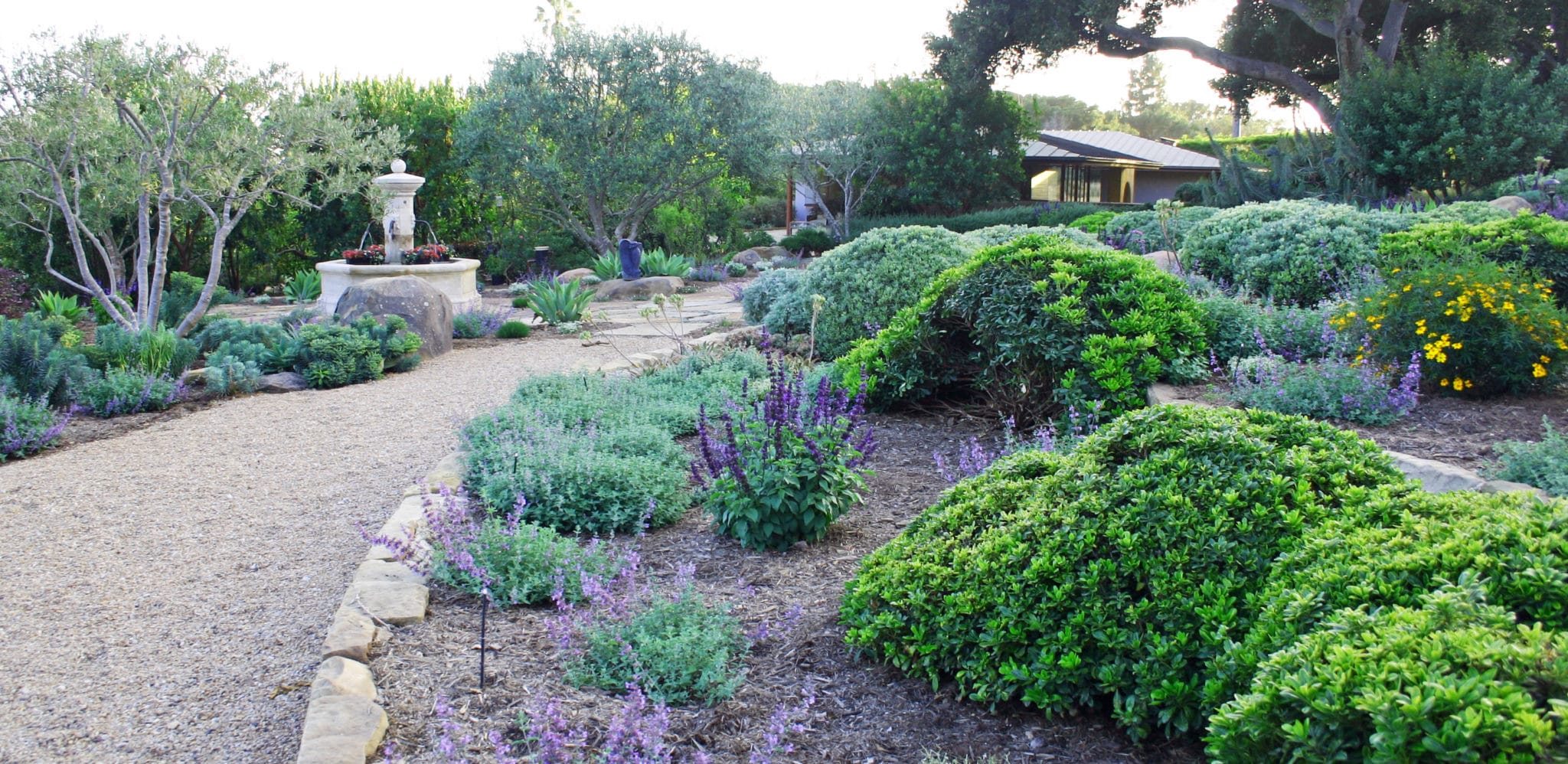
The house had the “good bones” for this garden redesign.

Since then, Montecito Landscape has specialized in design and installation of residential landscapes. Chris has created some of the mainstays of the “Montecito Landscape” that are part of the image we see when we think of Montecito. For example, he was responsible for the creation of original landscaping at Ennisbrook (on Sheffield Road) adding the double line of Stone Pines that line the walking paths through the west end and choosing the specific type of trees planted at the entrance to match the plaster wall of the original construction (the plaster color was later changed, but the trees still remain).

Eye of the Day|Montecito Landscape|Garden Carpinteria Design
Santolina planted alongside the pathway.

One of Chris and Lisa’s newest projects is a Santa Barbara home. The property had “good bones” but needed refinement. There were a number of unattractive hedges that blocked the beautiful vistas and made it feel hemmed in. The home is a work of art in itself with its simple, modern design and the way it is nestled into the property gives it the sense that it is a work of nature. Their job was to enhance the organic feel of the house and property while creating some space both visually and literally.

Eye of the Day|Montecito Landscape|Garden Carpinteria Design
Keeping the natural feel of the property.

Consistent with Montecito Landscape’s garden design philosophy, they first isolate, and then focus on bringing out the best features of a property. Their feeling that each location is as different as each client helps them to approach every new project “intending to help the client see and appreciate their assets and then work with them to discover what it is they need and want.” It then becomes a focus to fulfill the clients’ dreams in such a way that uses their home and property’s intrinsic beauty in unexpected and surprising ways. The goal is to use the entire property in the “picture”, creating “negative space” in a three dimensional design.

Eye of the Day|Montecito Landscape|Garden Carpinteria Design
Sage to keep it keep the garden colorful.

Eye of the Day|Montecito Landscape|Garden Carpinteria Design
Succulents planted to keep it waterwise.

When determining exactly what needed to be done when working on this project and how to fulfill what the client wanted, the Cullens knew that something about the landscape “wasn’t quite right” but they couldn’t identify it themselves. “In fact most of our clients know what they want and know when something works and when it doesn’t. What they don’t know is how fix it. That’s where we come in. This garden already had a drought tolerant theme, however many of the plantings were just not working; they were kind of ‘clunky.’ We suggested the addition of brightness and light to the scene, so that is what we did. With the addition of Euphorbia, Mexican Sage, Nepeta, Santa Barbara Daisy, Santolina and others we were able to add color and softness. When there is a lot of hardscape, as there was in this landscape, we wanted some softness as a counterpoint.”

Eye of the Day|Montecito Landscape|Garden Carpinteria Design
The handcarved French limestone fountain from Eye of the Day

When it came to adding garden décor “the client knew they wanted a water feature as a focal point and so of course, we sent them to Eye of the Day. With Brent’s help they found exactly what they were looking for. It then became our job to incorporate the fountain into the landscape in such a way that it seemed as if it were always there. This is our goal, then, when we utilize garden décor, fountains, sculpture, etc. it should feel as it belongs.”

Eye of the Day|Montecito Landscape|Garden Carpinteria Design
Montecito Landscape creates a harmonious design between decor and design.

For Chris and Lisa, “It is always a pleasure to create a beautiful ‘picture’ in the landscape; it’s why we do what we do. We live for the creation of aesthetics. The pleasure comes in working with the client to give them a garden they will use and enjoy for years to come. This project was no different. We loved collaborating with this particular couple because they were very involved and they love to work in their garden.”

Eye of the Day|Montecito Landscape|Garden Carpinteria Design

See more of Chris and Lisa Cullen’s work at Montecito Landscape.

A LANDSCAPE ARCHITECT DESIGNS FOR THE DROUGHT

Eye of the Day Garden Design Center|Sally Farnum Before and After garden design|drought

A LANDSCAPE ARCHITECT DESIGNS FOR THE DROUGHT

While landscape architect Sally Farnum of SE Farnum Associates has been taking the time to educate her clients about how to deal with their outdated, thirsty landscapes—especially rolling, green lawns—she has designed and implemented an outside environment for her own home that is water-considerate and still lush, inviting and peaceful.

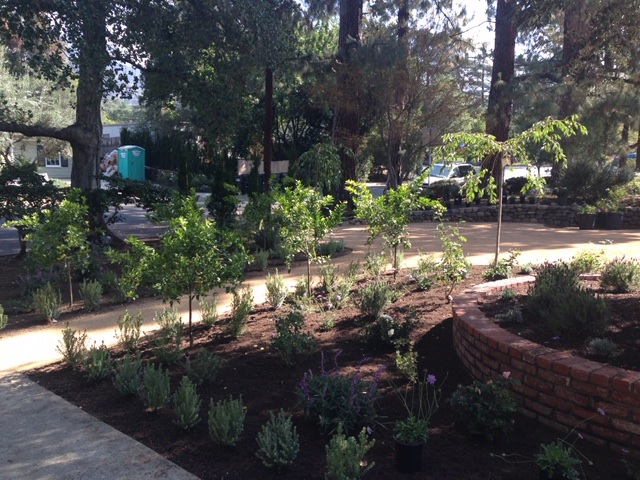
The first task was to remove a large front lawn and some accompanying flower beds.

BEFORE: Water-thirsty lawn

DURING: Removing lawn and introducing granite

Next, grading, drainage and landscape plan was translated to the area. Decomposed granite was used as the base of the pathway from the driveway, culminating in a keyhole design, at the end of which a dry-stacked rock wall would serve as a retaining wall as well as the background for a Gladding McBean fountain conversion.


ALMOST FINISHED!
Flanking each side of the pathway are two Antique Green Gladding McBean Oil Jars, preparing the eye for the fountain.  Planting on the perimeter of the path area includes a variety of water-friendly plants and trees.


STAY TUNED
Check back next month on Sally’s design in progress for photos of the finished project.


How a Landscape Architect Approaches Garden Design During California Drought

Eye of the Day|Sally Farnum Landscape Architect|garden design drought

Having a sister with a long, successful career as a landscape architect has made it easy to have an ongoing conversation with Sally Farnum about design, client concerns and current issues. We are all especially interested in California’s water problem and wanted to find out how Sally is helping her clients address the issue.

Suzi: What have your clients have been asking about when it comes to water and their gardens?
Sally: Most of my clients are trying to be responsible when it comes to water usage in their landscape. They want to know if they need to take out their lawns, replace their flowering plants with desert plants and if it will still look pretty.

Suzi: How do you approach designing a plan that reflects water-consciousness but is still pretty?
Sally: I really work to combine good elements of design in all my plans: scale, balance, variety, form, line, texture and color. I like to use California natives, salvias, lavenders along with containers, sculpture and fountains.  I suggest using decomposed granite and gravel and, really important, an extra-efficient irrigation system.

Suzi: How do you convince them that a huge, green lawn isn’t the best plan anymore
Sally: Most people are visually oriented, so to describe an idea in words alone doesn’t always convince them. I show them photos or have them visit other projects I have completed.  But I don’t feel that it’s necessary to remove ALL lawn. Only 5% of residential water is used to keep lawns green and it contributes to cooling an area, cleaning the air and reduces noise. Grass in a front yard, used to fill space, should be eliminated.

Suzi: Do you have a favorite or most challenging project which incorporated water-wise elements?

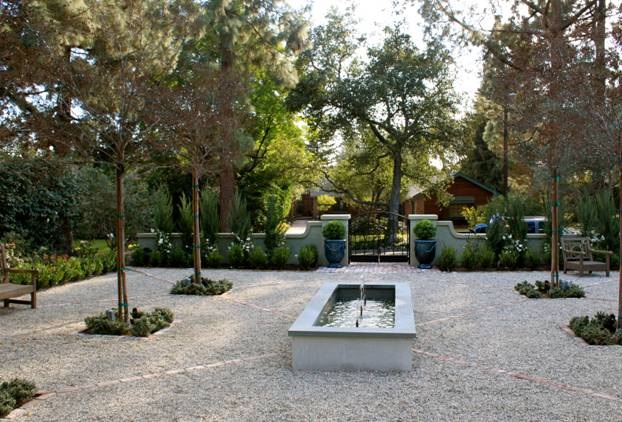
Sally: One of my favorite and most challenging designs is right across the street from my own home.  Challenging because the home belongs to a friend and because I look at it most every day. My favorite because of the transformation from a front yard with a large asphalt driveway and lawn, to a garden with a walled-in gravel courtyard with a fountain and pots planted with flowering plants on the street side of the wall.

Suzi: How have you managed to change the way you designed in the past to meet the new challenges presented by the drought?
Sally:  The challenges are mainly in working with my clients and helping them accept new plants and watering habits.  Most plants will adapt to using less water, but people tend to water more than necessary.  I haven’t changed the way I design, but I have changed the materials and plants I use.


Suzi: Thanks, Sal.  You’re always such a wealth of information, and a fine sister, too.
Sally: You’re not so bad yourself.


The Landscape Professional and Client Relationship Part 2

Eye of the Day|Puck Erickson|garden design architect

The Landscape Professional and Client Relationship, Part II

Principal at Arcadia Studio in Santa Barbara and a resident of Los Olivos, Carol Puck Erickson, ASLA,  has an extensive portfolio of residences and arid gardens in Arizona and beautiful installations throughout California, Puck was initially educated in the visual arts, which still informs her work. She is an avid bi-coastal hiker and amateur botanist who is intrigued by the relationships between the cultural and agrarian landscapes and the native environment.

Puck is also committed to the therapeutic value of gardens, as a founding member of the Santa Ynez Valley Botanic Garden and pro bono consultant for many school and community gardens.  She has worked with Eye of the Day on a large variety of projects over the last two decades and is one of our favorite landscape professionals.

EOD: How has your design relationship evolved over time with any particular client?

I have enjoyed working with clients on multiple projects, sometimes over decades as the gardens reflect an evolution in their owners’ perspectives on the twists and turns of their own lives. Working together, we gain an understanding of the role time plays in a garden and in our own lives.  Often, with their second or third gardens, people are willing to plant a bit smaller and also to simplify their approach to garden designs.  While others, coaxed into the out-of-doors by their first garden, become avid collectors and gardening enthusiasts.

EOD: How do you accommodate the client’s changing tastes over a span of time and still allow your own accumulated professional experience to show through?

I listen closely, very closely!! As the years have flown by, I find that often I am simply a translator and steward as my client churns out ideas with unbridled enthusiasm, often without recognizing their own insight into a space, or an observation gleaned from their travels. It is through my experience and design discipline that we can take these wonderful ideas and marry them to the environment of the new garden.

I am often surprised at how easily some designers seem to let go of their gardens and the evolution of those spaces, from both a horticultural and aesthetic perspective. When we work with clients we are not creating a garden image, frozen in time. Once the garden is completed, the real fun begins. The garden begins to build its own rhythm and dynamic as it flows from season to season and we are committed to continue that dialogue with our clients and their gardens over years, if not decades!  I think responding to the drought is a perfect example of how an on-going relationship with the client and their garden can make a real difference.

To view more of Puck’s work, visit Arcadia Studio.


Morocco in Your Own Garden

Eye of the Day|Moroccan Garden|Newsletter

Morocco in Your Own Garden

California gardens, especially those in Southern California have long utilized the concept of outdoor rooms. Countries with warm, dry climates around the Mediterranean basin have been creating miniature oases outdoors for centuries. Taking a cue from them is one way to replicate both the feel and appropriateness of this style.

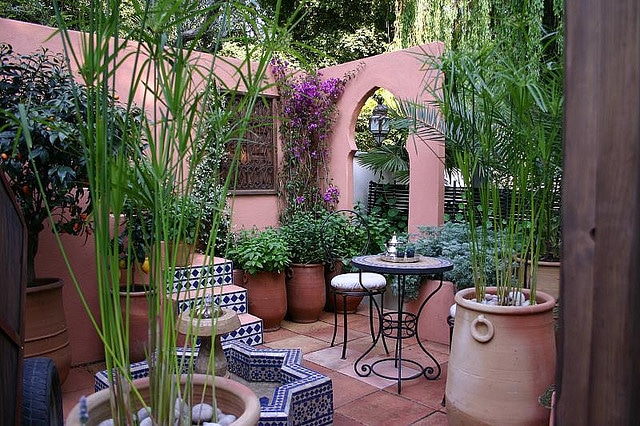
Moroccan gardens provide great examples of the restrained use of water to create a lush setting in outdoor courtyards and passageways. Even while reducing your water use in the landscape, you can create an intimate, yet luxuriant garden space by taking inspiration from arid North Africa. Gardens there are generally central to the dwelling, both to provide privacy and protection from the heat and winds.

One of the key elements of these enclosed spaces is limiting water use. The Arabic word for a garden of this type is riad and usually refers to the central fountain or ornamental pool. The fountain need not be large to provide a bit of cooling to the air as well as a sense of peace and luxury in a climate where water is scarce.  It is possible to recreate that feeling with a simple water feature created from a glazed pot and a small, efficient pump instead of building a large fountain.

Another feature is the exuberant use of color. Colorful pots, a painted wall or gate as well as bright flowers make for a vibrant and even joyful setting. Vivid glazed tiles, whether on the patio floor or the surface of a fountain, also contribute to creating an exotic paradise.

Plants can be used as well and they do not have to be those that require a lot of water. There are many that are drought tolerant, yet lush-looking. Large leaves give a more topical feel and species such as bird of paradise, aspidistra and pygmy date palm do well in containers. Succulents are a great choice; from cacti to agaves and aloes, they thrive on little water and their foliage provides drama and color. The Canary Islands is home to a wonderful group of succulents, the aeoniums, whose fleshy leaves grow in large, showy rosettes and would be perfect choices. Even the humble geranium (Pelargonium) is sturdy and produces flowers nearly year round. Assemble several plants in one container to provide a miniature landscape or group individual pots together, mixing and matching your color palette.

Look at Planted Wells blog for more Moroccan garden design inspiration.

Image Credits:
Moroccan Garden – Creative Commons, Chelsesa Flower Show Gardens by Rictor Norton and David Allen is licensed under CC by 2.0
Plant Image – Creative Commons, BCSS gloucester branch auction – The national agave collection by stephen boisvert is licensed under CC by 2.0 


Clay Pot Irrigation Benefits During Drought

We had a very quick winter here on the Central Coast with just a little bit of rain, spotty at best, while the rest of the country has been buried under blankets of snow. As California is technically still experiencing a severe drought, I want to address ceramics in irrigation.

Irrigation Through Clay
In the newsletter, we have covered many subjects concerning ceramics.  In irrigation, ceramics also has many uses. The Romans created an intricate system of aqueducts, which directed water throughout all parts of the empire. We see this around the world, ceramic pipe systems carrying water through towns and villages.

Clay Shards and Slow Water Release
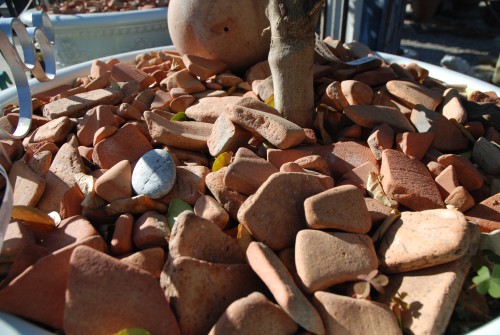
Ceramic “shards” can also be used as a soil amendment. The broken pottery has to be low fire to be absorbent.  Low fire ware may be crushed and added to the soil and as you water, the shards act as little sponges and absorb the water and release it essentially as needed below ground.

Clay Pot Irrigation

Another use I find very interesting is what is called “clay pot irrigation.” If you perform an internet search of this term and go to “Images,” you will see excellent examples of how this works.  Essentially, it is a very simple technique.  Again, a low fire vessel is made by a potter, and is then buried right next to the plants you want to irrigate; fill it with water, and because of the porosity of the low fire ceramic, it leeches through the walls of the vessel and waters the plant by slowly releasing a minimal amount of water.

Cultures around the world have been using this method forever!  Look it up, check it out, and enjoy these new yet very old techniques of gardening.  Ceramics in your garden is not just decorative, it can be very functional.