Eco Friendly Landscape Design by Lisa Cox for Hacienda Style Home

Lisa Cox, of Lisa Cox Landscape Design has happily designed landscapes ranging from simple tract homes to vast estates.  As she plans an outdoor environment, she envisions a transformation that communicates the lifestyle and personal taste of the client, while incorporating her own style. Each garden is designed and built with all materials including stone, plants, trees, water features, and garden art selected by Lisa using local, top qualified growers and suppliers.

Eye of the Day Garden Design|Blueprint Eco Friendly Landscape Design|Lisa Cox landscape design
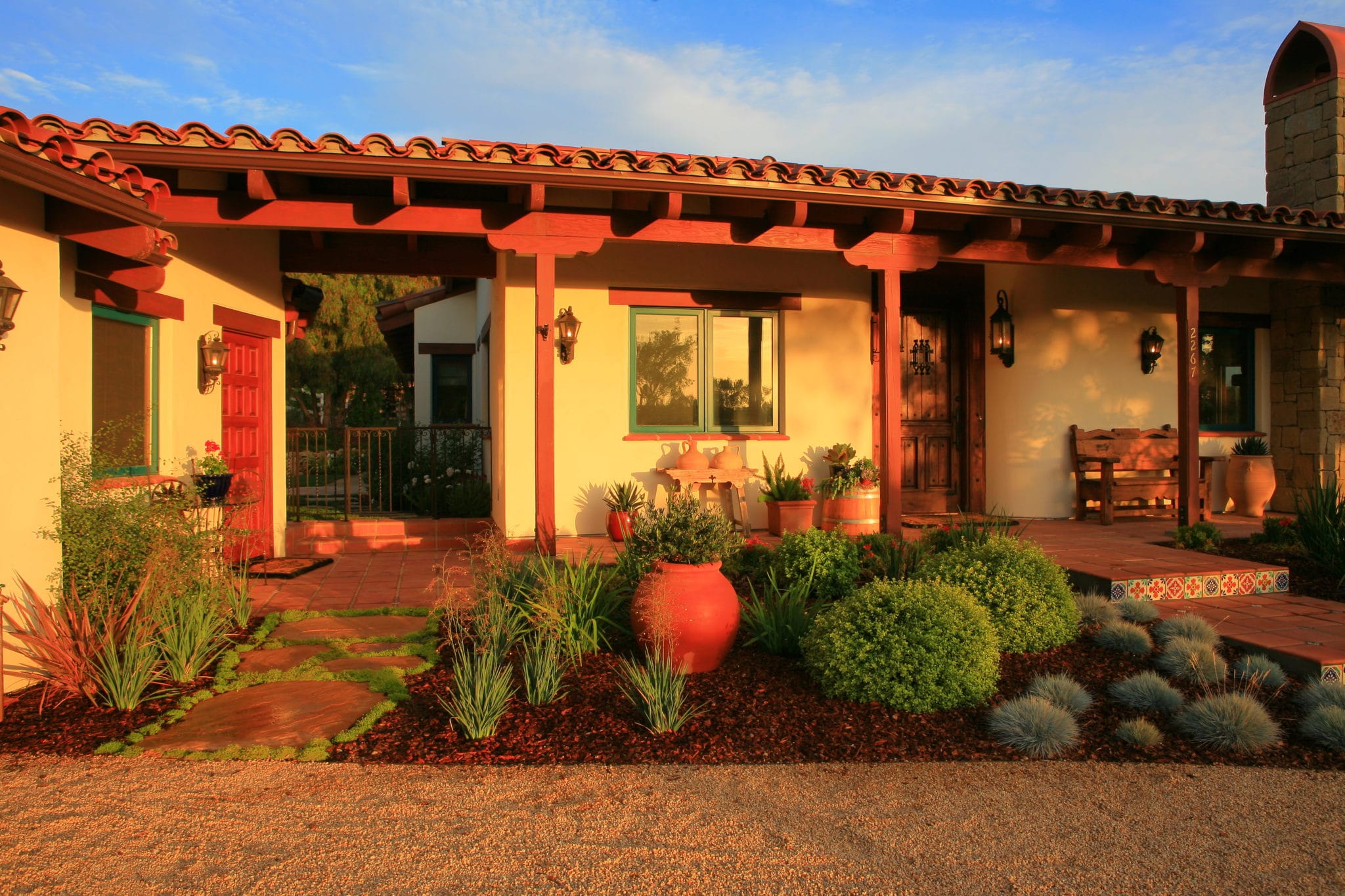
The Hacienda style home’s landscape design now incorporates eco-friendly plantings.

Commitment to sustainability, the use of drought tolerant plants and trees, including California natives, has been an integral part of her design process, allowing a more “naturalistic” result that mimics the local terrain.

Eye of the Day Garden Design|Blueprint Eco Friendly Landscape Design|Lisa Cox landscape design
Drought tolerant plants and California natives were used in the design.

When Lisa met with her new clients in the Santa Ynez Valley, they requested that the newly constructed home not have any sod in the front area, and that she use drought tolerant plants including grasses and succulents. Working with a blank slate, except four nice sized olive trees at the entrance, she was free to design the space, including selection of a plant palette that complimented the Hacienda style of the home. With the use of local sandstone boulders, salvias and phormiums as her base, she also incorporated deciduous trees and perennials for color in the Spring and Summer, and a few rows of grape vines because after all, it’s the Santa Ynez Valley!

Eye of the Day Garden Design|Blueprint Eco Friendly Landscape Design|Lisa Cox landscape design
Lisa incorporated Eye of the Day products like the Greek terracotta in the design.

Choosing Greek terracotta pots from Eye of the Day, filled with “Blue Glow” Agaves gave the clean, rustic look she was looking for on the front porch and the traditional Terrecotte San Rocco terracotta pot in front worked perfectly to show off the “Little Ollie.”

It seems everything progressed perfectly for Lisa and her clients, but there WERE a few important challenges:

  1. The need to place a gopher basket for every plant as the local area is inundated with gophers that would quickly destroy the plantings, and
  2. The necessity of paying close attention to selecting plants that can stand the heat as well as the sometimes frigid nights where temperatures can go into the low 20’s or below.

Eye of the Day Garden Design|Blueprint Eco Friendly Landscape Design|Lisa Cox landscape design
Close ups of the plantings Lisa used in the landscape that would work all year.

As Lisa’s work on the project came to a close, she felt deep satisfaction; in fact she felt this was a home environment she could inhabit herself.  The project was a dream to work on and the end result was exactly what the homeowner envisioned.

Visit Lisa Cox Landscape Design to view more of her work.


Landscaping to Keep Your Friends: An Outdoor Makeover

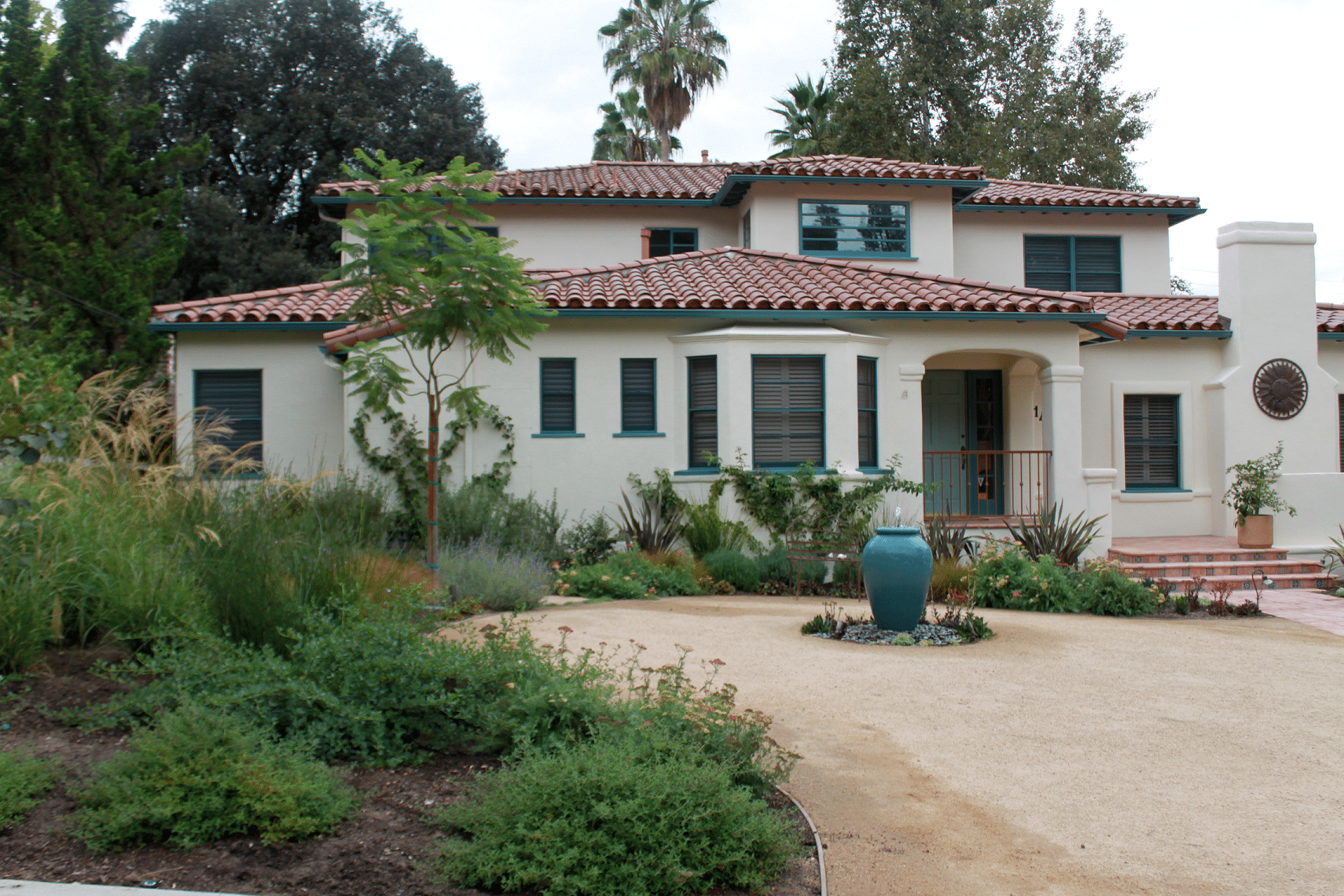
The owners of this classic Mediterranean home in Glendale, California contacted Sally Farnum of SE Farnum Associates in Altadena for a new front yard design requiring minimal maintenance and low water use. Her design included a Gladding McBean Oil Jar fountain conversion in Caribbean, as well as two Gladding McBean planters flanking the front entrance.

The neighborhood in Glendale, California, a suburb of Los Angeles, was lined with houses showing off well-manicured lawns and lush plantings. But like most streets, it had ”that one house.” You know the house. Dried and dying lawn, gopher holes dotting the landscape, and essentially an eyesore to a neighborhood that otherwise boasts its curb appeal.  Before their neighbors stopped talking to them, my clients contacted me to revamp the landscape in front of their home. These were busy clients who just work, work, work, leaving very little time for yard work. They were leaving the digging and turning of the soil to the gophers and the trimming to the deer. They even spent a few hours a week unsuccessfully trying to combat rodents with traps, flooding, and varmint bombs.


Change did not come easily to these clients, but they knew they needed to do something. They requested a garden design that would require minimal maintenance and low water but still incorporate beautiful plantings, as well as being deer and gopher proof. I discussed the beauty of replacing their lawn with a composition of decomposed granite, new and colorful water-wise plantings, hardscape using saltillo concrete tiles and a new fountain.

Initially the clients’ three colors of choice were beige, dark beige, and white, but I was able to convince them that a lively color palette can be beautiful, energizing, and attractive not only to them, but to desirable visitors like butterflies, bees, and birds. The plantings include colorful sages, ceanothus, lantana, and achillea that not only drink little but the deer and pesky gophers don’t find them to their culinary liking.  It’s been almost a year and they haven’t lost any plants to the wildlife, what a success!


The colors of the Malibu tiles that we used in the hardscape were definitely an influence on my desire to use a Gladding, McBean oil jar for a fountain. I was thrilled that my clients selected the Caribbean blue over a more subtle color and love the fountain conversion done by Eye of the Day. The clients are so happy with their colorful garden that they recently asked me to help select the palette for the re-painting of their house and of course the selections are very close to the color of the Gladding McBean fountain.


Design and Los Angeles Love: Interview with Mark Rios of RCH Studios

Design and Los Angeles Love: Interview with Mark Rios of Rios Clementi Hale Studios

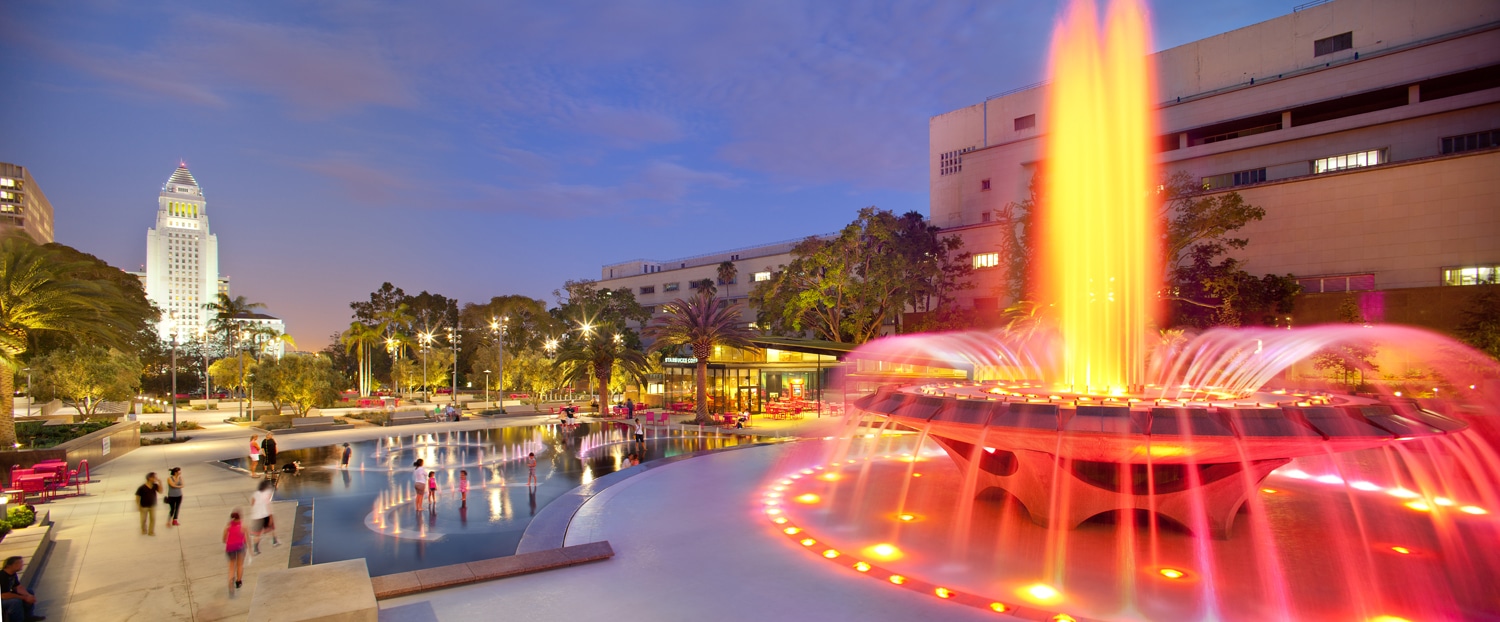
The easiest way to the heart of a native Angeleno is to give accolades about their beloved, but often maligned, city. Mark Rios, FASLA, FAIA, Founding Principal of the award-winning and admired design firm Rios Clementi Hale Studios in Los Angeles, is ten minutes into our interview when he says, “LA is this amazing melting pot,” before rattling off LA neighborhoods like a seasoned Metro driver. That regional knowledge would be a necessity at this point as RCH Studios has made their mark in elevating the Los Angeles landscape with high-profile designs as large as Grand Park in downtown and as small as Sunset Plaza in Silverlake, which was the prototype for a now citywide parklet program.

In much of the work in their portfolio there is a balance of the city’s cultural heritage, sustainability efforts, and an evolving and limitless design process. The firm plans to introduce the first living green wall to Sunset Boulevard. The dramatic six-story sculptural lattice of native plantings and an accompanying public plaza “will provide a breath of fresh air for further build a sense of community.”

With over 75 design awards and a fine educational pedigree, it would be easy to sit back, but Rios insists on being challenged by, and having fun with, design and the city’s rich mix of cultures. Rios and his firm don’t just praise the uniqueness of LA, but seem to be making this a long-term love story.

Eye of the Day: Your firm takes on a diverse mix of projects, from traditional houses and gardens, to campuses, public parks, and even furniture. What design philosophy do you personally bring to each project? Is it important that you finish a design with a certain goal in mind?

Mark Rios: I really believe that having a diverse body of work inspires…one project inspires another in a non-linear way. There are really great architects and really great landscape architects that focus on a particular work type, whether it’s residential, healing gardens, or tall buildings or something. And we try to do the exact opposite. And maybe it’s because we get bored quickly. (laughs) But I think the idea of learning about a problem you’re trying to solve is really fundamental to how we work. And so, I’m just passionate about the research that goes behind each project. So doing something you’ve never done before, or haven’t designed before, is really exhilarating because you have to go through all this detective work and find out about all the things that go on in making decisions about it. So a broad practice is definitely harder to achieve and it’s kind of harder from a business model. But I think for us as designers it’s more satisfying.

EOTD: I think that’s important. It must be hard to balance the business model, but to also stay true to what you want as a designer and get what you want out of that project.

MR: (laughs) It is complicated. I think that we try to establish really high aspirations for each project and that sometimes those goals or concepts evolve as you learn more about the project and more about what its needs are, what the client is about, and what the design is about. You always want to end up with a solution that solves all the issues, works really well, is on budget, and is really beautiful. But on top of that, it has to address a higher concept of nature, it has to have an idea, it has to be memorable. You want it to be provocative in some way, and so I think good work has to tell a story—it has to have a big idea behind it.

EOTD: You’re a Los Angeles-based design firm that’s changing the landscape of the city. I can play a game of chess in a pocket park in Glendale under glowing abstract chess pieces that tower over me or celebrate the Fourth of July in Grand Park—you’ve got Angelenos ditching their beloved cars to walk around downtown LA. In many of your projects there seems to be a drive to revive the city in a modern and fresh way. What about Los Angeles and its people inspire your projects? Do you think LA doesn’t get enough credit as a place for great architecture?

MR: You know, I think that LA is this amazing melting pot. And what I love about it, what I’m really inspired by, is the cultural diversity. And I think it’s the most diverse American city. And diverse in a really authentic way, not in a Disneyland way. You have all these different, really rich communities. They’re really vibrant; they have their own sort of villages within this bigger city. And there are all these facts we’ve learned, like LAUSD recognizes 95 different languages, and, you know, there’s just this amazing spread of people. So I think our work is always trying to understand all these different cultures we are operating with and what the heritages and traditions of these different people are, and how you mix them up—this mash up of culture which is Los Angeles—so that the design is contemporary and it’s about our present-day inhabitants, yet somehow it connects people unexpectedly.

EOTD: Are there any LA spots you really like?

MR: The arts district in downtown Los Angeles is pretty amazing. It’s really transforming very, very fast. People are living there, there’s great…you know…

EOTD: Bars?

MR: (laughs) Bars and great restaurants, and people are having all sorts of new creative office space. It’s a really quickly changing community, but there are all these other enclaves. I think it’s really amazing to drive through Beverly Blvd., from the Westside all the way through Beverly Hills, West Hollywood, Koreatown, and as you go through downtown Los Angeles, it turns into First Street and you go through Mariachi Plaza. And Beverly through to First street is kind of nice—it cuts culturally through all of Los Angeles. So I think those are the really great things about our city. We are in our cars a lot and so I’m always looking at the signs when I’m in my car. What language are they in? What kind of food are they serving? (laughs) You see, you go through all these precincts of different cultures. It’s fun.

EOTD: I think taking someone new to LA through Beverly is a good way to show how our city is, in a lot of ways.

MR: Yes. And it takes all the bad stuff about LA—the traffic, the car culture—and all of a sudden makes you reexamine it in a new way. Your car is your vehicle to be a cultural explorer. It’s like this little space capsule that lets you go and see all these different things. Other cities don’t have that as much.

EOTD: Because you’re based in California, drought is an issue that must come up in your design projects. To keep designs sustainable, how do you still incorporate features that one would traditionally expect in a garden or landscape, like trees, lush plants, or fountains, while in drought-conscious California?

MR: I think it’s really our responsibility as architects, landscape architects, and designers, to really push forward, to get off the grid. Sustainability really deals with all different aspects. It deals with water, power, and energy. And it’s really about trying to make everyone less dependent on and not wasting natural resources. So we’re trying to make all of our work more sustainable as far as taking less water, as far as planting areas. It’s about recycling and reusing and filtering water, as far as water drain-off, before we put it back into the ground through the storm drain system. We’re always looking at ways of generating and powering our projects and how they can be more off the grid. And there are all these living building challenges. And the AIA has a 2030 Challenge [to reduce fossil fuel usage in the building industries to attain carbon-neutral status by 2030]. And architects and landscape architects are really pushing hard to change our physical environment to make it more balanced.

EOTD: Do you have any recent projects that speak to that philosophy?

MR: One project that’s kind of fun is on Sunset Blvd. We’re doing a renovation of a big office building on the corner of Holloway and Sunset for IAC, Barry Diller’s company. And we’re putting this huge, new planted façade on the building that’s about six stories tall. It’s this big huge, moving, kind of curved awning that hangs out. It’s all planted with these plants from the Santa Monica Mountains—so all the plants are native plants. It’s sort of built like a big billboard, so it feels like one of the billboards on Sunset Blvd., but only it’s a plants billboard. I think what’s interesting about it is there is a very high water table under the building and so they are always taking water, pumping water out from underneath the building, and adding it to the water of the sewer system. So we’re basically capturing that water. All the water that we’re using to water this thing is basically from under the building. So we’re reusing the water table water to irrigate it. And it’s all sensor controlled so it only gets a drop of water when it needs it. What’s nice about it is that it’s not potable water. It is water that’s basically discharged water from under the building. So that’s a very sustainable story. People might ask, Why are you putting all these plantings on this building on Sunset during a drought? But we’re actually reusing all this water that’s getting thrown away to do it. And by doing it, it also helps with air purification and all sorts of things. I hope everybody looks at it and goes, That’s really beautiful, that’s cool and I really love it. They won’t realize it, but it has all these layers of research behind it.

EOTD: You have degrees in architecture from USC and Harvard and your designs are known for their clean and modern lines. You have formal training, but your projects go beyond traditional explorations as you’ve ventured into product and graphic design. Can you tell us more about your and RCH Studio’s multi-disciplinary approach to design?

MR: You know, I like to think of the office as this design think tank and that we are a group of designers that do research, and we evolve ideas, and those ideas get built or manufactured, and made into lots of different things. An idea can be realized through a building, can be realized through a sign, or it can be realized through a plate. But it’s the same process, analysis, research, and inspiration that goes into that. Whatever the final craft you are making is, it’s kind of the same design process. We really think of ourselves foremost as designers, and not sort of limited by a traditional discipline. We think of ourselves as interpreters of culture, just like someone who is making a movie or writing a book, trying to tell stories about our culture—and we are using a variety of methodologies to elaborate on and tell those stories.

EOTD: Are there any projects you’re currently working on that you likeparticularly that are outside of the box of what we think landscape architects typically do?

MR: We’re starting to experiment with fashion. Most landscape architects may think about it, you know, but it’s kind of a hard new thing to be learning. We’re starting with small pieces, like bags, scarves, and pocket squares, and things like that. We’re starting to think about other stuff, but I think that we’ll continue to evolve and hopefully try new things. I don’t want to know what I’ll be doing in three years! I want to see what happens—surprise myself.

EOTD: Container gardening is an easy way to control water consumption and is a popular form of gardening in drought-stricken California. In residential design, containers are often one of the last components added to a garden or home. How do you incorporate pottery, containers, or planters in your overall design?

MR: I think container gardens are fantastic for all the sustainability issues we’ve mentioned, and as far as limited means that give you great results. Containers are also really popular for another set of practical reasons. They’re like raised gardens, they’re easier to get to; they’re great for kids, the elderly. There’re a lot of practical things about container gardens. I think of container gardens as accessories. You think of your house, you have your favorite things around that animate the house, those things that bring your personality to a particular room. And people don’t think of outdoor spaces as being accessorized in any sort of way. So the first advice I’d give to everybody is don’t worry if all the containers match. (laughs) Don’t get caught up with buying containers that all look alike, you know. Just buy things you love. If you love something a lot, or this thing a lot, or that thing, then all those pieces will go together because, as artistic people, our taste comes through. I think it’s pretty impossible that if somebody loves five different things that those things aren’t going to all work together.

EOTD: So going back to school, you went to USC but also served as faculty at UCLA. One of your partners, Bob Hale, got his degree at UCLA. The schools play each other next month at the Rose Bowl. So when you go into work that day are you sporting Trojan or Bruin colors?

MR: (without pausing) I think it’s probably going to be the Trojans. (laughs) I have a long affiliation with USC and I think they have a great school of landscape architecture now and their art history department is fantastic. UCLA is terrific. I love the faculty there and they’re doing a really amazing job, but I think I’d be on the Trojans side.

EOTD: So no pranking Bob Hale? 

MR: No…we’ll be nice to each other, but you know we’ll each be rooting for our own team.

See the RCH Studio design portfolio here.

Home Outside Palette App: Landscape Design Made Easy and On the Go

Could it be time to add your mobile device to your set of gardening tools? There really is an app for everything. Bring out your inner designer to create the dream landscape you always imagined with the Home Outside Palette app. Move, resize, and even undo with over 280 available elements (trees, paths, enclosures, and more) to an existing or new landscape before even stepping outside. Design on the go has never been easier for novice and experienced designers.

“We created the Home Outside Palette app to help homeowners design their properties,” says Julie Moir Messervy, owner of landscape architecture and design firm JMMDS and creator of the app and the Home Outside online landscape design service. Using any iOS or Android smartphone or tablet, users can upload a property survey and use it as a background, or select a grid or colored background, and mock up their landscape by tapping and dragging hundreds of elements into place. The grouping feature lets you lock permanent elements together (such as the house, garage, and driveway), and the layers tool gives you the ability to play with different versions of a design.

An in-app purchase offers additional elements as well as a measuring tool that lets you input rectangular measurements or “walk-and-click” a GPS-based outline of your space. A drawing tool allows you to sketch free-form garden beds and other features. “From the start we knew that we wanted to include all the green features that today’s homeowners need: laundry lines, greenroofs, chicken coops, veggie gardens, compost bins, greenhouses, solar panels, and more,” says Messervy. “It is possible to have a functional, sustainable yard that’s also beautiful—and this app helps you get the design right before ever picking up a shovel.” When you’re finished, get important feedback before committing to any design element. You can share designs from the app on social media or email them to friends. For additional help with your landscape, the Ask an Expert feature lets you send a design from the app to JMMDS’s award-winning designers for their expert suggestions. The app is designed to be practical and user-friendly for the imaginative homeowner to the professional designer. Messervy adds, “Our mission is to make beautiful design available to anyone, anywhere.”


By Jennifer Silver, Marketing and Special Projects Manager of Julie Moir Messervy Design Studio

Jennifer has held a variety of teaching, writing and editing positions. When she moved to Vermont 12 years ago, she discovered her true passion: sustainable agriculture. She is never happier than when writing or gardening. At JMMDS, she gets to write about gardens—what could be better?


Elements of Style: The Classic Mediterranean Garden

Elements of Style: The Classic Mediterranean Garden

A classic Mediterranean style garden is typically low-maintenance, drought tolerant and perfect for a climate dry and hot in Summer and warm and moist in Winter. For those of us living in California, this seems a perfect fit. Traveling throughout the Mediterranean region, focused on the landscape and gardens, reminders of California are constant.

The defining characteristics of the Mediterranean style are:

  • Focus on hardscapes, with very little or no lawn
  • Citrus, olive trees, rosemary and lavender often planted in terracotta pots
  • Fountains and water features are key. Water features became popular in the gardens of the Italian Renaissance. They reflect the garden and provide the relaxing elements of sight and sound.  Because of the scarcity of water in the Mediterranean,  many water elements offer a relief from the heat.
  • Large and small terracotta pots and urns and statuary. Pottery in many forms has been a part of Mediterranean gardens since their origins in ancient Roman households. From intricate bas-relief to simple and plain, they are quintessential for a European garden.  Statues, urns and planters provide focal points and because their footprints are small, they are particularly useful in a small garden. The Greeks and Romans filled their pots with flowers to add color to their courtyards and pathways without depleting the water supply, or they used them to grow fruit trees that could be moved about  according to the outside temperature.  But pots were also used as beautiful objects on their own – a classic oil jar at the end of an allee, a row of terracotta pots topping a balustrade, or an urn crowning a pedestal.

You don’t have to live in Spain, Greece or Italy to reflect the siren call of the Mediterranean classic garden.  A few carefully chosen garden elements… an antique Greek pithari, a scattering of large terracotta pots and urns and a simple water feature will create your classic otium.  Being water conscious and embracing a rustic, muted look will go a long way toward making your space the place to be.


Lisa Cox Design | Los Olivos Tasting Room Gets Design Update

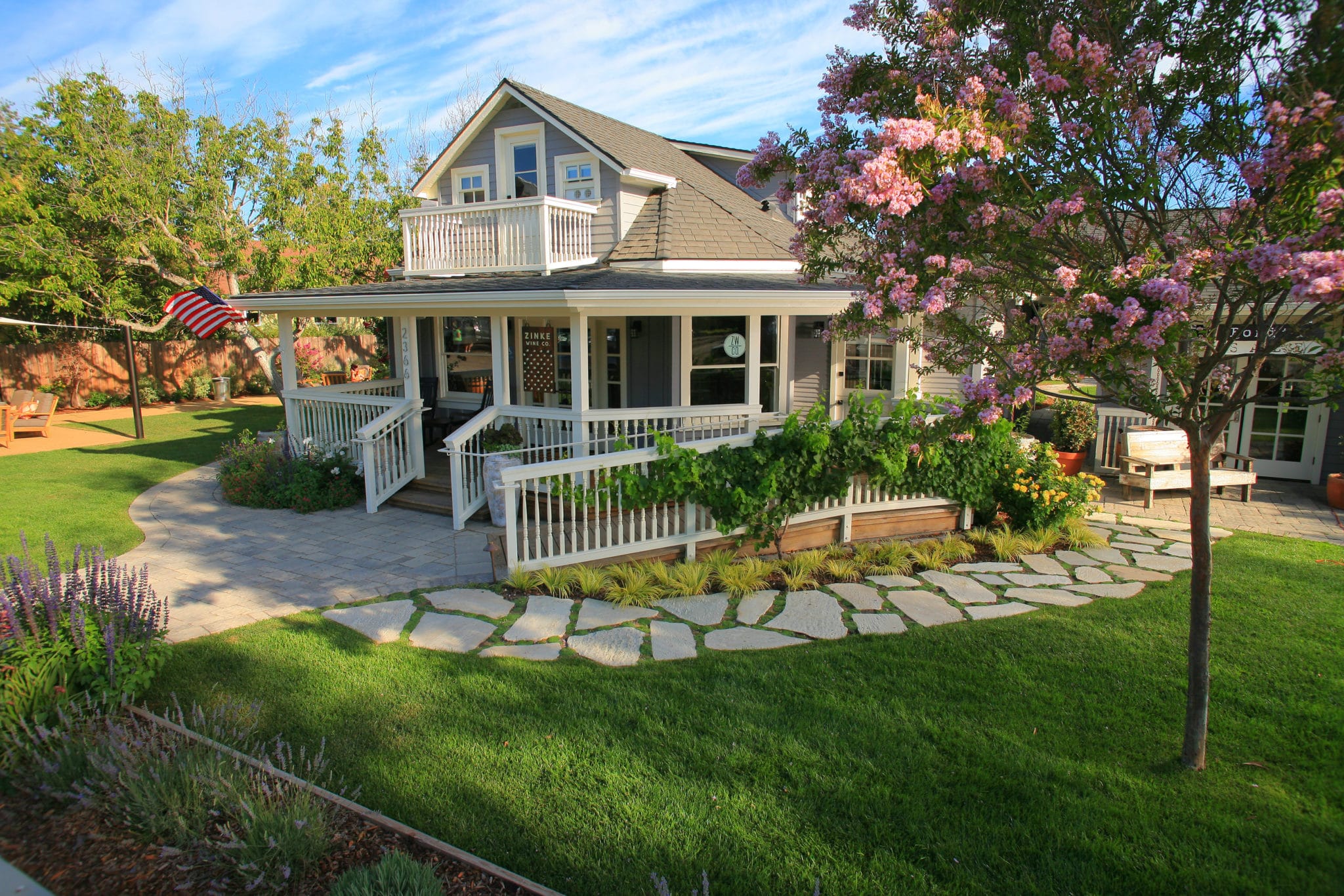
In the relatively short time Lisa Cox Landscape Design has been working in the Santa Barbara area and Santa Ynez Valley, she has become the go-to for anyone wanting clean and sharp designs with a focused point of view. This is clearly evident in her design for the brand new Zinke Wine Co. tasting room. Lisa says she can’t take complete credit for the beautiful design as she worked closely with Thierry Fraye of Paysage Landscape and the Zinkes who have impeccable taste and a clear vision for their brand.

Michael and Ashley Zinke are Zinke Wines. Michael Zinke is a self-taught winemaker that apprenticed at Girouard and Sans Liege wineries before venturing out on his own. They opened their state-of-the-art tasting facility in the wine country township of Los Olivos, CA this past May. They create single vineyard Rhone varietal wines sourced from a handful of Central Coast vineyards. They needed a venue befitting their precious creations and Lisa was the one to deliver.

Lisa incorporated Eye of the Day products throughout her design. As you approach the building you are greeted by two ‘aged’ Greek Bottle pots customized by Eye of the Day standing guard aside the main entrance. Each pot is planted with drought tolerant growth. While enjoying your first taste of Viognier you overlook an impressive Asian carved granite trough bursting with colorful succulents. You can also admire the lovely Italian San Rocco Giara Liscia pot that flanks the bocce court while waiting for your next throw. Zinke Winery Blueprint OverheadAfter taking it all in, we had some questions for Lisa:  

What was your inspiration for the design?
My Inspiration came from a few sources.  First and foremost, the owners, Michael and Ashley Zinke have distinct, incredible taste.  They were looking for a look that felt something with a rustic/industrial look and a warm welcoming feeling from the street that would draw in customers who were looking for something a little different.  Also, with the existing Cape Cod style structure of the Tasting Room, we wanted to keep that charm, but infuse it with a bit of modern charm!

Did the Zinkes have strong opinions on what they wanted or did they leave it up to you?
I would say they gave me a direction as stated above, but pretty much let me design what I felt would present both function and form to the space.

What were the particular challenges with this project?
We needed an area that would allow furniture placement which I accomplished with the DG cutouts that are surrounded with lush green grass. There was some existing hardscape that we “improved” with either widening pathways or substituting new flagstone stepping stones. With a mixed plant palette of natives, lush perennials and color, the end product turned out quite pleasing to the eye…and of course the succulent filled planters are incredible!

What do you most like about designing in the ‘Valley’?
I can honestly say, what I like most about designing in the valley are the people! Since my husband and I have only been here for 1½ years, we can honestly say we are overwhelmed with the warm, friendly and caring SYV community!  And of course, how can you beat our gorgeous natural landscape of rolling hills, oak trees and vineyards…it’s hard to beat! A special thanks to Rich Cox Photography for the images!