California Garden Designer Jennifer Voss of Gardefacts

Jennifer Voss|Gardefacts|California Garden Design

Jennifer Voss of Gardefacts Designs Thoughtful and Practical California Gardens

In our continued series, Blueprint, that covers the work and projects of landscape and garden professionals, we are happy to count Jennifer Voss of Gardefacts in Santa Barbara, California as one of our most loyal designers. She has been using Eye of the Day as a primary resource for over a decade and she uses our products to highlight and enhance her California garden designs.

Jennifer’s love of horticulture began with visits to the Los Angeles County Arboretum with her grandparents, where they wandered through the garden and bamboo forests, feeding the plentiful peacocks and learning the names of the plants.

Jennifer Voss|Gardefacts|California Garden Design
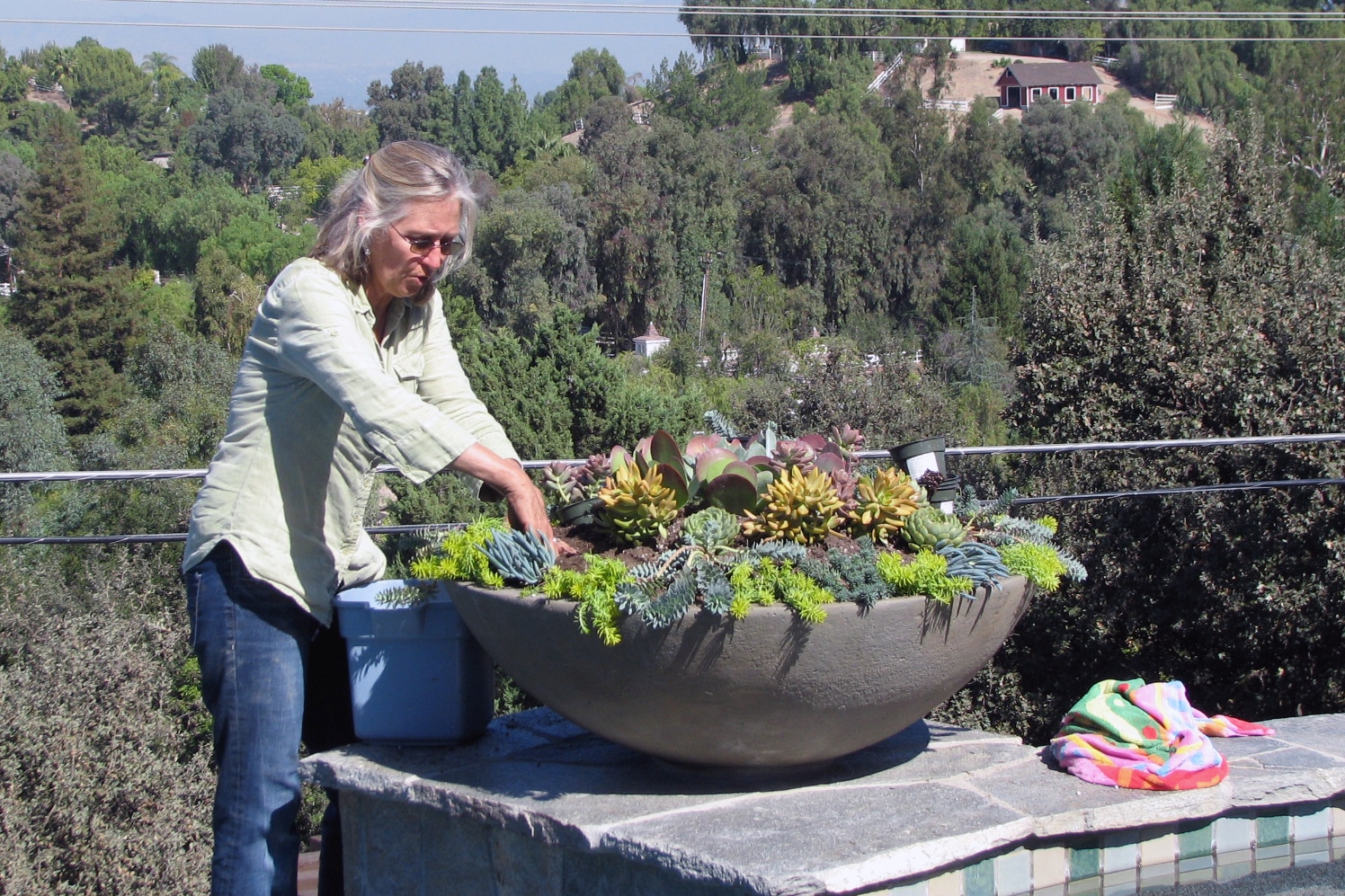
Jennifer Voss starts planting in one of Eye of the Day’s concrete low bowls.

Jennifer Voss|Gardefacts|California Garden Design
The finished design for this concrete low bowl uses water wise succulents.

With Jennifer’s knowledge of plants, she became interested in design and plant care and studied botany in college and Landscape Design at UCLA.  She has visited hundreds of gardens throughout England, France, Italy and the United States and these influences help guide her in her designs.

Jennifer Voss|Gardefacts|California Garden Design
This design uses Eye of the Day’s own Italian terracotta Jar Aubagne pots.

Jennifer Voss|Gardefacts|California Garden Design
An Eye of the Day American concrete planter flanks this California home’s entrance.

Jennifer finds that the best method for working with a new client is to listen closely to how they describe their vision for their space and translate that to a design that is both beautiful and practical.  Check out the photos and you’ll see how Jennifer seamlessly incorporates Eye of the Day pots into her designs.

Jennifer Voss|Gardefacts|California Garden Design
More Eye of the Day concrete low bowls throughout this design.

See more of Jennifer’s work at Gardefacts including more container gardens, design projects, and even edibles!


Tips for Successful Edible Gardening by The Conscious Garden

Eye of the Day|Edible Gardening|The Conscious Garden

Tips for Successful Edible Gardening by The Conscious Garden

In Southern California we love to eat healthy food and there is no fresher, tastier or more nutrient dense foods than those that you pick from your own garden or that you buy from the farmers market.  It is important to know that your food is free of chemicals, organic and full of nutrients,  so what better way to know what is in your plants than growing it yourself?  I want to share with you some of the main things to remember when setting up an edible garden, and whether you have a yard or not, it IS possible!

I have been growing food since I was a kid, and one of the things I have learned, is that plants will grow in anything.  So, what ever you have to grow food in, whether it is a raised bed, beautiful container or just a simple plastic drum, you too can have edible vegetables right at your home.

Tips for a Successful Edible Gardening

Soil
The key to having good nutrients in your food is in the soil and that is also the advantage of growing at home: you can truly know if it is organic and what’s in it as you plant.  Use a premium potting soil to begin with.  If you have a large garden, use a mixture of different composts such as manure and worm castings.  The soil provides the nutrients to the plants and allows them to be strong.

Water
Edible plants require a little bit of water often and if you add a drip system, it will ensure the plants are getting water directly to their roots where it is required and it makes the garden more water efficient.  This is especially important in container gardening, and it will make life SO much easier.

Plants
When you decide to plant, choose seedlings from a good organic local supplier, providing bio-dynamic organic seedlings. This will ensure that the roots are strong and will stand up to transplanting and our current drought conditions, giving the plants a good start to their edible nutrient supplying journey. It is also time efficient.

Pest Control
Be ready for providing pest control – and keep it organic, non-toxic.  Sluggo for snails, Organocide for bugs and Serenade for diseases.  I find that if you notice bugs attacking a particular plant, leave one of those plants free of pest control and the bugs will eat that one plant and leave the rest alone.  (Periodically remove the bug-plant and destroy it removing the bugs and disease).

Feeding
Remember plants need food too!  Fish and kelp as the master formula is great. Or you can use an organic food with mycorrhizae. The numbers on the pack of organic fertilizer should not be higher than 5-5-5, which are nitrogen, phosphorus and potassium in a low balanced form.

Just remember, take care of your edibles and they will take care of you. Don’t be afraid to try your hand at an edible garden. If you see something you would like to plant, try a handful of plants and see how it goes.  Plants are sustaining and will grow for you if you just give them a chance.

I am available for consultations or garden support to fulfill your edible garden desires.

Happy Planting!

Sagar Faucheaux
The Conscious Garden

Phone:  (805) 745 5555
consciousgarden@


The Art of Building Large Terracotta Pottery

Eye of the Day|Baked Earth|Scott Semple Large Terracotta

The Art of Building Large Terracotta Pottery

In all my days of fascination with clay, there is one tool that I would call my tool of choice: the wheel. But the two things that have influenced me most are my teachers and my travels.
Eye of the Day|Baked Earth|Scott Semple Large Terracotta

Over the past thirty years or so I have had the great fortune of traveling throughout the world.  My interest in large format pottery began in the early 90s and quickly became one of the key purposes of my explorations.

There are many ways to build a large, ceramic container.  In Thailand, I watched two assistant potters feed a rope of clay the size of my leg and 20’ long, over their shoulders to a master potter, who would very slowly spin a crude wheel and pinch the coils on top of each other.   This seems to be the most common way cultures build large terra cotta containers.
Eye of the Day|Baked Earth|Scott Semple Large Terracotta

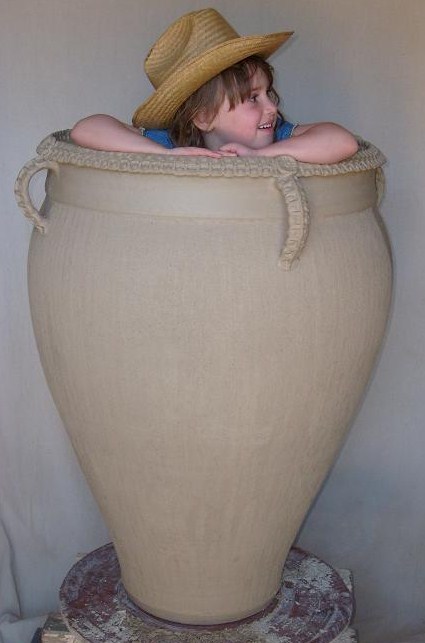
Recently I was a guest artist at a conference where, over the course of three days I made a 7’ Amphora using two wheels. I was positioned next to next to a family of Koreans who were making traditional Kimchi fermentation jars. These things were huge! They used the same coil/pinch method, but paddled the shapes into the forms.   In Georgia (Eastern Europe), they have been fermenting red wine for thousands of years in enormous ceramic vases called Qvervi; they use the same method. Spain probably has the largest pots I’ve ever seen called Tinajas. These absolutely spectacular containers are also used for fermentation,  as well as storing water.

Throughout my travels I have found that around the world, large terracotta forms are still produced for a great variety of uses.


The Rogue Garden

Eye of the Day|Rogue Garden| Container Garden

Brent’s Rogue Garden

People often ask me what my garden at home looks like.  I laugh and reply it looks like a psychedelic trip to a botanic garden gone rogue with cracked pots.  Then they laugh, not sure if I’m being honest or just outrageous, and they’re right, my garden is outrageous and honestly, it is a trip. While we sell volumes of the best and most authentic pottery and garden statuary around, we get our share of damage. Handling heavy pottery, moving it, merchandising it and delivering it involves some mistakes. So I have plenty of opportunities to take beautiful Italian terracotta pots home, albeit with chips and cracks (we epoxy the cracks so they will last just as long as the first quality ones). The problem is what to do with over twenty years’ worth of damaged pots.

Welcome to my test kitchen where I try different plants in different pots to learn what works. Just like a cook’s test kitchen, I have learned what works when potting different plants, hence my belief that the first thing to growing healthy container plants is the drainage.  No matter the plant, it must have freedom to drain continuously.

Eye of the Day|Rogue Garden| Container Garden

Second is the soil. If you match the plant’s root system with the proper soil mixture you will have a healthy plant growing in a beautiful pot. I am a strong believer that perlite added to any soil mixture helps to grow healthy container plants.  Why do I spend more on organic soil amendments? Because I’ve learned that chemical fertilizers work fast and make container plants grow and look healthy initially, but down the road, your container plants will suffer the toxicity of chemical salts which build up in the soil. Using products like “SuperThrive”, soap, Epsom salts, wood ash from my pizza oven and most of all, composted soils amendments from the great composter I got from .

I have pots everywhere, hence the “garden gone rogue.” I have created patio areas on all sides of my house to accommodate all of the pots and plants. If a planted pot at Eye of the Day begins to look shabby, I’ll will take the plant home and perform triage by restarting it in an appropriate looking pot. I learn from doing this what looks good from a design point of view and I can share what works in containers that clients may not have considered before. I have been able to grow and pair plants with our products to help market Eye of the Day while making my “test garden” a realistic place to prove that container gardening is the best way to create “Paradise at Home”!


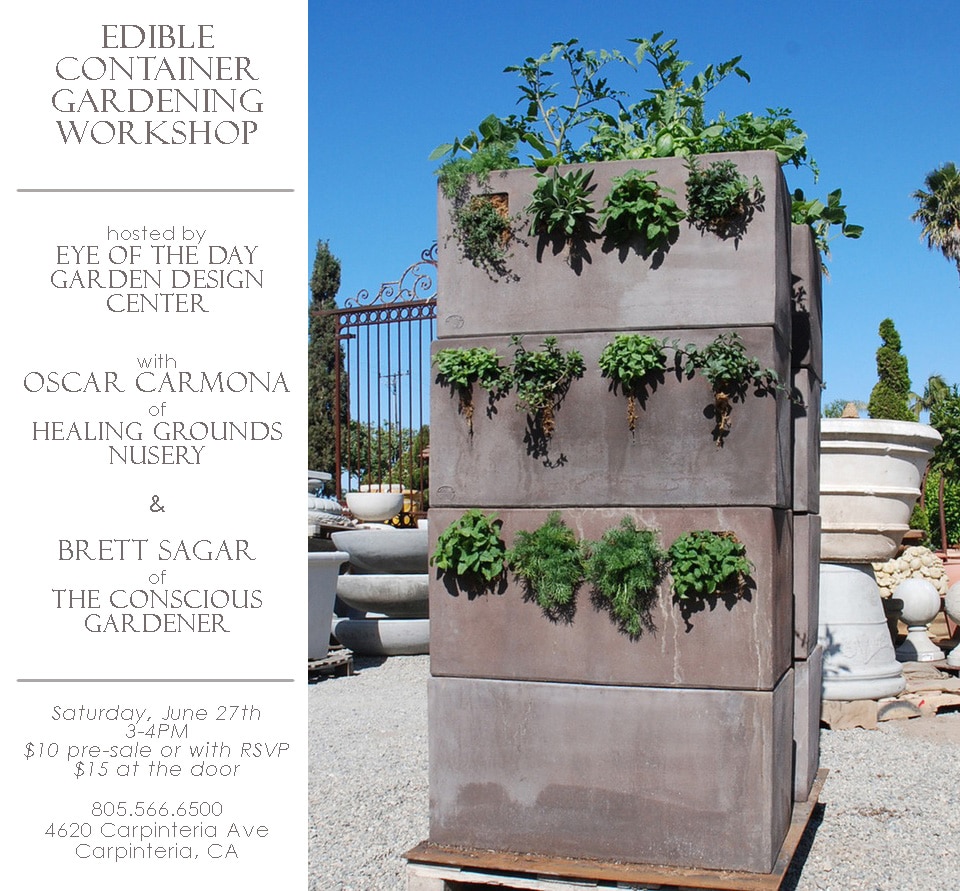
Eye of the Day’s Edible Container Gardening Workshop

Edible Container Gardening Workshop Ad 1 copy


Eye of the Day Garden Design Center is pleased to announce an Edible Container Gardening Workshop right here at our store.

It will be conducted by Oscar Carmona of Healing Grounds Nursery and Sagar Faucheaux  of The Conscious Gardener.

When: Saturday, June 27th

Time: 3-4 PM

Where: Eye of the Day Garden Design Center, 4620 Carpinteria Ave, Carpinteria, CA

Attendance is only $10 before June 27th or $15 at the door.
Attendees who RSVP before the day of the event will be guaranteed the $10 fee.
All participants may have their entrance fee credited toward any purchase on the day of the event!

RSVP at 805-566-6500 or suzi@. Space is limited so please contact us to reserve your spot.


From Your Edible Garden: Go From Terracotta Bowl to Salad Bowl

Eye of the Day|Kale and Cilantro Salad|

From Your Edible Garden: Go From Terracotta Bowl to Salad Bowl

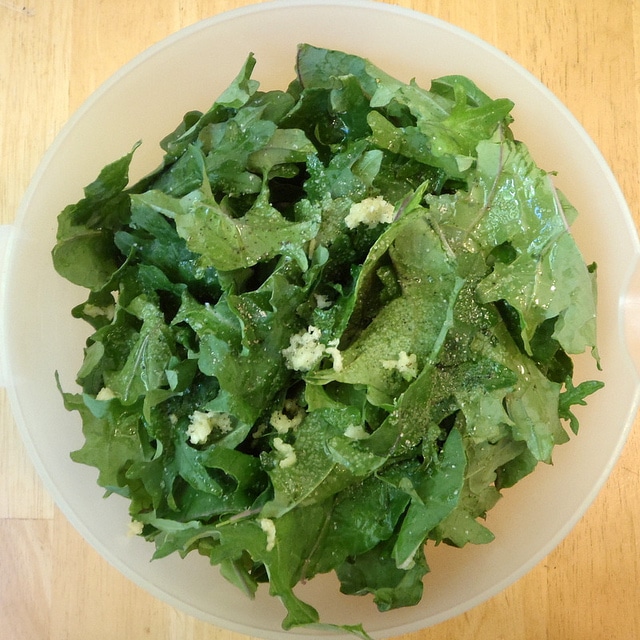
A few edible green things you could EASILY plant in your edible garden container are KALE and CILANTRO.  Oh, I know…kale, kale, kale…maybe you think you’ve heard enough about kale to last until the end of your days.  I’m with you.  But when I tasted this at the home of some great friends, I thought I could EAT this until the end of my days.

Salad Recipe:

  1. Pick a bunch of young, black kale (lacinato kale, Tuscan kale, dinosaur kale) from the beautiful Italian terra cotta bowl you so carefully planted. Alternatively, purchase a bunch at your farmers’ market.
  2. Do the same with a bunch of cilantro. Stem both kale and cilantro and mix together in a large bowl.
  3. Douse it with the best tasting olive oil you know. Squeeze a lemon on it.  Scatter salt and pepper then toss it all together.  Taste it and add more lemon juice if it needs more sparkle.
  4. It’s so perfect just the way it is, but thin shards of Parmigiano Reggiano only make you want to have a never ending supply of kale and cilantro for this salad.


Photo Credit: Kale Salad, Creative Commons, PA113178 by Joy is licensed under C.C. 2.0