Clay Pot Irrigation Benefits During Drought

We had a very quick winter here on the Central Coast with just a little bit of rain, spotty at best, while the rest of the country has been buried under blankets of snow. As California is technically still experiencing a severe drought, I want to address ceramics in irrigation.

Eye of the Day|Clay Pot Shards| Clay, irrigation, water
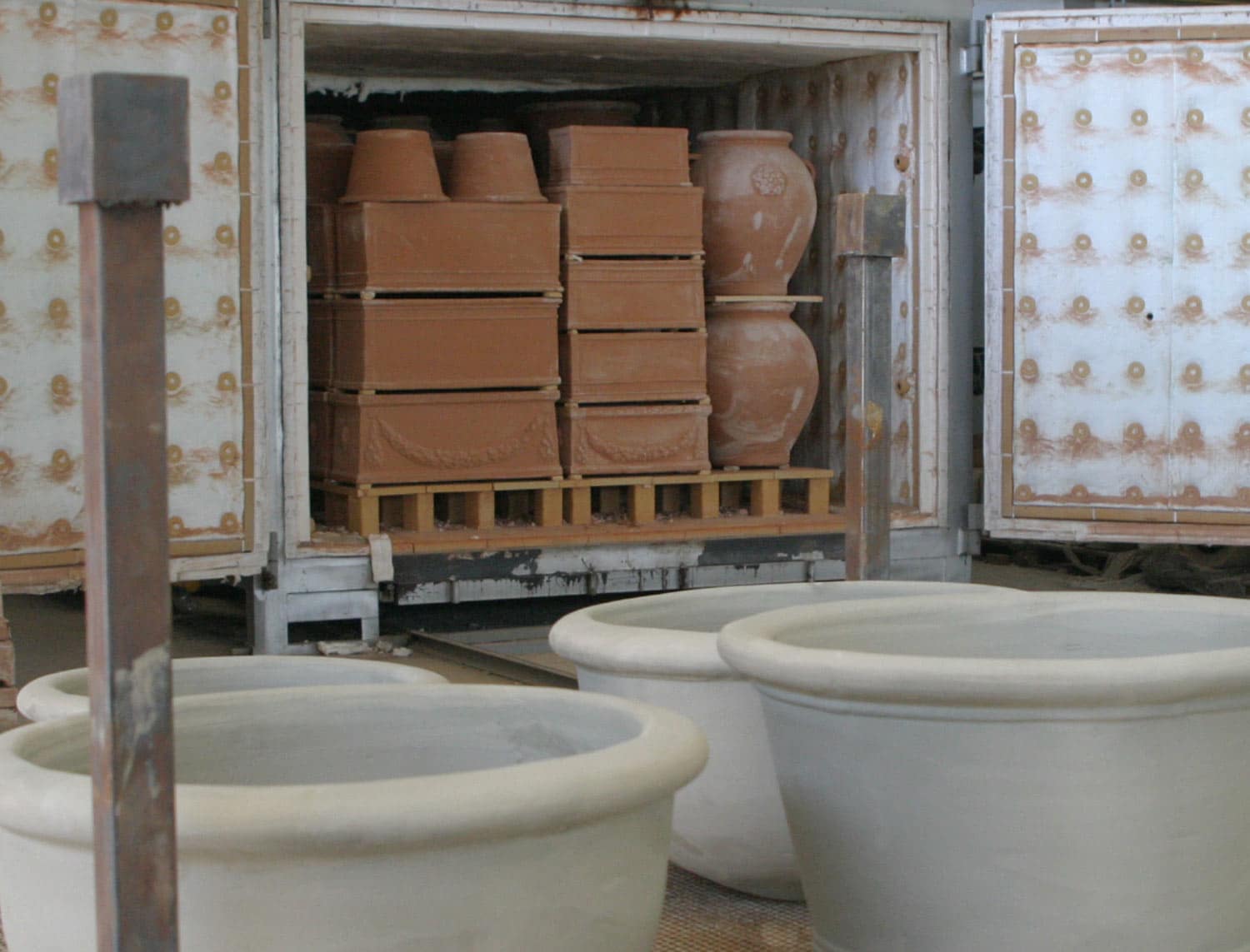
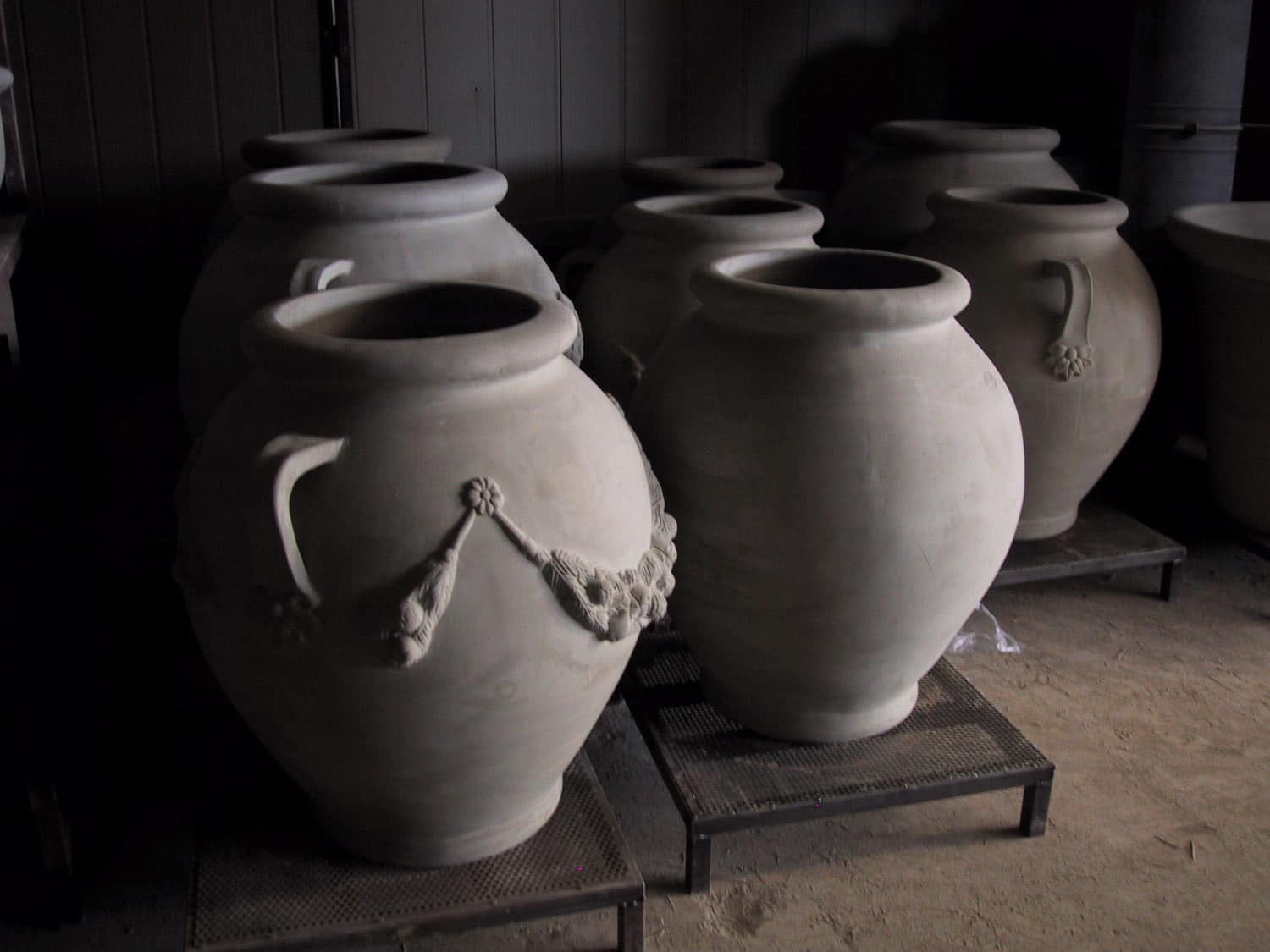
Pottery that can be used to store water (or drought tolerant plants) for your garden.

Irrigation Through Clay
In the newsletter, we have covered many subjects concerning ceramics.  In irrigation, ceramics also has many uses. The Romans created an intricate system of aqueducts, which directed water throughout all parts of the empire. We see this around the world, ceramic pipe systems carrying water through towns and villages.

Eye of the Day|Clay Pot Shards| Clay, irrigation, water
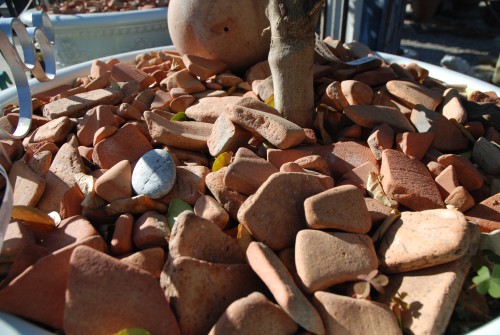
Broken off clay shards can be decorative and practical.

Clay Shards and Slow Water Release
Ceramic “shards” can also be used as a soil amendment. The broken pottery has to be low fire to be absorbent.  Low fire ware may be crushed and added to the soil and as you water, the shards act as little sponges and absorb the water and release it essentially as needed below ground.

Eye of the Day|Clay Pot Shards| Clay, irrigation, water
Burying the clay pot and filling it with water can help when water resources are limited. Photo Credit: steveilott

Clay Pot Irrigation

Another use I find very interesting is what is called “clay pot irrigation.” If you perform an internet search of this term and go to “Images,” you will see excellent examples of how this works.  Essentially, it is a very simple technique.  Again, a low fire vessel is made by a potter, and is then buried right next to the plants you want to irrigate; fill it with water, and because of the porosity of the low fire ceramic, it leeches through the walls of the vessel and waters the plant by slowly releasing a minimal amount of water.

Cultures around the world have been using this method forever!  Look it up, check it out, and enjoy these new yet very old techniques of gardening.  Ceramics in your garden is not just decorative, it can be very functional.


Terracotta Transformations: The Fire Behind Baked Earth

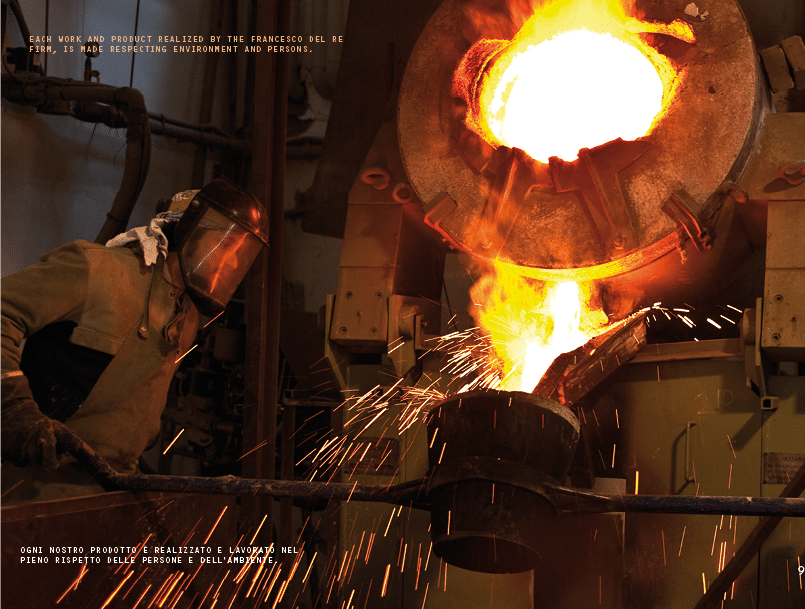
As the days grow shorter, and we inch toward the certainty of a cold winter, it seems fitting to talk about fire. I love fire. It takes a deep understanding of this primary element to master the process of “firing” clay. In my last installment we talked about frost proof ceramics and even that conversation must begin with a discussion about fire.

Clay begins as granite, decomposes and compressed for a millennia, then becoming a sticky, malleable mud with memory. When it passes through human hands, turning it into functional art… the real fun begins: the firing. Once the clay morphs all the way back to stone, it changes from stone to mud and back to stone again, transformed by fire. I feel lucky to be in the middle of this cycle, the one that gets to instruct the clay. Kind of a big responsibility really, manipulating the earth while it regenerates itself.

It takes a lot of heat to fire ceramics and even more heat to fire clay to vitrification (refer to Baked Earth installment How It Works: Frost proof Terracotta). Firing clay depends on what material we burn. This is why so many ceramic wares are under-fired: limited combustibles. In the developing world many traditional peoples have to travel further and further to harvest the wood or brush. As the forest recedes, they begin to use less fuel to burn the clay, because transportation is more difficult. Travel can take three or four times what it used to for procuring wood, or other combustibles, to fire the pottery, cook and heat their homes.

In the US, you will see many types of firings: wood, salt, recycled automobile oil, sawdust, dung, natural gas, propane, passive solar, and electricity. We are fortunate to have so many options within reach when it comes to firing pottery. Regardless of how the work is fired, some basic transformations occur on the clay’s long journey back to stone.

At 212°F the water in the clay converts to steam and is slowly released. At approximately 400 °F, all organic matter in the clay has burned out, and the cristobalite (a crystalline form of silica found in all clays) suddenly shrinks. Between 1000°F and 1100°F the quartz crystals change from an alpha crystal structure to a beta structure. Referred to as Quartz Inversion, the temperature must increase gradually.

From 1500°F to 1650°F, “sintering” begins. This is the stage where clay particles begin to cement themselves together to form a hard material called ceramic. From this point on, depending on the temperature range of the clay, vitrification occurs. For earthenware clays, this happens at approximately 2050°F. For stoneware clay, about 2300°F, and for porcelaneous clay, 2500°F.

The transformation of clay from stone and full circle back to stone is a long, hot journey that no other material makes. And here’s a little point of reference: Kilauea, the volcano on the big island of Hawaii, spewing lava into the Pacific Ocean was recently tested for temperature. The orange lava is only 1800°F—low fire in the world of clay!

See you next month!


How It Works: Frostproof Terracotta

How It Works: Frostproof Terracotta

It’s hard to believe that it is already Fall. In California, leaves don’t change much in a drought, no matter what time of year. But as another October becomes a thing of the past, much of the country can already feel the promise of winter. So let’s talk about frostproof terracotta.

Many of you live and work in places that freeze, and much has been said, both by homeowners and garden designers about the freeze/thaw capability of ceramic plant containers. Remember that ‘clay’ is the earthen material, ‘ceramic’ is the clay when it has been fired. Terracotta is low fire red clay found all over the world. There are low fire clay bodies, and high fire clay bodies. Low fire is also referred to as earthenware, high fire is stoneware. Once clay is fired it becomes ceramic no matter what temperature it is fired to. But that doesn’t mean it is mature. I want to introduce you to two new key words: “vitrify” and “absorption.”

Every clay, whether earthenware or stoneware, has an optimum maturation point when fired. When this point is reached, the clay is “vitrified.” When clay becomes vitreous, it means that all the different ingredients in the clay have melted and bonded together to form a mature, very strong, “ceramic.” If a clay is over-fired it becomes flakey and worthless. If a clay is under-fired (like many of the pottery containers that are called “terracotta”) it is weak and porous and highly susceptible to cracking, even without being frozen. So when we talk about frostproof ceramic or terracotta, interestingly enough, we have to talk about fire first. In ceramics it always, always, always, comes back to the fire.

The key equation: the more vitrified, the less absorption. Did you catch that? Absorption yields expansion/contraction and hence cracking, during a freeze/thaw cycle. That’s basically it. You’ve got clay, you’ve got fire, you’ve got maturation/vitrification, and you’ve got frostproof ceramic. Or, more plainly put, if a ceramic vessel is not fired to its target temperature, it will die an easy death no matter what the weather is doing.  But if it will last longer than you do.  Just think about that for a moment.

Here is what you can do when you are ready to purchase frostproof ceramic containers:

1) Research the manufacturer’s credibility. If you are buying real, frostproof ware, know where it comes from and how it was fired, and get something on paper, like a warranty.

2) Protect your investment! Do not add moisture to a vessel that you know is going to freeze. And if you are going to take the time to cover the plants, take the time to cover the container too. Start to think of the ceramics as a living, breathing, expanding and contracting entity, just like the plant that it holds.

3) IMMEDIATELY call Eye of the Day. They have been selling frostproof terracotta for more than fifteen are not only knowledgeable, but relatively good looking and congenial, and carry the best frostproof terracotta on the market (guaranteed to withstand temperatures down to minus 15° F).

4) Move to California!


Debunking the Terracotta Mythos

Debunking the Terracotta Mythos

The sun has yet to awaken, the moon just rose as a wink on the horizon, and the roosters are making that heinous sound only roosters can make, disturbing my first cup of coffee. Excuse me while I get that cup…


I want to talk about terracotta and it’s classification as an earthenware clay body. In ceramics we have hundreds of clays available to us, but all of them fit into one of two categories; earthenware, or stoneware. The difference between earthenware and stoneware is the maturation temperature, more easily termed as low or high fire clay. Low fire clays, having been fired to their maximum temperature (anywhere from 1800-2100°F) remain porous, while high fire clays vitrify when fired to higher temperatures ( 2200-2500° F). Since clays have many “ingredients” that are specific to their particular region, all clays have a different temperature range, but all can be classified as either low fire or high fire clay. Terracotta is technically a red earthenware, a low fire clay containing between 5 and 10% iron.


The meaning of “terracotta” is “baked earth” in Italian. Many people mistakenly use the words “terracotta” to describe anything made of clay from anywhere in the world, whether it is low or high fired. But as we are beginning to understand, terracotta is an actual clay body itself. It is abundant and utilitarian, can be found on every continent, and has been used for millennia to create irrigation piping, garden pots, and roof tile. It is best to speak of terracotta regionally, for example Mexican terracotta is essentially the same as Italian, but fired at a lower temperature. Another mistake about terracotta is that it is weak. In many places in the world it is hard to find even enough fuel to bring the fire up to the maturation temperature of the clay. If the temperature that matures (hardens, strengthens) the red clay is 1980°F, but the fire only reaches 1800°F, what happens? You have immature, under-baked pottery that is susceptible to cracking and doesn’t last very long. This happens all over the places simply don’t have the wood to do the firings, so they will use whatever they can to heat up their pots, resulting in a market in which one terracotta pot will last only two years and the one next to it will last two hundred… it just depends on the fire and country of origin.

The next time someone says to you that terracotta is junk and won’t stand the test of time, tell them in all confidence that it depends on where it is from and how it was fired. Then you can say that Eye of the Day garden design center only sells authentic Italian Galestro terracotta, mined for five generations from the same clay deposit, and fired to perfection. You can always depend on Eye of the Day for the highest quality in garden design products.

Hope this was informative. See you all next month!