The Clay Authority: Protecting Terracotta

The Clay Authority: Protecting Terracotta

As a fifth generation Californian, it’s easy for me to take beautiful weather and sunny, sandy beaches for granted, I also realize that for most of the country, this time of year presents some concerns when it comes to taking care of your garden and terracotta planters

Two years ago I wrote an article for Eye of the Day entitled “How it Works: Frost Proof Terra Cotta”. The big take away from this article are the two words “vitrify” and “porosity” that are of particular interest to those of you from areas concerned with freeze/thaw issues, due to the porosity of certain clay used to make planters.

The following month I continued with “Terra Cotta Transformations”, bringing the reader into the realm of technical ceramics by explaining what exactly happens with clay during its firing cycle.

Eye of the Day| Clay Authority| Protecting Terracotta
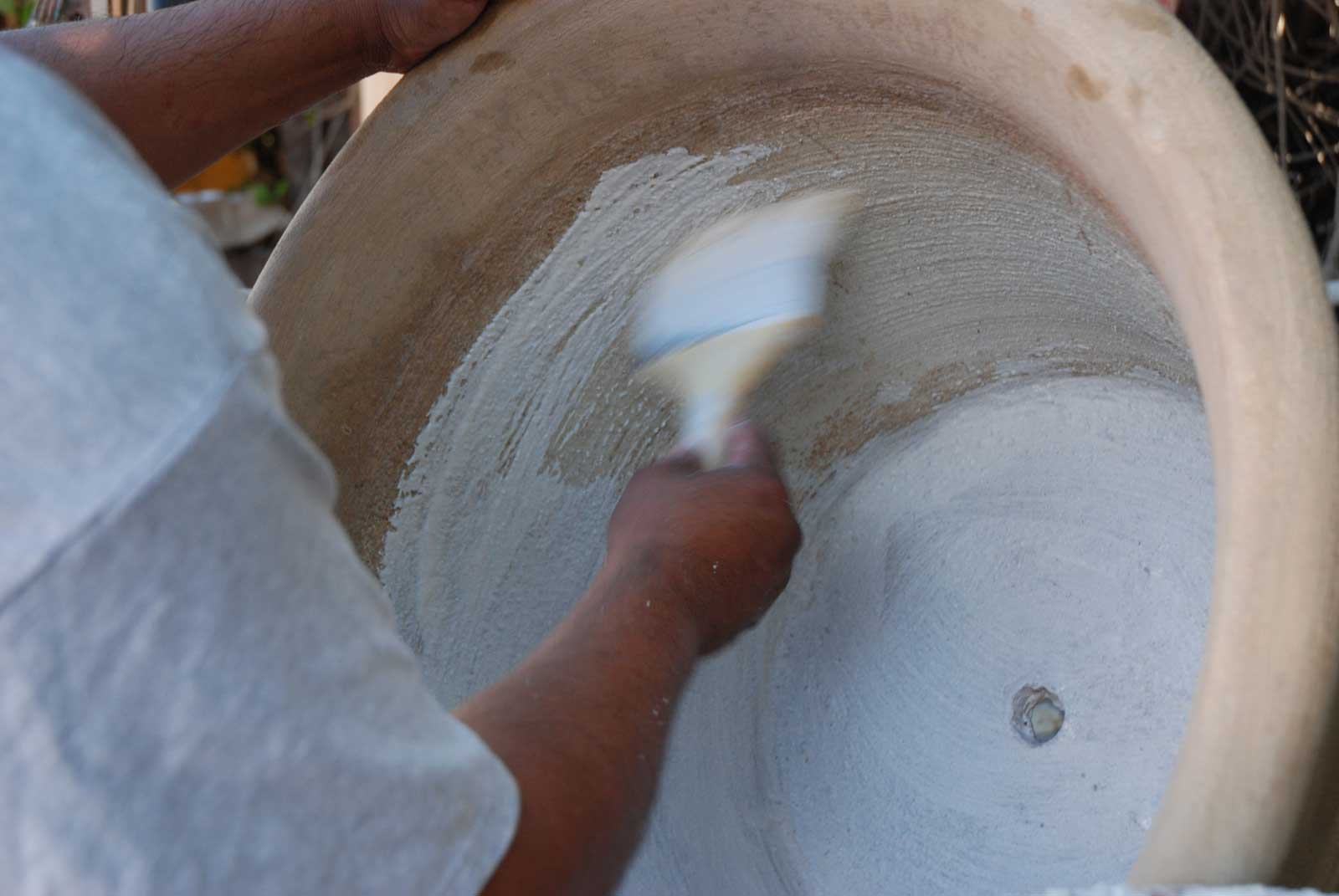
Sealing the inside of a terracotta pot.

Freeze/thaw can be viewed as synonymous with expansion/contraction. But there are also many reasons to want to waterproof pottery. Although waterproofing and frost proofing pottery both pertain to porosity, frost proofing also deals with extreme temperatures.

So as we begin to move into winter and we consider protecting our garden pottery investments, here are a few things to think about:

Protection from Frost and Cold:
If you need to protect your terra cotta from freezing, either move it inside, cover the planter (and the plants), and definitely do not over water, or if possible, don’t water at all.  A quick test for the pottery itself would be to ask the dealer where you purchased the planters if they have any pot shards. Use them to test the durability of the pottery by soaking them in water, then put them in your freezer for a day or two. If it hasn’t cracked, take it directly from the freezer and put the shard in the sun. You’ll learn about the quality of your investment.

Waterproofing Terracotta:
If your concern is waterproofing your pottery, the research is simple to find a myriad of products on the market these days to seal low fire pottery (especially for tile). If it’s high fire then you don’t have to worry about water leeching through, especially if it’s been glazed.

Let’s all settle in for what always proves to be an elegant, sometimes challenging, yet always amazing time of year—Winter!

And if you ever have any technical questions about garden pottery, feel free to consult with me through EOD.
Baked Earth: The Truth Behind Authentic Impruneta Pottery

Eye of the Day|Impruneta clay|terracotta Baked Earth

Baked Earth: The Truth Behind Authentic Impruneta Pottery

Welcome to another edition of Baked Earth, with information about what’s happening in the world of clay, ceramics and installation pottery. This month, we would like to pop the mythical bubble concerning Impruneta pottery.

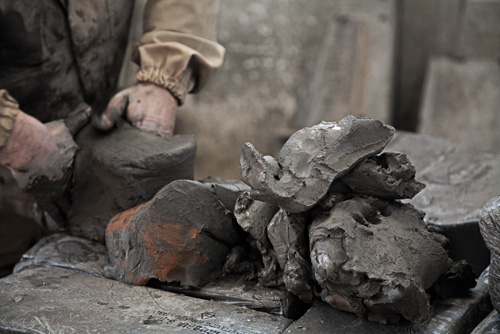
Impruneta is a commune in the province of Florence, in the Tuscany region of Italy. It has been famous for many centuries as the producer of the region’s finest terracotta, everything from tiles to garden art, to large terracotta planters. Along with the handmade nature and unparalleled craftsmanship of Impruneta terracotta lies the real secret of its success: the clay body.

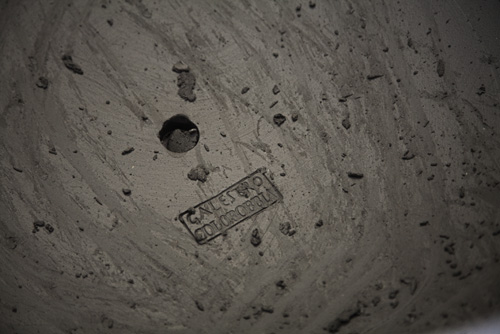
It has been known for countless generations that Galestro clay is the superior material of the region. Galestro clay is extremely high in subsoil minerals, has an excellent plasticity, and due to its unusually high granitic content, can withstand sub freezing temperatures. Galestro clay yields a high quality product with great versatility and many ceramic manufacturers in the Tuscany region use Galestro, including Terrecotte San Rocco, Eye of the Day’s premier terracotta source.

Only a handful of factories produce wares actually in the commune of Impruneta and therein lies the problem. Because the potteries in the outlying communities are also using Galestro clay, or part Galestro and part local material, some producers will stamp their work with the word “Impruneta,” which can lead to retailers here in the US (either unknowingly or complicit in the process) to sell merchandise as “Impruneta terracotta,” when in fact it was not made within the boundaries of the Impruneta commune.

It’s akin to wearing a Timex and calling it a Rolex. Both are well made watches, but one has the reputation of distinct craftsmanship and is branded as such, so you are paying for the brand. It is the same with Impruneta—it has been branded by generations of superb craftsmanship and these days it is not uncommon for people in this business to use the branding of “Impruneta” to their advantage by calling it something that it is not.

So garden designers, homeowners, and landscape architects alike, be forewarned! There are only a handful of families producing authentic Impruneta terracotta in that commune, so if someone claims to be selling or installing Impruneta wares made with Galestro clay, be sure to ask them who the manufacturer is, and cross check their references. But as I have said countless times, it all comes back to the clay. And anything made with Galestro clay from the foothills of Tuscany is a sure bet as the highest quality pottery for your home.

By the way, I’m wearing a Timex…
Know your terracotta!


Baked Earth: The Making of a Greek Pot

Eye of the Day|How to Make a Greek Pot| design

The Making of a Greek Pot

This month I’m going to discuss a tool that has captured my imagination for nearly 40 years: THE POTTER’S WHEEL. It started for me in Orange County California in 1976 at Irvine High School. For my P.E. class I was taking surfing and the instructor also taught Ceramics. It didn’t take me long to figure out that all the cool kids not only took surfing, but took Ceramics for second period, so if the waves were particularly good, the surf class would just stay and surf all the way through second period!

Thirty years later, I am still doing ceramics, primarily because of my fascination with the potter’s wheel, which is a relatively new invention in the history of pottery making. Originally functional vessels made of clay were constructed using a coiling technique. The artist would roll out “ropes” of clay and slowly, methodically, hand turn a small form by placing the coils on top of each other and pinching each coil into the one beneath it. Although this time honored method can be very slow and tedious in terms of production, there are still many cultures in the world that use this technique to create functional ceramic containers.

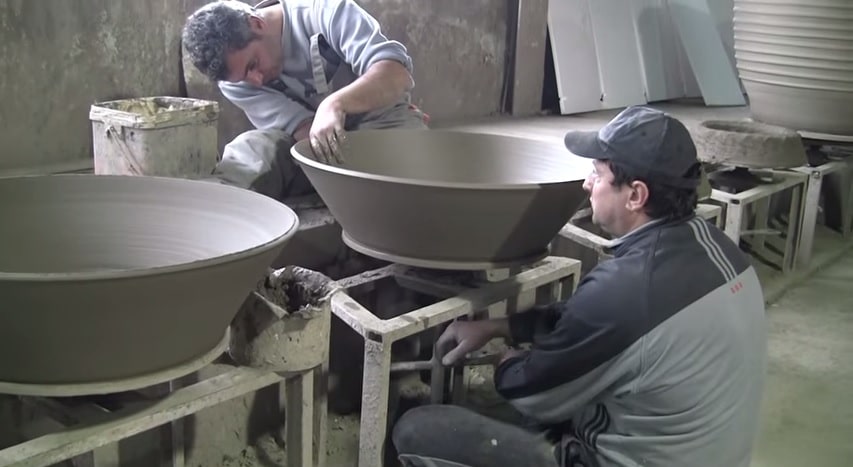
The potter’s wheel was born out of necessity. There are many theories, but all agree it was a matter of industrialization that brought about its creation. Recently I found a few video clips in my inbox that Brent (owner of Eye of the Day) had shot on the Island of Crete. They are an intimate look at the processes used in the production of the authentic Greek vessels Eye of the Day sells. The pieces are wheel thrown but on a wheel that is hand cranked by a potter’s assistant. The clay is made into fat coils, and added to the clay beneath it by pinching. Then the assistant spins the wheel faster and the potter begins to lift the clay into a form. It is particularly fascinating that Greece employs both old and new world techniques. They start with a slab of clay for the bottom, and work their way up by coiling, and pinching, and finally throwing the clay into shape. In the videos you see that there are multiple wheels working at once with vessels on each, in different stages of completion. When the clay needs to rest on one wheel,, the potters move in succession to each wheel down the line, until returning to the beginning to continue working toward a finished piece. These pieces are then fired and shipped directly to Eye of the Day.

We are very lucky to have this direct connection to handmade vessels for our garden design needs. The next time you are at Eye of the Day, remember what it takes for the artisans who build these vessels to deliver such an authentic and timeless piece of history for our own daily aesthetic.


Top Your Pot with Tumbled Terracotta

Eye of the Day|Tumbled Terracotta Pot Topper|Baked Earth

TOP YOUR POT WITH TUMBLED TERRACOTTA

You have a beautiful citrus tree and a beautiful pot, together making a perfect statement piece, but maybe there’s something to make it even better from a design standpoint and for water conservation.

Design professionals typically use under-planting to finish the look of  a tree or tall plant in a pot.  They might use Alyssum,  Baby Tears, Lobelia,  Creeping Rosemary or any other trailing or low-growing plant.  During our current drought, we see more succulents being used, such as String of Bananas, String of Pearls,  Hens and Chicks or Sedum as under-planting and as a living mulch. You can see these same plants in action as part of our video: How to Convert a Fountain to a Succulent Garden. 

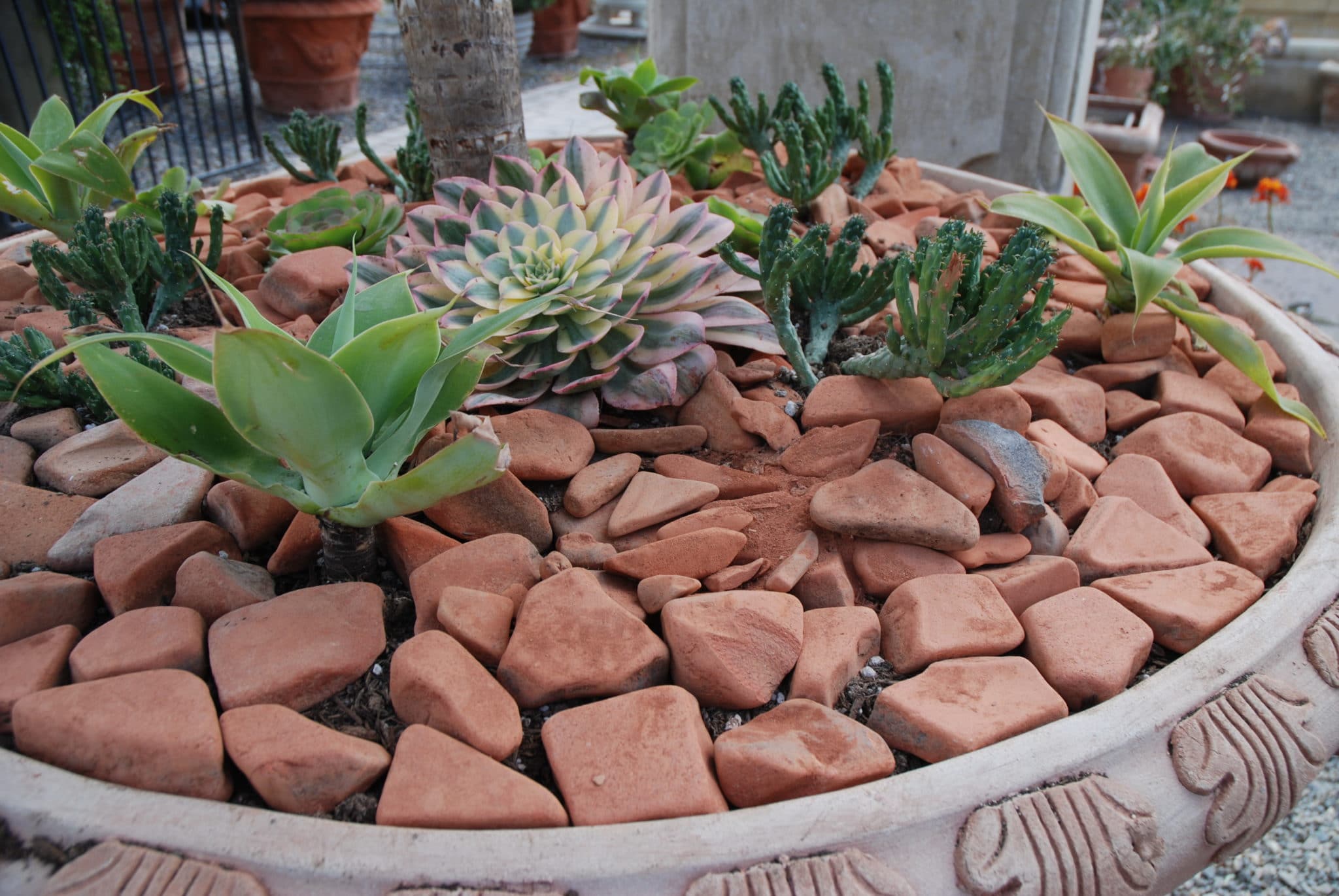
More recently, designers have moved beyond plants and have progressed to using tumbled glass in almost any color, moonstones and beach pebbles.  At Eye of the Day, we are ALL about terracotta, so we have developed a new “pot topper” which not only looks beautiful, but helps maintain and control soil moisture in the container while allowing the surface of the soil to breathe (VERY important to container health).

This new product is Tumbled Terracotta, produced from Italian terracotta fragments, tumbled to soften the edges.  Succulents, cactuses and aloes can also be planted between the pieces for a more carpeted effect further enhancing the design and beauty of container planting.

Our Tumbled Terracotta is available in pieces categorized into three sizes, small at $3 per pound, medium and large at $2 per pound.  The next time you visit Eye of the Day, we’ll show you how using Tumbled Terracotta Pot Toppers adds beauty and practicality to your container planting.


The Truth Behind the Aged Terracotta You Buy

Eye of the Day|Quality terracotta differences|design pottery

The Truth Behind the Aged Terracotta You Buy

If you have read the articles by Scott Semple you now have a good understanding of what makes up terracotta pottery. From Gladding McBean’s stoneware to our Italian frost resistant earthenware containers, at Eye of the Day Garden Design Center we sell high-quality terra cotta products which last and last.

Now, what about aesthetics? Do you want your pots to last? Is it important that future generations are given your garden pots along with your jewelry, silverware and bedroom set? Many people love the patina of terracotta when it gets older and though a crumbling pot is not the same thing as “patina” they think it still looks cool.

This Italian pot from Terrecotte Olympia of Tuscany, Italy is a favorite of designers in Southern California. It is not made with frost proof Galestro clay but with Sienna clay, which is clay Americans typically find at their garden store. Olympia, like many Italian clays and other clays from which garden pots are produced, will almost immediately begin to spall and flake. Although they have a wonderful aged patina that designers love to specify in their designs, the material does not have a long life compared to pottery made from Galestro clay. The problems will be seen in Mexican and most Asian terracotta products as well.

At Eye of the Day, we hope that our retail and professional design clients will consider the investment they are making and choose terracotta for the centuries. For a further example of how these pots age and look, take a look at the following pictures of the Italian pots at the Ralph Lauren Store at the Stanford Shopping Center in Palo Alto. If this is not enough to convince you, well, that’s why there are both vanilla and chocolate…something for everyone.

If you like that falling-apart look, come and see our seconds and close-out area at the store where we have lots of consigned pottery from customers who are replacing their containers with new ones. The prices are great and the look is shabby/chic. We also have remaining stock from Terrecotte Olympia at half price: it’s still half-good.


How To Choose A Terracotta Pot By Its Porosity

Eye of the Day|Baked Earth|terracotta porosity

In past articles I have discussed how freeze/thaw has an effect on ceramic containers and I have also discussed clay pot irrigation. We are in the worst drought in the state of California’s history, so by irrigating with low fire pots with high porosity,  water can be sent directly to the root system and feed plants on demand, as opposed to spraying the crusty, evaporative surface.

Eye of the Day|Baked Earth|terracotta porosity

Technically porosity is the amount of empty space in the structure of the fired clay that makes it capable of absorbing or distributing liquids. Simple, right? So if the terracotta is absorbing water and the temperature drops below freezing, you’re going to have potential problems with your investment as the water expands while it freezes.  But if your intention is to use the porosity to slowly distribute water, then the more porous the better. There are other uses for porosity in ceramics, for example insulation. The less dense a brick is, the more insulating capabilities it has.

Eye of the Day|Baked Earth|terracotta porosity

Natural clays can have a very high porosity.  When the grains are very small, there are countless small pore spaces, but what clay does NOT have is good permeability, which is the way you would measure how connected these porous spaces are. So generally speaking, if the clay is high fired it will be far less porous. This is advantageous for a freeze/thaw condition. If the clay is low fired, or under fired it will be porous and best for releasing or absorbing water.

So the bottom line is that the level of porosity you should seek depends on your intention for use of the ceramics.