Terra Malia Designs : Santa Barbara Sonos Headquarters

Eye of the Day| Terra Malia Designs| Sonos

Earlier this year we were fortunate to meet Terra Basche of Terra Malia Designs in Santa Barbara.  She was looking for pots for the new Sonos location in Santa Barbara and found them at Eye of the Day.  We caught up with this busy woman and asked her a few questions about her blooming career.

Eye of the Day| Terra Malia Designs| Sonos
Designer Terra Basche of Terra Malia Designs creates succulent gardens inside Italian terracotta pots for Sonos

How did you become interested in landscape design and what was your path to your current career?
I completely fell head over heels in love with succulents back in 1996 when I was attending UCSB. I remember the very visit to Santa Paula Nursery where I ohhh and ahhhed over the variety of colors, textures and structural make up of each individual one. I tried to fit as many in each fist as possible, as I headed to Ivan at check out.

I naturally have a design eye, as those on my mom’s side of the family have practiced every kind of art. I designed succulent centerpieces for my own wedding in 2001 and proceeded to design pots, weddings, gifts and mini-landscapes for friends and family until I started getting offers from others who would actually pay me to do what I loved. When my oldest daughter was born, I quit my 9 to 5 to be a mom, but began to lazily pursue my love professionally on a very part-time basis. Terra Malia Designs was my “second born” back in 2008.

Eye of the Day| Terra Malia Designs| Sonos
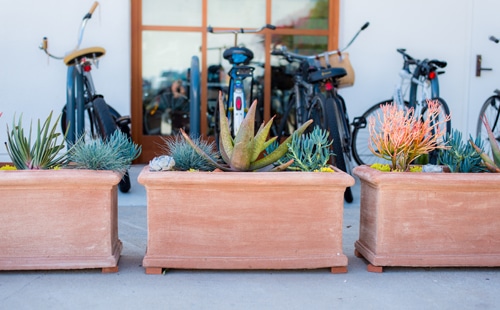
The terracotta pots create a separate area away from the parking lot.

My business presently is a healthy mix of artistic interiors/exteriors for residential and business and wedding floral with a healthy dose of untraditional elements including mixing succulents, tillandsias and other living props, so the plants in tablescapes can be reused and planted back into the ground, so unnecessary waste is eliminated. My business model closely mirrors my life models and beliefs about sustainability and what makes sense. Plain and simple…it feels good!

Eye of the Day| Terra Malia Designs| Sonos
Tumbled terracotta and succulents create beautiful container gardens.

What are your clients asking you about water-wise planting and hardscaping?
Most often, clients seek me out for my succulent design. I have almost always reached for plants that require low water, as they are just as lovely as those other plants that need lots of water. Saving resources when necessary is responsible.

Eye of the Day| Terra Malia Designs| Sonos
A peaceful place to take a break or enjoy your lunch.

How do you design a plan that addresses water issues but is welcoming and pleasing to the eye?
There are so many varieties of succulents and cacti; it is easy to create a design that has enough variety for the eye. I enjoy combining succulents with grasses to add movement potential and texture. The continual exotic blooms from succulents create a softer feel, while adding interest. Using the neon green Crassula, mixed with Aloe Striata and Blue Fescue for color variation, for instance, provides the viewer with color difference so each plant can be appreciated, and the style boasts both soft and hard lines with movement in the Blue Fescue.

Eye of the Day| Terra Malia Designs| Sonos
Terra Malia Designs create green spaces.

How did you approach the Sonos project in order to solve the physical issues of a “parking lot?”
Sonos wishes to maintain their offices in the city of Santa Barbara…which means convenience for their employees, but at the same time, means not as much potential for green space. Terra Malia Designs has helped to transform parking lots, patios and rooftops into greener spaces where a more natural environment can be enjoyed.

The Sonos headquarters, located at 614 Chapala Street, has a staff parking lot that backs up to the building. Sonos wanted to create a patio area where staff could go to have an outdoor meeting or sit and have lunch. Terra Malia Designs utilized the Cassetta Liscia Atlas Italian terracotta pots from Eye of the Day placed side-by-side to create a barrier between the parking lot and the patio zone. Visually, the barrier is essential to differentiate the spaces and as the planting has filled in, it has created a space that is more pleasing to spend time.

Eye of the Day| Terra Malia Designs| Sonos
A more natural environment is created for the commercial space of the Sonos headquarters.

To see more of Terry Basche’s work, please visit Terra Malia Designs 

The Rogue Garden: Brent’s Test Kitchen

Eye of the Day|Brent's Rogue Garden|The Test Kitchen

THE ROGUE GARDEN: Brent’s Test Kitchen

Hey! All you hoity toity landscape designers—this blog’s for you!

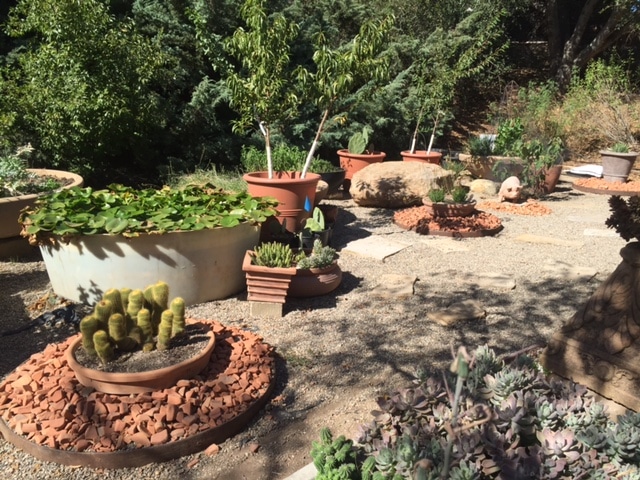
When my professional landscape design friends come to my home garden for the first time, they are usually thrown off balance by what they see: there are pots and containers everywhere.  I constantly rescue or buy plants to try out in our pots to show how they work together in the landscape and also to see how a plant performs in a container versus the ground.

While my garden is a “test kitchen”, it serves as inspiration for Eye of the Day as well as for the genetic sequence I received from my Portuguese great grandfather. He was a truck farmer who indentured himself in 1868 to the Campbell Estate in Hawaii to grow sugarcane. I love putting my hands in the dirt.
Eye of the Day|Brent's Rogue Garden|The Test Kitchen

My garden at home has helped us at Eye of the Day in many ways. We have learned that French Anduze pottery must be sealed or the glazing starts to fall off almost immediately. So, we tell everyone that if you purchase French Anduze, you must have it sealed to protect the glazing.

Something that every design professional should know about is how to properly plant pots and especially large pots. Pots that have diameters larger than 30” usually have plant material that starts big or will grow large due to the space for more root ball. But after a period of years and sometime climate conditions, a large plant needs to be removed from its container and trimmed and replaced. By replicating these situations in my own garden, I have formulated successful service practices for performing operations which allow clients to benefit by getting the most from their purchase of our products.

Also in my garden, there are odd experimental items like “vertical wall” planters and terra cotta shelf units for the patio. 25 years of business has resulted in a new product. Whether damaged in the container coming from Italy or through rough handling here at Eye of the Day, we take the broken pieces of pottery and produce Tumbled Terra Cotta.

Yes, my garden at home looks like a madman’s landscape but, I love it and I love spending time in this intimate setting surrounded by the products, plants and ideas that fuel my life.

Let me know if you’d like to visit.

Brent, the Rogue Gardener


5 Tips for Winterizing Your Terracotta Pottery

Eye of the Day|How To Winterize Your Terracotta Pots

5 Tips for Winterizing Your Terracotta Pottery

To many people winterizing terra cotta pottery may seem like a completely irrelevant subject for discourse, but consider that you can add this information to your knowledge just IN CASE it ever gets cold enough to freeze. This is an actual problem for people with terracotta pots in parts of the US , which is why you don’t see great pottery everywhere.

There ARE steps that can be taken to help prevent your pots from cracking when old man winter whips through your garden. The goal is to eliminate the possibility of water being absorbed, frozen and thus causing the pot to crack.

  1. Lift the pot from the ground by placing it on pot feet, wooden blocks or pieces of stone. This will allow air to circulate beneath the pot.
  2. Seal the pot with a penetrating sealer, such as one used to seal slate floors and swimming pools
  3. Remove plants and soil from the pot, as the soil will absorb water, freeze, expand and can cause cracking
  4. Cover the pot with plastic sheeting to avoid contact with water
  5. Most fool-proof: move it inside

Much depends on the quality of the terra cotta as well.  Eye of the Day’s is the highest quality, high fired Italian terracotta, made from Galestro clay. Our pots, manufactured by Terrecotte San Rocco, are guaranteed frost proof to minus 15 degrees. It helps to know that if a pot is high-fired, the absorption rate is lower, and so the risk of cracking in freezing weather is reduced.

You may need this information some day. Maybe.

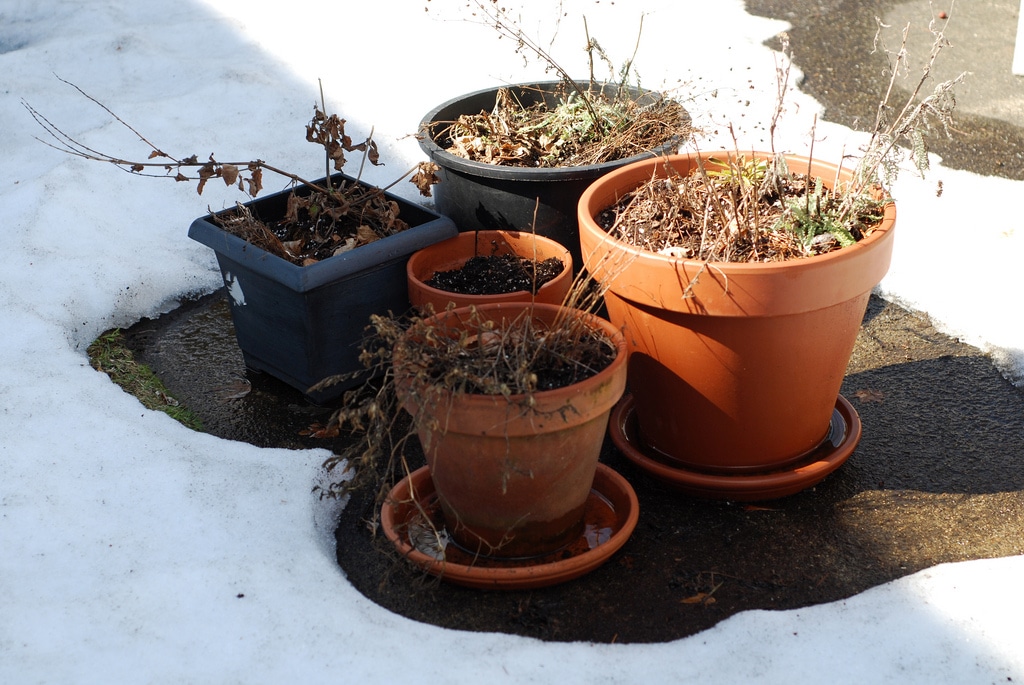
Photo Credit: Terracotta Pots, Creative Commons, My Container Garden After Winter by Rachel James is licensed under CC BY-NC-ND 2.0


A Day In the Life of a Ceramic Terracotta Commission Artist

Eye of the Day|Scott Semple Baked Earth|terracotta design

Baked Earth: A Day In the Life of a Ceramic Terracotta Commission Artist

It’s a random Tuesday afternoon in September of any year. I am sipping ginger tea and trying to figure out what to do with the tail end of an already long day, when the phone rings and it’s a number I don’t recognize.  I answer and it’s a potential client with an exterior aesthetic conundrum. “Well”,  I say to myself, “here we go again!”
Eye of the Day|Scott Semple Baked Earth|terracotta design ceramic

This month I am going to walk you through what it is like to be on the receiving end of an exterior ceramic commission.

Now…I love people.  With that in mind, as a commission artist, in many ways I become a problem solver as well as a solution.  I always want to get to the heart of what the client wants for his or her space, and often the gray area is that word “want”.  What a client wants and what works best aesthetically for a space, may be two different things!  So I end up being the voice not only for the client, but for the land, the property as it relates to other properties, the overall environment, the seasons, and of course the clay.  Why are we using clay on this project? Why does using an earthen material make the most sense here?  And so on.
Eye of the Day|Scott Semple Baked Earth|terracotta design ceramic

Typically, I will begin with an interview.  I will Skype if I have to, but the best way to get to know a project is to get on site during the initial phase.  (Many times I‘ve  shown up to a job site and actually found native clay on the property!)  We then move into constructing the pieces. It has always been my practice to have an open door policy to my studio; I love the client to get involved with the construction process.  This way we can troubleshoot together  and/or celebrate any pieces that come from my hands.  I realized a long time ago that when building things to the specifications of others, it’s important to be very clear and communicative, especially during the “wet work” phase.

Eye of the Day|Scott Semple Baked Earth|terracotta design ceramic

I also like to discuss the inherent connection between interior and exterior space. Sure, we can do planters and water features , but what if you had a vessel sink in your bathroom or a fireplace surround, or an interior sconce or two with the same motif? The transition between interior and exterior spaces has always fascinated me as an artist, so that’s often what I strive for.
Eye of the Day|Scott Semple Baked Earth|terracotta design ceramicThe last phase is delivery and installation.  When I end up placing pieces and getting down and dirty in a garden, I know I have made someone very happy.  I have made the environment happy, the property happy, the neighbors happy, and being the solution is always an awesome feeling!  In this phase, I know that what I have made is not only SITE specific, but RESOLVE specific.


Blue Agave Landscape Design Project

Eye of the Day|Blue Agave Landscape| Garden Design

Blue Agave Landscape Design Project

After whetting your appetite for planting your own meadow and inspiring visions of golden grasslands,  we want to show you a different way of using the “no lawns” concept.

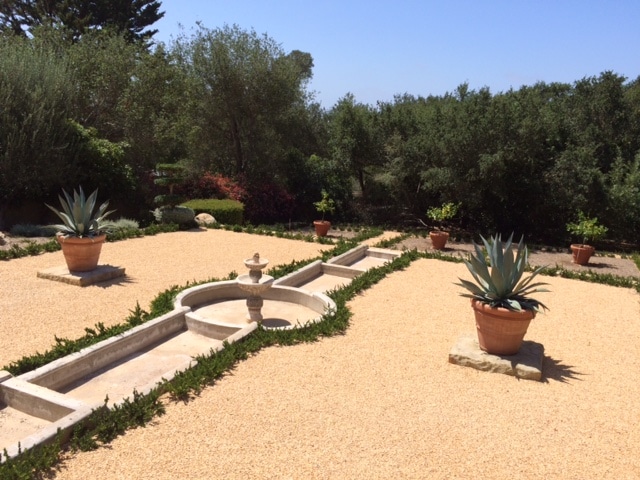
Adan Venegas of Blue Agave Landscape in Santa Barbara used lots of Italian terracotta rolled rim pots for planting (surprise!) agaves and placing them throughout the area which was at one time planted in lawn.

Also in place of green grass, there is now the lovely soft golden hue of decomposed granite, offering an interesting textural and color contrast.  The lines of the fountain feature complete  the design with a complementary architectural edge.

Adan, along with photos of another of his designs is featured in our Look Book as well. See the rest of his Designer Profile here.


The Art of Building Large Terracotta Pottery

Eye of the Day|Baked Earth|Scott Semple Large Terracotta

The Art of Building Large Terracotta Pottery

In all my days of fascination with clay, there is one tool that I would call my tool of choice: the wheel. But the two things that have influenced me most are my teachers and my travels.
Eye of the Day|Baked Earth|Scott Semple Large Terracotta

Over the past thirty years or so I have had the great fortune of traveling throughout the world.  My interest in large format pottery began in the early 90s and quickly became one of the key purposes of my explorations.

There are many ways to build a large, ceramic container.  In Thailand, I watched two assistant potters feed a rope of clay the size of my leg and 20’ long, over their shoulders to a master potter, who would very slowly spin a crude wheel and pinch the coils on top of each other.   This seems to be the most common way cultures build large terra cotta containers.
Eye of the Day|Baked Earth|Scott Semple Large Terracotta

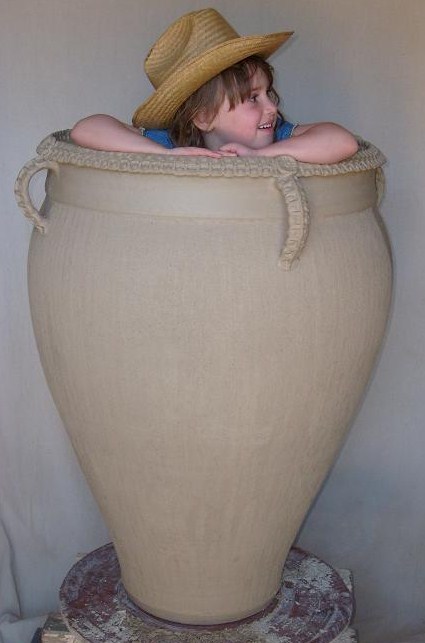
Recently I was a guest artist at a conference where, over the course of three days I made a 7’ Amphora using two wheels. I was positioned next to next to a family of Koreans who were making traditional Kimchi fermentation jars. These things were huge! They used the same coil/pinch method, but paddled the shapes into the forms.   In Georgia (Eastern Europe), they have been fermenting red wine for thousands of years in enormous ceramic vases called Qvervi; they use the same method. Spain probably has the largest pots I’ve ever seen called Tinajas. These absolutely spectacular containers are also used for fermentation,  as well as storing water.

Throughout my travels I have found that around the world, large terracotta forms are still produced for a great variety of uses.