Arugula Sauté: A Weed of the People

Eye of the Day|Arugula Saute Recipe| garden weed cook

A Weed of the People

We find vegetable gardening is a little difficult when we can’t water. This is why you need to grow ARUGULA  in your garden. It is actually a weed that doesn’t need much water, it grows wild in many parts of Europe, especially Mediterranean areas and it will grow wild in your garden, too. People in Europe pick it wild and throw it in their salads. Arugula is a weed of the people.

And it’s good for you, high in vitamin A, folic acid, iron, potassium, calcium. It’s a veritable miracle. The small, young leaves are our salad of choice (see previous recipe for Freitasalad), but as the leaves grow larger and stronger in flavor, sauté them like spinach and they lose their bite and take on an entirely different flavor and texture, not as slimy as spinach can be.

Eye of the Day|Arugula Saute Recipe| garden weed cook
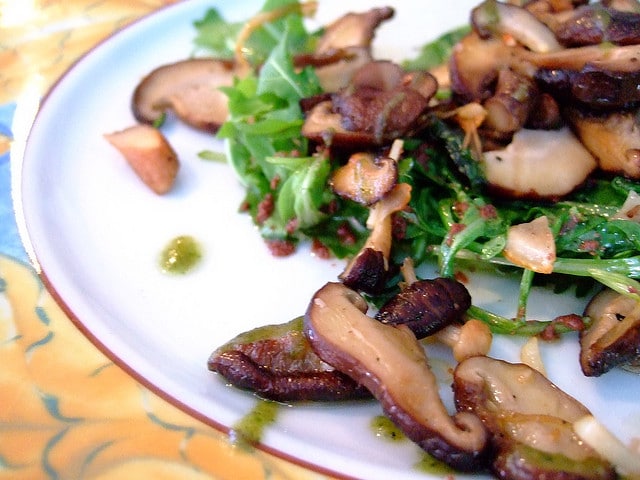
Sauteed arugula and mushrooms

ARUGULA SAUTE

1 T olive oil

½ LB mixed wild and cultivated mushrooms

1 small red onion, slivered

4 garlic cloves, minced

1/3 c dry vermouth

¼ t coarse sea salt

A pinch of red pepper flakes

8 c washed, dried arugula

parmigiano

Heat olive oil in a large pan over medium heat and add mushrooms , onions and garlic for about 4 minutes.  Add vermouth and continue to sauté until liquid is mostly absorbed.  Add salt, red pepper flakes and arugula and stir until the arugula is wilted, about 3 additional minutes.  Sprinkle with a little cheese and never eat spinach again.

Image Credit:
Arugula – Creative Commons, Mushrooms with arugula by yosoynuts is licensed under CC by 2.0
Planting in the Edges and Cracks of a Garden

Eye of the Day| succulents rock wall garden |garden

Planting in the Edges and Cracks of a Garden

For several years I tried to get a lovely, drought tolerant plant established in my garden. Lychnis coronaria is a perennial that forms low-growing rosettes of gray-green leaves that in late spring and summer sends up glorious stalks of dark magenta flowers. It just refused to grow in my nice fertile beds, but it is now flourishing, all on its own, between the cracks of my brick path. Like many plants, it apparently doesn’t want coddling and can find the moisture and nurture it needs at the edges of the more cultivated part of the garden. Even the Gaillardia seems to do just as well in the gravel terrace outside of the confines of the bed I originally planted it in.

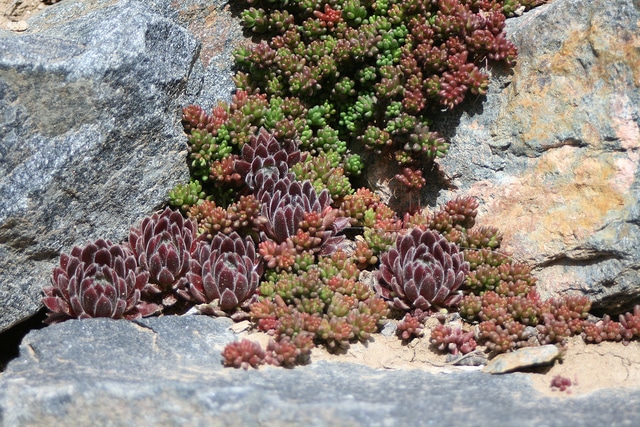
There are plenty of other species that also seem to thrive on the margins. Many succulents, for example, will multiply in the cracks of a wall or at the edge of the walkway. The stones provide a heat sink as well as a barrier to evaporation so that the root zone of these castaways is protected. Succulents such as sedums, sempervivums, and portulacas are particularly suited for this lifestyle. But other, tough plants like the herbs rosemary, oregano, creeping thyme, and even sage can fend for themselves in these microzones.

You may already have a dry-laid stone wall, or a flagstone or brick path that can accommodate a few plants tucked in the crevices. But, if you are planning such a feature, imagine leaving a wider gap in a few places. Some landscape material suppliers even have broken concrete or tile that has been salvaged from former gardens that make ideal patterns to include a few hardy plants to complete the patio, path or wall with the re-used paving.

And if some plant escapes the confines of your established garden bed, give it a chance and see if it is one of the hardy survivors that can lend softness and charm to the margin.


Image Credits:
Rose Campion – Creative Commons, Rose campion by Ruth Hartnup is licensed under CC by 2.0
Herb Garden- Creative Commons, Herb Garden1 by theoldpanther is licensed under CC by 2.0
Rock Wall Garden – Creative Commons, Rock Wall Garden by Patrick Standish is licensed under CC by 2.0


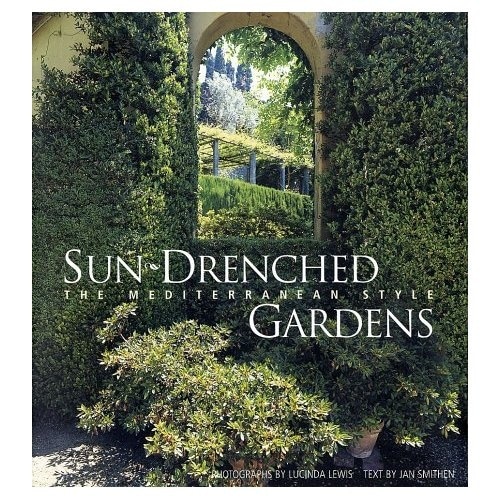
Book Review – Sun Drenched Gardens: The Mediterranean Style

Eye of the Day|Sun Drenched Gardens Book Cover|Mediterranean style garden

Sun Drenched Gardens: The Mediterranean Style by Jan Smithen 

 Author Jan Smithen and photographer Lucinda Lewis have put together a beautiful and pertinent book that is even more noteworthy today than it was when it was published in 2002. Mediterranean-style gardens offer easy maintenance as well as water-saving planting that is environmentally sound and enormously appealing.

Sun-Drenched Gardens; the Mediterranean Style features gardens from France, Italy, Spain and California that employ drought-tolerant plants such as agaves and other succulents, wisteria, lavenders, geraniums and even some roses. Design features such as terraces, arbors, hedges, pergolas, topiary, statuary, decorative tile, and terracotta containers are used in the gardens.

While paging through the book, Californians and especially those familiar with Santa Barbara will recognize landscape designs and terracotta containers so familiar that it seems the photos were taken in our backyards, or even at Eye of the Day. The eight chapters include one entitled “Endless Sunshine – Precious Water” which has great information and design ideas.  Another entitled “Living Outdoors” highlights our need to be in the open air and how to plan and enjoy our gardens even during a drought.

If you have difficulty finding this amazing book, the next time you visit Eye of the Day, ask to see our house copy, it’s truly worth seeing.


The Landscape Professional and Client Relationship Part 2

Eye of the Day|Puck Erickson|garden design architect

The Landscape Professional and Client Relationship, Part II

Principal at Arcadia Studio in Santa Barbara and a resident of Los Olivos, Carol Puck Erickson, ASLA,  has an extensive portfolio of residences and arid gardens in Arizona and beautiful installations throughout California, Puck was initially educated in the visual arts, which still informs her work. She is an avid bi-coastal hiker and amateur botanist who is intrigued by the relationships between the cultural and agrarian landscapes and the native environment.

Puck is also committed to the therapeutic value of gardens, as a founding member of the Santa Ynez Valley Botanic Garden and pro bono consultant for many school and community gardens.  She has worked with Eye of the Day on a large variety of projects over the last two decades and is one of our favorite landscape professionals.

EOD: How has your design relationship evolved over time with any particular client?

I have enjoyed working with clients on multiple projects, sometimes over decades as the gardens reflect an evolution in their owners’ perspectives on the twists and turns of their own lives. Working together, we gain an understanding of the role time plays in a garden and in our own lives.  Often, with their second or third gardens, people are willing to plant a bit smaller and also to simplify their approach to garden designs.  While others, coaxed into the out-of-doors by their first garden, become avid collectors and gardening enthusiasts.

EOD: How do you accommodate the client’s changing tastes over a span of time and still allow your own accumulated professional experience to show through?

I listen closely, very closely!! As the years have flown by, I find that often I am simply a translator and steward as my client churns out ideas with unbridled enthusiasm, often without recognizing their own insight into a space, or an observation gleaned from their travels. It is through my experience and design discipline that we can take these wonderful ideas and marry them to the environment of the new garden.

I am often surprised at how easily some designers seem to let go of their gardens and the evolution of those spaces, from both a horticultural and aesthetic perspective. When we work with clients we are not creating a garden image, frozen in time. Once the garden is completed, the real fun begins. The garden begins to build its own rhythm and dynamic as it flows from season to season and we are committed to continue that dialogue with our clients and their gardens over years, if not decades!  I think responding to the drought is a perfect example of how an on-going relationship with the client and their garden can make a real difference.

To view more of Puck’s work, visit Arcadia Studio.


Morocco in Your Own Garden

Eye of the Day|Moroccan Garden|Newsletter

Morocco in Your Own Garden

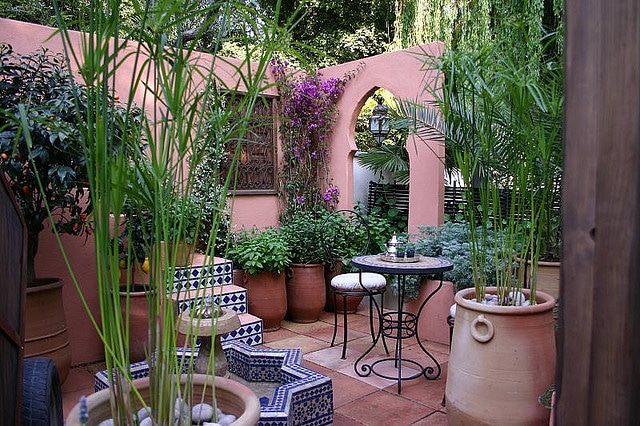
California gardens, especially those in Southern California have long utilized the concept of outdoor rooms. Countries with warm, dry climates around the Mediterranean basin have been creating miniature oases outdoors for centuries. Taking a cue from them is one way to replicate both the feel and appropriateness of this style.

Moroccan gardens provide great examples of the restrained use of water to create a lush setting in outdoor courtyards and passageways. Even while reducing your water use in the landscape, you can create an intimate, yet luxuriant garden space by taking inspiration from arid North Africa. Gardens there are generally central to the dwelling, both to provide privacy and protection from the heat and winds.

One of the key elements of these enclosed spaces is limiting water use. The Arabic word for a garden of this type is riad and usually refers to the central fountain or ornamental pool. The fountain need not be large to provide a bit of cooling to the air as well as a sense of peace and luxury in a climate where water is scarce.  It is possible to recreate that feeling with a simple water feature created from a glazed pot and a small, efficient pump instead of building a large fountain.

Another feature is the exuberant use of color. Colorful pots, a painted wall or gate as well as bright flowers make for a vibrant and even joyful setting. Vivid glazed tiles, whether on the patio floor or the surface of a fountain, also contribute to creating an exotic paradise.

Plants can be used as well and they do not have to be those that require a lot of water. There are many that are drought tolerant, yet lush-looking. Large leaves give a more topical feel and species such as bird of paradise, aspidistra and pygmy date palm do well in containers. Succulents are a great choice; from cacti to agaves and aloes, they thrive on little water and their foliage provides drama and color. The Canary Islands is home to a wonderful group of succulents, the aeoniums, whose fleshy leaves grow in large, showy rosettes and would be perfect choices. Even the humble geranium (Pelargonium) is sturdy and produces flowers nearly year round. Assemble several plants in one container to provide a miniature landscape or group individual pots together, mixing and matching your color palette.

Look at Planted Wells blog for more Moroccan garden design inspiration.

Image Credits:
Moroccan Garden – Creative Commons, Chelsesa Flower Show Gardens by Rictor Norton and David Allen is licensed under CC by 2.0
Plant Image – Creative Commons, BCSS gloucester branch auction – The national agave collection by stephen boisvert is licensed under CC by 2.0 


The Landscape Professional and Client Relationship

THE DESIGN PROCESS SHOULD BE ENJOYABLE FOR EVERYONE
An interview with Stacy Fausett

Stacy Fausett is a highly respected Landscape Architect who takes great pride in what she does. She is quick to say that when she is asked to return and do further work for a client, she considers it a great compliment. We often see her at Eye of the Day, pen and paper in hand, walking the greenhouse and annex, taking lots of notes for her clients. She is looking for things that will fit into a particular design for her clients’ landscape and home. Stacy has worked to build long-lasting relationships with many of her clients, seeing them through a project, and over time moving on to new ideas in the same project later and then to other properties as they change homes. I asked Stacy a few questions about how she achieves these long-term client relationships.

EOD: How has your design relationship evolved with a client’s different projects?

SF: Obviously, having an established working relationship and familiarity allows me to skip the formalities of getting to know the client and then I can jump right into the design process. The familiarity is wonderful and makes for a fun project. It’s like working with an old friend.

EOD: How do you accommodate the client’s changing tastes over a span of time and still allow your own accumulated professional experience to show through?

SF: Each project varies with the style of architecture, the unique qualities of the property, and the client’s needs and desires. The client’s needs may have changed over time, so assessing these elements are the same as it would be for a new project. Having more years of experience behind me and knowing the likes and dislikes of the client allows me to make assessments and design suggestions. It is a very efficient way to work on a project.

EOD: What does it take to gain the client’s confidence in order for them to continue a long-term personal and professional relationship with you?

SF: It’s actually very simple to gain the trust and confidence of a client:

  1. Listen to your clients: their wants, likes, dislikes,needs and critical elements susch as time frame and budget. Respect this information.
  2. Do your homework and present quality, well thought out materials and design work.
  3. Most importantly, do what you say you are going to do in a professional and timely manner. Organization and communication are key to a successful relationship in every circumstance.


Eye of the Day|Stacey Fausett| client professional relationships STACY FAUSSET studied Landscape Architecture at California State Polytechnic University and has been practicing for over twenty six years. After many years of working for other Landscape Architects, she opened her own office in Santa Barbara in 2010.