Eye of the Day’s Edible Container Gardening Workshop

Edible Container Gardening Workshop Ad 1 copy


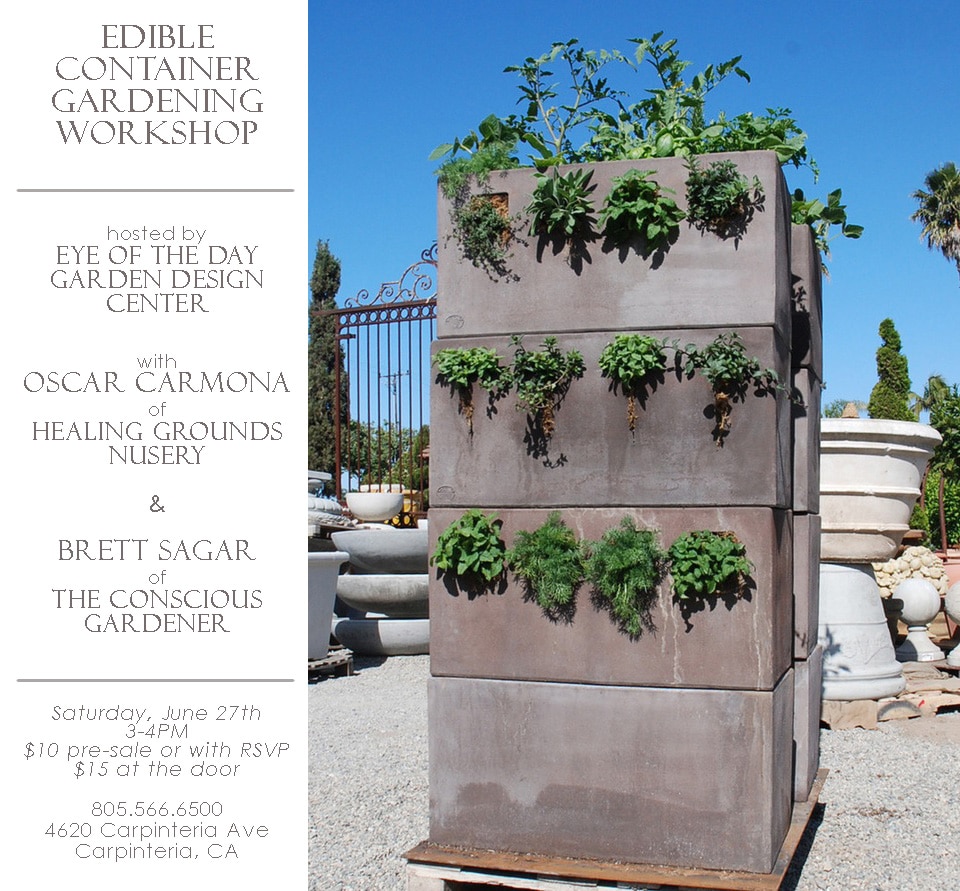
Eye of the Day Garden Design Center is pleased to announce an Edible Container Gardening Workshop right here at our store.

It will be conducted by Oscar Carmona of Healing Grounds Nursery and Sagar Faucheaux  of The Conscious Gardener.

When: Saturday, June 27th

Time: 3-4 PM

Where: Eye of the Day Garden Design Center, 4620 Carpinteria Ave, Carpinteria, CA

Attendance is only $10 before June 27th or $15 at the door.
Attendees who RSVP before the day of the event will be guaranteed the $10 fee.
All participants may have their entrance fee credited toward any purchase on the day of the event!

RSVP at 805-566-6500 or suzi@. Space is limited so please contact us to reserve your spot.


Top Your Pot with Tumbled Terracotta

Eye of the Day|Tumbled Terracotta Pot Topper|Baked Earth

TOP YOUR POT WITH TUMBLED TERRACOTTA

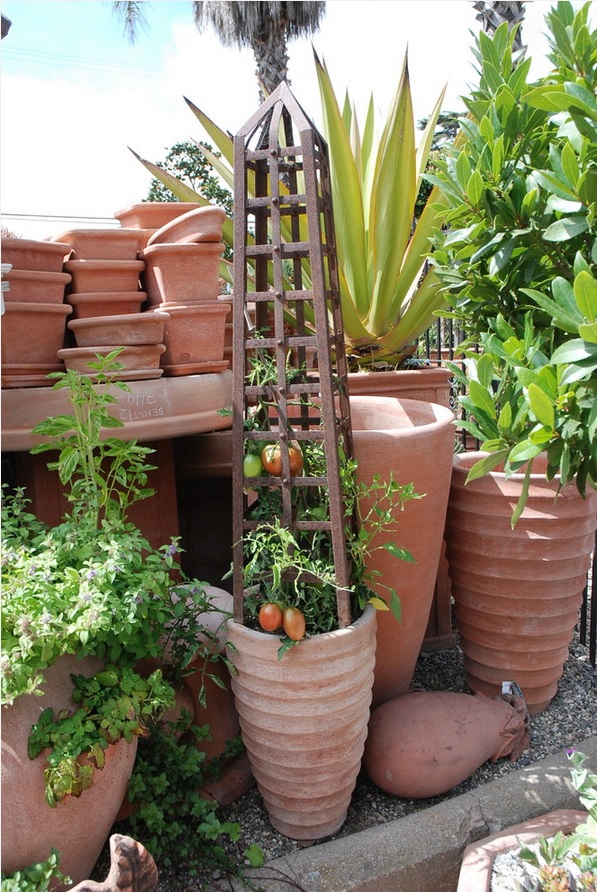
You have a beautiful citrus tree and a beautiful pot, together making a perfect statement piece, but maybe there’s something to make it even better from a design standpoint and for water conservation.

Design professionals typically use under-planting to finish the look of  a tree or tall plant in a pot.  They might use Alyssum,  Baby Tears, Lobelia,  Creeping Rosemary or any other trailing or low-growing plant.  During our current drought, we see more succulents being used, such as String of Bananas, String of Pearls,  Hens and Chicks or Sedum as under-planting and as a living mulch. You can see these same plants in action as part of our video: How to Convert a Fountain to a Succulent Garden. 

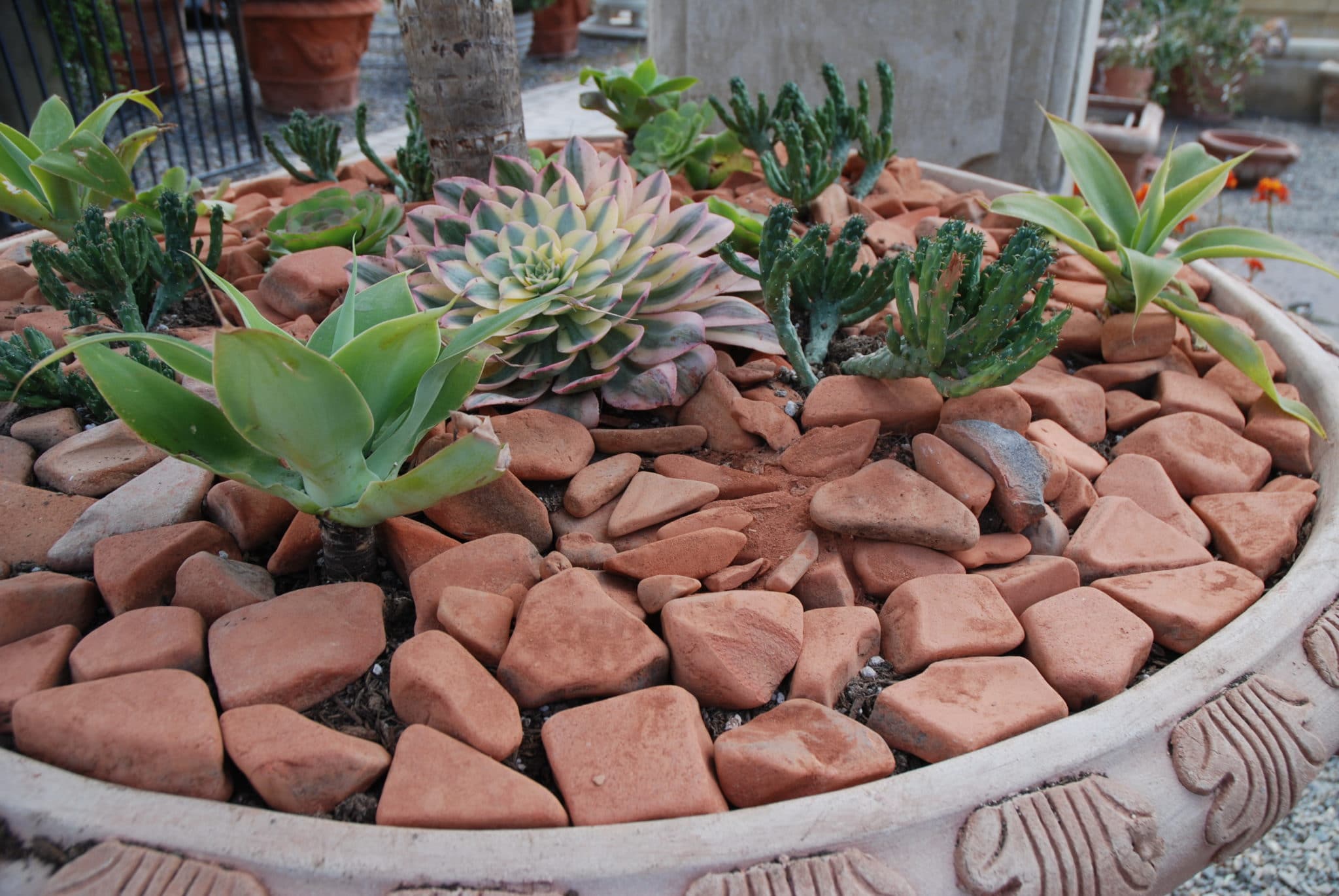
More recently, designers have moved beyond plants and have progressed to using tumbled glass in almost any color, moonstones and beach pebbles.  At Eye of the Day, we are ALL about terracotta, so we have developed a new “pot topper” which not only looks beautiful, but helps maintain and control soil moisture in the container while allowing the surface of the soil to breathe (VERY important to container health).

This new product is Tumbled Terracotta, produced from Italian terracotta fragments, tumbled to soften the edges.  Succulents, cactuses and aloes can also be planted between the pieces for a more carpeted effect further enhancing the design and beauty of container planting.

Our Tumbled Terracotta is available in pieces categorized into three sizes, small at $3 per pound, medium and large at $2 per pound.  The next time you visit Eye of the Day, we’ll show you how using Tumbled Terracotta Pot Toppers adds beauty and practicality to your container planting.


A LANDSCAPE ARCHITECT DESIGNS FOR THE DROUGHT

Eye of the Day Garden Design Center|Sally Farnum Before and After garden design|drought

A LANDSCAPE ARCHITECT DESIGNS FOR THE DROUGHT

While landscape architect Sally Farnum of SE Farnum Associates has been taking the time to educate her clients about how to deal with their outdated, thirsty landscapes—especially rolling, green lawns—she has designed and implemented an outside environment for her own home that is water-considerate and still lush, inviting and peaceful.

The first task was to remove a large front lawn and some accompanying flower beds.

BEFORE: Water-thirsty lawn

DURING: Removing lawn and introducing granite

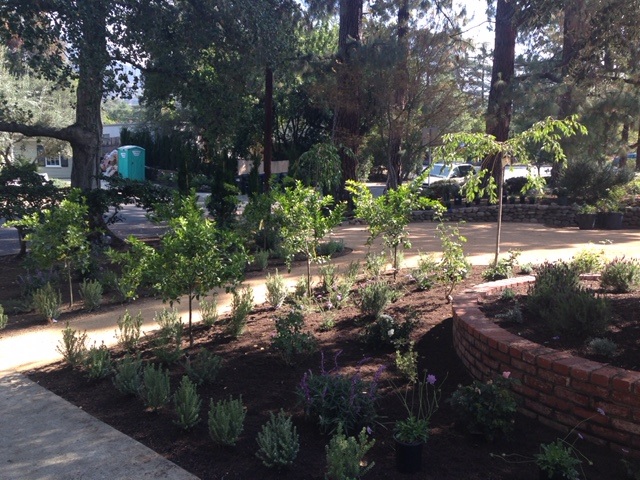
Next, grading, drainage and landscape plan was translated to the area. Decomposed granite was used as the base of the pathway from the driveway, culminating in a keyhole design, at the end of which a dry-stacked rock wall would serve as a retaining wall as well as the background for a Gladding McBean fountain conversion.


ALMOST FINISHED!
Flanking each side of the pathway are two Antique Green Gladding McBean Oil Jars, preparing the eye for the fountain.  Planting on the perimeter of the path area includes a variety of water-friendly plants and trees.


STAY TUNED
Check back next month on Sally’s design in progress for photos of the finished project.


Edible Container Gardening 101

Eye of the Day Garden Design Center|Edible Container Garden| Oscar Carmona

Edible Container Gardening 101

Edible container gardening is a great way to grow vegetables especially when there is no space for a traditional garden. If you live in a condominium or an apartment, containers can provide valuable growing options. A container on casters gives you the ability to move your vegetables to sun or shade, depending on what you want to grow and the time of year. With good, fertile potting soil and a topping of protective mulch you can get by with minimal water.

If you have never tried growing edibles in a container or have not had much success, here are five key considerations  that will greatly enhance your efforts.

POT SIZE

It is important to match the size of your pot to the types of vegetables you want to grow. Bowl shaped pots that are somewhat shallow, approximately 8 to 10 inches, can be great for growing lettuces and other leafy greens. Peppers, cucumbers, beans and larger growing herbs need a deeper pot, 12- 18 inches. Tomatoes like pots that are 18-24 inches deep and about 12-14 inches in diameter.

POTTING SOIL

I recommend choosing an organic potting soil that includes lots of good compost, organic nutrients and important beneficial soil microbiology. EB Stone’s 420 blend has all of these ingredients. Plants grow well in pots when they have a rich growing medium and regular watering. Purchasing top quality potting soil is key to growing healthy, productive plants in containers.

WHERE TO LOCATE YOUR EDIBLE GARDEN

Sunlight and favorable temperatures are also important to growing healthy plants.  Observe how much sun exposure your selected area gets.  Morning sun with shade in the afternoon is good for growing leafy greens such as lettuces, arugula or kale. Sun all day is great for tomatoes and peppers. Shade loving plants like the ambient temperature range of 56-75 degrees. Full sun loving plants are comfortable in the temperature range  of 60 to the mid to upper 80’s. You may find that you have spots in and around your home to grow a bit of both. Remember that the sunlight and temperature will vary throughout the year. So you may need to make adjustments to what you want to grow and/or move containers from season to season.

PLANT NUTRITION

Good organic potting soil will contain necessary organic nutrients. These nutrients not only provide an important food source for your plants, but also for the beneficial microorganisms in the soil. Beneficial soil microbiology will help plants grow strong, nutrient dense and more disease resistant. I also recommend an all-purpose fish/kelp liquid fertilizer applied once weekly throughout the growing season to ensure that your edibles have access to a full range of organic nutrients.

WATERING

Plants in pots need regular, efficient watering as they can become dry more quickly than when planted in the ground. Water until you see it coming out of the drain hole at the bottom of the pot. This means that you have watered completely through the root zone. Fertile potting soil and a layer of mulch will help retain moisture. As you get to know your growing environment you will be able to fine-tune your watering schedule.

Once you have experienced success  with your container garden, you can take growing to the next level by planting your favorite crops in succession over the course of the growing season, which is all year in our neck of the woods!   So don’t plant everything all at once. Start a little at a time with strategic new plantings at  four, eight and twelve week intervals. Leafy greens can be successively grown every four to six weeks. Longer growing crops can be planted every eight to twelve weeks.

Now you are ready to get started or advance your edible container gardening efforts. With some good observation for growing potential in and around your home and care to provide your edibles with a good growing environment you will enjoy successful harvests well into the future.

Oscar Carmona, Healing Grounds Nursery 

Special Event: Eye of the Day will be hosting a special Edible Container Gardening Workshop with Oscar Carmona on Saturday, June 27th. For more information and to reserve your spot, please visit the event page.
Musing on Design: Bonsai – Tiny Landscaping Using Very Little Water

Eye of the Day|musing on design|Joe Kalina bonsai

Musing on Design: Bonsai – Tiny Landscaping Using Very Little Water

Eye of the Day’s interest in gardening, plants and outdoor living goes beyond residential and commercial landscape architecture and into a special type of gardening—almost a form of intellectual gardening—with Joe Kalina, a man who is certainly musing on design.

Joe is always interested in a challenge and always interested in intellectual probing.  He received his degree in Fine Arts, worked as a draftsman and then pursued a degree in Business Administration while working as a designer at Northrup Grumman.  Now “retired,” Joe has a million projects, but one has held his attention since 1977.

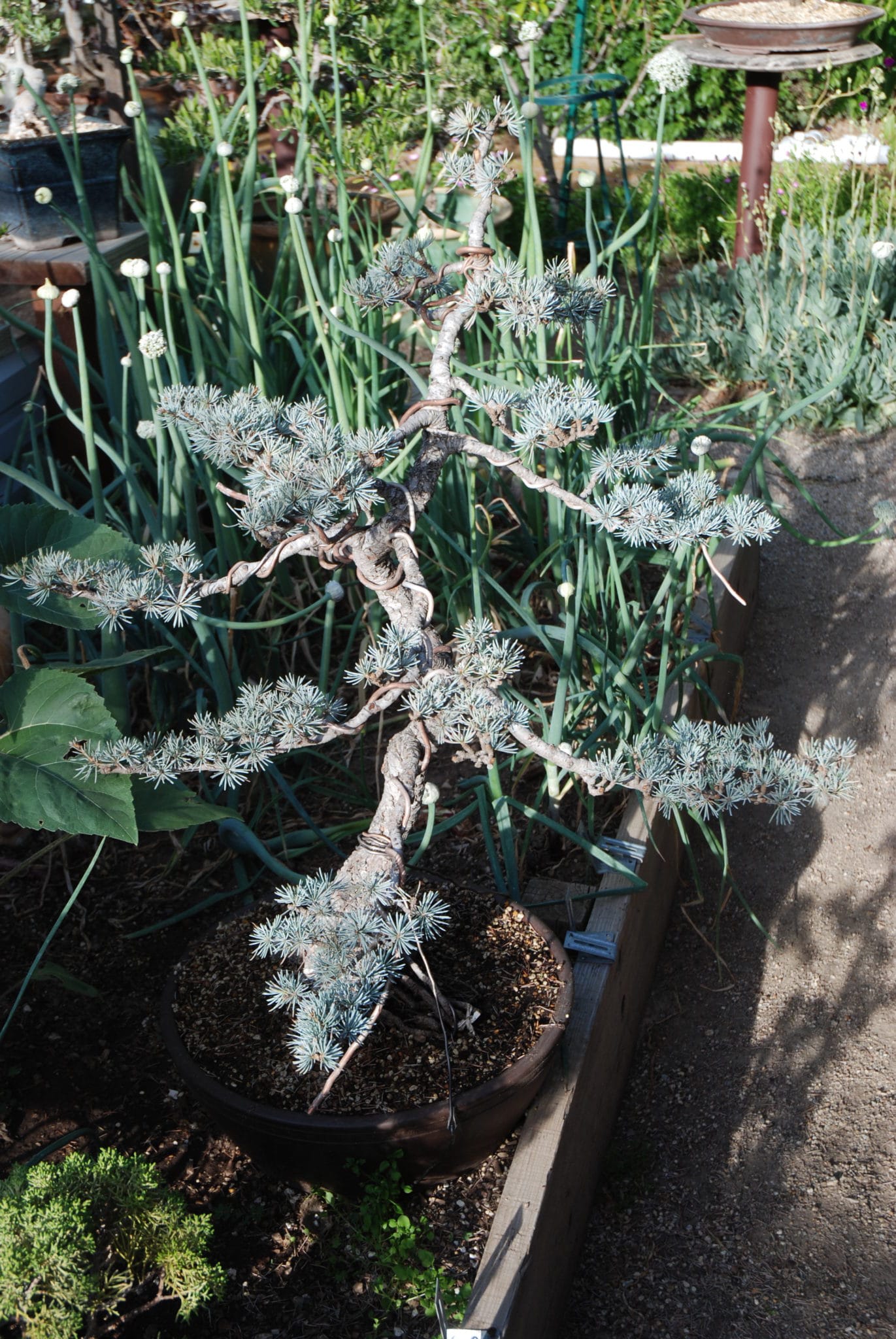
With his knowledge of the elements of design, the art of Bonsai became a challenge and a love for him.  He first chooses a potential tree by looking at the size of the trunk based on how he envisions the outcome in the distant future. He then examines how the roots are dispersed around the base of the trunk to give structure and visual pleasure. The optimum plant has many branches which in traditional Bonsai practice are numbered.

Practicing the art of Bonsai is a true form of meditation and has helped Joe to gain the discipline to learn patience, as many of his projects have been ongoing for decades. For a few hours almost every day, tiny leaves are pulled and even tinier pine needles are removed with tools that are almost surgical.  Copper wires and wooden spacers are used to coax the tree into shapes that are traditionally sound as well as pleasing to the eye.

Many of the same methods that are used in landscape design are used in Bonsai: planning, strategy, use of sculptural elements, linear design, visual significance and personal style.  Joe has become genius at planning his unique landscapes, but he acknowledges there is time to learn even more patience.  He is a patient man.


How a Landscape Architect Approaches Garden Design During California Drought

Eye of the Day|Sally Farnum Landscape Architect|garden design drought

Having a sister with a long, successful career as a landscape architect has made it easy to have an ongoing conversation with Sally Farnum about design, client concerns and current issues. We are all especially interested in California’s water problem and wanted to find out how Sally is helping her clients address the issue.

Suzi: What have your clients have been asking about when it comes to water and their gardens?
Sally: Most of my clients are trying to be responsible when it comes to water usage in their landscape. They want to know if they need to take out their lawns, replace their flowering plants with desert plants and if it will still look pretty.

Suzi: How do you approach designing a plan that reflects water-consciousness but is still pretty?
Sally: I really work to combine good elements of design in all my plans: scale, balance, variety, form, line, texture and color. I like to use California natives, salvias, lavenders along with containers, sculpture and fountains.  I suggest using decomposed granite and gravel and, really important, an extra-efficient irrigation system.

Suzi: How do you convince them that a huge, green lawn isn’t the best plan anymore
Sally: Most people are visually oriented, so to describe an idea in words alone doesn’t always convince them. I show them photos or have them visit other projects I have completed.  But I don’t feel that it’s necessary to remove ALL lawn. Only 5% of residential water is used to keep lawns green and it contributes to cooling an area, cleaning the air and reduces noise. Grass in a front yard, used to fill space, should be eliminated.

Suzi: Do you have a favorite or most challenging project which incorporated water-wise elements?

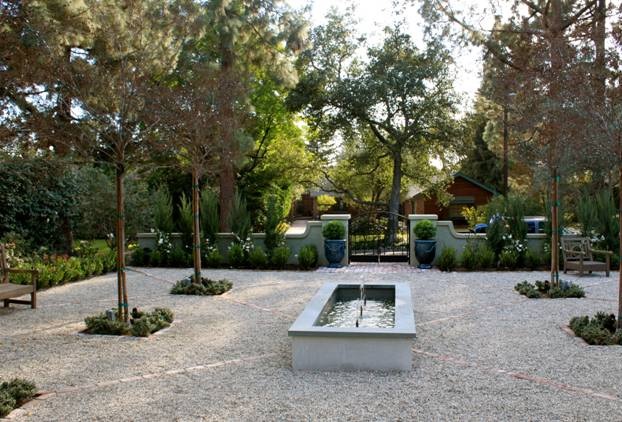
Sally: One of my favorite and most challenging designs is right across the street from my own home.  Challenging because the home belongs to a friend and because I look at it most every day. My favorite because of the transformation from a front yard with a large asphalt driveway and lawn, to a garden with a walled-in gravel courtyard with a fountain and pots planted with flowering plants on the street side of the wall.

Suzi: How have you managed to change the way you designed in the past to meet the new challenges presented by the drought?
Sally:  The challenges are mainly in working with my clients and helping them accept new plants and watering habits.  Most plants will adapt to using less water, but people tend to water more than necessary.  I haven’t changed the way I design, but I have changed the materials and plants I use.


Suzi: Thanks, Sal.  You’re always such a wealth of information, and a fine sister, too.
Sally: You’re not so bad yourself.