Elements of Style: The Classic Mediterranean Garden

Elements of Style: The Classic Mediterranean Garden

A classic Mediterranean style garden is typically low-maintenance, drought tolerant and perfect for a climate dry and hot in Summer and warm and moist in Winter. For those of us living in California, this seems a perfect fit. Traveling throughout the Mediterranean region, focused on the landscape and gardens, reminders of California are constant.

Mediterranean style Old Greek jar collection
Eye of the Day’s collection of antique Greek pithari.

The defining characteristics of the Mediterranean style are:

  • Focus on hardscapes, with very little or no lawn
  • Citrus, olive trees, rosemary and lavender often planted in terracotta pots
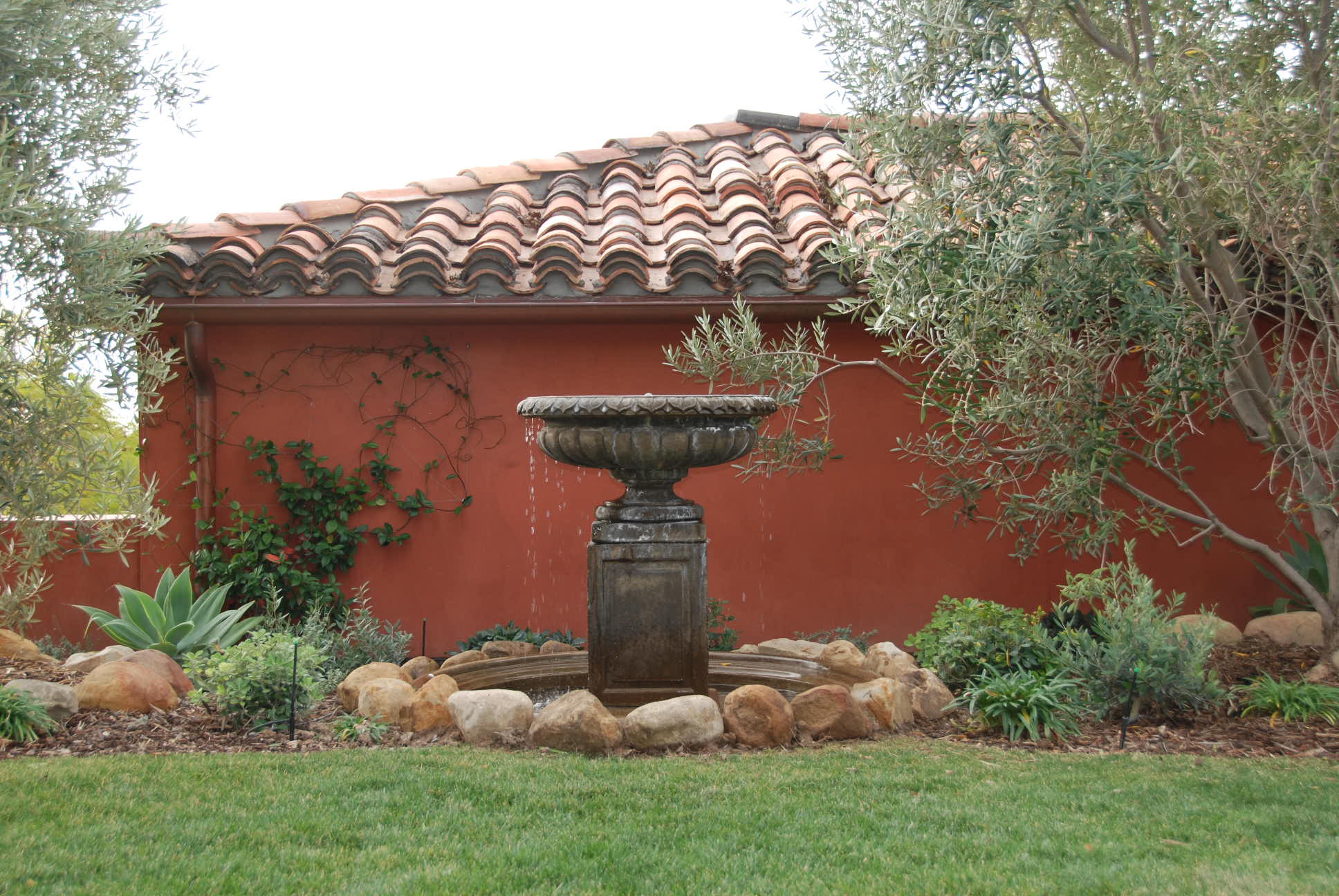
  • Fountains and water features are key. Water features became popular in the gardens of the Italian Renaissance. They reflect the garden and provide the relaxing elements of sight and sound.  Because of the scarcity of water in the Mediterranean,  many water elements offer a relief from the heat.
  • Large and small terracotta pots and urns and statuary. Pottery in many forms has been a part of Mediterranean gardens since their origins in ancient Roman households. From intricate bas-relief to simple and plain, they are quintessential for a European garden.  Statues, urns and planters provide focal points and because their footprints are small, they are particularly useful in a small garden. The Greeks and Romans filled their pots with flowers to add color to their courtyards and pathways without depleting the water supply, or they used them to grow fruit trees that could be moved about  according to the outside temperature.  But pots were also used as beautiful objects on their own – a classic oil jar at the end of an allee, a row of terracotta pots topping a balustrade, or an urn crowning a pedestal.

You don’t have to live in Spain, Greece or Italy to reflect the siren call of the Mediterranean classic garden.  A few carefully chosen garden elements… an antique Greek pithari, a scattering of large terracotta pots and urns and a simple water feature will create your classic otium.  Being water conscious and embracing a rustic, muted look will go a long way toward making your space the place to be.
How To Keep Your Fountains Water Wise During Drought

As we all face this unprecedented drought, we need to make smart choices about using water. At this point I’m praying for rain, but I’m realistic enough to know my lobbying may not be that influential.

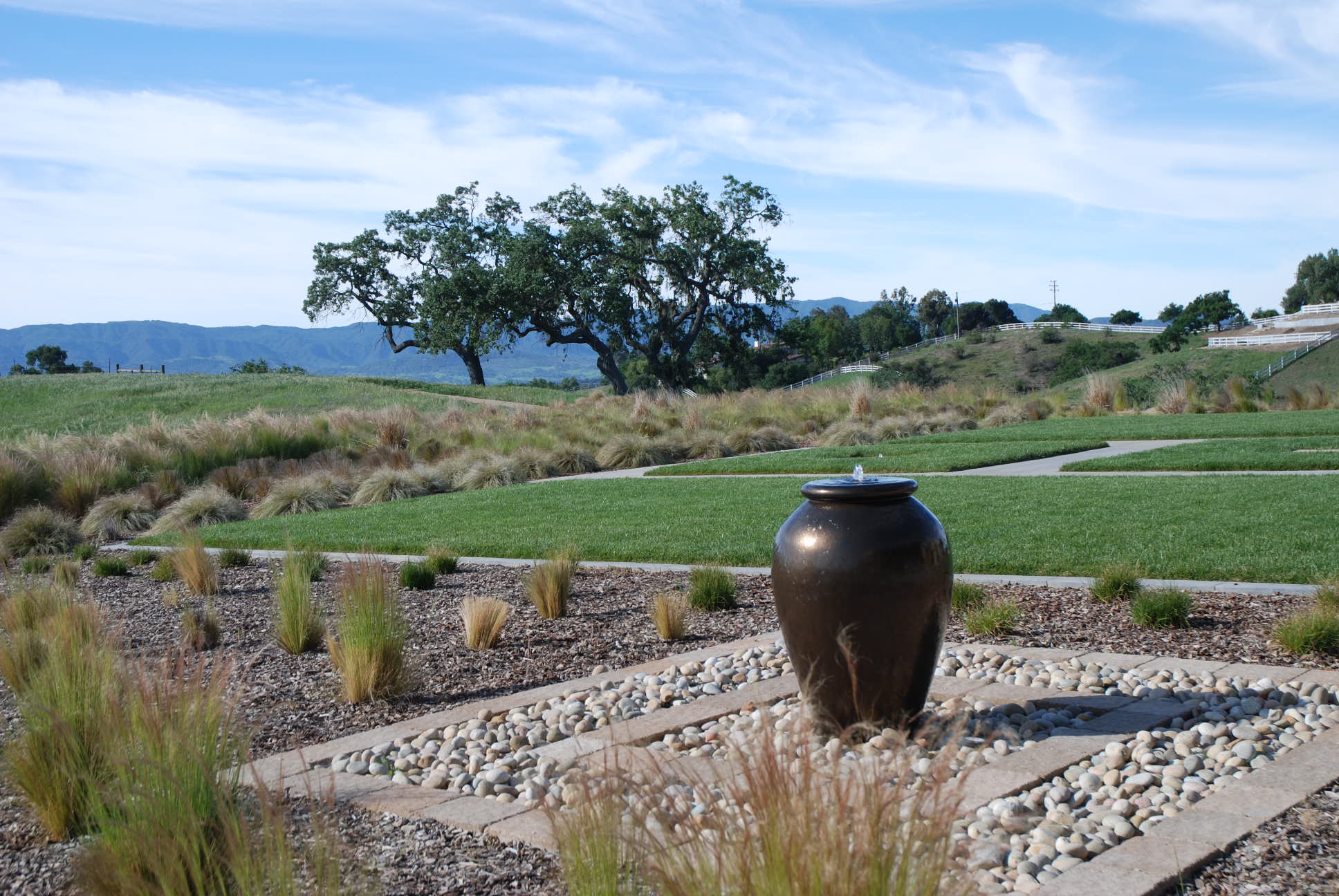
But I have instituted several measures, the first of which regards my fountain. This water element is an essential part of the environment at my home. It runs 24/7 at this time of year and requires filling once a week. The sound it provides directly affects my sleep.  Could I live without it? Yes, I suppose I could, but why should I? It just doesn’t use as much water as one might think. It recycles the water and other than splash, evaporation and birds, the water goes round and round. I have calculated that I typically add about five gallons a week. The equivalent of about two toilet bowl flushes.

Water Wise fountain

Think about how much water a small lawn consumes and the minimal use of a fountain along with its relaxing and recuperative powers. It seems to me to that it’s a good use of water in my home. Some other tricks for your fountains are:

  • Turn down the pump to reduce the flow and splash
  • If you have a  fountain that splashes a lot, place plastic buckets around it to catch the errant water to add back to the fountain.
  • Use bath water: I am an ardent bather, I love a hot bath even in the summer, and I use that water to fill my fountains as well as water container plants. It’s easy to use an old pump and some tubing and when you’re finished with the bath, pump the water into 5 gallon pails and use it in the garden.

I don’t have any tips for you for your lawn because I haven’t had a lawn in twenty years. My feeling is: JUST SAY NO TO LAWNS. There are so many things that you can do instead and probably will have to do instead, especially if this drought continues for much longer.


Right Plant, Right Place: The What and Where of Drought Tolerant Planting

My client was happy; she’d just completed installation of major landscape improvements designed by an award-winning designer. I was not so happy. Some of the plants the designer had chosen were simply not suited for the area where they’d been planted and it was my job to make them look good.

Landscape architects, designers, and maintenance crews are largely trained in the nuts and bolts of building landscape: walls, paths, site lines, and the mechanics of irrigation systems, but may not be as versed in the fine art of plant selection. The lusty plants at the nursery look fantastic in their pots, but growing information is scanty.

The tag says full sun to partial shade. Were the conditions it was tested in similar to your site? The tag says drought tolerant. What kind of soil would provide the support the plant needs to actually survive a drought? And for how long?

Especially in water-challenged Southern California, consider the following as essential to a successful landscape:

Soil

Test the soil. Is it heavy clay, loamy or sandy? Each different type requires specific treatments or careful plant selection. Match plant requirements to what is available (or achievable).

Plant Grouping

Group plants by water and exposure requirements. Even the Cadillac of irrigation systems will support plants only if all of them in the area being watered require the same amount at the same application rate. In our climate it should always be the primary principle to reduce the amount of water required for any given garden zone.

Environment

We shouldn’t have to relinquish every lush-looking palm, fern or ginger, just make sure they are placed where their water requirements don’t conflict with those of the more drought-tolerant ones.

Professional botanists and horticulturists have taken these questions to heart and provide more complete information in books, magazines and websites. Call on their expertise and experience to create a successful, beautiful garden.

See more of my writing on sustainable landscaping here.


Lisa Cox Design | Los Olivos Tasting Room Gets Design Update

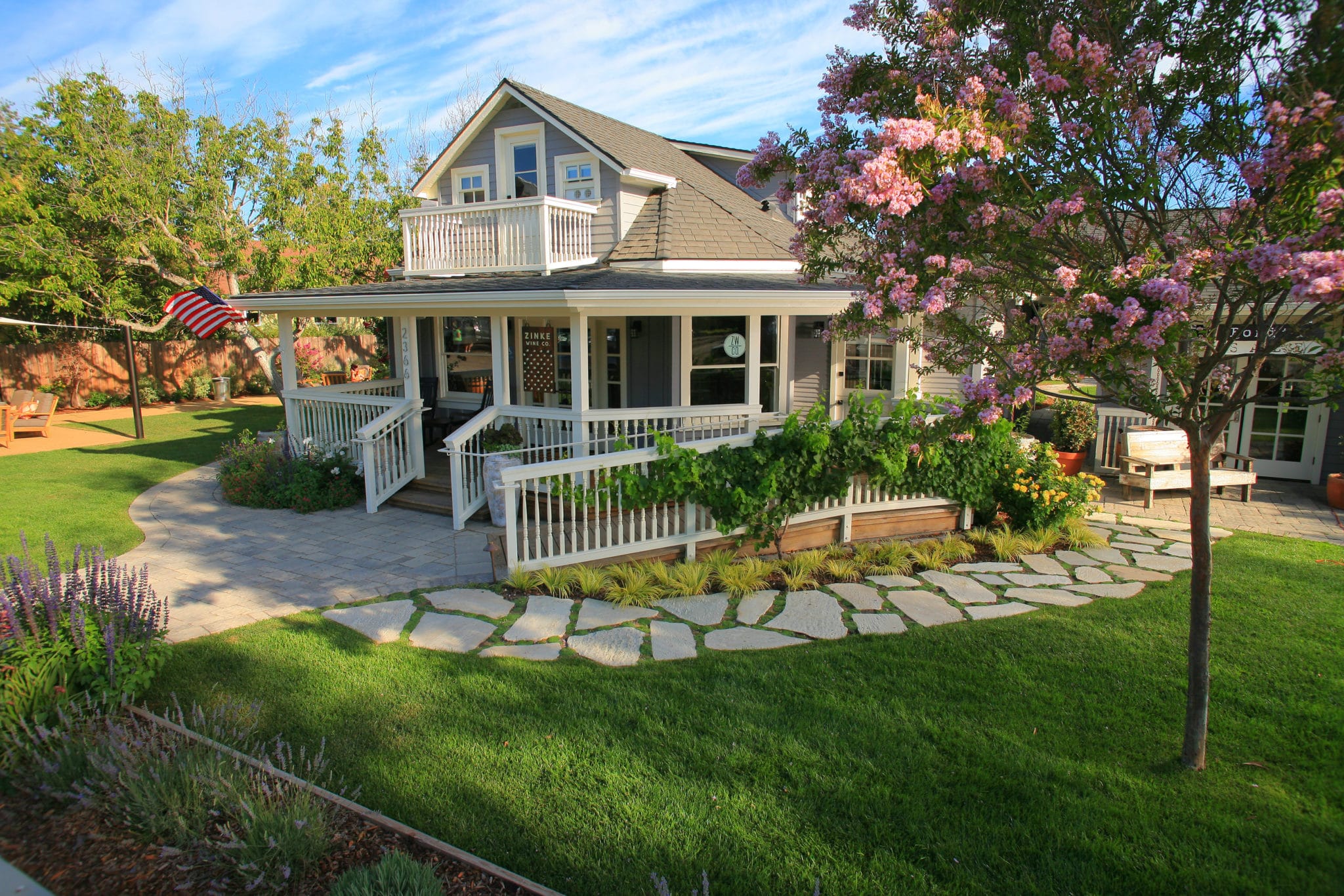
In the relatively short time Lisa Cox Landscape Design has been working in the Santa Barbara area and Santa Ynez Valley, she has become the go-to for anyone wanting clean and sharp designs with a focused point of view. This is clearly evident in her design for the brand new Zinke Wine Co. tasting room. Lisa says she can’t take complete credit for the beautiful design as she worked closely with Thierry Fraye of Paysage Landscape and the Zinkes who have impeccable taste and a clear vision for their brand.

Michael and Ashley Zinke are Zinke Wines. Michael Zinke is a self-taught winemaker that apprenticed at Girouard and Sans Liege wineries before venturing out on his own. They opened their state-of-the-art tasting facility in the wine country township of Los Olivos, CA this past May. They create single vineyard Rhone varietal wines sourced from a handful of Central Coast vineyards. They needed a venue befitting their precious creations and Lisa was the one to deliver.

Lisa incorporated Eye of the Day products throughout her design. As you approach the building you are greeted by two ‘aged’ Greek Bottle pots customized by Eye of the Day standing guard aside the main entrance. Each pot is planted with drought tolerant growth. While enjoying your first taste of Viognier you overlook an impressive Asian carved granite trough bursting with colorful succulents. You can also admire the lovely Italian San Rocco Giara Liscia pot that flanks the bocce court while waiting for your next throw. Zinke Winery Blueprint OverheadAfter taking it all in, we had some questions for Lisa:  

What was your inspiration for the design?
My Inspiration came from a few sources.  First and foremost, the owners, Michael and Ashley Zinke have distinct, incredible taste.  They were looking for a look that felt something with a rustic/industrial look and a warm welcoming feeling from the street that would draw in customers who were looking for something a little different.  Also, with the existing Cape Cod style structure of the Tasting Room, we wanted to keep that charm, but infuse it with a bit of modern charm!

Did the Zinkes have strong opinions on what they wanted or did they leave it up to you?
I would say they gave me a direction as stated above, but pretty much let me design what I felt would present both function and form to the space.

What were the particular challenges with this project?
We needed an area that would allow furniture placement which I accomplished with the DG cutouts that are surrounded with lush green grass. There was some existing hardscape that we “improved” with either widening pathways or substituting new flagstone stepping stones. With a mixed plant palette of natives, lush perennials and color, the end product turned out quite pleasing to the eye…and of course the succulent filled planters are incredible!

What do you most like about designing in the ‘Valley’?
I can honestly say, what I like most about designing in the valley are the people! Since my husband and I have only been here for 1½ years, we can honestly say we are overwhelmed with the warm, friendly and caring SYV community!  And of course, how can you beat our gorgeous natural landscape of rolling hills, oak trees and vineyards…it’s hard to beat! A special thanks to Rich Cox Photography for the images!


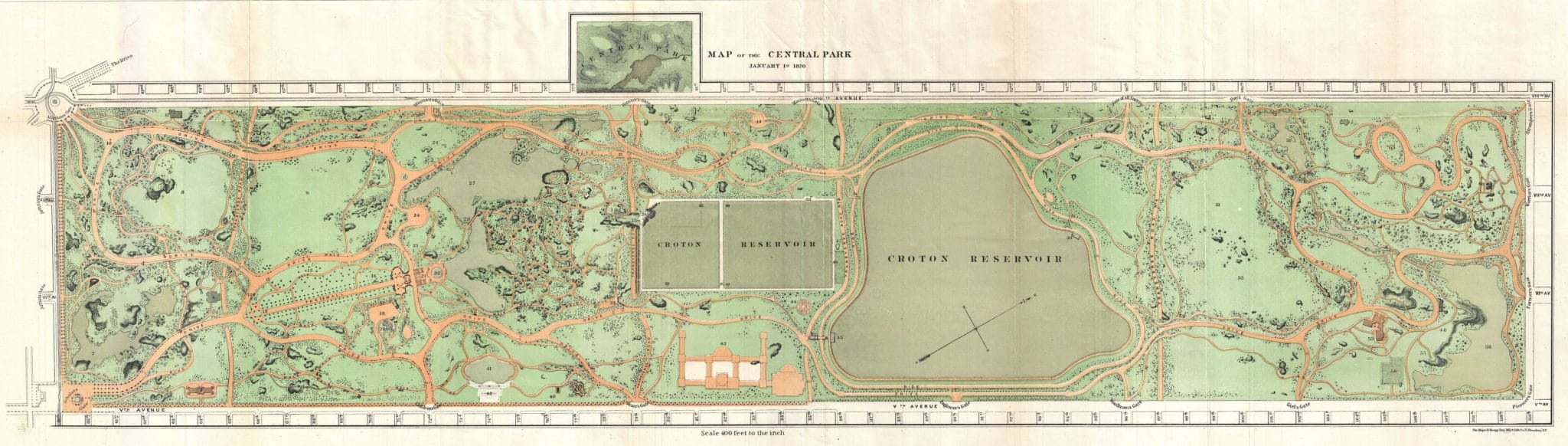
10 Design Principles of Frederick Law Olmsted

Frederick Law Olmsted, the father of American landscape architecture, is in many ways responsible for the way America looks. Beginning in 1857 with Central Park in New York City, he created designs for thousands of landscapes, including many of the world’s most important parks. Prospect Park and Fort Greene Park in Brooklyn are designed by Olmsted, as well as Boston’s Emerald Necklace, The Biltmore Estate in North Carolina, Mount Royal in Montreal, the grounds of the U.S. Capitol and the White House, Washington Park, Jackson Park and the World’s Columbian Exposition of 1893 in Chicago. Many of the green spaces that define towns and cities across the country are influenced by Olmsted. Frederick Law Olmsted Full Photo The “Maker of Parks”, Olmsted was a prolific writer and outlined his approach to design with ten principles:

1) Respect “the genius of a place”
Olmsted wanted his designs to stay true to the character of their natural surroundings.  The goal was to “access this genius” and let it infuse all design decisions.

2) Subordinate details to the whole
There was no room for details that were to be viewed as individual elements.  In his work, they were threads in a larger fabric.

3) The art is to conceal art
Olmsted believed the goal wasn’t to make viewers see his work. It was to make them unaware of it. To him, the art was to conceal art. And the way to do this was to remove distractions and demands on the conscious mind. Viewers weren’t supposed to examine or analyze parts of the scene. They were supposed to be unaware of everything that was working.

4) Aim for the unconscious
His designs subtly direct movement through the landscape. Pedestrians are led without realizing they’re being led. There is the sensation of feeling lost yet completely confident that you can easily return to your starting point.

5) Avoid fashion for fashion’s sake
He felt popular trends of the day, like specimen planting and flower-bedding of exotics, often intruded more than they helped.

FLO map6) Formal training isn’t required
Olmsted had no formal design training and didn’t commit to landscape architecture until he was 44.  His views on landscapes developed from traveling and reading.

7) Words matter
Olmsted wrote often and thought hard about the words he used. For example, he rejected the term “landscape gardening” for his own work since he felt he worked on a larger scale than gardeners.

8) Stand for something
His writings show that, in his view, he wasn’t just making pretty, green spaces, he was democratizing nature.

9) Utility trumps ornament
He wrote, “So long as considerations of utility are neglected or overridden by considerations of ornament, there will be not true art.”

10) Never too much, hardly enough
He constantly simplified the scene, clearing and planting to clarify the “leading motive” of the natural site. Thirty years after he helped to design Central Park, he wrote to his ex-partner, Calvert Vaux, “The great merit of all the works you and I have done is that in them the larger opportunities of the topography have not been wasted in aiming at ordinary suburban gardening, cottage gardening effects. We have let it alone more than most gardeners can. But never too much, hardly enough.”

Olmsted believed in the restorative power of landscape for ordinary people. He disliked straight lines. He loved contrasting textures, but it was a cardinal rule with him to blur the boundaries. The architecture of Europe impressed him, but trees were his true love. And that true love shows.  Everywhere.


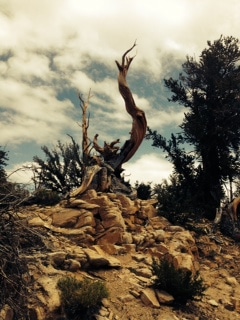
Groundskeeping: On The Road to an Ancient Landscape – The Bristlecone Pine Forest

Rushing from place to place trying to fulfill our obligations to one and all, we miss so many beautiful moments and opportunities.  I recently made a large delivery to El Dorado Hills to a client who found Eye of the Day through our website.  The house reminded me of L’Amorosa in Tuscany, a mini fortress built of stone. The entrance required two of our largest Terrecotte San Rocco Orcios (oil jars). bristlecone 1 However, rushing this order to meet a deadline, I was not excited about a 14-hour round trip from Santa Barbara to Sacramento. After all, with fear and trepidation, I could have freighted it all including the antique Orcios, but I had a plan that would allow my sense of adventure, my love of horticulture and my need to spend time with South Pasadena’s 2014 Teacher of the Year, my sister Nan, on her much deserved summer break. bristlecone 4bristlecone 5The plan was to take advantage of being so near to California Highway 49, which goes through California’s Gold Country, and drive back via this scenic byway checking out how things have developed over the last 20 odd years. Then, we could take advantage of the open passes over the Sierra Nevada Mountains to smell the pine sapped air and dip our toes in cool mountain lakes. And because I suffer from a Sisyphus complex, crest the divide and descend the eastern side down to Highway 395 to the Owens Valley (think about the movie Chinatown and you’ll remember the fight for the water from this valley). bristlecone 3And here, just 26 miles up, up and up outside of Lone Pine, California was our true destination: the Bristlecone Pine Forest, home to Earth’s oldest living things, trees that are over 4,000 years old. Nature’s longest lasting landscape design in one of the planet’s harshest environments. A trek at 10,000 feet sucking thin air to be in a landscape of such desolation and beauty.  I look at sophisticated, lush, and beautiful landscape designs and gardens every day of my life and the contrast of this magnificent place and its unfathomable significance is seared into my mind’s eye forever. bristlecone 2Oh, the places my work takes me!