The Rogue Garden: Preparing for El Nino

Eye of the Day|Rogue Garden| Preparing for El Nino

The Rogue Garden: Preparing for El Nino

Rain, rain, go ! No!  Rain, rain, please stay…we need you, desperately!  We all want it to rain here in California more than those outside the Southwest understand.  As I am in traffic in either Southern or Northern California, I often wonder how we can keep watering our landscape or even fill every commode tank in this state of over 39 million people. It is truly frightening.

Once El Niño begins, all hell may break loose.  Flooding, mudslides, standing water, highways washing out and roofs leaking are just a few of the problems being anticipated. A positive is all of the rainwater we can capture.  I have over 40 five-gallon pails strategically located to capture roof runoff. I’m working on a collection system to store this runoff for later in the Spring to use on all of my container plants.  Another thing to deal with is mosquitoes breeding in that stored water. I use mosquito dunks, sold everywhere.

Eye of the Day|Rogue Garden| Preparing for El NinoIf you have a lot of plants in containers, as I do, a wet winter can drown plants in containers that do not drain well. If your containers have mature plants it is possible that the root system has clogged the drain holes. During a wet period this can mean that your plants are sitting in a swimming pool of water unable to drain out of the pot and the root system begins to rot. Here are some suggestions for maintaining a balanced environment in you container plantings:

  1. If you can manage it, turn the container onto its side (usually by laying it down on something soft like a tire or thick cardboard). Then with a screwdriver or something sturdy and sharp, clean any roots clogging the drain holes. Use a rod to poke into the hole to clear a drain path through the hole further into the pot or container.
  2. While the container is on its side, use a concrete/ceramic drill bit to add additional holes to the bottom. Be careful not to fracture the pot or to place the holes too close together, weakening the bottom structure of the pot.
  3. If you can’t get the container onto its side think about drilling an extra drain hole into the side of the pot at or near the bottom. This will allow for more drainage.  Many pots are made with drain holes in their sides so this isn’t something unusual.  You can place the side of the pot with the drain hole to the back for aesthetic purposes.
  4. You can move pots under eaves or downspouts under cover and use the water captured during the downpour to water the pot appropriately.
  5. If you are up to the challenge, remove the plant from the container and trim the roots/root ball (best done in the dormant period for the plant), add some new soil and repot.

Too much water can drown your plants, so be careful, and make sure you have good drainage even if they are planted in the ground and PRAY FOR RAIN!

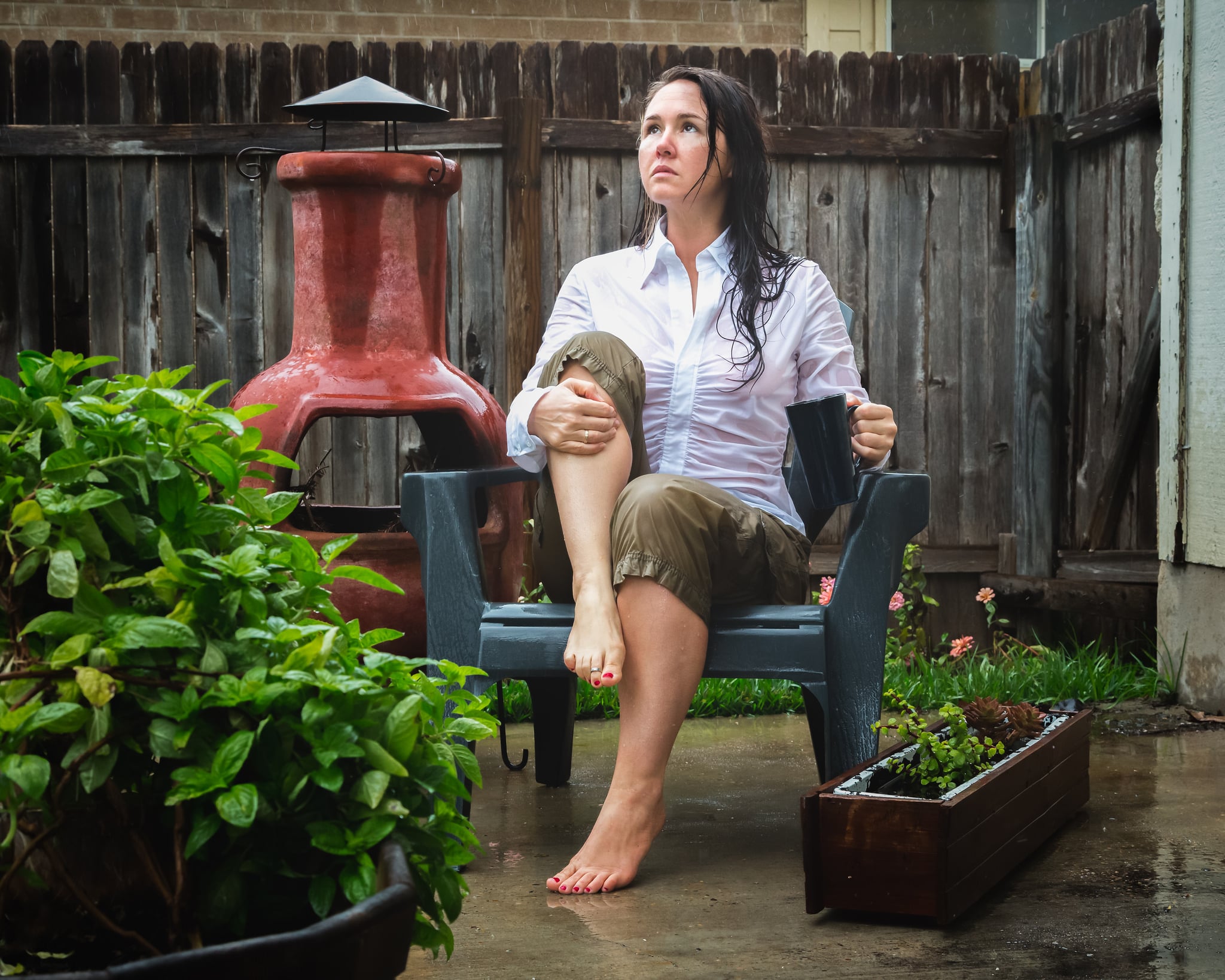
Photo Credit: Rain in the Garden, Creative Commons, Let It Come by Lotus Carroll is licensed under CC BY-NC-SA 2.0

Baked Earth: The Truth Behind Authentic Impruneta Pottery

Eye of the Day|Impruneta clay|terracotta Baked Earth

Baked Earth: The Truth Behind Authentic Impruneta Pottery

Welcome to another edition of Baked Earth, with information about what’s happening in the world of clay, ceramics and installation pottery. This month, we would like to pop the mythical bubble concerning Impruneta pottery.

Impruneta is a commune in the province of Florence, in the Tuscany region of Italy. It has been famous for many centuries as the producer of the region’s finest terracotta, everything from tiles to garden art, to large terracotta planters. Along with the handmade nature and unparalleled craftsmanship of Impruneta terracotta lies the real secret of its success: the clay body.

It has been known for countless generations that Galestro clay is the superior material of the region. Galestro clay is extremely high in subsoil minerals, has an excellent plasticity, and due to its unusually high granitic content, can withstand sub freezing temperatures. Galestro clay yields a high quality product with great versatility and many ceramic manufacturers in the Tuscany region use Galestro, including Terrecotte San Rocco, Eye of the Day’s premier terracotta source.

Only a handful of factories produce wares actually in the commune of Impruneta and therein lies the problem. Because the potteries in the outlying communities are also using Galestro clay, or part Galestro and part local material, some producers will stamp their work with the word “Impruneta,” which can lead to retailers here in the US (either unknowingly or complicit in the process) to sell merchandise as “Impruneta terracotta,” when in fact it was not made within the boundaries of the Impruneta commune.

It’s akin to wearing a Timex and calling it a Rolex. Both are well made watches, but one has the reputation of distinct craftsmanship and is branded as such, so you are paying for the brand. It is the same with Impruneta—it has been branded by generations of superb craftsmanship and these days it is not uncommon for people in this business to use the branding of “Impruneta” to their advantage by calling it something that it is not.

So garden designers, homeowners, and landscape architects alike, be forewarned! There are only a handful of families producing authentic Impruneta terracotta in that commune, so if someone claims to be selling or installing Impruneta wares made with Galestro clay, be sure to ask them who the manufacturer is, and cross check their references. But as I have said countless times, it all comes back to the clay. And anything made with Galestro clay from the foothills of Tuscany is a sure bet as the highest quality pottery for your home.

By the way, I’m wearing a Timex…
Know your terracotta!


The Rogue Garden: Brent’s Test Kitchen

Eye of the Day|Brent's Rogue Garden|The Test Kitchen

THE ROGUE GARDEN: Brent’s Test Kitchen

Hey! All you hoity toity landscape designers—this blog’s for you!

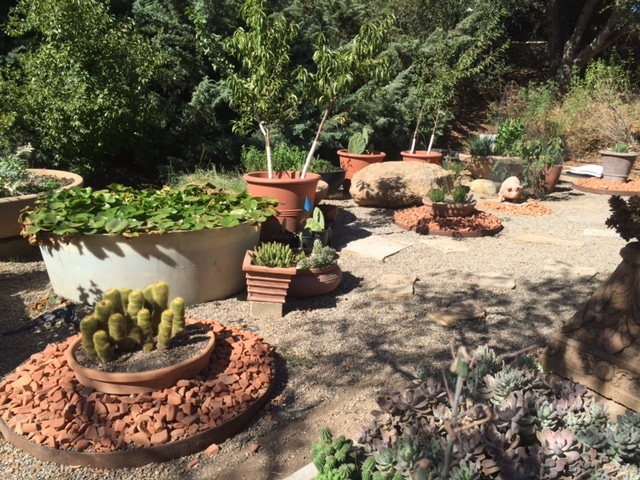
When my professional landscape design friends come to my home garden for the first time, they are usually thrown off balance by what they see: there are pots and containers everywhere.  I constantly rescue or buy plants to try out in our pots to show how they work together in the landscape and also to see how a plant performs in a container versus the ground.

While my garden is a “test kitchen”, it serves as inspiration for Eye of the Day as well as for the genetic sequence I received from my Portuguese great grandfather. He was a truck farmer who indentured himself in 1868 to the Campbell Estate in Hawaii to grow sugarcane. I love putting my hands in the dirt.
Eye of the Day|Brent's Rogue Garden|The Test Kitchen

My garden at home has helped us at Eye of the Day in many ways. We have learned that French Anduze pottery must be sealed or the glazing starts to fall off almost immediately. So, we tell everyone that if you purchase French Anduze, you must have it sealed to protect the glazing.

Something that every design professional should know about is how to properly plant pots and especially large pots. Pots that have diameters larger than 30” usually have plant material that starts big or will grow large due to the space for more root ball. But after a period of years and sometime climate conditions, a large plant needs to be removed from its container and trimmed and replaced. By replicating these situations in my own garden, I have formulated successful service practices for performing operations which allow clients to benefit by getting the most from their purchase of our products.

Also in my garden, there are odd experimental items like “vertical wall” planters and terra cotta shelf units for the patio. 25 years of business has resulted in a new product. Whether damaged in the container coming from Italy or through rough handling here at Eye of the Day, we take the broken pieces of pottery and produce Tumbled Terra Cotta.

Yes, my garden at home looks like a madman’s landscape but, I love it and I love spending time in this intimate setting surrounded by the products, plants and ideas that fuel my life.

Let me know if you’d like to visit.

Brent, the Rogue Gardener


A Day In the Life of a Ceramic Terracotta Commission Artist

Eye of the Day|Scott Semple Baked Earth|terracotta design

Baked Earth: A Day In the Life of a Ceramic Terracotta Commission Artist

It’s a random Tuesday afternoon in September of any year. I am sipping ginger tea and trying to figure out what to do with the tail end of an already long day, when the phone rings and it’s a number I don’t recognize.  I answer and it’s a potential client with an exterior aesthetic conundrum. “Well”,  I say to myself, “here we go again!”
Eye of the Day|Scott Semple Baked Earth|terracotta design ceramic

This month I am going to walk you through what it is like to be on the receiving end of an exterior ceramic commission.

Now…I love people.  With that in mind, as a commission artist, in many ways I become a problem solver as well as a solution.  I always want to get to the heart of what the client wants for his or her space, and often the gray area is that word “want”.  What a client wants and what works best aesthetically for a space, may be two different things!  So I end up being the voice not only for the client, but for the land, the property as it relates to other properties, the overall environment, the seasons, and of course the clay.  Why are we using clay on this project? Why does using an earthen material make the most sense here?  And so on.
Eye of the Day|Scott Semple Baked Earth|terracotta design ceramic

Typically, I will begin with an interview.  I will Skype if I have to, but the best way to get to know a project is to get on site during the initial phase.  (Many times I‘ve  shown up to a job site and actually found native clay on the property!)  We then move into constructing the pieces. It has always been my practice to have an open door policy to my studio; I love the client to get involved with the construction process.  This way we can troubleshoot together  and/or celebrate any pieces that come from my hands.  I realized a long time ago that when building things to the specifications of others, it’s important to be very clear and communicative, especially during the “wet work” phase.

Eye of the Day|Scott Semple Baked Earth|terracotta design ceramic

I also like to discuss the inherent connection between interior and exterior space. Sure, we can do planters and water features , but what if you had a vessel sink in your bathroom or a fireplace surround, or an interior sconce or two with the same motif? The transition between interior and exterior spaces has always fascinated me as an artist, so that’s often what I strive for.
Eye of the Day|Scott Semple Baked Earth|terracotta design ceramicThe last phase is delivery and installation.  When I end up placing pieces and getting down and dirty in a garden, I know I have made someone very happy.  I have made the environment happy, the property happy, the neighbors happy, and being the solution is always an awesome feeling!  In this phase, I know that what I have made is not only SITE specific, but RESOLVE specific.


Blue Agave Landscape Design Project

Eye of the Day|Blue Agave Landscape| Garden Design

Blue Agave Landscape Design Project

After whetting your appetite for planting your own meadow and inspiring visions of golden grasslands,  we want to show you a different way of using the “no lawns” concept.

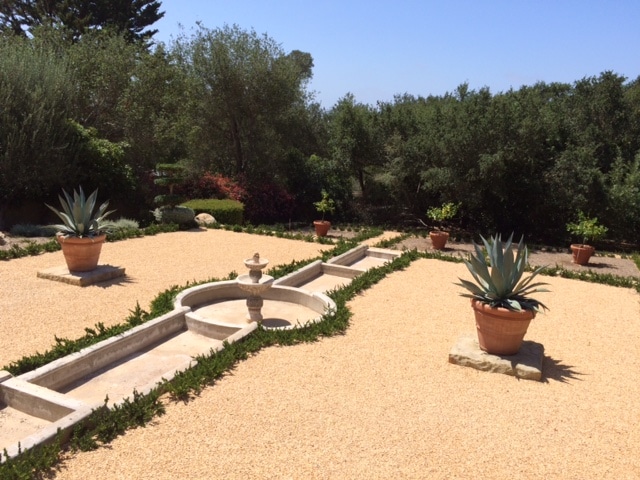
Adan Venegas of Blue Agave Landscape in Santa Barbara used lots of Italian terracotta rolled rim pots for planting (surprise!) agaves and placing them throughout the area which was at one time planted in lawn.

Also in place of green grass, there is now the lovely soft golden hue of decomposed granite, offering an interesting textural and color contrast.  The lines of the fountain feature complete  the design with a complementary architectural edge.

Adan, along with photos of another of his designs is featured in our Look Book as well. See the rest of his Designer Profile here.


The Art of Building Large Terracotta Pottery

Eye of the Day|Baked Earth|Scott Semple Large Terracotta

The Art of Building Large Terracotta Pottery

In all my days of fascination with clay, there is one tool that I would call my tool of choice: the wheel. But the two things that have influenced me most are my teachers and my travels.
Eye of the Day|Baked Earth|Scott Semple Large Terracotta

Over the past thirty years or so I have had the great fortune of traveling throughout the world.  My interest in large format pottery began in the early 90s and quickly became one of the key purposes of my explorations.

There are many ways to build a large, ceramic container.  In Thailand, I watched two assistant potters feed a rope of clay the size of my leg and 20’ long, over their shoulders to a master potter, who would very slowly spin a crude wheel and pinch the coils on top of each other.   This seems to be the most common way cultures build large terra cotta containers.
Eye of the Day|Baked Earth|Scott Semple Large Terracotta

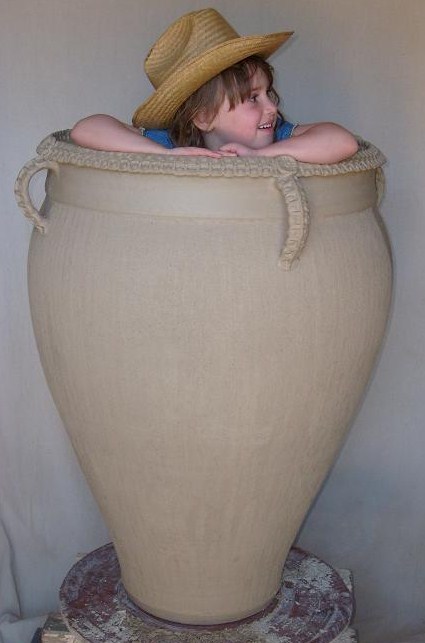
Recently I was a guest artist at a conference where, over the course of three days I made a 7’ Amphora using two wheels. I was positioned next to next to a family of Koreans who were making traditional Kimchi fermentation jars. These things were huge! They used the same coil/pinch method, but paddled the shapes into the forms.   In Georgia (Eastern Europe), they have been fermenting red wine for thousands of years in enormous ceramic vases called Qvervi; they use the same method. Spain probably has the largest pots I’ve ever seen called Tinajas. These absolutely spectacular containers are also used for fermentation,  as well as storing water.

Throughout my travels I have found that around the world, large terracotta forms are still produced for a great variety of uses.