City Fountains I Have Loved

City Fountains I Have Loved

My love of city fountains begins with my formative years.  I grew up in a suburb of Los Angeles where my father was a news photographer and intimately knew the nooks and crannies of the city.  Family drives all over the state and especially throughout greater L.A. were always amazing; there was so much to see. My sisters, brother and I were all given our own park, freeway, tree, public garden and fountain and I always thought my fountain was THE BEST. What a coincidence that when I met Brent I soon discovered my fountain was also HIS fountain. At the corner of Los Feliz Boulevard and Riverside Drive, near Griffith Park, is MY fountain, the William J. Mulholland Memorial Fountain. Each time we drive by the fountain, we both claim it. It’s still my favorite, but the two of us have also found other fountains to love in other US cities.

THE FACTS: The first “decorative” fountain in the US was dedicated in City Hall Park, New York City in 1842. Before that, fountains were primarily used to provide clean drinking water and had few decorative qualities. In the 20th century, fountains weren’t needed for drinking water and became purely ornamental, designed to honor events or individuals. There are now many computer controlled fountains that can even dance and perform music.

SOME FOUNTAINS OF CHOICE:

Eye of the Day Garden Center|William Mulholland Memorial Fountain|City Fountains
William J. Mulholland Memorial Fountain in Los Angeles CA.


1. William J. Mulholland Memorial Fountain, Los Angeles CA. William Mulholland was the “father of the Los Angeles Water System.” His greatest contribution was being the engineer of the 233-mile long Los Angeles Aqueduct, completed in 1913. Unfortunately, many L.A. officials, including Mulholland were accused of shady dealings, from using scare tactics to convince Angelenos that the aqueduct was necessary to ensure the survival of the city, to buying up the San Fernando Valley from unsuspecting ranchers.  Remember Chinatown? After his death, all of these issues were forgotten and public funds were raised to construct a permanent shrine to Mulholland: The William J. Mulholland Memorial Fountain.

Eye of the Day Garden Design Center|Forsyth Park Fountain|City Fountains
The Forsyth Park Fountain in Savannah, GA. 


2. The Forsyth Park Fountain, Savannah. GA.  The most well known feature of Forsyth Park is its fountain.  It was installed in 1858 and selected from a manufacturer’s catalogue, rather than being an individually commissioned artwork.  Unlike other monuments in Forsyth Park, such as the Confederate Memorial and the Spanish American War Memorial, the fountain’s purpose is only its beauty.  It has been witness to the Civil War, survived vandalism and the forces of weather and through the generous support of the Savannah community, it lives on today.

Eye of the Day Garden Design Center|Longwood Gardens Fountains| City Fountains
The Fountains at Longwood Gardens in Kennett Square, PA.

3. The Fountains at Longwood Gardens, Kennett Square, PA.  Even if there were no fountains at the former estate of Pierre DuPont, the beauty of the 1100 acre, multi-faceted gardens is worth a long visit. It’s fantastic that Pierre DuPont himself made all the hydraulic calculations for the elaborately controlled, electrically illuminated and fountains known collectively as “The Waterworks,” the first of which began flowing in the mid 1920s.

Eye of the Day Garden Design Center|Bethesda Fountain NYC|City Fountains
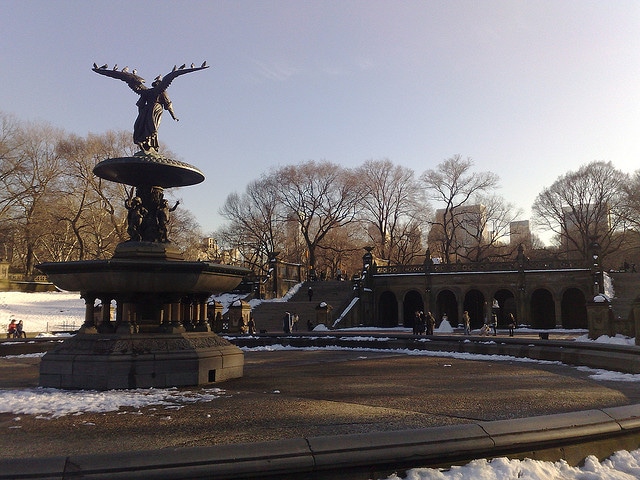
Bethesda Fountain in Central Park, New York City.

4. The Bethesda Fountain, Central Park, NY, also called “The Angel of the Waters.” Everyone knows this fountain, it seems like it’s in every movie shot in New York City and Bill Cunningham loves it, especially when it’s frozen.  The fountain was designed in 1868 by Emma Stebbens, the first woman to receive a public commission for a major work of art in New York City and was the only statue called for in the original design of the park.  Beneath the angel are four cherubs representing Temperance, Purity, Health and Peace.

This is the short version of the Fountain Favorites tour, but the best of the best so far seen in our worldwide review.

Image Credits:
Fountains Longwood Gardens via Flickr/Joshua Ludwig
William Mulholland Memorial Fountain-Griffith Park via Flickr/Konrad Summers
Bethesda Fountain via Flickr/V Manninen
Licensed under  CC by 20

Winter Gardening Tips and Ideas

Holiday time is approaching, but that doesn’t mean there isn’t time to get a little gardening in between the shopping and entertaining. Since the sun is shining less brightly, the soil has started to cool. Lower light and shorter days mean less productivity for plants.

Here are some ideas for winter gardening:

1. Plant for the Coming Cool Season

Winter vegetables include everything in the cabbage family: broccoli, cauliflower, mustard greens, and everyone’s new favorite—kale. Any of these can be grown as row crops for the kitchen, but consider putting a few in a half barrel or other container for both their edible and ornamental uses. Colorful rainbow chard is another great choice.

2. Consider Color

Cool season flowers like bachelor’s button, stock, sweet alyssum, calendula, foxglove, Iceland poppies, and pansies all thrive as winter approaches. Pick a color palette of similar or contrasting tones and group different types together in the container of your choice. Only one or two colorful pots will lend a festive air to your patio or deck. If you tuck in a few dormant bulbs, they will take over as the annuals wane. Narcissus and all its forms, gladiolus, lilies, tuberose, Mexican shell flower, and rain lily all fit the bill.

3. Compost in the Cold

Compost all the trimmings from your garden. Even in the cool months, bacteria and fungi will be doing their magic to produce beautiful planting amendments for spring. Use one of the patented composting bins, build your own, or just layer the materials in a corner of the garden. If you are ambitious, turn the pile once or twice (a good way to monitor the moisture level) or simply leave as is.

Mulch and water your favorite trees and shrubs. Much editing is going on because of the drought, but these are ways to nurse these larger shrubs along.

4. Gifts for the Wildlife

Don’t forget the birds and beasts, too. A shallow bowl of water will give them a welcome drink and a cleansing splash. Place the bowl in a quiet place where visitors have a view of the surroundings and potential threats. Keep filled and flushed with clean water as needed.


Landscaping to Keep Your Friends: An Outdoor Makeover

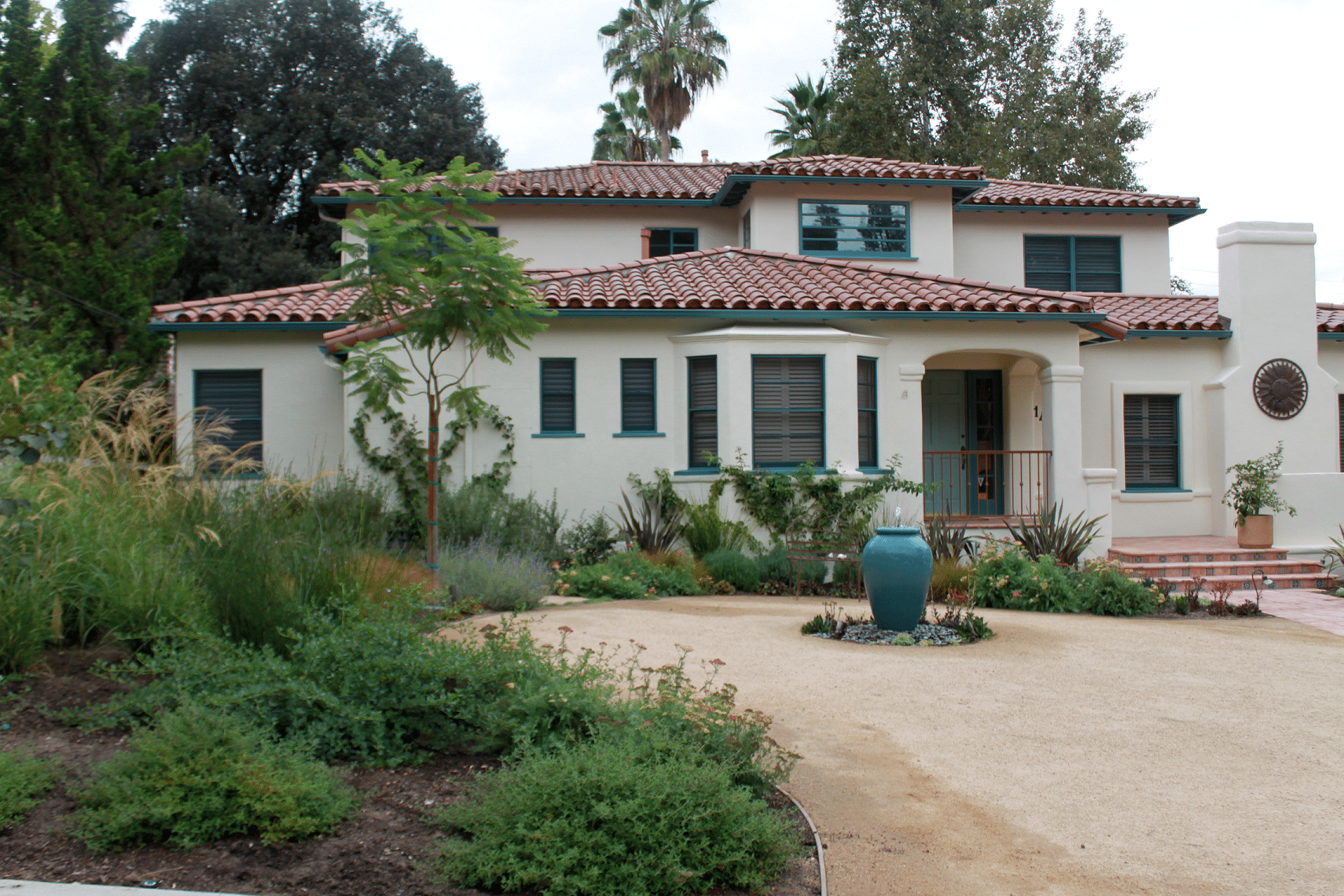
The owners of this classic Mediterranean home in Glendale, California contacted Sally Farnum of SE Farnum Associates in Altadena for a new front yard design requiring minimal maintenance and low water use. Her design included a Gladding McBean Oil Jar fountain conversion in Caribbean, as well as two Gladding McBean planters flanking the front entrance.

The neighborhood in Glendale, California, a suburb of Los Angeles, was lined with houses showing off well-manicured lawns and lush plantings. But like most streets, it had ”that one house.” You know the house. Dried and dying lawn, gopher holes dotting the landscape, and essentially an eyesore to a neighborhood that otherwise boasts its curb appeal.  Before their neighbors stopped talking to them, my clients contacted me to revamp the landscape in front of their home. These were busy clients who just work, work, work, leaving very little time for yard work. They were leaving the digging and turning of the soil to the gophers and the trimming to the deer. They even spent a few hours a week unsuccessfully trying to combat rodents with traps, flooding, and varmint bombs.


Change did not come easily to these clients, but they knew they needed to do something. They requested a garden design that would require minimal maintenance and low water but still incorporate beautiful plantings, as well as being deer and gopher proof. I discussed the beauty of replacing their lawn with a composition of decomposed granite, new and colorful water-wise plantings, hardscape using saltillo concrete tiles and a new fountain.

Initially the clients’ three colors of choice were beige, dark beige, and white, but I was able to convince them that a lively color palette can be beautiful, energizing, and attractive not only to them, but to desirable visitors like butterflies, bees, and birds. The plantings include colorful sages, ceanothus, lantana, and achillea that not only drink little but the deer and pesky gophers don’t find them to their culinary liking.  It’s been almost a year and they haven’t lost any plants to the wildlife, what a success!


The colors of the Malibu tiles that we used in the hardscape were definitely an influence on my desire to use a Gladding, McBean oil jar for a fountain. I was thrilled that my clients selected the Caribbean blue over a more subtle color and love the fountain conversion done by Eye of the Day. The clients are so happy with their colorful garden that they recently asked me to help select the palette for the re-painting of their house and of course the selections are very close to the color of the Gladding McBean fountain.


Rosette Succulents for the Garden

Succulents are all the rage and for several good reasons: many have a unique make-up that puts them ahead of the game in extreme heat. Succulents are composed of spongy tissue capable of storing water in dry times. And they maintain their good looks without a lot of maintenance.

Some of my favorite succulents are in the plant family known as the houseleek family. Many form rosettes of leaves, giving them a floral quality, but without the need for deadheading and other pruning. The other great part about this family is that there are a variety of shapes and forms to choose from. Their main requirement is a bright sunny spot, though some will even take a spell of shade if they have to.

The stone crops are all in the genus Sedum and most are low-growing perennials. Sedum acre is grayish with leaves that form small, whorled rosettes. Two other diminutive species are S. brevifolium and S. dasyphyllum.

“Live Forever” is just an English translation of the botanical Latin Sempervivum. All form densely star-like rosettes composed of many pointed leaves. Two commonly available species are S. tectorum and its many varieties and S. arachnoideum, called the cobweb houseleek because of the white filaments that cross from leaf tip to leaf tip.

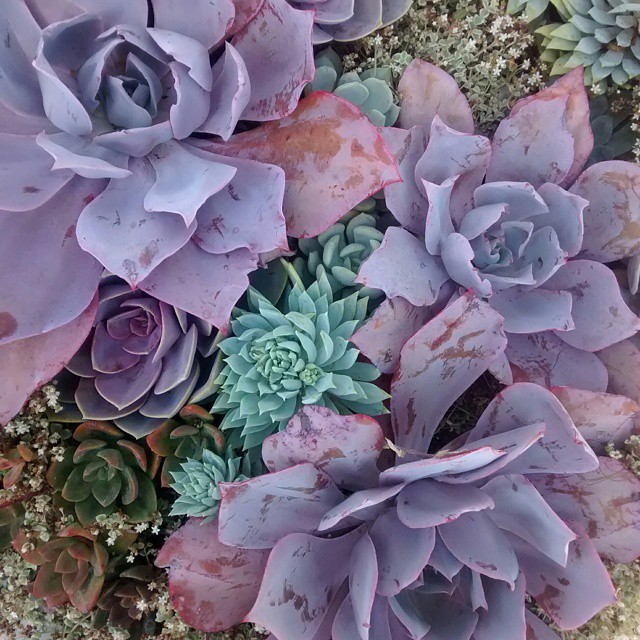
Another group of ground-hugging plants are in the genus Echeveria and many are commonly called hens and chicks. Their leaves come in simple or densely whorled bunches that look like fleshy roses and the colors and forms are mind-boggling. From pale whitish green through bluish, to purple, bronze, red, and even yellowish tones, collectors can go wild accumulating them all. Then, there are the leaf shapes and textures; edges may be smooth to wavy to elaborately crimped and top surfaces may be cupped and smooth or bowed and covered with warty bumps (or both!).

Last are the many forms of Aeonium. From flattened dinner plate sized A. tabuliforme to the more tree-like forms such as the nearly black A. ‘Zwartkop’ and colorfully variegated A.‘Sunburst’, there are many selections for bold color and form.

Tough, sculptural, colorful—what more could you ask for in a plant family?


Container Gardening: Finding Joy in Scarcity

Author Brené Brown stated in her now famous Ted Talk, “The opposite of scarcity is not abundance, it is enough.” As we deal with the drought in our gardens, let’s not respond by grabbing more water from others or becoming despondent about losing lawns that are largely unsustainable in our climate.

Use your creativity and discover how container gardening can enliven your landscape while using little water. Let go of those garden images where plants luxuriate in 95% humidity and weekly rainfall. Let’s get started.

Destination Inspiration

Why do we love love love Italy, Mexico, Spain, or Morocco? Courtyards and shade. It’s not the turf. Most of our residences have outdoor living spaces that are too small or too close to the house to be truly enjoyed. If you are considering what to do with your thirsty landscape, think about expanding or adding terraces or courtyards adjacent to your home. Add new gathering areas in other parts of the garden. Even in a very small garden, you can create a new space at the back or side of the property and discover a new view into your landscape.

Planters: The Versatile Garden Feature

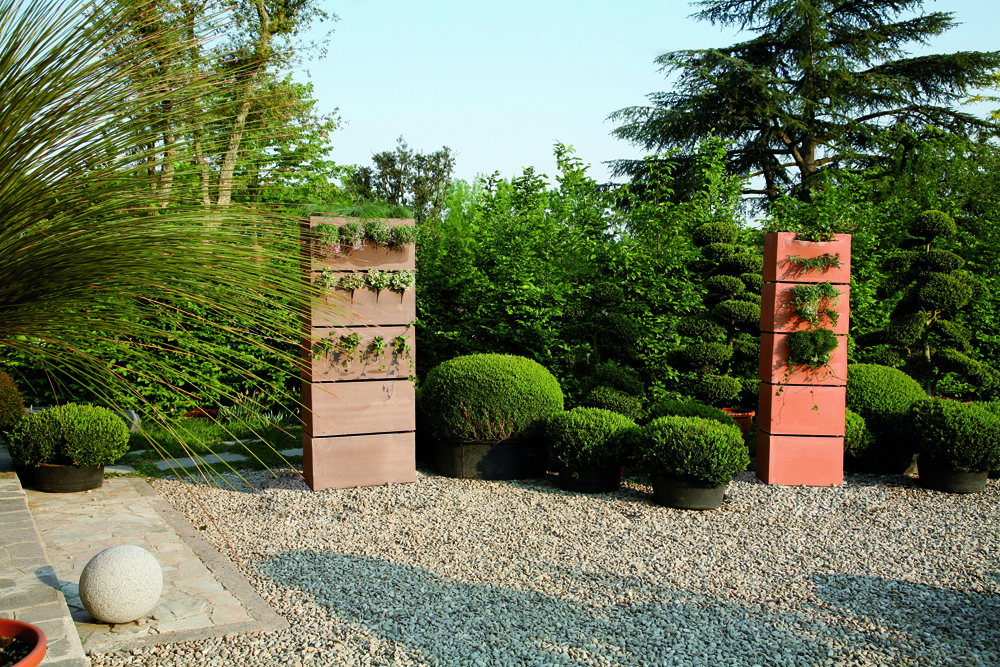
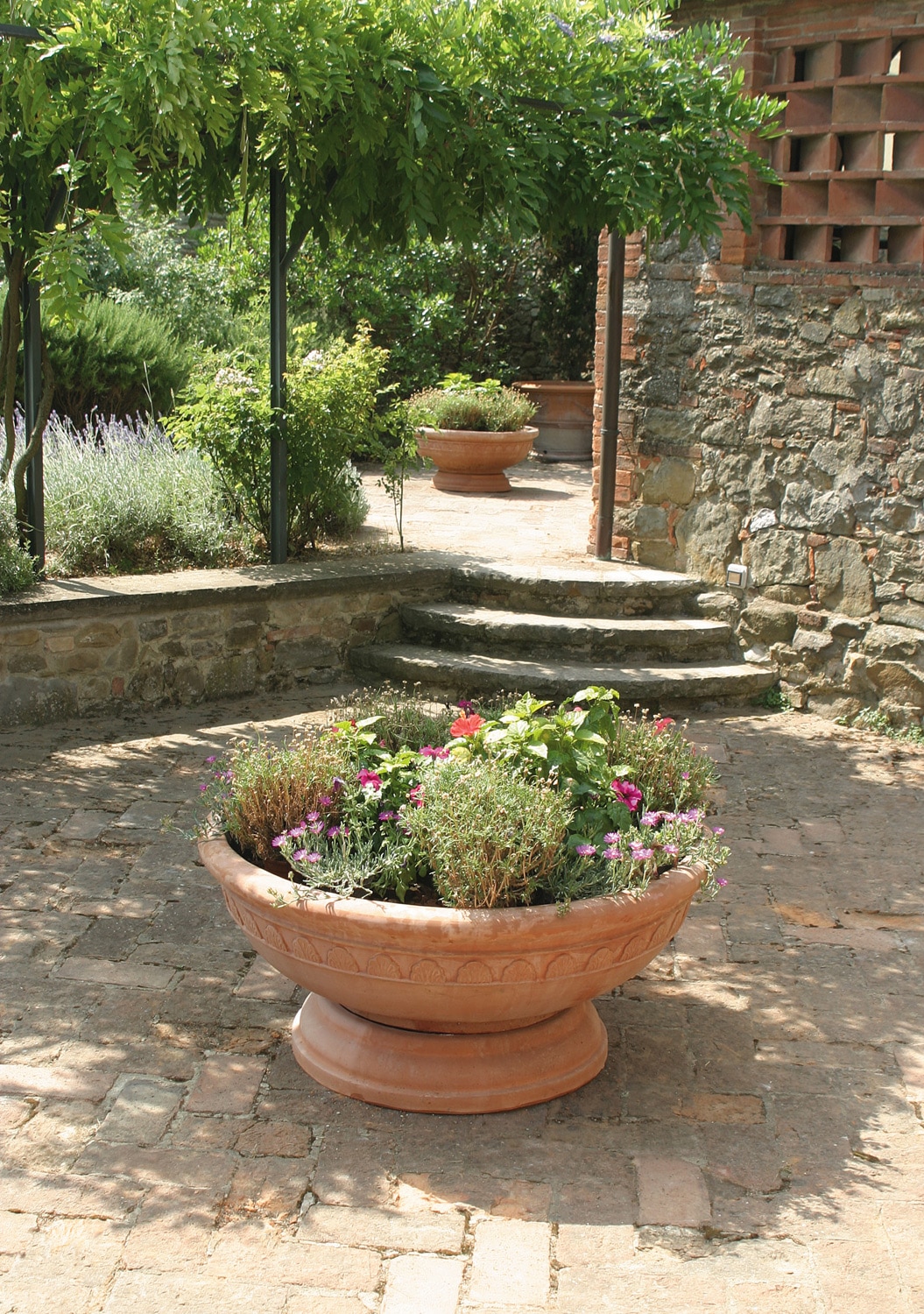
These new spaces can be paved with a variety of materials such as gravel, recycled concrete, stone or pavers. A grouping of planters can serve a variety of functions. Need some shade? Find a large pot, 42” diameter plus and add a drought tolerant small tree such as a fruitless olive. Add smaller pots with succulents or color and you have quickly filled your new garden space with pattern and detail, two aesthetic qualities that enliven our living spaces.

Planters can be adapted or reinforce the visual quality of any type of garden. If you have young children, add lots of color and tuck in a few edibles to share at the table. If you are looking for a place to escape the pace of work and family, discover the cool palette of succulents. Be brave, take a risk. Planter gardening is a great way to play with plants without breaking your budget.

So let go of some of the old ideas and embrace the challenge to live with ‘enough.’ Take a fresh look at that existing landscape and find joy in a new direction for your garden.

To view more of Puck Erickson’s work, please visit Arcadia Studio.