Morocco in Your Own Garden

Eye of the Day|Moroccan Garden|Newsletter

Morocco in Your Own Garden

California gardens, especially those in Southern California have long utilized the concept of outdoor rooms. Countries with warm, dry climates around the Mediterranean basin have been creating miniature oases outdoors for centuries. Taking a cue from them is one way to replicate both the feel and appropriateness of this style.

Moroccan gardens provide great examples of the restrained use of water to create a lush setting in outdoor courtyards and passageways. Even while reducing your water use in the landscape, you can create an intimate, yet luxuriant garden space by taking inspiration from arid North Africa. Gardens there are generally central to the dwelling, both to provide privacy and protection from the heat and winds.

Eye of the Day|Moroccan Garden|Newsletter
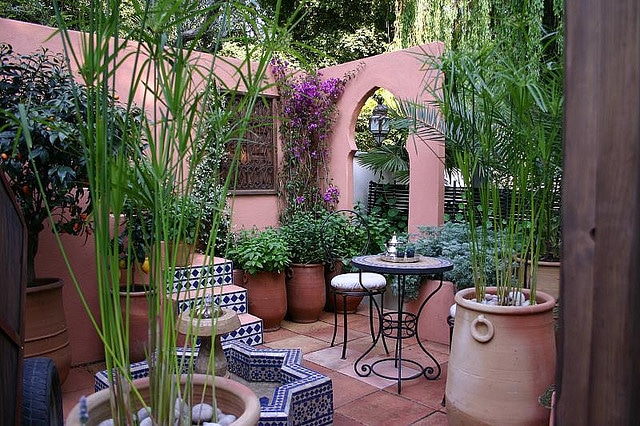
A Moroccan Courtyard Garden that incorporates a water feature, colorful plantings and pottery.

One of the key elements of these enclosed spaces is limiting water use. The Arabic word for a garden of this type is riad and usually refers to the central fountain or ornamental pool. The fountain need not be large to provide a bit of cooling to the air as well as a sense of peace and luxury in a climate where water is scarce.  It is possible to recreate that feeling with a simple water feature created from a glazed pot and a small, efficient pump instead of building a large fountain.

Another feature is the exuberant use of color. Colorful pots, a painted wall or gate as well as bright flowers make for a vibrant and even joyful setting. Vivid glazed tiles, whether on the patio floor or the surface of a fountain, also contribute to creating an exotic paradise.

Eye of the Day|Plants for Moroccan Garden|Newsletter blog
Plants for an outdoor Moroccan style garden

Plants can be used as well and they do not have to be those that require a lot of water. There are many that are drought tolerant, yet lush-looking. Large leaves give a more topical feel and species such as bird of paradise, aspidistra and pygmy date palm do well in containers. Succulents are a great choice; from cacti to agaves and aloes, they thrive on little water and their foliage provides drama and color. The Canary Islands is home to a wonderful group of succulents, the aeoniums, whose fleshy leaves grow in large, showy rosettes and would be perfect choices. Even the humble geranium (Pelargonium) is sturdy and produces flowers nearly year round. Assemble several plants in one container to provide a miniature landscape or group individual pots together, mixing and matching your color palette.

Look at Planted Wells blog for more Moroccan garden design inspiration.

Image Credits:
Moroccan Garden – Creative Commons, Chelsesa Flower Show Gardens by Rictor Norton and David Allen is licensed under CC by 2.0
Plant Image – Creative Commons, BCSS gloucester branch auction – The national agave collection by stephen boisvert is licensed under CC by 2.0 

Groundskeeping: Exploring Urban Landscapes and Frederick Law Olmsted

GROUNDSKEEPING is about my travels for my life’s work, keeping Eye of the Day fresh and exciting not just for me, but our clients and customers. I am always trying to find what others are seeking for their designs.  Like a chef experimenting with ingredients and flavors to interest his public, I look for those things that different places and cultures want and need, and that architecture requires for exteriors to be in harmony with structures.

Recently I decided to return to the East Coast, which is the market we ship to more and more frequently. While walking throughout New York and Boston my goal was to come up with new ideas and directions.

Revisiting and walking the length of Central Park, one of my favorite urban places on earth, was a specific goal.  It is 2.9 miles long (in a straight line), but my meandering probably added another half mile or so.  Fredrick Law Olmsted was a remarkable genius and I marvel at his accomplishments. The Ramble is still my favorite area of all.  It is hard to believe you’re in the city at all.

As I approached the northern end I came to the Conservatory Garden, the only formal garden in the Park. It’s truly an intense, wonderful experience for garden lovers. I recommend that you go to Google images for more wonderful photos. From the corner of 110th Street I took the bus down 5th Avenue to my reward, lunch at Gramercy Tavern. I needed plenty of oysters to soothe my soul and rest my sore feet.

Next, I traveled to Boston ($ one-way bus ticket) to compare cities and get a better feel for this historic place and the homes and offices of its famous residents. Boston is to NYC as Santa Barbara is to LA; while it is a major city and urban center, it feels much more intimate.

Boston Public Garden, like Central Park, is right in the center of the city; it’s smaller, but very dynamic. The 24-acre park was the first public botanic garden in the USA, established in 1837. My favorite site is the magnificent bronze statue of George Washington on his horse.

Boston Garden Lake & Bridge - Brent Travel Photo

Across the street from the Park is Beacon Hill. The word “historic” doesn’t begin to do justice to this neighborhood. Walking its narrow streets is not for those of weak ankle. I immediately saw what I was looking for, something you rarely see in the West: window boxes.  They were everywhere and many decorated for Halloween.

Boston Window Box 7 Boston Window Box 3 Boston Window Box 5I could have walked all day through the streets of Beacon Hill, taking pictures of the Federal style homes packed side by side sporting window boxes below every wonderfully fenestrated opening.  San Francisco, Pasadena, and Brentwood: why don’t you have any window boxes?  They are jewelry for the home. Designers, what are you afraid of?  I want window boxes.  I have window boxes.

Next, my pilgrimage led me to the unassuming home office of Frederick Law Olmsted in Brookline, Massachusetts. This is the location where The Master worked on his brilliant, timeless designs. The Park Rangers and volunteers were wonderful, helpful and spunky. It is moments from downtown Boston, just a short cab ride.

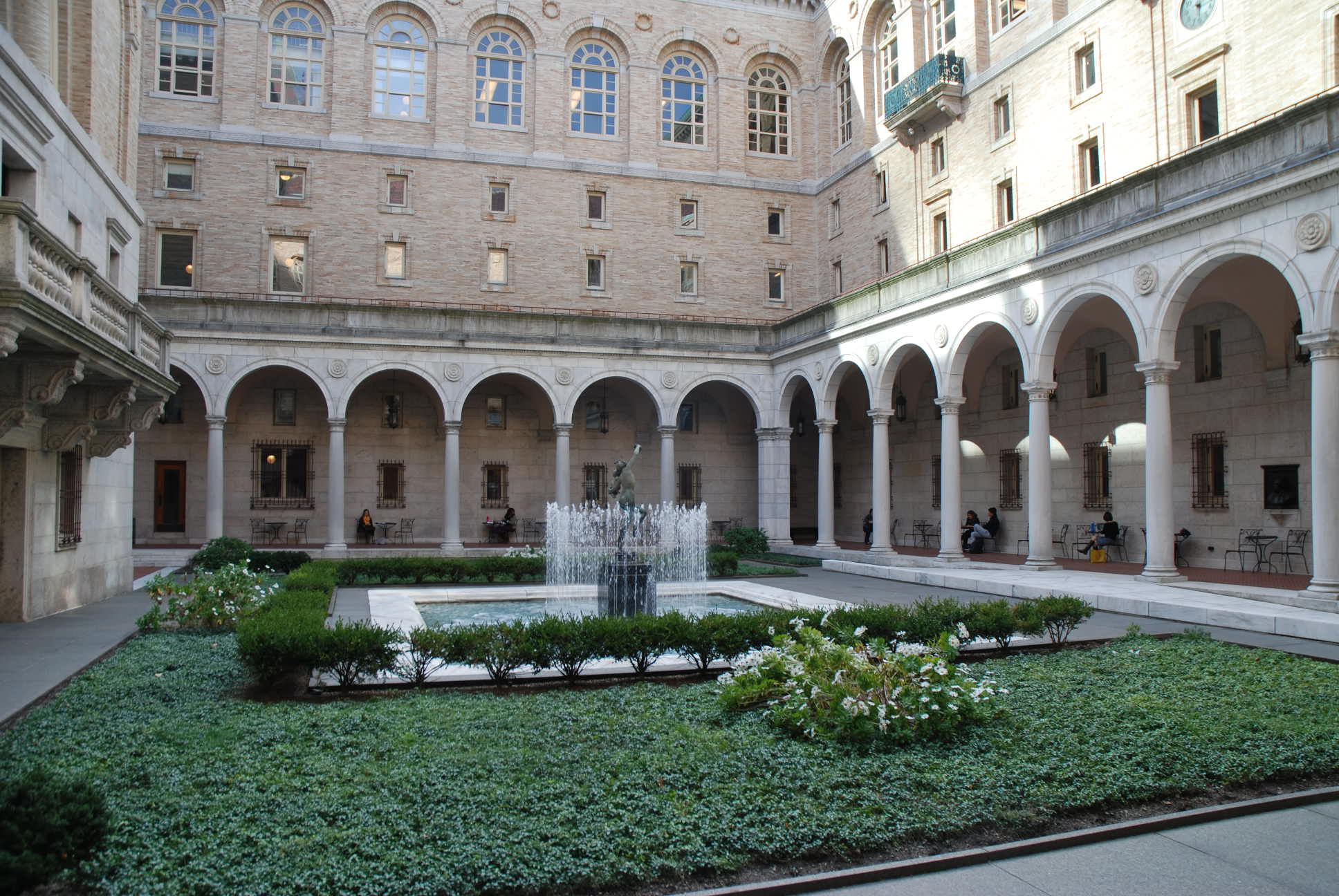
20459367-F2BB-45CB-9071-4C8F2EAC083FFinally: the fountain I stumbled upon when I walked through Boston’s main library.  In the courtyard is a fountain that replaces my favorite for many years, The Electric Fountain at the corner of Wilshire Boulevard and Santa Monica Boulevard in Beverly Hills.  In the courtyard of Boston’s public library is the most wonderful fountain, Frederick MacMonnies’ Bacchante and Infant Faun.

Boston Library Fountain 1

In its unique setting it is difficult to think of another fountain I’ve seen in my travels that could make me smile more.

Where to next??


City Fountains I Have Loved

City Fountains I Have Loved

My love of city fountains begins with my formative years.  I grew up in a suburb of Los Angeles where my father was a news photographer and intimately knew the nooks and crannies of the city.  Family drives all over the state and especially throughout greater L.A. were always amazing; there was so much to see. My sisters, brother and I were all given our own park, freeway, tree, public garden and fountain and I always thought my fountain was THE BEST. What a coincidence that when I met Brent I soon discovered my fountain was also HIS fountain. At the corner of Los Feliz Boulevard and Riverside Drive, near Griffith Park, is MY fountain, the William J. Mulholland Memorial Fountain. Each time we drive by the fountain, we both claim it. It’s still my favorite, but the two of us have also found other fountains to love in other US cities.

THE FACTS: The first “decorative” fountain in the US was dedicated in City Hall Park, New York City in 1842. Before that, fountains were primarily used to provide clean drinking water and had few decorative qualities. In the 20th century, fountains weren’t needed for drinking water and became purely ornamental, designed to honor events or individuals. There are now many computer controlled fountains that can even dance and perform music.

SOME FOUNTAINS OF CHOICE:


1. William J. Mulholland Memorial Fountain, Los Angeles CA. William Mulholland was the “father of the Los Angeles Water System.” His greatest contribution was being the engineer of the 233-mile long Los Angeles Aqueduct, completed in 1913. Unfortunately, many L.A. officials, including Mulholland were accused of shady dealings, from using scare tactics to convince Angelenos that the aqueduct was necessary to ensure the survival of the city, to buying up the San Fernando Valley from unsuspecting ranchers.  Remember Chinatown? After his death, all of these issues were forgotten and public funds were raised to construct a permanent shrine to Mulholland: The William J. Mulholland Memorial Fountain.


2. The Forsyth Park Fountain, Savannah. GA.  The most well known feature of Forsyth Park is its fountain.  It was installed in 1858 and selected from a manufacturer’s catalogue, rather than being an individually commissioned artwork.  Unlike other monuments in Forsyth Park, such as the Confederate Memorial and the Spanish American War Memorial, the fountain’s purpose is only its beauty.  It has been witness to the Civil War, survived vandalism and the forces of weather and through the generous support of the Savannah community, it lives on today.

3. The Fountains at Longwood Gardens, Kennett Square, PA.  Even if there were no fountains at the former estate of Pierre DuPont, the beauty of the 1100 acre, multi-faceted gardens is worth a long visit. It’s fantastic that Pierre DuPont himself made all the hydraulic calculations for the elaborately controlled, electrically illuminated and fountains known collectively as “The Waterworks,” the first of which began flowing in the mid 1920s.

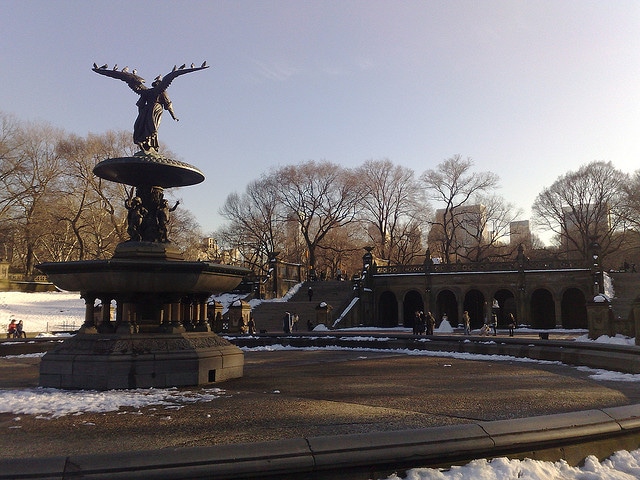
4. The Bethesda Fountain, Central Park, NY, also called “The Angel of the Waters.” Everyone knows this fountain, it seems like it’s in every movie shot in New York City and Bill Cunningham loves it, especially when it’s frozen.  The fountain was designed in 1868 by Emma Stebbens, the first woman to receive a public commission for a major work of art in New York City and was the only statue called for in the original design of the park.  Beneath the angel are four cherubs representing Temperance, Purity, Health and Peace.

This is the short version of the Fountain Favorites tour, but the best of the best so far seen in our worldwide review.

Image Credits:
Fountains Longwood Gardens via Flickr/Joshua Ludwig
William Mulholland Memorial Fountain-Griffith Park via Flickr/Konrad Summers
Bethesda Fountain via Flickr/V Manninen
Licensed under  CC by 20


Landscaping to Keep Your Friends: An Outdoor Makeover

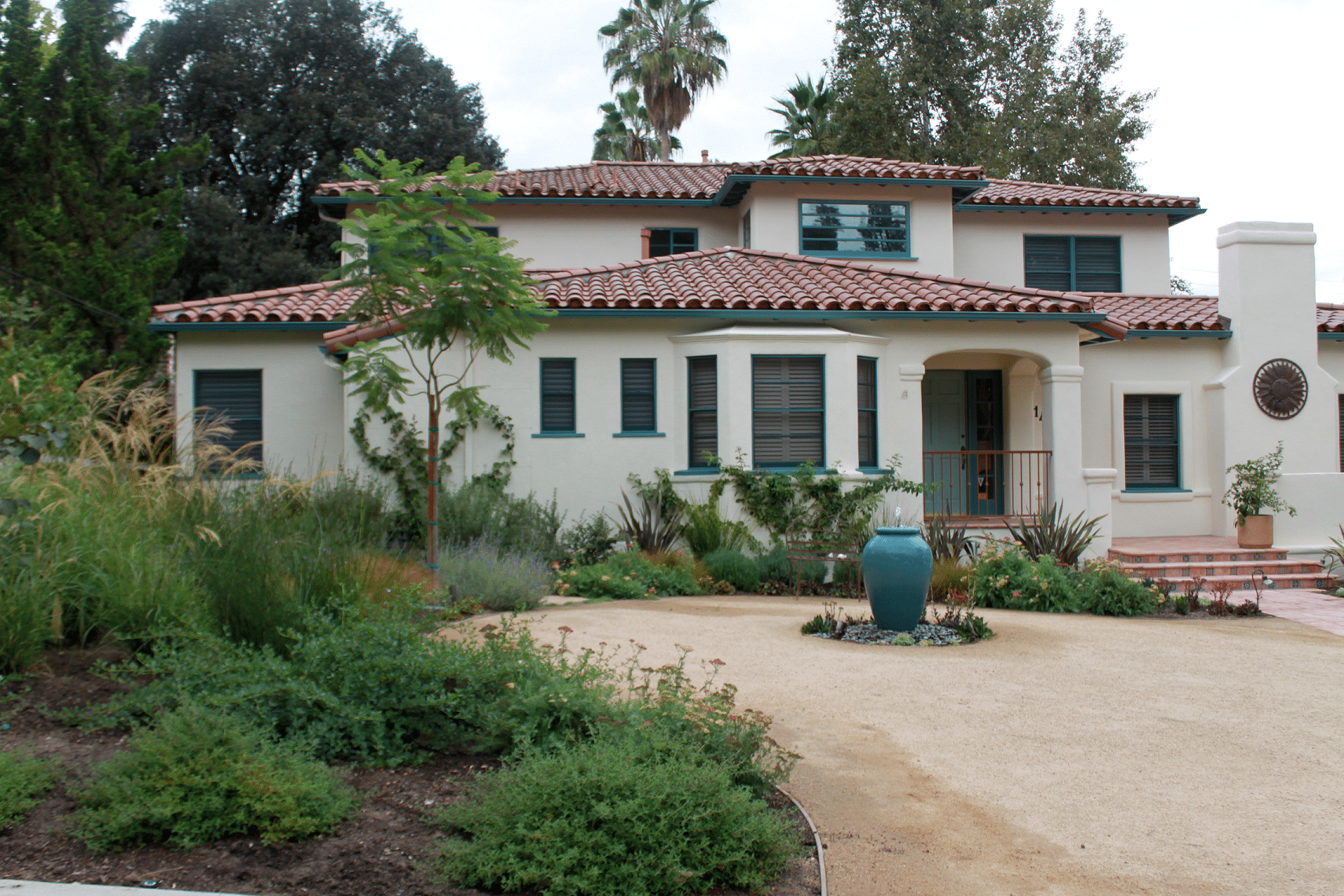
The owners of this classic Mediterranean home in Glendale, California contacted Sally Farnum of SE Farnum Associates in Altadena for a new front yard design requiring minimal maintenance and low water use. Her design included a Gladding McBean Oil Jar fountain conversion in Caribbean, as well as two Gladding McBean planters flanking the front entrance.

The neighborhood in Glendale, California, a suburb of Los Angeles, was lined with houses showing off well-manicured lawns and lush plantings. But like most streets, it had ”that one house.” You know the house. Dried and dying lawn, gopher holes dotting the landscape, and essentially an eyesore to a neighborhood that otherwise boasts its curb appeal.  Before their neighbors stopped talking to them, my clients contacted me to revamp the landscape in front of their home. These were busy clients who just work, work, work, leaving very little time for yard work. They were leaving the digging and turning of the soil to the gophers and the trimming to the deer. They even spent a few hours a week unsuccessfully trying to combat rodents with traps, flooding, and varmint bombs.


Change did not come easily to these clients, but they knew they needed to do something. They requested a garden design that would require minimal maintenance and low water but still incorporate beautiful plantings, as well as being deer and gopher proof. I discussed the beauty of replacing their lawn with a composition of decomposed granite, new and colorful water-wise plantings, hardscape using saltillo concrete tiles and a new fountain.

Initially the clients’ three colors of choice were beige, dark beige, and white, but I was able to convince them that a lively color palette can be beautiful, energizing, and attractive not only to them, but to desirable visitors like butterflies, bees, and birds. The plantings include colorful sages, ceanothus, lantana, and achillea that not only drink little but the deer and pesky gophers don’t find them to their culinary liking.  It’s been almost a year and they haven’t lost any plants to the wildlife, what a success!


The colors of the Malibu tiles that we used in the hardscape were definitely an influence on my desire to use a Gladding, McBean oil jar for a fountain. I was thrilled that my clients selected the Caribbean blue over a more subtle color and love the fountain conversion done by Eye of the Day. The clients are so happy with their colorful garden that they recently asked me to help select the palette for the re-painting of their house and of course the selections are very close to the color of the Gladding McBean fountain.


Stylish and Sustainable Garden Design

Stylish and Sustainable Garden Design

Living and designing in California, the ongoing and severe drought we’re experiencing is on everyone’s minds. And as such, drought-tolerant gardens are rapidly replacing outdated water-thirsty landscapes. While everyone is on board with the concept of a drought-tolerant garden I inevitably hear the same hesitation from clients – they don’t want their low-water garden to look like their neighbor’s new garden down the street. They want to make sure their new garden still reflects their personality and individual style.

This is a valid concern as it seems many drought-tolerant gardens seem to focus on the same twenty plants over and over again, with the end result being one of uninspired predictability. Luckily, there are a few simple ways to avoid this common trap.

For my clients who want a more traditional East Coast feeling in their garden, color is key. It’s important that I include low-water plants that contain a higher proportion of greens, maroons, blues and purples to mix along with the more common gray tones. The effect will be the same – a reduction in water use – but the garden will appear cool and lush.

For my clients who prefer a Mediterranean feel in their gardens, I tend to use a larger amount of warm colors, such as oranges, golds and reds mixed in with the greens and grays. The result is a garden that appears to glow in our perpetually sunny days.

But just because I’m reducing the use of water in these gardens doesn’t mean I’m eliminating it all together. On the contrary, it’s important to include a source of water in the garden as the sight and sound of it not only reinforces that we’re not living in the Sahara Desert but it also provides a much-needed source of water for wildlife during these thirsty times.

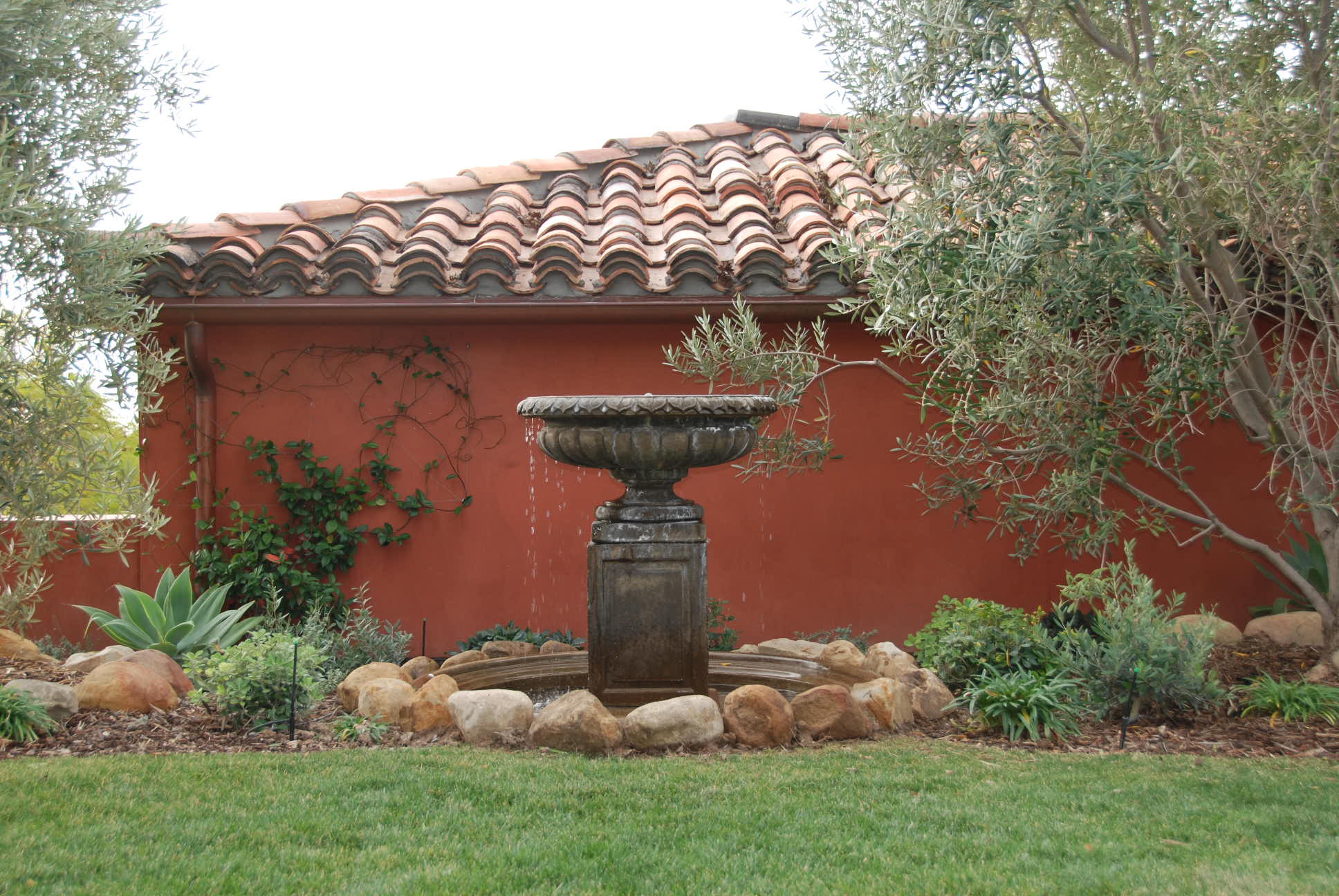
And depending on the style chosen, the fountain is one more way to help further define the character of the garden. For my East Coast inspired gardens, a traditional, stately three-tiered fountain is right at home, nestled among the Corsican hellebore, lavender and native penstemon.

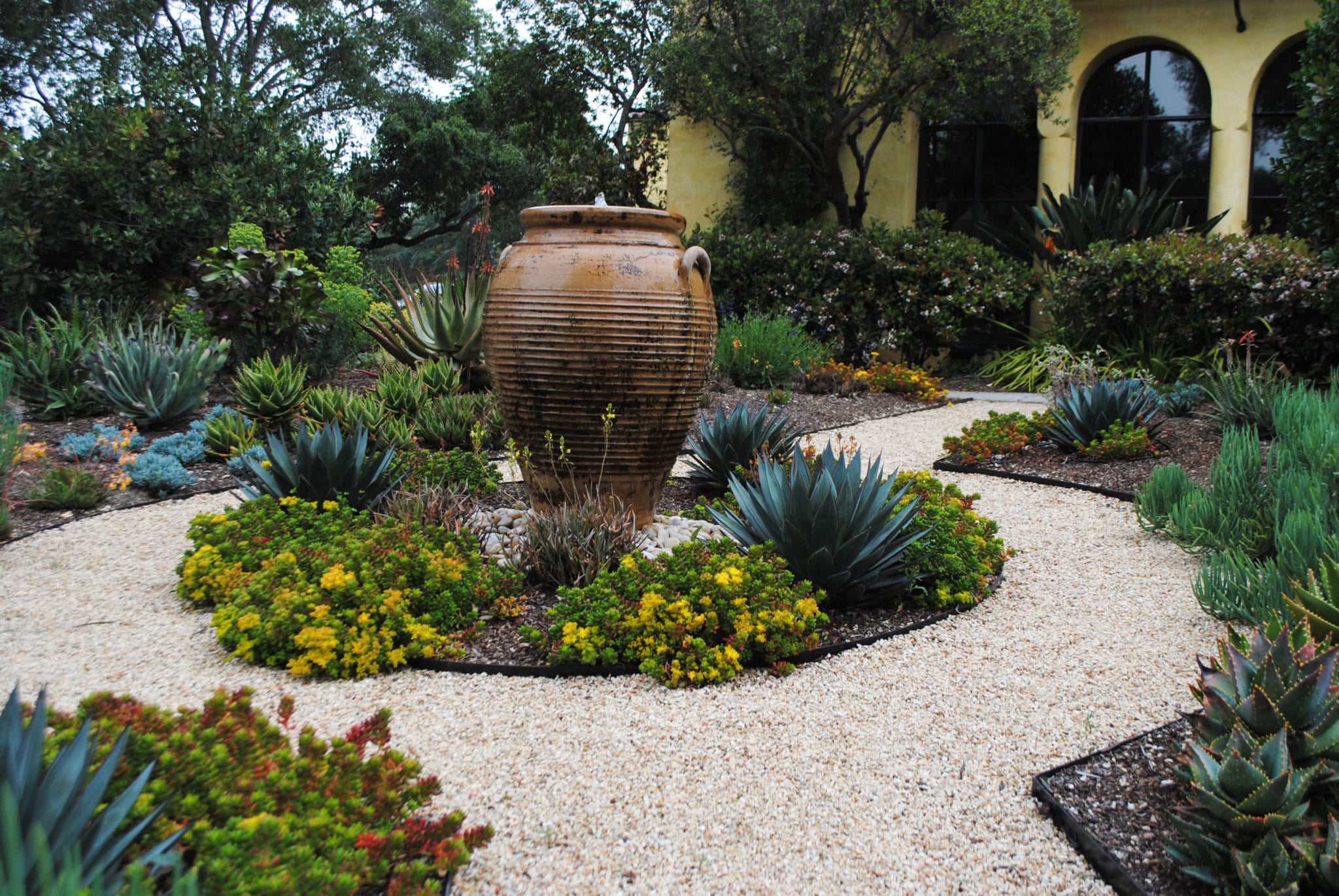
And for my Mediterranean-inspired gardens, a simple antique olive jar blends seamlessly into the surrounding garden filled with succulents, salvias and grasses.


How To Keep Your Fountains Water Wise During Drought

As we all face this unprecedented drought, we need to make smart choices about using water. At this point I’m praying for rain, but I’m realistic enough to know my lobbying may not be that influential.

But I have instituted several measures, the first of which regards my fountain. This water element is an essential part of the environment at my home. It runs 24/7 at this time of year and requires filling once a week. The sound it provides directly affects my sleep.  Could I live without it? Yes, I suppose I could, but why should I? It just doesn’t use as much water as one might think. It recycles the water and other than splash, evaporation and birds, the water goes round and round. I have calculated that I typically add about five gallons a week. The equivalent of about two toilet bowl flushes.

Water Wise fountain

Think about how much water a small lawn consumes and the minimal use of a fountain along with its relaxing and recuperative powers. It seems to me to that it’s a good use of water in my home. Some other tricks for your fountains are:

  • Turn down the pump to reduce the flow and splash
  • If you have a  fountain that splashes a lot, place plastic buckets around it to catch the errant water to add back to the fountain.
  • Use bath water: I am an ardent bather, I love a hot bath even in the summer, and I use that water to fill my fountains as well as water container plants. It’s easy to use an old pump and some tubing and when you’re finished with the bath, pump the water into 5 gallon pails and use it in the garden.

I don’t have any tips for you for your lawn because I haven’t had a lawn in twenty years. My feeling is: JUST SAY NO TO LAWNS. There are so many things that you can do instead and probably will have to do instead, especially if this drought continues for much longer.