Fountain Conversion – Bringing Your Water Feature to Life

The Fountain Conversion – Bringing Your Water Feature to Life

FONT – FONTANA – FUENTE – FONTÄN – آبنما –噴泉 – FOUNTAIN

It is said that elephants are good luck because wherever you find them you find water and food.  Water fountains have become a necessity of life in our gardens: the sound, the reflection, the energy of water in our environment. The Chinese art or practice of feng shui is to create harmonious surroundings and water is an essential element. Natural surroundings balanced between wind, water, light and energy come together to create an environment of peace and serenity.

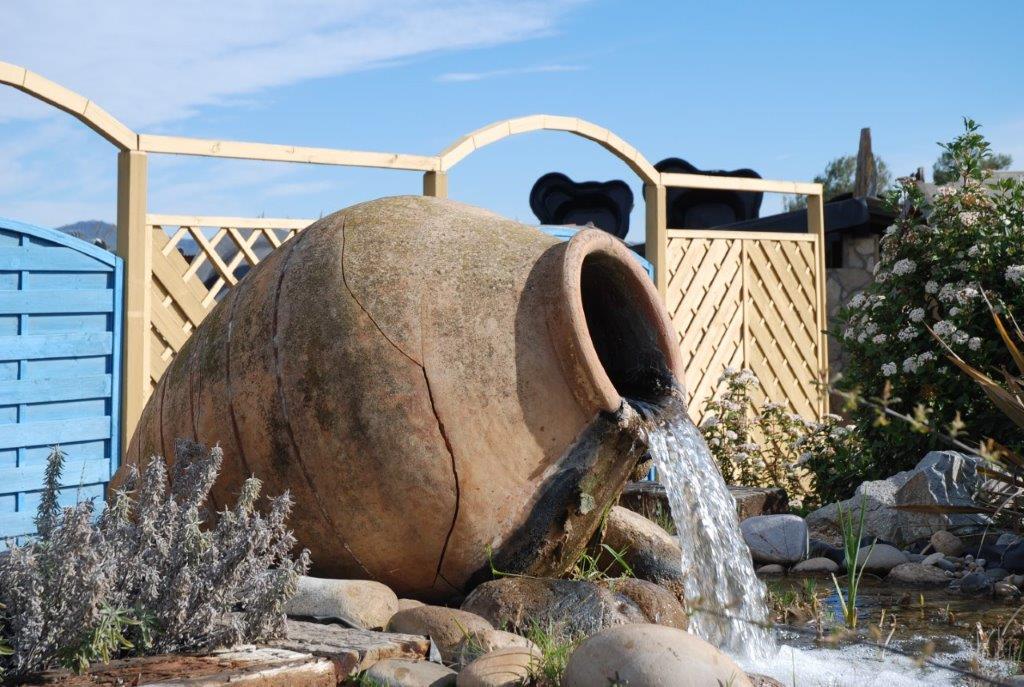
French Biot Fountain Conversion

This time of year, lying in bed on a balmy night, listening to the timpani of a running fountain is a luxury. When you wake and look out the window into the garden, what catches your eye? Is it the fresh bloom on the rose bush or the luxuriousness of a newly cut lawn or the sparkling water of your fountain? The perfect answer would be:  all three.

What is the main element to look for in your fountain?  Is it “visual”?

Think of your favorite fountain when you were a child. Suzi’s was the fountain at Griffith Park on Los Feliz Boulevard. Mine was the fountain at the corner of Wilshire Boulevard and Santa Monica Boulevard in Beverly Hills. At night, it was alive with colored lights. Built in 1931 and known as the Beverly Hills Electric Fountain.

19th Century Spanish wine jar fountain conversion
19th Century Spanish wine jar fountain conversion found outside of Barcelona, Spain

19th Century Spanish wine jar fountain conversion
This fountain conversion makes a striking presence.

19th Century Spanish wine jar fountain conversion
A unique, one-of-a-kind water feature for the garden.

Another element is “sound”. From the roar of a natural waterfall to the zen-esque rhythm of a Japanese bamboo deer-scare fountain, as it fills, spills and then the hollow knock as it hits its rock.  From quiet to loud, hearing water move and splash, tumble and fall onto itself creates mood, energy and a powerful balm for the soul.

The third element is “form”, possibly the most subjective when choosing your fountain.

All fountains work the same: water circulates, rises and falls from its source and back. The physical form and structure of the fountain resists, shapes and redirects the water’s flow. There are tiered fountains that many describe as a wedding cake. There are wall fountains, structures with spouts directing the water to flow into a vessel or intermediate bowls and finally spilling into a pond or container to recirculate up and down again.

John Russo American Concrete Fountain Conversion
American Concrete Fountain Conversion against this home’s wall. PC: John Russo Photo

Sally Farnum Fountain Conversion Pasadena
A concrete fountain conversion using more traditional elements.

A vessel is defined as a hollow or concave utensil, as a cup, bowl, pitcher, or vase, used for holding liquids. At Eye of the Day we can convert almost any pot, container, urn, or vase in our inventory into a fountain. Fountain conversions have become a signature service and our reputation for making bespoke fountains for the projects of our clients and designers has led us to shipping them throughout the United States.

A fountain conversion can be performed on most any pot, allowing for hundreds if not thousands of choices. If you want a unique fountain for your space and don’t want one that looks like the one your neighbor has, think about choosing your own shape, color, design and then have us convert it into a fountain.

Our Gladding McBean 88-33 is a simple pot; a sleek, high fired and colorful urn perfect for a fountain conversion.  We create a water-tight seal at the bottom and attach a copper riser to carry the water to the top and create a head.

Fountains GMB 88 Conversions
Our most popular fountain conversion is the GMB88-33 Oil Jar

The “head” is the water that bubbles above the waterline at the top of the pot and creates the reflection, motion and sound when its falls back upon itself. As the vessel fills to the brim, it will spill over the pot and fall back to the basin and be recirculated back to the top forever and ever (as long as you keep the basin full).

The basin, which we refer to most often as the “pond” can sit above grade or below. It is very popular to hide the basin below grade and then cover it with rocks or pebbles or tumbled glass, giving the appearance of an eternal spring, its source hidden and mysterious as if it emanates from the earth.

Fountain Conversion Rebecca Sweet garden design
A Greek terracotta fountain conversion that hides the basin with ground cover. PC: Harmony in the Garden

The pump is housed in this pond or basin and its electric cord either comes out underneath the basin/pond or over its side where it can be obscured with stones or other ground cover. Always remember to keep a couple of inches of the basin above grade so that when it rains, dirt and debris can’t wash into it and compromise the pump.

Your container must be prepared to hold water and have water run over all surfaces continuously for a long period of time.  There are many quality products on the market to seal and waterproof your fountain. You can use any larger container to act as your basin, it doesn’t have to be concrete or something special. I once had a client who took a heavy-duty trash can and cut it down to 12 inches and buried it in the ground.

Custom Colored Italian Terracotta Fountain Conversion
Custom Colored Italian Terracotta Fountain Conversion. Pump house hidden beneath.

In addition to the vessel to be made into your fountain and the basin for it to sit in, you will need a “pump house”.  This is exactly what it sounds like: a house for your pump. In addition to hiding the pump from view, the pump house has another purpose, to act as a pedestal for your fountain vessel to sit on and it must be strong and stable enough to carry the fountain’s weight.

Converting pottery to fountains is easy and everything to complete the job can be purchased from your local hardware store. The one thing you might want to spend time searching for is that perfect vessel.

Another type of fountain conversion has the water returning inside of the vessel. This eliminates the need for a basin/pond and the pump house, eliminating the cost of these two additional items and the same container will fit into an even smaller space.

Terracotta Low Bowl Fountain Conversion
Italian Terracotta Low Bowl Fountain Conversion that returns water inside the vessel.

There is very little splash if the water is kept at a lower level within the container.  Also, the sound will resonate at different pitches depending on how full you keep the vessel. Just think of a wine glass being tapped with a knife.

Other ideas for Fountain Conversions:

  • Rectangular troughs
  • Low Bowls
  • Turning a wall into a fountain
  • Old Stones 


    French Limestone Fountain with Flowers
    French Limestone Fountain

    French Biot Fountain Conversion
    French Biot Fountain Conversion


Materials Needed:

  1. Vessel of your choice
  2. Basin/Pond to fit underneath and wide enough diameter to catch as much splash as possible.
  3. PVC or copper tubing for riser.
  4. Pump house large and sturdy enough to enclose your pump and carry the weight of your vessel filled with water.
  5. Water pump strong enough to pump water to top of your pot

Let your imagination be your guide and create a unique fountain for your space from almost any water worthy vessel.  Please come see our incredible selection of pots and containers as well as old European stone troughs, millstones and other garden art here at Eye of the Day.

We will bring your vision to life!
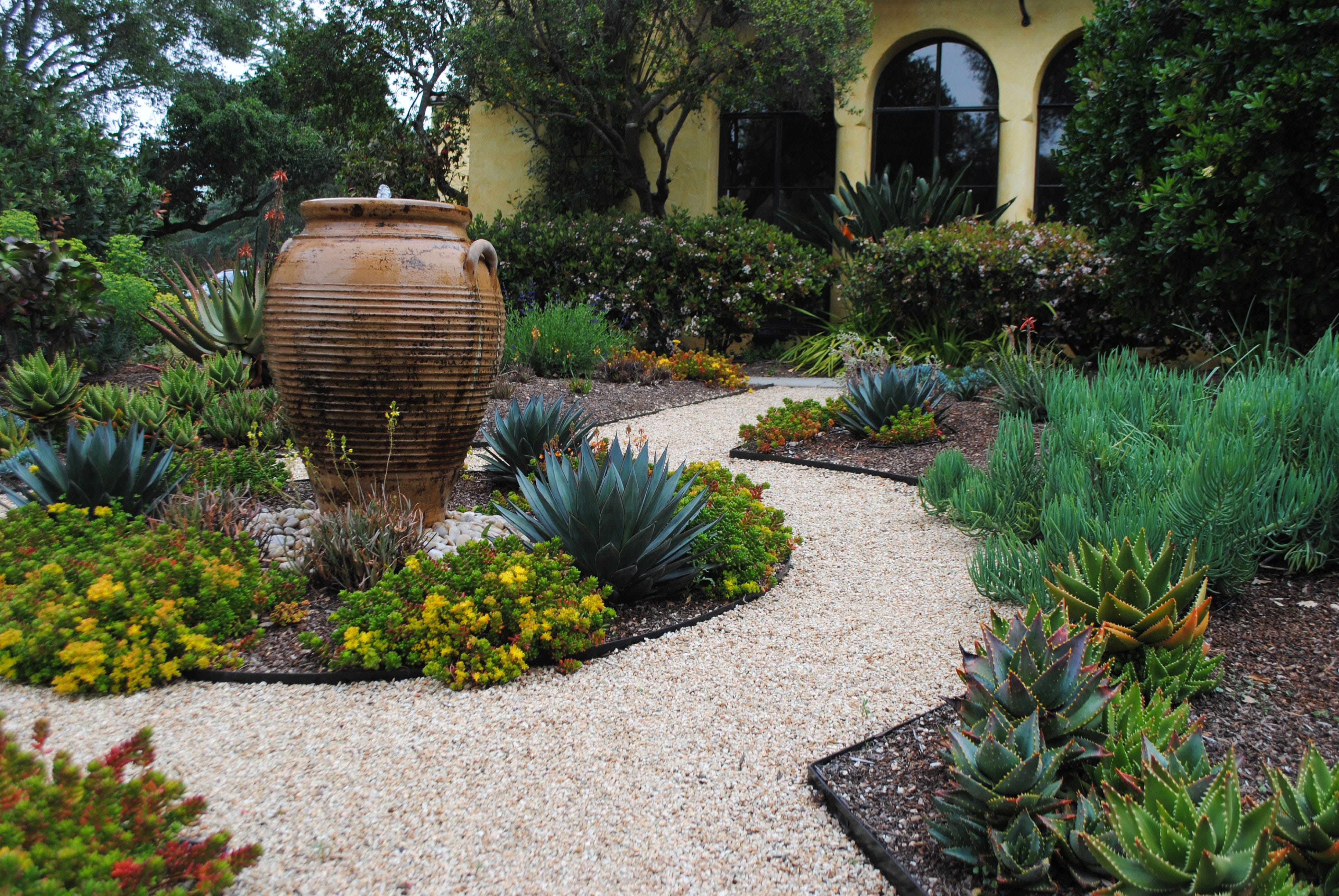

A Fountain Conversion by Rebecca Sweet

Fountain Conversion Rebecca Sweet garden design

Fountain Conversion: A Michalis in the Garden 

We have been fortunate to have Rebecca Sweet write for The Yardstick in the past and knowing that she has a sustained love for Mediterranean gardens and is busy with clients seeking her expertise and experience, we are pleased that she took the time to answer some questions about her garden design featuring Eye of the Day’s Greek pot, the Michalis, as a fountain conversion.  Rebecca is the author of several esteemed books on gardening and her work has been featured in Sunset Magazine, Horticulture and a variety of other national publications.  Her design firm, Harmony in the Garden, is in Los Altos California.


Q: Tell us a little about yourself as a designer and Harmony in the Garden.

I’m a California native, and though I’ve lived in both the southern and central parts of the state, I’ve spent most of my life in the Bay Area. Over the years I’ve seen this area’s sleepy suburbs transform into the bustling, densely populated, high-energy area that it is today. The people who call this place home come from all over the country, as well as the world, and have brought with them their unique perspectives on gardening. Having had my landscape design company, Harmony in the Garden, for over 15 years now, it’s been an incredible gift to be a part of these changes and to help so many people from different walks of life create their versions of paradise.

Q: What was your client’s goal for this garden?

As passionate gardeners themselves, the clients wanted to transform this part of their garden from a water-guzzling, and unsightly half-dead lawn into something that would require much less maintenance and water. This area is situated close to their home and can be viewed from several large windows, so it needed to look good year-round.

Q: What was your initial vision for the landscape and did that change over time?

My vision and theirs complemented one another perfectly, as we are all succulent fans. So, to reduce water consumption, as well as indulge in our love of succulents, we removed the lawn, replacing it with a low-water succulent and cactus garden. To help tie this new space in with their existing, and more traditional style of garden, we also incorporated   several flowering shrubs and perennials that were colorful, yet also drought-tolerant and low-maintenance.

Because the area is fairly large, we knew we needed to break up the space into smaller, more manageable planting areas. Wide decomposed granite pathways were the solution, gently meandering through the space, helping to bring down the scale of the oversized garden.

Q: Any unique issues or challenges for this project during the design or installation?

Initially, the homeowner wanted this garden to thrive without supplemental water but quickly realized that just wasn’t going to happen. This area is in full sun so even the cactus were suffering through the blistering summer heat-waves. Luckily, we had a feeling this might happen and had previously installed a framework of irrigation under the ground ‘just in case.’ We ended up irrigating the garden, on a very reduced schedule.

Q: What would you describe as your garden design aesthetic and how do you work with your client’s own vision for the landscape?

My own aesthetic is one that appears full and lush, yet is quite drought-tolerant. My passion for plants has allowed me to create drought tolerant gardens that don’t ‘look’ drought  tolerant, and is what I’m probably best known for creating.

Since so many of my clients come from around the world, their vision for their garden (and the    plants they’re used to seeing) can be challenging to translate with California’s lack of water. Luckily, living in a mild-winter climate such as ours, we have access to an expansive selection of drought-tolerant plants from which to choose.  I love interpreting their vision into a garden overflowing with plants that will thrive here.

Q: For garden décor, why the Michalis Greek pot for the fountain conversion?

When designing this garden, we knew we wanted a focal point to bisect the center of the pathways. To keep in scale with the large garden and home, we needed a large focal point.  The Michalis Greek pot an ideal choice for a fountain conversion and blends beautifully with their historic Mediterranean home. By converting the pot into to a fountain, we added the gentle sound of trickling water, entertainment from the multitude of birds that adore taking baths there, and the illusion of ‘coolness’ from the water itself. We couldn’t have chosen a more perfect focal point for this garden.


Q: What was your favorite part of this project?

My favorite part of this project was to see the joy on my clients’ faces as they saw their garden’s breathtaking transformation. I continue to visit them and their garden every few months and seeing the succulents grow and fill in, creating an ever-changing tapestry has given my clients so much happiness through the years – all while significantly reducing their water bill!


See Rebecca’s other work on our blog:

Rebecca Sweet On Shades of Gray in the Garden
Stylish and Sustainable Garden Design


Top 5 Fountain Conversions

American Concrete - Fountain Conversions

Top 5 Fountain Conversions

Fountain conversions have become a signature service of Eye of the Day. Spring and Summer is the time to order this popular water feature. From classic shapes to more contemporary forms, fountain conversions are an elegant addition to any garden design. Depending on the style and aesthetic of the garden, the conversion process starts with choosing a container. Almost any vessel at Eye of the Day can be converted, but there are definite favorites at the store. We rank the top five fountain conversions that homeowners and designers love.

5. French Terracotta Fountain Conversions

While not as common a choice for a fountain conversion, French Anduze pots and biots are an elegant option for a water feature. We recommend sealing for this type of terracotta, especially to protect the glaze,

4. Concrete Fountain Conversions

Our American made concrete pots are the ideal containers for both contemporary and traditional styles. These water features can be made up of different concrete garden décor pieces from birdbaths and urns, to ponds and containers.


This custom feature uses a concrete birdbath set into a pond based on an English garden the clients loved while visiting England.


This design used two American made concrete pots for the conversion. A custom insert was used for the flat spout.


3. Greek Terracotta Fountain Conversions

Here in California, Mediterranean style gardens are popular throughout the state. With sunshine filled days, proximity to the ocean, and lush plant life, our similar climates are the ideal foundation for a Mediterranean garden. Our Greek line of terracotta pottery is a popular option for containers and fountain conversions.

The Michalis pot fountain conversion was a popular design for Bay Area designer, Rebecca Sweet. Its classic shape was perfect for the Mediterranean garden design of her Palo Alto clients.

2. Italian Terracotta Fountain Conversions

Eye of the Day specializes in Italian terracotta pottery. Naturally, many clients and designers choose an Italian terra cotta pot as the vessel for their fountain conversion. We carry classic, ornate, and contemporary styles.

1. Gladding McBean Oil Jar Fountain Conversions

This is the most popular fountain conversion we do—and with good reason. The classic oil jar shape is a favorite among customers and as a water feature, it becomes a striking focal point in the home or garden. Available in a variety of colorful glazed finishes from Gladding McBean, both traditional and modern designs can incorporate this oil jar fountain conversion. The GMB88-33 is the most popular, but the GMB45 with the narrow neck is a lovely option as well.

Get inspired with the pottery and containers from Eye of the Day for your next garden design project. Contact us today to learn more about fountain conversions.


Montecito Landscape Garden Design – The Cullen Meadow

Garden Design | Montecito Landscape | Cullen Meadow

Montecito Landscape Garden Design – The Cullen Meadow

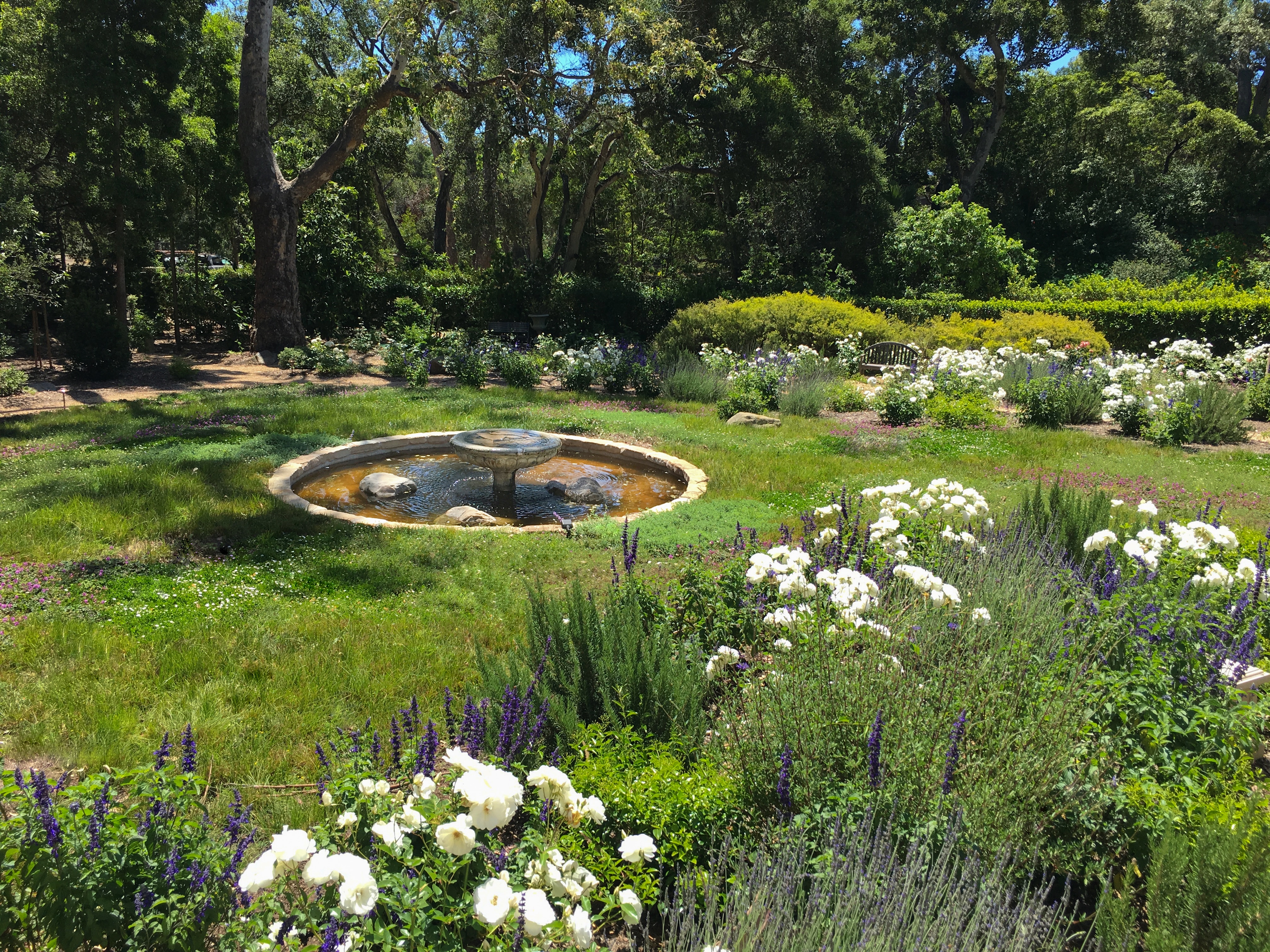
Lisa and Chris Cullen of Montecito Landscape are long time customers of Eye of the Day. We feature one of their recent designs as they transform a large lawn to a walking garden with a central water feature using a custom Eye of the Day fountain conversion.


Garden Design | Montecito Landscape | Cullen Meadow

Tell us a little about Montecito Landscape and this project. 

Montecito Landscape is celebrating 47 years of creating gardens in Montecito and beyond this month! We are a small, boutique company specializing in landscape design and installation. This particular project is one of our favorites. The client was very involved in the development of the design and she trusted us when we presented an out-of-the ordinary idea.

What was your client’s goal for this garden?

The area was a huge, dead lawn and with the drought and water restrictions it was going to be difficult if they wanted to keep it looking good. They wanted something drought tolerant but beautiful and interesting. Initially, the client wanted lawn, but we wanted to do something completely different from the norm. They trusted our vision and agreed to go along.

What was your initial vision for the landscape?

We wanted to eliminate the lawn all together and create a “walking garden” providing destinations that would invite meandering and discovering. We also wanted to take advantage of the outer perimeter of the property by removing the Pittosporum hedges that were cutting off what became “the forest” from the rest of the property. We created pathways and destinations in this area that connected to the main garden, so that one could enjoy it from every vantage point.

Our innovation was “The Cullen Meadow” which is a drought tolerant alternative to lawn. The “meadow” consists of drought tolerant, flowering plants such as Santa Barbara daisy, Nepeta, Carex and others that can be walked on and mowed like a lawn, but that needs only occasional maintenance. Plus, it is way more interesting than a lawn!

The idea for the central pond came from the client when she sent us a photo of one she saw in England. The minute we saw it, we knew this was exactly what this garden needed. We also needed a fountain to mitigate the noise from the street and the pond created the perfect way of integrating a water feature into the design.


Were there any unique problems that came up during the design or installation?

Working out how to make the “Cullen Meadow” something that could be used as a lawn and how to lessen the street sounds and visual distraction of cars going by without blocking the distant views.


What would you describe as your garden design aesthetic and how do you work with your client’s own vision for the landscape?

We work with Nature not against her. We design gardens that are cohesive from conception to the finished product. A garden should flow, it should “feel right”. They should have a theme, a vibe and a sense of place. Our designs take the entire property into account, taking advantage of the unique qualities and features of that specific property. We begin by looking at what makes the space special, what are the assets and work out how we can use those features to their best advantage. We also believe that drought tolerant gardens can be beautiful. They can have roses, camellias and even hydrangeas if planted in the appropriate location and using correct gardening technique.

We love to collaborate with the client. We spend time with them, driving around if needed, pointing out various gardens so that we can tune into their specific aesthetic and discover exactly how they envision using the garden. We want our clients to get out and be in their gardens so we design for the individual. Gardens are for living and we know we have been successful when we hear how much our clients love their new landscapes.


For the garden décor, why these pieces?

The fountain needed to be simple and the correct scale if it was to work in the pond. The pond is 15 feet across and is the main feature of the landscape design, so the fountain needed to be perfect. Brent Freitas at Eye of the Day helped us in selecting the exact right fountain and we (and the client) are very happy with the result.

What was your favorite part of this project and design?

The central pond, fountain and the “meadow” are what make this garden so special. We knew the house and the location deserved something special and I think we succeeded. I love water features, ponds, and fountains and believe that every garden needs one or two for the visual and musical sound aesthetic. Fountains and water features can be “tuned” to fit the type of effect you are trying to create. And fountains are not just for aesthetic reasons! A fountain brings birds and bees to a garden and we all know how important the birds and the bees are!


Visit Montecito Landscape to view more of their work.


A Brief History of Fountains at Eye of the Day

Contemporary fountain design fess parker

A Brief History of Fountains at Eye of the Day

About twenty years ago, Brent and I had a life-changing meeting with the rep of a company that manufactures concrete garden ornaments. Of course, we didn’t know at the time it was life-changing. If anything, it was more “mystifying” to me. For reasons only apparent in Brent’s mind, we were choosing fountains that we would sell at our fledgling store, which we had named for our nine-year-old daughter, Daisy.

Honestly, I had never thought about fountains, they were alien to me, but there we were choosing three-tier fountains topped with angels, little fountains to put against a wall that were reminiscent of rocky outcroppings.

I had a favorite: two frogs on a loveseat sitting under an umbrella; water sliding down the concrete umbrella, protecting the love-frogs. So began our long-term relationship with fountains for the garden.

We have seen tastes change dramatically, though not everyone’s—animal figurines and faux-stone fountains are not so popular any longer.  Majestic, Mediterranean style concrete fountains have slowed down. About fifteen years ago, on a trip to France, Daisy and Brent came across a stone carver and soon fantastic hand-carved limestone fountains graced our showroom, and continue to do so.

In recent years we find that many of our customers want something completely different and decide to choose a beautiful pot, maybe a richly hued Gladding McBean Oil Jar or a rustic Greek Pithari and we convert their choice into a fountain, water glistening over the sides of the vessel and recirculation via a hidden pond.

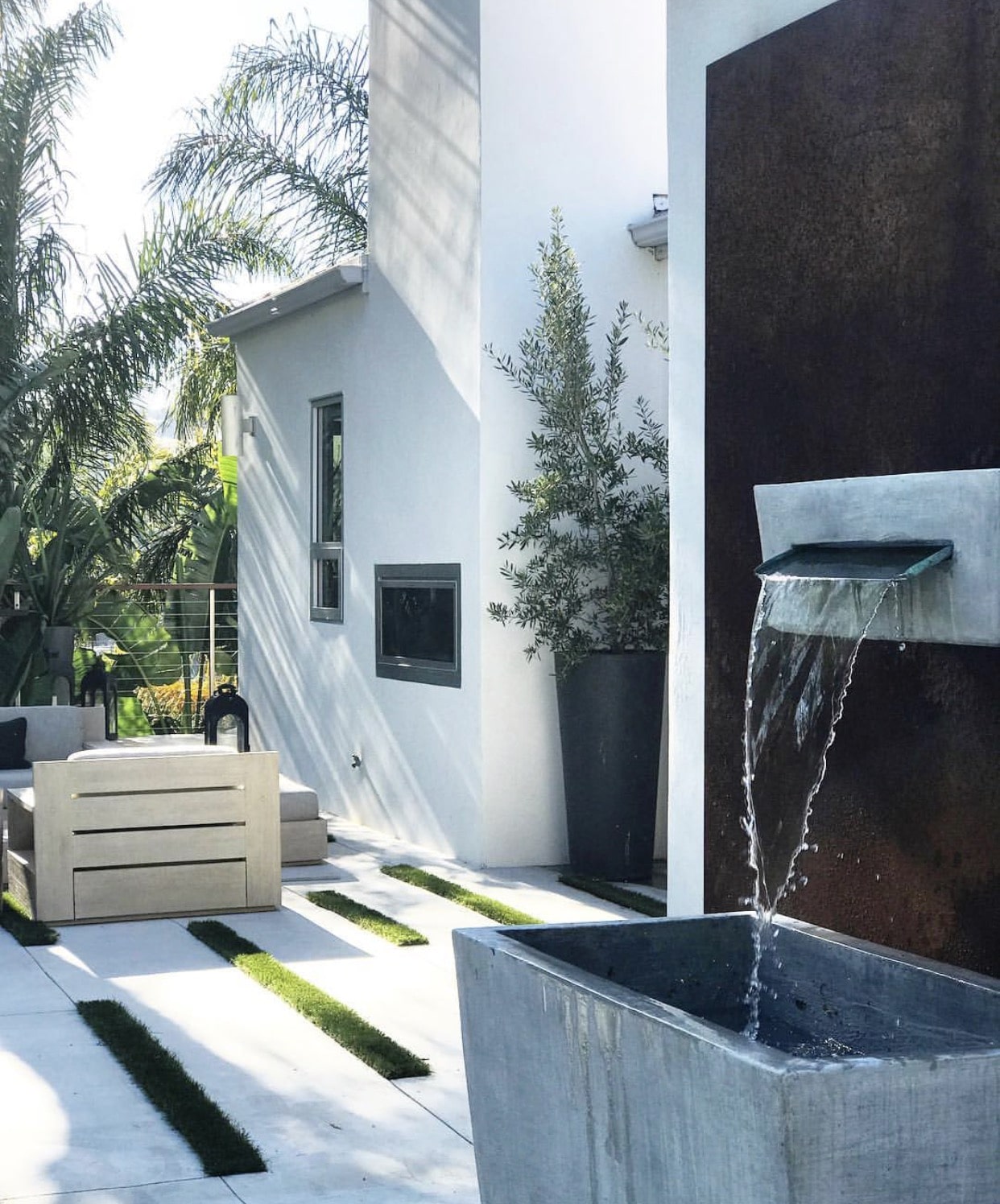
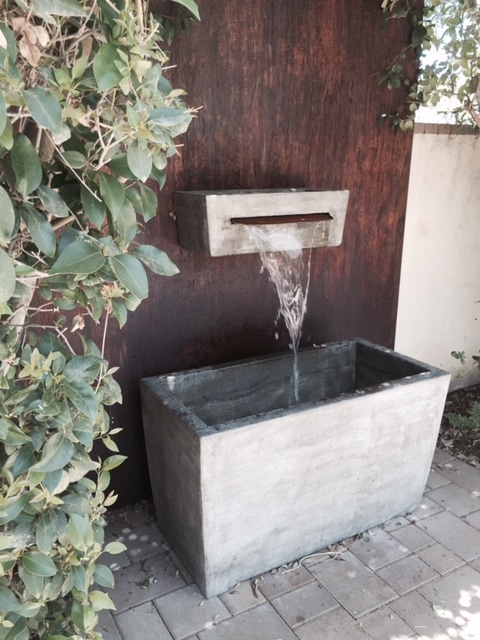
And now, a few individuals have come to us with a new idea for their water feature, something we are excited to produce for them. The Modern or Mid-Century Modern trend is directing a movement toward vastly more contemporary looking fountains. So not only in architecture and home furnishings, we’re seeing many customers who want something with clean lines and no “frou-frou”.

contemporary fountains garden design
Both The Fess Parker Wine Country Inn and a well-known celebrity photographer asked us to fabricate a fountain that would complement a modern aesthetic.  We accomplished this by almost turning the concept upside down. Well, sideways, anyway. Using two rectangular concrete pots, we turned one on its side, cut a long, narrow piece from the center and inserted a copper “tongue” for the water to exit the piece and flow into a larger rectangle placed on the ground.

With the success of this custom fountain conversion design, we are not only producing fountains with an old world charm and a rustic look, but moving into the Mid-Century—so modern in our approach.  Working on more ideas, coming your way.


DIY Project How to Make a Succulent Fountain

DIY Succulent Fountain Conversion Garden Design

DIY: How to Make a Succulent Fountain 

Looking for a way to add a beautiful and water friendly feature to your garden? We’ve got the perfect garden project for your next weekend outdoors.

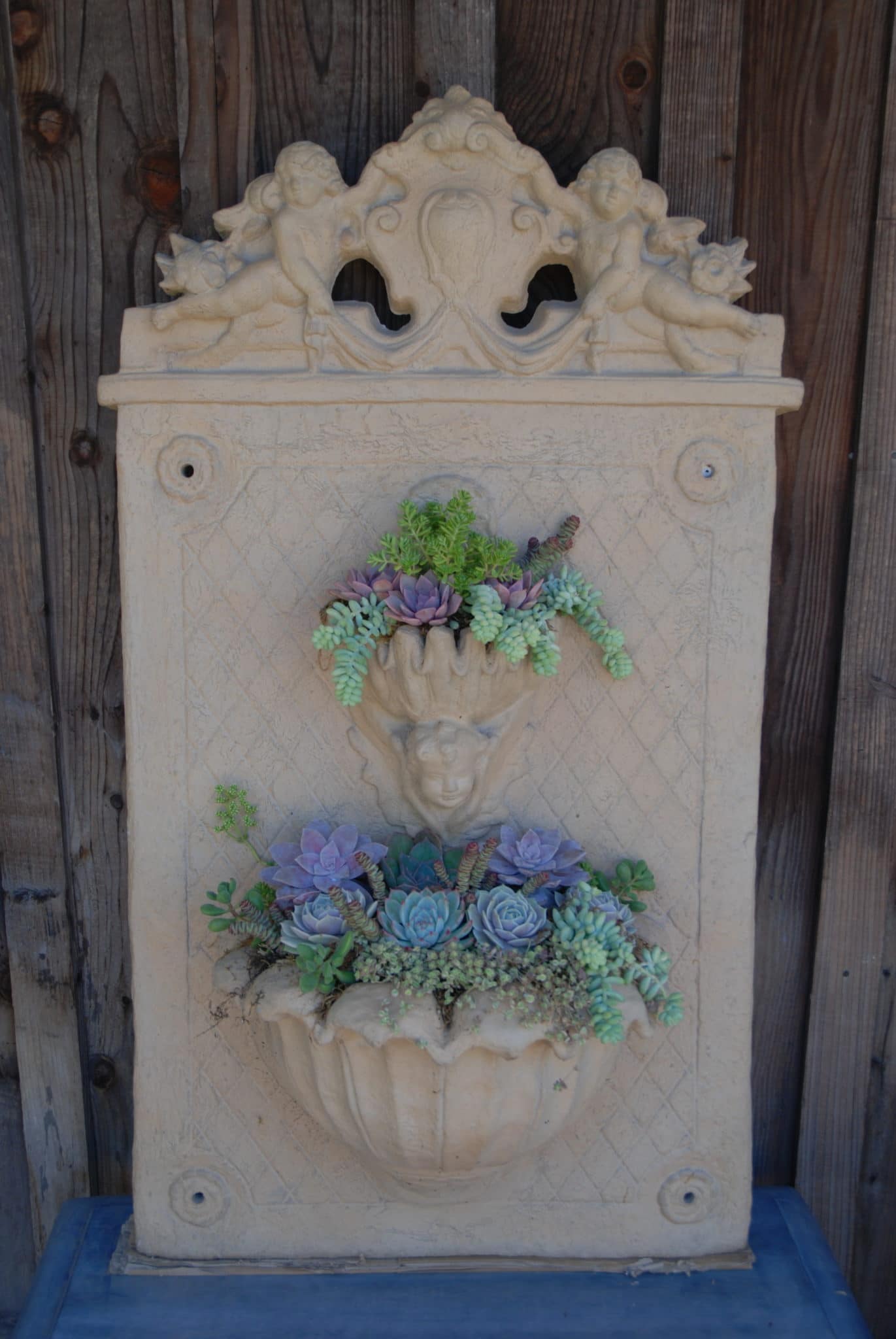
Here at Eye of the Day, Amelia Richardson, better known as Mimi, takes care of the succulent plantings around the store. An expert on succulents, she takes an overlooked wall fountain and transforms it into a beautiful container garden. This project is great not just for drought-stricken California, but any garden that gets enough sunlight throughout the year.

Here is a step-by-step guide to converting a fountain into a succulent fountain garden.

Step 1: Choose Your Vessel

Choose a fountain. It can be one meant to mount a wall, a standalone fountain, single or multi-tiered, or even a birdbath will do!

Step 2: Prep Your Container

Drain the fountain of water and make sure that any drainage holes are covered, if any. You can use a broken piece of pottery or terracotta. The soil will still shift so periodically check the draining that soil isn’t completely blocking it off.

You can also add a layer of rock gravel first before adding soil. If you’re using a birdbath, this step is a must.

Step 3: Add Your Soil

We recommend using cactus mix when planting succulents. It drains quickly which is good for plants that can’t sit in wet soil. We use EB Stone’s Organic Cactus Mix. If you live near Eye of the Day here in the Santa Barbara area, be sure to stop by and get some!DIY Succulent Fountain Conversion Garden Design

Step 4: Choose Your Succulents

When picking succulents, it will really depend on the planter. On large planters, you can choose a focal plant that you can work smaller succulents around. For example: A large Echeveria or Aeonium in the center that is worked around with smaller accent pieces like Sedum morganianum. 

Mimi Tips:

  • Have fun when picking succulents. Grouping like with like is also easier.
  • Color story: Jewel toned, all greens, chartreuses, blacks, cool tones versus warm tones
  • Textural: Soft, sharp, or hardy.
  • Shape: Round (Echeveria, aeonium, sempervivum), spiky (crassula, sansevieria), mix of large and small, tall and short. Senicio radicans and Sedum morganianum even mimic water flow as they drape over the edges.
  • Single type: Just one type of succulent for beginner planters. All rosette types are always pretty.

Step 5: Plan the Layout

Before you start the actual planting, place the succulents either on the ground or in the fountain as you imagine the final product. Here you can edit and rearrange as you see how it’ll all come together.

Sometimes planters can be organized and others more organic and wild. It will depend on the container and where it’s going.DIY Succulent Fountain Conversion Garden Design

Step 6: Start Planting

When removing a succulent from its plastic container, sometimes you’ll be transplanting to an area smaller than the soil around the succulent. You can remove much of the soil while still preserving the roots to get it to fit in the container spot.DIY Succulent Fountain Conversion Garden Design

Mimi Tip: Don’t be afraid to plant them close together. You can always leave space to let them fill out but getting into every nook and cranny helps to create its own ecosystem and that full growth actually slows down the propagation.

DIY Succulent Fountain Conversion Garden DesignBesides, you can always remove, replace and transplant—that’s the great nature of succulents. Succulents are hardy; they’re hard to ruin so press them into the soil. You can also use wet sheet moss to keep the plants moist and reduce the need for additional watering.

Step 7: Add Decorative Elements

Depending on the container get creative using shells, pieces of wood, rocks, broken pot or statue pieces, sea glass, etc. as added decorative material. If you prefer space between your succulents, these elements can help cover the soil.

DIY Succulent Fountain Conversion Garden Design

Step 8: Final Watering 

Give it a quick but generous soak and wash off the container with any leftover dirt. With succulents you want to water once or twice a week depending on sun and weather conditions. Soil should dry out (not completely bone dry) between watering. If soil is still damp you don’t need to water just yet.

If you’re using a container that does not have a drainage hole like a birdbath, then you would let it go bone dry between watering.

DIY Succulent Fountain Conversion Garden Design

Voila! You have a beautiful, water friendly, succulent fountain!


To check out another fun DIY project take a look at Design Rulz article on DIY Macrame Plant Hanger Patterns.