Book Review: Fountains – Splash and Spectacle

Eye of the Day Garden Design Center| Fountains Splash and Spectacle| Fountains

FOUNTAIN AS MUSE

Sunday morning.  Outside the bank of our bedroom windows, the fountain’s splash and play completely encompass the peacefulness of home.  Our shy friend, a tiny iridescent green hummingbird is curiously eyeing the droplets arcing into the air. Especially while we are all thinking about water problems in California, enjoying a few moments with the sound, sight and spray of our fountain is almost intoxicating.

Eye of the Day Garden Design Center| Fountains Splash and Spectacle| Fountains
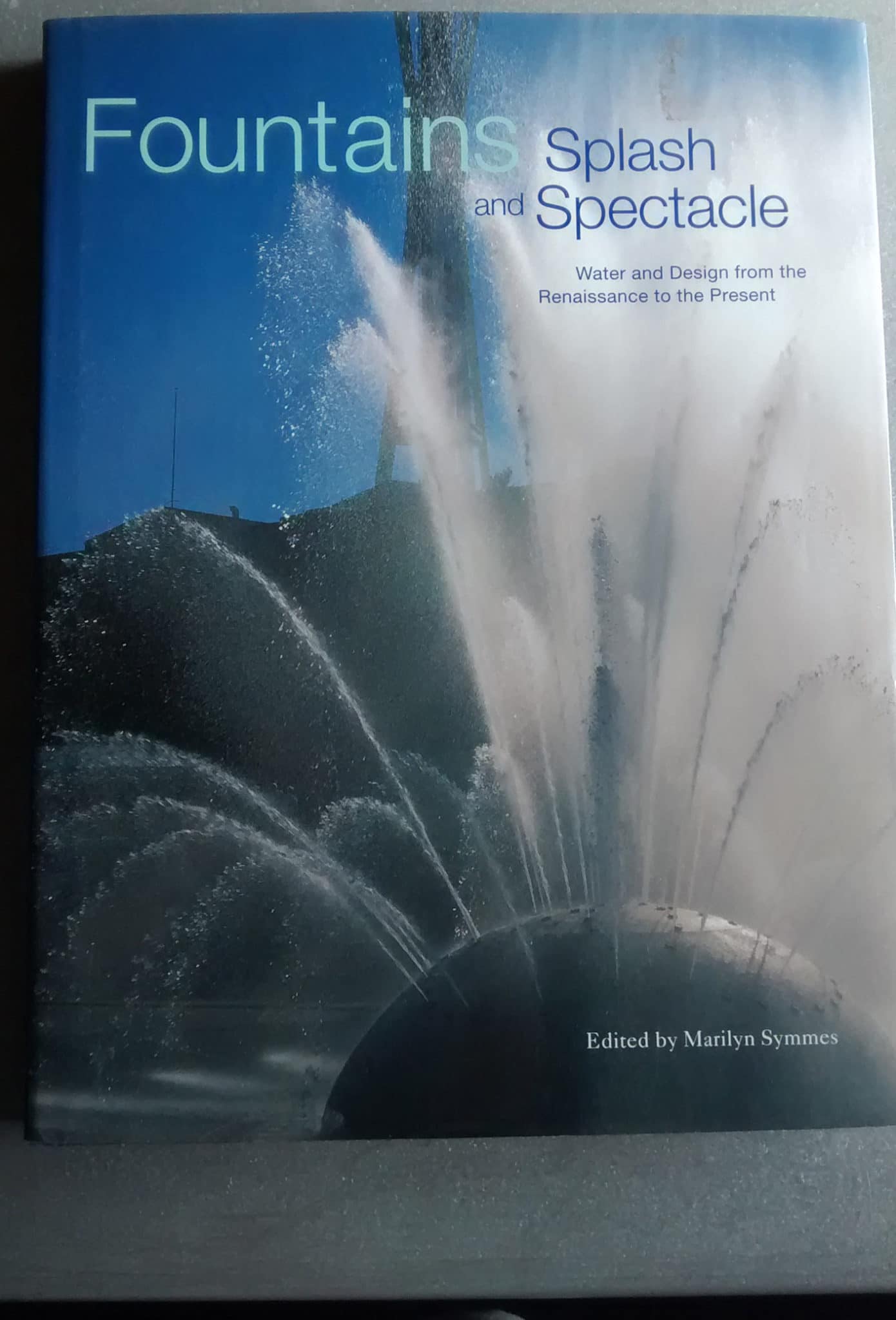
Book Cover for Fountains Splash and Spectacle

Throughout the years we have consistently added to Eye of the Day’s library of books pertaining to gardening, fountains, pottery, terracotta and European antiques. While I was mesmerized by the muse of my fountain, I remembered a book I found for Brent a few years ago:  Fountains Splash and spectacle: Water and Design from the Renaissance to the Present edited by Marilyn Symmes. The book traces the history of fountains throughout the world from the renovations of ancient Roman aqueducts to choreographed, computer controlled displays combining light, music, and fireworks.

Photographs, paintings, illustrations, etchings and drawings are so plentiful and varied that even if you only pick up the book to see them you’ll be drawn into reading a few paragraphs like this one:

Water possesses almost magical qualities.  A spraying fire hydrant can transform a sweltering city street into a temporary oasis, offering neighborhood children a showery playground as welcome relief—from the dry, hard pavement…the sound of moving water—sometimes a roar, at other times a whisper–breaks the stillness and can provide an aural refreshment on a warm day.

The last photo in the book is the best possible illustration of this paragraph.

Eye of the Day Garden Design Center| Fountains Splash and Spectacle| Fountains
USA. Harlem. NY. 1963. The fire hydrants are opened during the summer heat. Photo by Leonard Freed, Magnum Freed. 

Though our water problems have no foreseeable end and we may need to regulate the use of our fountains, the birds, bees and butterflies not only enjoy, but need water to survive and even a few hours a day provide a magical quality.  And that’s not just for animals, but for those of us staring out the window on a Sunday morning as well.


Fountains: Splash and Spectacle – Water and Design from the Renaissance to the Present. Edited by Marilyn Symmes. The Smithsonian Institution, 1998.

The Truth Behind the Aged Terracotta You Buy

Eye of the Day|Quality terracotta differences|design pottery

The Truth Behind the Aged Terracotta You Buy

If you have read the articles by Scott Semple you now have a good understanding of what makes up terracotta pottery. From Gladding McBean’s stoneware to our Italian frost resistant earthenware containers, at Eye of the Day Garden Design Center we sell high-quality terra cotta products which last and last.

Now, what about aesthetics? Do you want your pots to last? Is it important that future generations are given your garden pots along with your jewelry, silverware and bedroom set? Many people love the patina of terracotta when it gets older and though a crumbling pot is not the same thing as “patina” they think it still looks cool.

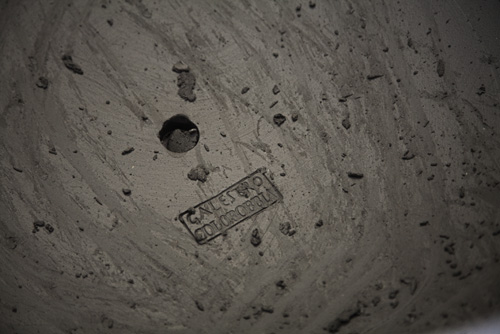
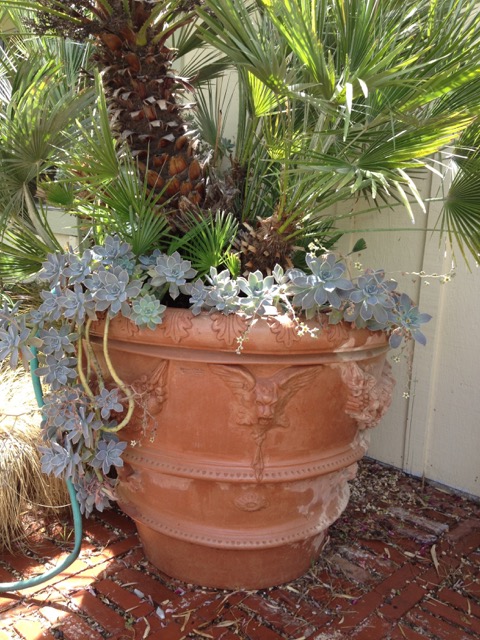
This Italian pot from Terrecotte Olympia of Tuscany, Italy is a favorite of designers in Southern California. It is not made with frost proof Galestro clay but with Sienna clay, which is clay Americans typically find at their garden store. Olympia, like many Italian clays and other clays from which garden pots are produced, will almost immediately begin to spall and flake. Although they have a wonderful aged patina that designers love to specify in their designs, the material does not have a long life compared to pottery made from Galestro clay. The problems will be seen in Mexican and most Asian terracotta products as well.

At Eye of the Day, we hope that our retail and professional design clients will consider the investment they are making and choose terracotta for the centuries. For a further example of how these pots age and look, take a look at the following pictures of the Italian pots at the Ralph Lauren Store at the Stanford Shopping Center in Palo Alto. If this is not enough to convince you, well, that’s why there are both vanilla and chocolate…something for everyone.

If you like that falling-apart look, come and see our seconds and close-out area at the store where we have lots of consigned pottery from customers who are replacing their containers with new ones. The prices are great and the look is shabby/chic. We also have remaining stock from Terrecotte Olympia at half price: it’s still half-good.


How a Landscape Architect Approaches Garden Design During California Drought

Eye of the Day|Sally Farnum Landscape Architect|garden design drought

Having a sister with a long, successful career as a landscape architect has made it easy to have an ongoing conversation with Sally Farnum about design, client concerns and current issues. We are all especially interested in California’s water problem and wanted to find out how Sally is helping her clients address the issue.

Suzi: What have your clients have been asking about when it comes to water and their gardens?
Sally: Most of my clients are trying to be responsible when it comes to water usage in their landscape. They want to know if they need to take out their lawns, replace their flowering plants with desert plants and if it will still look pretty.

Suzi: How do you approach designing a plan that reflects water-consciousness but is still pretty?
Sally: I really work to combine good elements of design in all my plans: scale, balance, variety, form, line, texture and color. I like to use California natives, salvias, lavenders along with containers, sculpture and fountains.  I suggest using decomposed granite and gravel and, really important, an extra-efficient irrigation system.

Suzi: How do you convince them that a huge, green lawn isn’t the best plan anymore
Sally: Most people are visually oriented, so to describe an idea in words alone doesn’t always convince them. I show them photos or have them visit other projects I have completed.  But I don’t feel that it’s necessary to remove ALL lawn. Only 5% of residential water is used to keep lawns green and it contributes to cooling an area, cleaning the air and reduces noise. Grass in a front yard, used to fill space, should be eliminated.

Suzi: Do you have a favorite or most challenging project which incorporated water-wise elements?

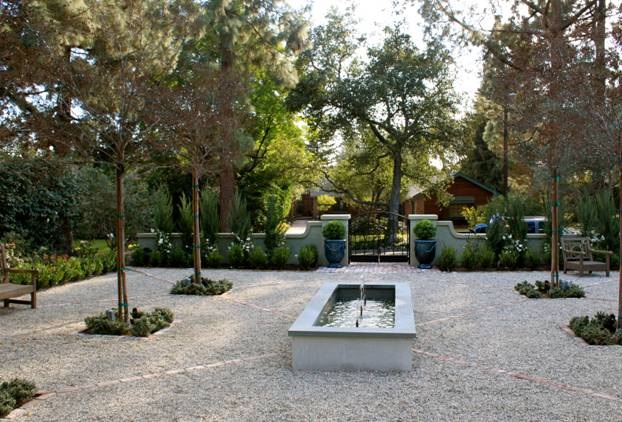
Sally: One of my favorite and most challenging designs is right across the street from my own home.  Challenging because the home belongs to a friend and because I look at it most every day. My favorite because of the transformation from a front yard with a large asphalt driveway and lawn, to a garden with a walled-in gravel courtyard with a fountain and pots planted with flowering plants on the street side of the wall.

Suzi: How have you managed to change the way you designed in the past to meet the new challenges presented by the drought?
Sally:  The challenges are mainly in working with my clients and helping them accept new plants and watering habits.  Most plants will adapt to using less water, but people tend to water more than necessary.  I haven’t changed the way I design, but I have changed the materials and plants I use.


Suzi: Thanks, Sal.  You’re always such a wealth of information, and a fine sister, too.
Sally: You’re not so bad yourself.


Masterpiece: Virginia Robinson Gardens 27th Annual Garden Tour

Eye of the Day|Virginia Robinson Garden Tour|Masterpiece Garden tour

FRIENDS OF ROBINSON GARDENS

Cordially invite you to our twenty-seventh annual

“…into the garden Benefit Tour”

Saturday, May 16, 2015, 10:00 a.m. to 4:00 p.m.

Grand Marshal
Victoria Tennant

New this year – Valet Parking
Valet parking must be purchased prior to the day of Garden Tour.

Eye of the Day|Virginia Robinson Garden Tour|Masterpiece Garden tour

Eye of the Day|Virginia Robinson Garden Tour|Masterpiece Garden tour


Virginia Robinson Estate and Tours of Four Exquisite Beverly Hills Gardens

The Garden Tour is a multi-faceted day, considered “…. the most glamorous (event) of its kind in Southern California.”   For the only time during the year, the entire Robinson residence is open for the day, decorated by the finest florists and designers.

The Beverly House:  William Randolph Hearst’s mini-castle, where he lived with Marion Davies, is an architectural masterpiece with its famous gardens laid out by Paul Thiene in the 1920s.  The property includes lavish reflecting pools, old-growth trees and expansive grounds.

Hernando’s Hideaway:  Originally built by the owner of the Beverly Hills Hotel and occupied by hotelier Hernando Courtwright, a frequent guest of Virginia Robinson, this Gable and Wyant treasure has charm to spare:  hanging gardens, passion fruit vines lining the tennis court fence, a playhouse courtyard and a secret garden lined with bottle art.

A Hilltop With A View:  an Italianate villa with recirculating water that feeds three waterfalls into a placid lake, a grand lawn with colorful flowers and citrus borders, manicured hedges that include a maze and a glorious pool with a view of the canyon.

 The Best Exotic Bel Air Estate:  Climb deep into this 8-acre canyon that boasts a series of garden rooms, from koi ponds to Balinese sundecks to terraced vegetable gardens.  There is even an art studio and a hillside amphitheater.

PLEASE NOTE:  Due to parking limitations, this house is a BONUS for all Concierge and VIP Van ticket holders only.

To purchase by mail please CLICK HERE to print response card and mail to:

Robinson Gardens, 1008 Elden Way, Beverly Hills, CA  90210

Friends of Robinson Gardens
1008 Elden Way
Beverly Hills, California 90210
(310) 550-2068


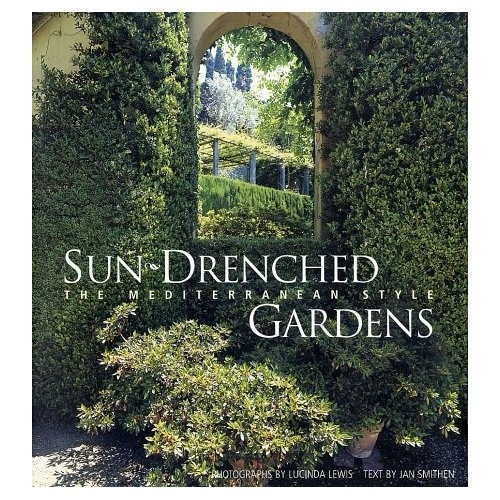
Book Review – Sun Drenched Gardens: The Mediterranean Style

Eye of the Day|Sun Drenched Gardens Book Cover|Mediterranean style garden

Sun Drenched Gardens: The Mediterranean Style by Jan Smithen 

 Author Jan Smithen and photographer Lucinda Lewis have put together a beautiful and pertinent book that is even more noteworthy today than it was when it was published in 2002. Mediterranean-style gardens offer easy maintenance as well as water-saving planting that is environmentally sound and enormously appealing.

Sun-Drenched Gardens; the Mediterranean Style features gardens from France, Italy, Spain and California that employ drought-tolerant plants such as agaves and other succulents, wisteria, lavenders, geraniums and even some roses. Design features such as terraces, arbors, hedges, pergolas, topiary, statuary, decorative tile, and terracotta containers are used in the gardens.

While paging through the book, Californians and especially those familiar with Santa Barbara will recognize landscape designs and terracotta containers so familiar that it seems the photos were taken in our backyards, or even at Eye of the Day. The eight chapters include one entitled “Endless Sunshine – Precious Water” which has great information and design ideas.  Another entitled “Living Outdoors” highlights our need to be in the open air and how to plan and enjoy our gardens even during a drought.

If you have difficulty finding this amazing book, the next time you visit Eye of the Day, ask to see our house copy, it’s truly worth seeing.


How To Choose A Terracotta Pot By Its Porosity

Eye of the Day|Baked Earth|terracotta porosity

In past articles I have discussed how freeze/thaw has an effect on ceramic containers and I have also discussed clay pot irrigation. We are in the worst drought in the state of California’s history, so by irrigating with low fire pots with high porosity,  water can be sent directly to the root system and feed plants on demand, as opposed to spraying the crusty, evaporative surface.

Eye of the Day|Baked Earth|terracotta porosity

Technically porosity is the amount of empty space in the structure of the fired clay that makes it capable of absorbing or distributing liquids. Simple, right? So if the terracotta is absorbing water and the temperature drops below freezing, you’re going to have potential problems with your investment as the water expands while it freezes.  But if your intention is to use the porosity to slowly distribute water, then the more porous the better. There are other uses for porosity in ceramics, for example insulation. The less dense a brick is, the more insulating capabilities it has.

Eye of the Day|Baked Earth|terracotta porosity

Natural clays can have a very high porosity.  When the grains are very small, there are countless small pore spaces, but what clay does NOT have is good permeability, which is the way you would measure how connected these porous spaces are. So generally speaking, if the clay is high fired it will be far less porous. This is advantageous for a freeze/thaw condition. If the clay is low fired, or under fired it will be porous and best for releasing or absorbing water.

So the bottom line is that the level of porosity you should seek depends on your intention for use of the ceramics.