Design and Los Angeles Love: Interview with Mark Rios of Rios Clementi Hale Studios
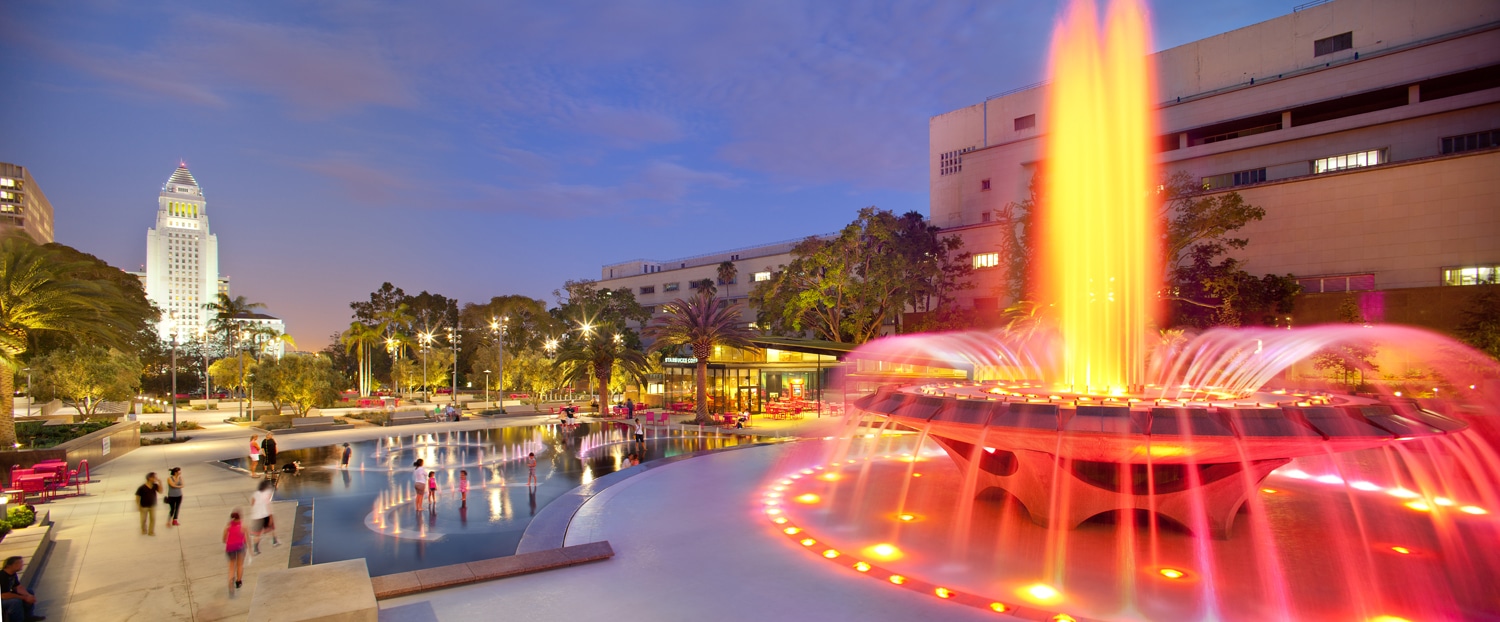
The easiest way to the heart of a native Angeleno is to give accolades about their beloved, but often maligned, city. Mark Rios, FASLA, FAIA, Founding Principal of the award-winning and admired design firm Rios Clementi Hale Studios in Los Angeles, is ten minutes into our interview when he says, “LA is this amazing melting pot,” before rattling off LA neighborhoods like a seasoned Metro driver. That regional knowledge would be a necessity at this point as RCH Studios has made their mark in elevating the Los Angeles landscape with high-profile designs as large as Grand Park in downtown and as small as Sunset Plaza in Silverlake, which was the prototype for a now citywide parklet program.
In much of the work in their portfolio there is a balance of the city’s cultural heritage, sustainability efforts, and an evolving and limitless design process. The firm plans to introduce the first living green wall to Sunset Boulevard. The dramatic six-story sculptural lattice of native plantings and an accompanying public plaza “will provide a breath of fresh air for further build a sense of community.”
With over 75 design awards and a fine educational pedigree, it would be easy to sit back, but Rios insists on being challenged by, and having fun with, design and the city’s rich mix of cultures. Rios and his firm don’t just praise the uniqueness of LA, but seem to be making this a long-term love story.
Eye of the Day: Your firm takes on a diverse mix of projects, from traditional houses and gardens, to campuses, public parks, and even furniture. What design philosophy do you personally bring to each project? Is it important that you finish a design with a certain goal in mind?
Mark Rios: I really believe that having a diverse body of work inspires…one project inspires another in a non-linear way. There are really great architects and really great landscape architects that focus on a particular work type, whether it’s residential, healing gardens, or tall buildings or something. And we try to do the exact opposite. And maybe it’s because we get bored quickly. (laughs) But I think the idea of learning about a problem you’re trying to solve is really fundamental to how we work. And so, I’m just passionate about the research that goes behind each project. So doing something you’ve never done before, or haven’t designed before, is really exhilarating because you have to go through all this detective work and find out about all the things that go on in making decisions about it. So a broad practice is definitely harder to achieve and it’s kind of harder from a business model. But I think for us as designers it’s more satisfying.
EOTD: I think that’s important. It must be hard to balance the business model, but to also stay true to what you want as a designer and get what you want out of that project.
MR: (laughs) It is complicated. I think that we try to establish really high aspirations for each project and that sometimes those goals or concepts evolve as you learn more about the project and more about what its needs are, what the client is about, and what the design is about. You always want to end up with a solution that solves all the issues, works really well, is on budget, and is really beautiful. But on top of that, it has to address a higher concept of nature, it has to have an idea, it has to be memorable. You want it to be provocative in some way, and so I think good work has to tell a story—it has to have a big idea behind it.
EOTD: You’re a Los Angeles-based design firm that’s changing the landscape of the city. I can play a game of chess in a pocket park in Glendale under glowing abstract chess pieces that tower over me or celebrate the Fourth of July in Grand Park—you’ve got Angelenos ditching their beloved cars to walk around downtown LA. In many of your projects there seems to be a drive to revive the city in a modern and fresh way. What about Los Angeles and its people inspire your projects? Do you think LA doesn’t get enough credit as a place for great architecture?
MR: You know, I think that LA is this amazing melting pot. And what I love about it, what I’m really inspired by, is the cultural diversity. And I think it’s the most diverse American city. And diverse in a really authentic way, not in a Disneyland way. You have all these different, really rich communities. They’re really vibrant; they have their own sort of villages within this bigger city. And there are all these facts we’ve learned, like LAUSD recognizes 95 different languages, and, you know, there’s just this amazing spread of people. So I think our work is always trying to understand all these different cultures we are operating with and what the heritages and traditions of these different people are, and how you mix them up—this mash up of culture which is Los Angeles—so that the design is contemporary and it’s about our present-day inhabitants, yet somehow it connects people unexpectedly.
EOTD: Are there any LA spots you really like?
MR: The arts district in downtown Los Angeles is pretty amazing. It’s really transforming very, very fast. People are living there, there’s great…you know…
EOTD: Bars?
MR: (laughs) Bars and great restaurants, and people are having all sorts of new creative office space. It’s a really quickly changing community, but there are all these other enclaves. I think it’s really amazing to drive through Beverly Blvd., from the Westside all the way through Beverly Hills, West Hollywood, Koreatown, and as you go through downtown Los Angeles, it turns into First Street and you go through Mariachi Plaza. And Beverly through to First street is kind of nice—it cuts culturally through all of Los Angeles. So I think those are the really great things about our city. We are in our cars a lot and so I’m always looking at the signs when I’m in my car. What language are they in? What kind of food are they serving? (laughs) You see, you go through all these precincts of different cultures. It’s fun.
EOTD: I think taking someone new to LA through Beverly is a good way to show how our city is, in a lot of ways.
MR: Yes. And it takes all the bad stuff about LA—the traffic, the car culture—and all of a sudden makes you reexamine it in a new way. Your car is your vehicle to be a cultural explorer. It’s like this little space capsule that lets you go and see all these different things. Other cities don’t have that as much.
EOTD: Because you’re based in California, drought is an issue that must come up in your design projects. To keep designs sustainable, how do you still incorporate features that one would traditionally expect in a garden or landscape, like trees, lush plants, or fountains, while in drought-conscious California?
MR: I think it’s really our responsibility as architects, landscape architects, and designers, to really push forward, to get off the grid. Sustainability really deals with all different aspects. It deals with water, power, and energy. And it’s really about trying to make everyone less dependent on and not wasting natural resources. So we’re trying to make all of our work more sustainable as far as taking less water, as far as planting areas. It’s about recycling and reusing and filtering water, as far as water drain-off, before we put it back into the ground through the storm drain system. We’re always looking at ways of generating and powering our projects and how they can be more off the grid. And there are all these living building challenges. And the AIA has a 2030 Challenge [to reduce fossil fuel usage in the building industries to attain carbon-neutral status by 2030]. And architects and landscape architects are really pushing hard to change our physical environment to make it more balanced.
EOTD: Do you have any recent projects that speak to that philosophy?
MR: One project that’s kind of fun is on Sunset Blvd. We’re doing a renovation of a big office building on the corner of Holloway and Sunset for IAC, Barry Diller’s company. And we’re putting this huge, new planted façade on the building that’s about six stories tall. It’s this big huge, moving, kind of curved awning that hangs out. It’s all planted with these plants from the Santa Monica Mountains—so all the plants are native plants. It’s sort of built like a big billboard, so it feels like one of the billboards on Sunset Blvd., but only it’s a plants billboard. I think what’s interesting about it is there is a very high water table under the building and so they are always taking water, pumping water out from underneath the building, and adding it to the water of the sewer system. So we’re basically capturing that water. All the water that we’re using to water this thing is basically from under the building. So we’re reusing the water table water to irrigate it. And it’s all sensor controlled so it only gets a drop of water when it needs it. What’s nice about it is that it’s not potable water. It is water that’s basically discharged water from under the building. So that’s a very sustainable story. People might ask, Why are you putting all these plantings on this building on Sunset during a drought? But we’re actually reusing all this water that’s getting thrown away to do it. And by doing it, it also helps with air purification and all sorts of things. I hope everybody looks at it and goes, That’s really beautiful, that’s cool and I really love it. They won’t realize it, but it has all these layers of research behind it.
EOTD: You have degrees in architecture from USC and Harvard and your designs are known for their clean and modern lines. You have formal training, but your projects go beyond traditional explorations as you’ve ventured into product and graphic design. Can you tell us more about your and RCH Studio’s multi-disciplinary approach to design?
MR: You know, I like to think of the office as this design think tank and that we are a group of designers that do research, and we evolve ideas, and those ideas get built or manufactured, and made into lots of different things. An idea can be realized through a building, can be realized through a sign, or it can be realized through a plate. But it’s the same process, analysis, research, and inspiration that goes into that. Whatever the final craft you are making is, it’s kind of the same design process. We really think of ourselves foremost as designers, and not sort of limited by a traditional discipline. We think of ourselves as interpreters of culture, just like someone who is making a movie or writing a book, trying to tell stories about our culture—and we are using a variety of methodologies to elaborate on and tell those stories.
EOTD: Are there any projects you’re currently working on that you like—particularly that are outside of the box of what we think landscape architects typically do?
MR: We’re starting to experiment with fashion. Most landscape architects may think about it, you know, but it’s kind of a hard new thing to be learning. We’re starting with small pieces, like bags, scarves, and pocket squares, and things like that. We’re starting to think about other stuff, but I think that we’ll continue to evolve and hopefully try new things. I don’t want to know what I’ll be doing in three years! I want to see what happens—surprise myself.
EOTD: Container gardening is an easy way to control water consumption and is a popular form of gardening in drought-stricken California. In residential design, containers are often one of the last components added to a garden or home. How do you incorporate pottery, containers, or planters in your overall design?
MR: I think container gardens are fantastic for all the sustainability issues we’ve mentioned, and as far as limited means that give you great results. Containers are also really popular for another set of practical reasons. They’re like raised gardens, they’re easier to get to; they’re great for kids, the elderly. There’re a lot of practical things about container gardens. I think of container gardens as accessories. You think of your house, you have your favorite things around that animate the house, those things that bring your personality to a particular room. And people don’t think of outdoor spaces as being accessorized in any sort of way. So the first advice I’d give to everybody is don’t worry if all the containers match. (laughs) Don’t get caught up with buying containers that all look alike, you know. Just buy things you love. If you love something a lot, or this thing a lot, or that thing, then all those pieces will go together because, as artistic people, our taste comes through. I think it’s pretty impossible that if somebody loves five different things that those things aren’t going to all work together.
EOTD: So going back to school, you went to USC but also served as faculty at UCLA. One of your partners, Bob Hale, got his degree at UCLA. The schools play each other next month at the Rose Bowl. So when you go into work that day are you sporting Trojan or Bruin colors?
MR: (without pausing) I think it’s probably going to be the Trojans. (laughs) I have a long affiliation with USC and I think they have a great school of landscape architecture now and their art history department is fantastic. UCLA is terrific. I love the faculty there and they’re doing a really amazing job, but I think I’d be on the Trojans side.
EOTD: So no pranking Bob Hale?
MR: No…we’ll be nice to each other, but you know we’ll each be rooting for our own team.
See the RCH Studio design portfolio here.