Top Your Pot with Tumbled Terracotta

Eye of the Day|Tumbled Terracotta Pot Topper|Baked Earth

TOP YOUR POT WITH TUMBLED TERRACOTTA

You have a beautiful citrus tree and a beautiful pot, together making a perfect statement piece, but maybe there’s something to make it even better from a design standpoint and for water conservation.

Design professionals typically use under-planting to finish the look of  a tree or tall plant in a pot.  They might use Alyssum,  Baby Tears, Lobelia,  Creeping Rosemary or any other trailing or low-growing plant.  During our current drought, we see more succulents being used, such as String of Bananas, String of Pearls,  Hens and Chicks or Sedum as under-planting and as a living mulch. You can see these same plants in action as part of our video: How to Convert a Fountain to a Succulent Garden. 

Eye of the Day|Tumbled Terracotta Pot Topper|Baked Earth
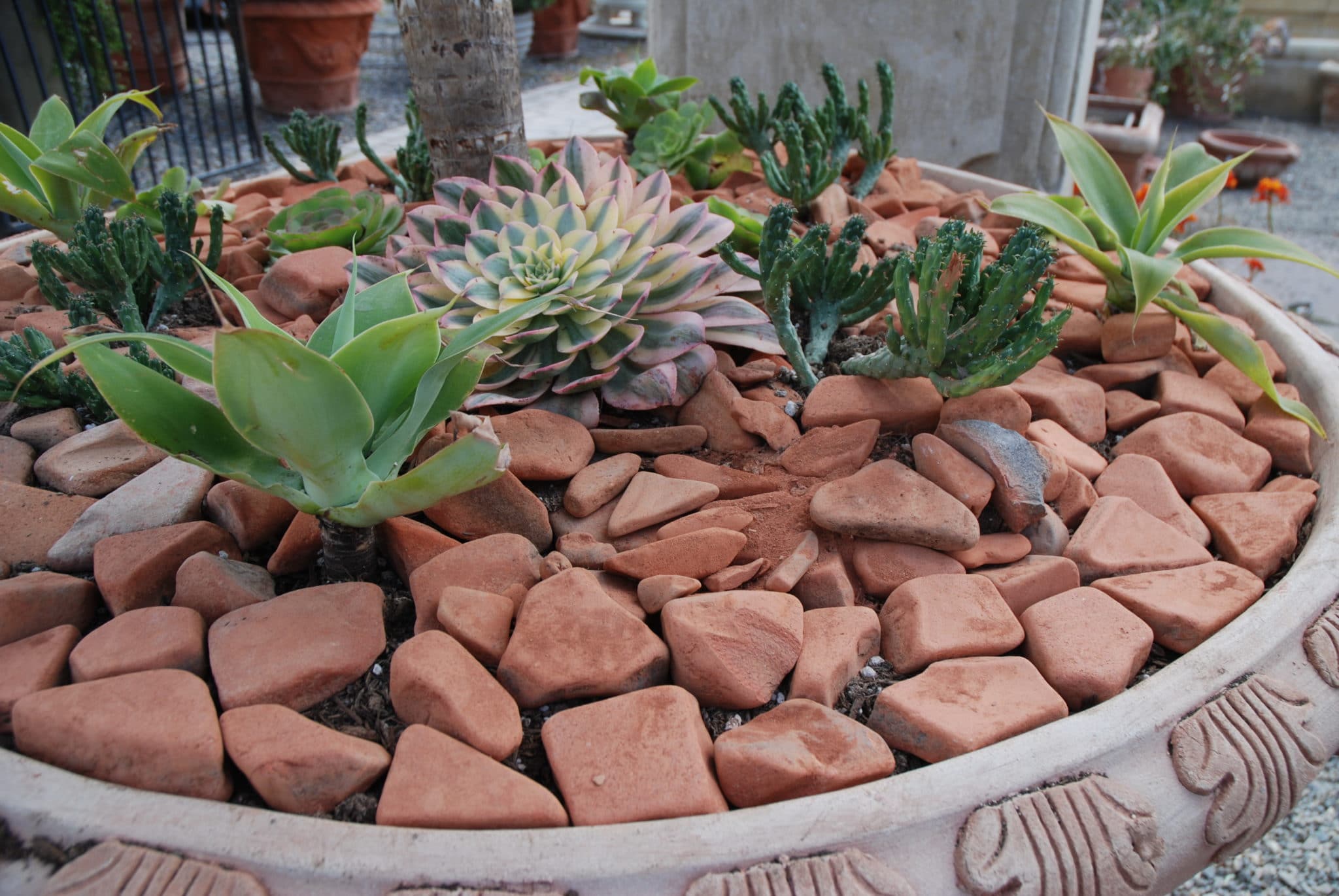
This container incorporates cacti and tumbled terracotta.

More recently, designers have moved beyond plants and have progressed to using tumbled glass in almost any color, moonstones and beach pebbles.  At Eye of the Day, we are ALL about terracotta, so we have developed a new “pot topper” which not only looks beautiful, but helps maintain and control soil moisture in the container while allowing the surface of the soil to breathe (VERY important to container health).

Eye of the Day|Tumbled Terracotta Pot Topper|Baked Earth
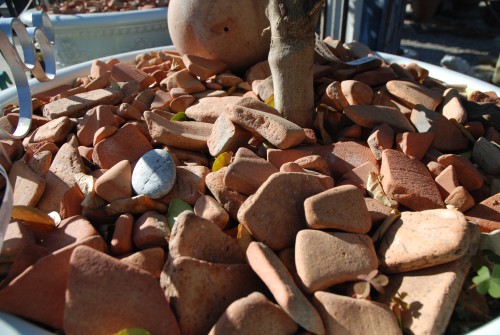
Tumbled terracotta is a great way to top your pot.

This new product is Tumbled Terracotta, produced from Italian terracotta fragments, tumbled to soften the edges.  Succulents, cactuses and aloes can also be planted between the pieces for a more carpeted effect further enhancing the design and beauty of container planting.

Eye of the Day|Tumbled Terracotta Pot Topper|Baked Earth
This design plants succulents at the base along with the tumbled terracotta.

Our Tumbled Terracotta is available in pieces categorized into three sizes, small at $3 per pound, medium and large at $2 per pound.  The next time you visit Eye of the Day, we’ll show you how using Tumbled Terracotta Pot Toppers adds beauty and practicality to your container planting.
The Truth Behind the Aged Terracotta You Buy

Eye of the Day|Quality terracotta differences|design pottery

The Truth Behind the Aged Terracotta You Buy

If you have read the articles by Scott Semple you now have a good understanding of what makes up terracotta pottery. From Gladding McBean’s stoneware to our Italian frost resistant earthenware containers, at Eye of the Day Garden Design Center we sell high-quality terra cotta products which last and last.

Now, what about aesthetics? Do you want your pots to last? Is it important that future generations are given your garden pots along with your jewelry, silverware and bedroom set? Many people love the patina of terracotta when it gets older and though a crumbling pot is not the same thing as “patina” they think it still looks cool.

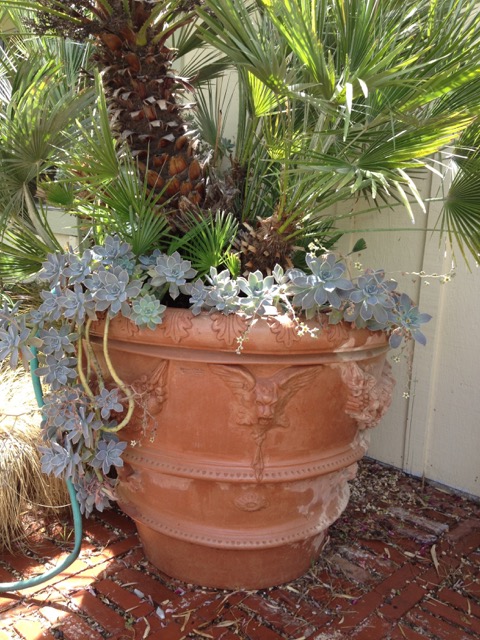
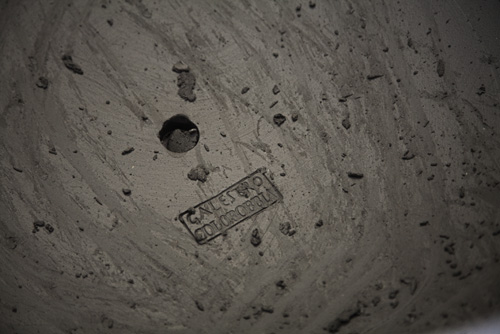
This Italian pot from Terrecotte Olympia of Tuscany, Italy is a favorite of designers in Southern California. It is not made with frost proof Galestro clay but with Sienna clay, which is clay Americans typically find at their garden store. Olympia, like many Italian clays and other clays from which garden pots are produced, will almost immediately begin to spall and flake. Although they have a wonderful aged patina that designers love to specify in their designs, the material does not have a long life compared to pottery made from Galestro clay. The problems will be seen in Mexican and most Asian terracotta products as well.

At Eye of the Day, we hope that our retail and professional design clients will consider the investment they are making and choose terracotta for the centuries. For a further example of how these pots age and look, take a look at the following pictures of the Italian pots at the Ralph Lauren Store at the Stanford Shopping Center in Palo Alto. If this is not enough to convince you, well, that’s why there are both vanilla and chocolate…something for everyone.

If you like that falling-apart look, come and see our seconds and close-out area at the store where we have lots of consigned pottery from customers who are replacing their containers with new ones. The prices are great and the look is shabby/chic. We also have remaining stock from Terrecotte Olympia at half price: it’s still half-good.


How To Choose A Terracotta Pot By Its Porosity

Eye of the Day|Baked Earth|terracotta porosity

In past articles I have discussed how freeze/thaw has an effect on ceramic containers and I have also discussed clay pot irrigation. We are in the worst drought in the state of California’s history, so by irrigating with low fire pots with high porosity,  water can be sent directly to the root system and feed plants on demand, as opposed to spraying the crusty, evaporative surface.

Eye of the Day|Baked Earth|terracotta porosity

Technically porosity is the amount of empty space in the structure of the fired clay that makes it capable of absorbing or distributing liquids. Simple, right? So if the terracotta is absorbing water and the temperature drops below freezing, you’re going to have potential problems with your investment as the water expands while it freezes.  But if your intention is to use the porosity to slowly distribute water, then the more porous the better. There are other uses for porosity in ceramics, for example insulation. The less dense a brick is, the more insulating capabilities it has.

Eye of the Day|Baked Earth|terracotta porosity

Natural clays can have a very high porosity.  When the grains are very small, there are countless small pore spaces, but what clay does NOT have is good permeability, which is the way you would measure how connected these porous spaces are. So generally speaking, if the clay is high fired it will be far less porous. This is advantageous for a freeze/thaw condition. If the clay is low fired, or under fired it will be porous and best for releasing or absorbing water.

So the bottom line is that the level of porosity you should seek depends on your intention for use of the ceramics.


Clay Pot Irrigation Benefits During Drought

We had a very quick winter here on the Central Coast with just a little bit of rain, spotty at best, while the rest of the country has been buried under blankets of snow. As California is technically still experiencing a severe drought, I want to address ceramics in irrigation.

Irrigation Through Clay
In the newsletter, we have covered many subjects concerning ceramics.  In irrigation, ceramics also has many uses. The Romans created an intricate system of aqueducts, which directed water throughout all parts of the empire. We see this around the world, ceramic pipe systems carrying water through towns and villages.

Clay Shards and Slow Water Release
Ceramic “shards” can also be used as a soil amendment. The broken pottery has to be low fire to be absorbent.  Low fire ware may be crushed and added to the soil and as you water, the shards act as little sponges and absorb the water and release it essentially as needed below ground.

Clay Pot Irrigation

Another use I find very interesting is what is called “clay pot irrigation.” If you perform an internet search of this term and go to “Images,” you will see excellent examples of how this works.  Essentially, it is a very simple technique.  Again, a low fire vessel is made by a potter, and is then buried right next to the plants you want to irrigate; fill it with water, and because of the porosity of the low fire ceramic, it leeches through the walls of the vessel and waters the plant by slowly releasing a minimal amount of water.

Cultures around the world have been using this method forever!  Look it up, check it out, and enjoy these new yet very old techniques of gardening.  Ceramics in your garden is not just decorative, it can be very functional.


Terracotta Incognito: The Method Behind the Form

Terra Incognito: The Method Behind the Form

There are various forming methods than can be used when working with clay.  As a self-proclaimed clay nerd, I can tell you that one of my favorite parts of the journey is actually forming the piece. There is a “form” and there is a “surface” and if you learn to treat the two as separate aspects of the same whole, you will have a successful composition. In ceramics, there are many ways to form something from clay. For example, a piece  of clay can be thrown on a potter’s wheel, press molded, slump molded, pinched into shape, coiled, built with slabs or extruded.

For this article I want to focus on just three forming methods: Throwing, Press Molding, and Coiling.

Throwing
To “throw” is to form clay using a potter’s wheel.  As the clay spins on the wheel it is then “lifted” into shape. This is a very popular method, usually used to fashion functional or utilitarian pieces, such as plates, cups, bowls, teapots, or containers.

The word “throw” comes from the old English meaning to twist, turn, or propel—a perfectly apt definition. The potter’s wheel is a relatively new invention in the 30,000 year history of ceramics, and not used by all clay cultures. Much of the Greek pottery at Eye of the Day is wheel thrown.

Press Molding

Press Molding is when a piece of clay is actually pressed into a mold or form. The mold is made from an original form which is made from clay, then reproduced in Plaster of Paris, which becomes the mold so the shape can be replicated over and over again. This is a particularly helpful method when forming large pieces that would otherwise be hard to reproduce. The Italian terracotta carried at Eye of the Day is traditionally press molded.

Coiling

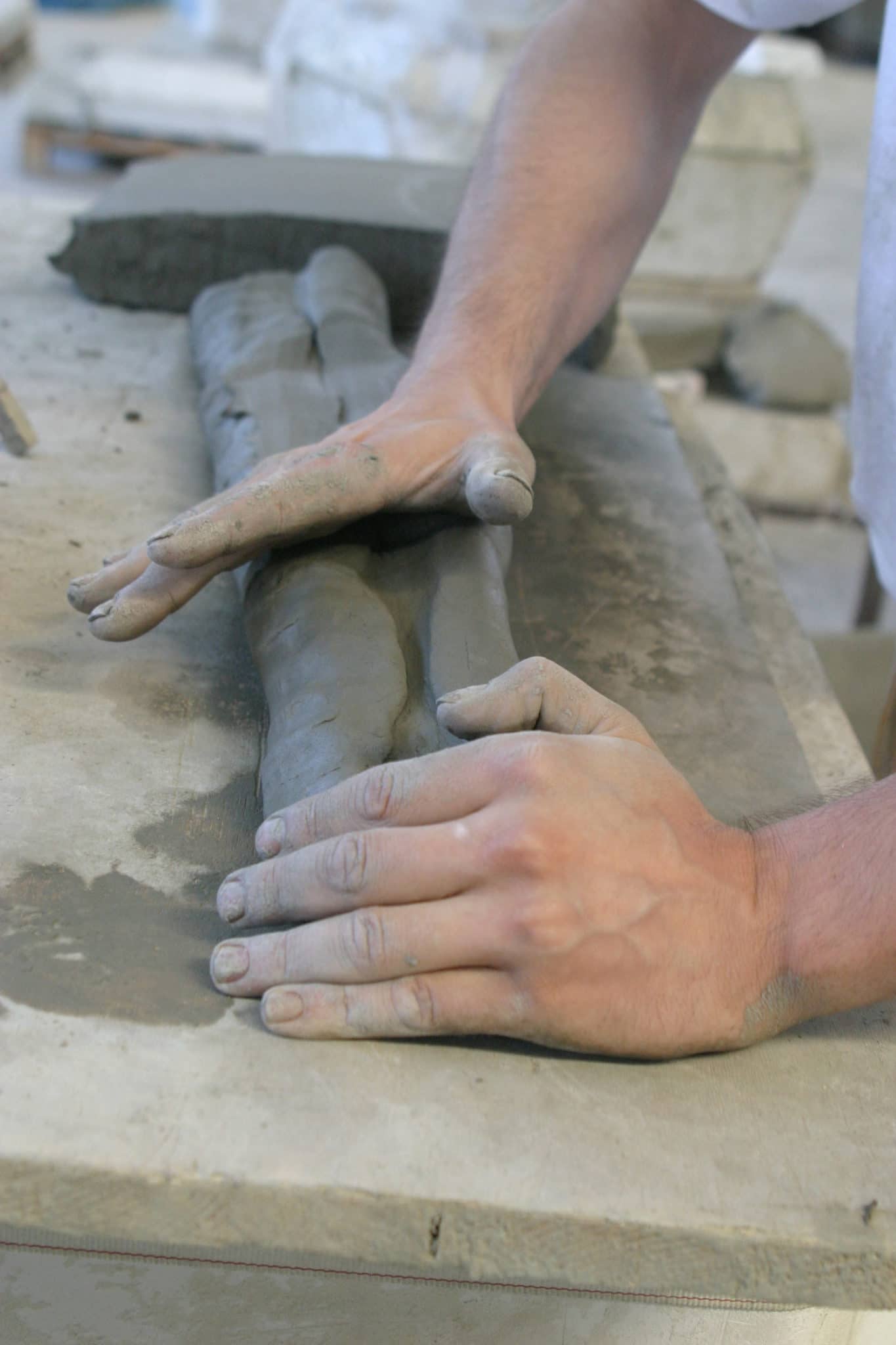
Coiling is one of the oldest methods for forming clay. The material is rolled back and forth until it looks like a “rope” of clay. You begin with a shape in mind, then the coils are placed on top of each other until the desired shape is formed. This is a particularly slow method, the clay needs to harden a bit before more coils can be stacked, so a potter will begin one piece and then move to another to begin, then move to another, and so on. By the time he has begun say the fourth or fifth shape, the first one will be stiff enough to continue the next phase of the shape.

Eye of the Day has an array of vessels produced using each of these traditional methods, authentically manufactured and imported directly from the very best potteries of the world.


Terracotta Transformations: The Fire Behind Baked Earth

As the days grow shorter, and we inch toward the certainty of a cold winter, it seems fitting to talk about fire. I love fire. It takes a deep understanding of this primary element to master the process of “firing” clay. In my last installment we talked about frost proof ceramics and even that conversation must begin with a discussion about fire.

Clay begins as granite, decomposes and compressed for a millennia, then becoming a sticky, malleable mud with memory. When it passes through human hands, turning it into functional art… the real fun begins: the firing. Once the clay morphs all the way back to stone, it changes from stone to mud and back to stone again, transformed by fire. I feel lucky to be in the middle of this cycle, the one that gets to instruct the clay. Kind of a big responsibility really, manipulating the earth while it regenerates itself.

It takes a lot of heat to fire ceramics and even more heat to fire clay to vitrification (refer to Baked Earth installment How It Works: Frost proof Terracotta). Firing clay depends on what material we burn. This is why so many ceramic wares are under-fired: limited combustibles. In the developing world many traditional peoples have to travel further and further to harvest the wood or brush. As the forest recedes, they begin to use less fuel to burn the clay, because transportation is more difficult. Travel can take three or four times what it used to for procuring wood, or other combustibles, to fire the pottery, cook and heat their homes.

In the US, you will see many types of firings: wood, salt, recycled automobile oil, sawdust, dung, natural gas, propane, passive solar, and electricity. We are fortunate to have so many options within reach when it comes to firing pottery. Regardless of how the work is fired, some basic transformations occur on the clay’s long journey back to stone.

At 212°F the water in the clay converts to steam and is slowly released. At approximately 400 °F, all organic matter in the clay has burned out, and the cristobalite (a crystalline form of silica found in all clays) suddenly shrinks. Between 1000°F and 1100°F the quartz crystals change from an alpha crystal structure to a beta structure. Referred to as Quartz Inversion, the temperature must increase gradually.

From 1500°F to 1650°F, “sintering” begins. This is the stage where clay particles begin to cement themselves together to form a hard material called ceramic. From this point on, depending on the temperature range of the clay, vitrification occurs. For earthenware clays, this happens at approximately 2050°F. For stoneware clay, about 2300°F, and for porcelaneous clay, 2500°F.

The transformation of clay from stone and full circle back to stone is a long, hot journey that no other material makes. And here’s a little point of reference: Kilauea, the volcano on the big island of Hawaii, spewing lava into the Pacific Ocean was recently tested for temperature. The orange lava is only 1800°F—low fire in the world of clay!

See you next month!