Baked Earth: The Truth Behind Authentic Impruneta Pottery

Eye of the Day|Impruneta clay|terracotta Baked Earth

Baked Earth: The Truth Behind Authentic Impruneta Pottery

Welcome to another edition of Baked Earth, with information about what’s happening in the world of clay, ceramics and installation pottery. This month, we would like to pop the mythical bubble concerning Impruneta pottery.

Eye of the Day|Impruneta clay|terracotta Baked Earth
High quality Galestro clay is used in Eye of the Day’s Italian terracotta from Terrecotte San Rocco.

Impruneta is a commune in the province of Florence, in the Tuscany region of Italy. It has been famous for many centuries as the producer of the region’s finest terracotta, everything from tiles to garden art, to large terracotta planters. Along with the handmade nature and unparalleled craftsmanship of Impruneta terracotta lies the real secret of its success: the clay body.

It has been known for countless generations that Galestro clay is the superior material of the region. Galestro clay is extremely high in subsoil minerals, has an excellent plasticity, and due to its unusually high granitic content, can withstand sub freezing temperatures. Galestro clay yields a high quality product with great versatility and many ceramic manufacturers in the Tuscany region use Galestro, including Terrecotte San Rocco, Eye of the Day’s premier terracotta source.

Eye of the Day|Impruneta clay|terracotta Baked Earth
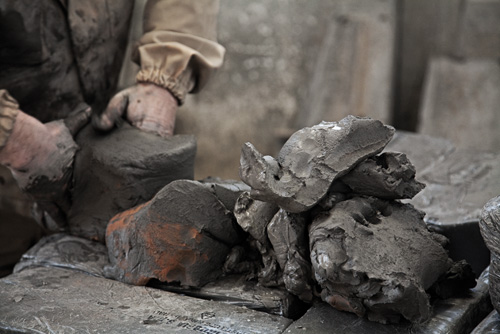
Galesltro clay from the Impruneta region arrives at the factory.

Only a handful of factories produce wares actually in the commune of Impruneta and therein lies the problem. Because the potteries in the outlying communities are also using Galestro clay, or part Galestro and part local material, some producers will stamp their work with the word “Impruneta,” which can lead to retailers here in the US (either unknowingly or complicit in the process) to sell merchandise as “Impruneta terracotta,” when in fact it was not made within the boundaries of the Impruneta commune.

It’s akin to wearing a Timex and calling it a Rolex. Both are well made watches, but one has the reputation of distinct craftsmanship and is branded as such, so you are paying for the brand. It is the same with Impruneta—it has been branded by generations of superb craftsmanship and these days it is not uncommon for people in this business to use the branding of “Impruneta” to their advantage by calling it something that it is not.

Eye of the Day|Impruneta clay|terracotta Baked Earth
A stamp of authenticity.

So garden designers, homeowners, and landscape architects alike, be forewarned! There are only a handful of families producing authentic Impruneta terracotta in that commune, so if someone claims to be selling or installing Impruneta wares made with Galestro clay, be sure to ask them who the manufacturer is, and cross check their references. But as I have said countless times, it all comes back to the clay. And anything made with Galestro clay from the foothills of Tuscany is a sure bet as the highest quality pottery for your home.

By the way, I’m wearing a Timex…
Know your terracotta!


5 Tips for Winterizing Your Terracotta Pottery

Eye of the Day|How To Winterize Your Terracotta Pots

5 Tips for Winterizing Your Terracotta Pottery

To many people winterizing terra cotta pottery may seem like a completely irrelevant subject for discourse, but consider that you can add this information to your knowledge just IN CASE it ever gets cold enough to freeze. This is an actual problem for people with terracotta pots in parts of the US , which is why you don’t see great pottery everywhere.

There ARE steps that can be taken to help prevent your pots from cracking when old man winter whips through your garden. The goal is to eliminate the possibility of water being absorbed, frozen and thus causing the pot to crack.

  1. Lift the pot from the ground by placing it on pot feet, wooden blocks or pieces of stone. This will allow air to circulate beneath the pot.
  2. Seal the pot with a penetrating sealer, such as one used to seal slate floors and swimming pools
  3. Remove plants and soil from the pot, as the soil will absorb water, freeze, expand and can cause cracking
  4. Cover the pot with plastic sheeting to avoid contact with water
  5. Most fool-proof: move it inside

Much depends on the quality of the terra cotta as well.  Eye of the Day’s is the highest quality, high fired Italian terracotta, made from Galestro clay. Our pots, manufactured by Terrecotte San Rocco, are guaranteed frost proof to minus 15 degrees. It helps to know that if a pot is high-fired, the absorption rate is lower, and so the risk of cracking in freezing weather is reduced.

You may need this information some day. Maybe.

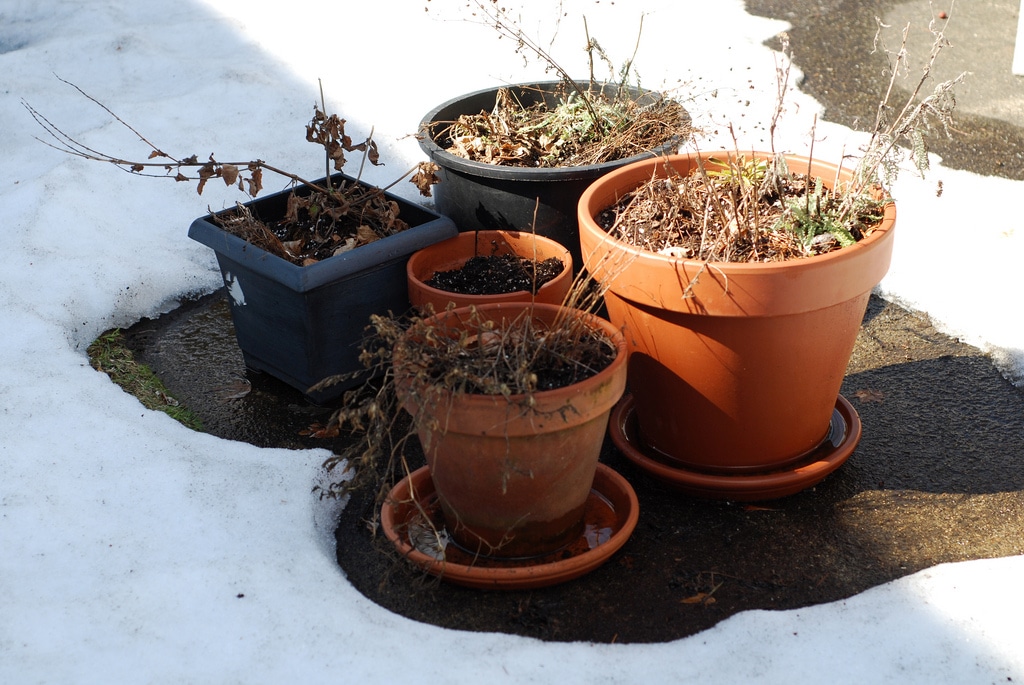
Photo Credit: Terracotta Pots, Creative Commons, My Container Garden After Winter by Rachel James is licensed under CC BY-NC-ND 2.0


A Day In the Life of a Ceramic Terracotta Commission Artist

Eye of the Day|Scott Semple Baked Earth|terracotta design

Baked Earth: A Day In the Life of a Ceramic Terracotta Commission Artist

It’s a random Tuesday afternoon in September of any year. I am sipping ginger tea and trying to figure out what to do with the tail end of an already long day, when the phone rings and it’s a number I don’t recognize.  I answer and it’s a potential client with an exterior aesthetic conundrum. “Well”,  I say to myself, “here we go again!”
Eye of the Day|Scott Semple Baked Earth|terracotta design ceramic

This month I am going to walk you through what it is like to be on the receiving end of an exterior ceramic commission.

Now…I love people.  With that in mind, as a commission artist, in many ways I become a problem solver as well as a solution.  I always want to get to the heart of what the client wants for his or her space, and often the gray area is that word “want”.  What a client wants and what works best aesthetically for a space, may be two different things!  So I end up being the voice not only for the client, but for the land, the property as it relates to other properties, the overall environment, the seasons, and of course the clay.  Why are we using clay on this project? Why does using an earthen material make the most sense here?  And so on.
Eye of the Day|Scott Semple Baked Earth|terracotta design ceramic

Typically, I will begin with an interview.  I will Skype if I have to, but the best way to get to know a project is to get on site during the initial phase.  (Many times I‘ve  shown up to a job site and actually found native clay on the property!)  We then move into constructing the pieces. It has always been my practice to have an open door policy to my studio; I love the client to get involved with the construction process.  This way we can troubleshoot together  and/or celebrate any pieces that come from my hands.  I realized a long time ago that when building things to the specifications of others, it’s important to be very clear and communicative, especially during the “wet work” phase.

Eye of the Day|Scott Semple Baked Earth|terracotta design ceramic

I also like to discuss the inherent connection between interior and exterior space. Sure, we can do planters and water features , but what if you had a vessel sink in your bathroom or a fireplace surround, or an interior sconce or two with the same motif? The transition between interior and exterior spaces has always fascinated me as an artist, so that’s often what I strive for.
Eye of the Day|Scott Semple Baked Earth|terracotta design ceramicThe last phase is delivery and installation.  When I end up placing pieces and getting down and dirty in a garden, I know I have made someone very happy.  I have made the environment happy, the property happy, the neighbors happy, and being the solution is always an awesome feeling!  In this phase, I know that what I have made is not only SITE specific, but RESOLVE specific.


The Art of Building Large Terracotta Pottery

Eye of the Day|Baked Earth|Scott Semple Large Terracotta

The Art of Building Large Terracotta Pottery

In all my days of fascination with clay, there is one tool that I would call my tool of choice: the wheel. But the two things that have influenced me most are my teachers and my travels.
Eye of the Day|Baked Earth|Scott Semple Large Terracotta

Over the past thirty years or so I have had the great fortune of traveling throughout the world.  My interest in large format pottery began in the early 90s and quickly became one of the key purposes of my explorations.

There are many ways to build a large, ceramic container.  In Thailand, I watched two assistant potters feed a rope of clay the size of my leg and 20’ long, over their shoulders to a master potter, who would very slowly spin a crude wheel and pinch the coils on top of each other.   This seems to be the most common way cultures build large terra cotta containers.
Eye of the Day|Baked Earth|Scott Semple Large Terracotta

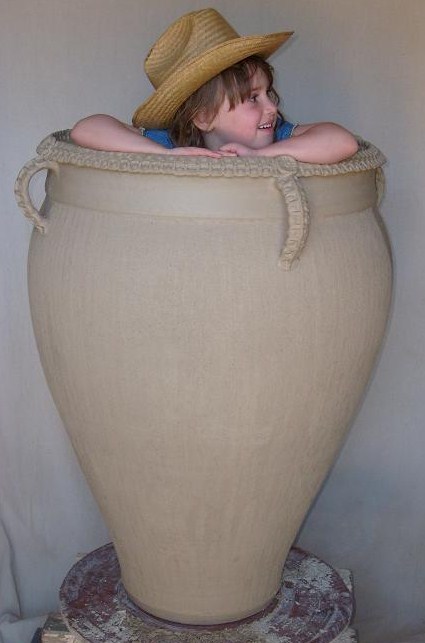
Recently I was a guest artist at a conference where, over the course of three days I made a 7’ Amphora using two wheels. I was positioned next to next to a family of Koreans who were making traditional Kimchi fermentation jars. These things were huge! They used the same coil/pinch method, but paddled the shapes into the forms.   In Georgia (Eastern Europe), they have been fermenting red wine for thousands of years in enormous ceramic vases called Qvervi; they use the same method. Spain probably has the largest pots I’ve ever seen called Tinajas. These absolutely spectacular containers are also used for fermentation,  as well as storing water.

Throughout my travels I have found that around the world, large terracotta forms are still produced for a great variety of uses.


Baked Earth: The Making of a Greek Pot

Eye of the Day|How to Make a Greek Pot| design

The Making of a Greek Pot

This month I’m going to discuss a tool that has captured my imagination for nearly 40 years: THE POTTER’S WHEEL. It started for me in Orange County California in 1976 at Irvine High School. For my P.E. class I was taking surfing and the instructor also taught Ceramics. It didn’t take me long to figure out that all the cool kids not only took surfing, but took Ceramics for second period, so if the waves were particularly good, the surf class would just stay and surf all the way through second period!

Thirty years later, I am still doing ceramics, primarily because of my fascination with the potter’s wheel, which is a relatively new invention in the history of pottery making. Originally functional vessels made of clay were constructed using a coiling technique. The artist would roll out “ropes” of clay and slowly, methodically, hand turn a small form by placing the coils on top of each other and pinching each coil into the one beneath it. Although this time honored method can be very slow and tedious in terms of production, there are still many cultures in the world that use this technique to create functional ceramic containers.

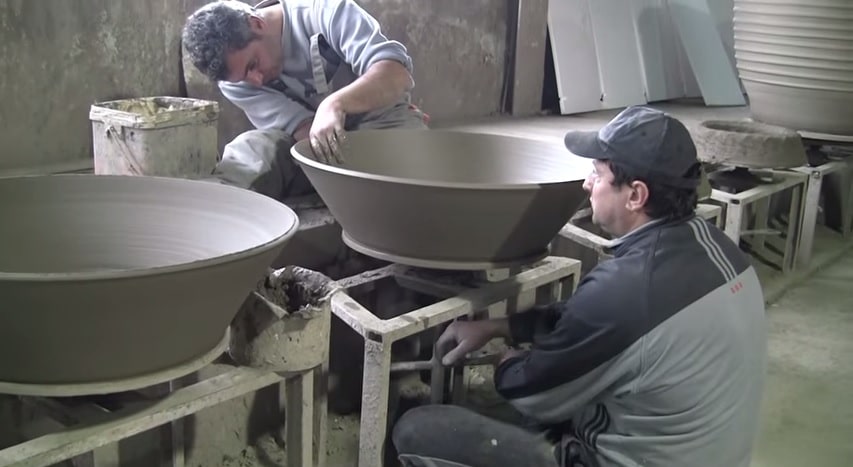
The potter’s wheel was born out of necessity. There are many theories, but all agree it was a matter of industrialization that brought about its creation. Recently I found a few video clips in my inbox that Brent (owner of Eye of the Day) had shot on the Island of Crete. They are an intimate look at the processes used in the production of the authentic Greek vessels Eye of the Day sells. The pieces are wheel thrown but on a wheel that is hand cranked by a potter’s assistant. The clay is made into fat coils, and added to the clay beneath it by pinching. Then the assistant spins the wheel faster and the potter begins to lift the clay into a form. It is particularly fascinating that Greece employs both old and new world techniques. They start with a slab of clay for the bottom, and work their way up by coiling, and pinching, and finally throwing the clay into shape. In the videos you see that there are multiple wheels working at once with vessels on each, in different stages of completion. When the clay needs to rest on one wheel,, the potters move in succession to each wheel down the line, until returning to the beginning to continue working toward a finished piece. These pieces are then fired and shipped directly to Eye of the Day.

We are very lucky to have this direct connection to handmade vessels for our garden design needs. The next time you are at Eye of the Day, remember what it takes for the artisans who build these vessels to deliver such an authentic and timeless piece of history for our own daily aesthetic.


Top Your Pot with Tumbled Terracotta

Eye of the Day|Tumbled Terracotta Pot Topper|Baked Earth

TOP YOUR POT WITH TUMBLED TERRACOTTA

You have a beautiful citrus tree and a beautiful pot, together making a perfect statement piece, but maybe there’s something to make it even better from a design standpoint and for water conservation.

Design professionals typically use under-planting to finish the look of  a tree or tall plant in a pot.  They might use Alyssum,  Baby Tears, Lobelia,  Creeping Rosemary or any other trailing or low-growing plant.  During our current drought, we see more succulents being used, such as String of Bananas, String of Pearls,  Hens and Chicks or Sedum as under-planting and as a living mulch. You can see these same plants in action as part of our video: How to Convert a Fountain to a Succulent Garden. 

More recently, designers have moved beyond plants and have progressed to using tumbled glass in almost any color, moonstones and beach pebbles.  At Eye of the Day, we are ALL about terracotta, so we have developed a new “pot topper” which not only looks beautiful, but helps maintain and control soil moisture in the container while allowing the surface of the soil to breathe (VERY important to container health).

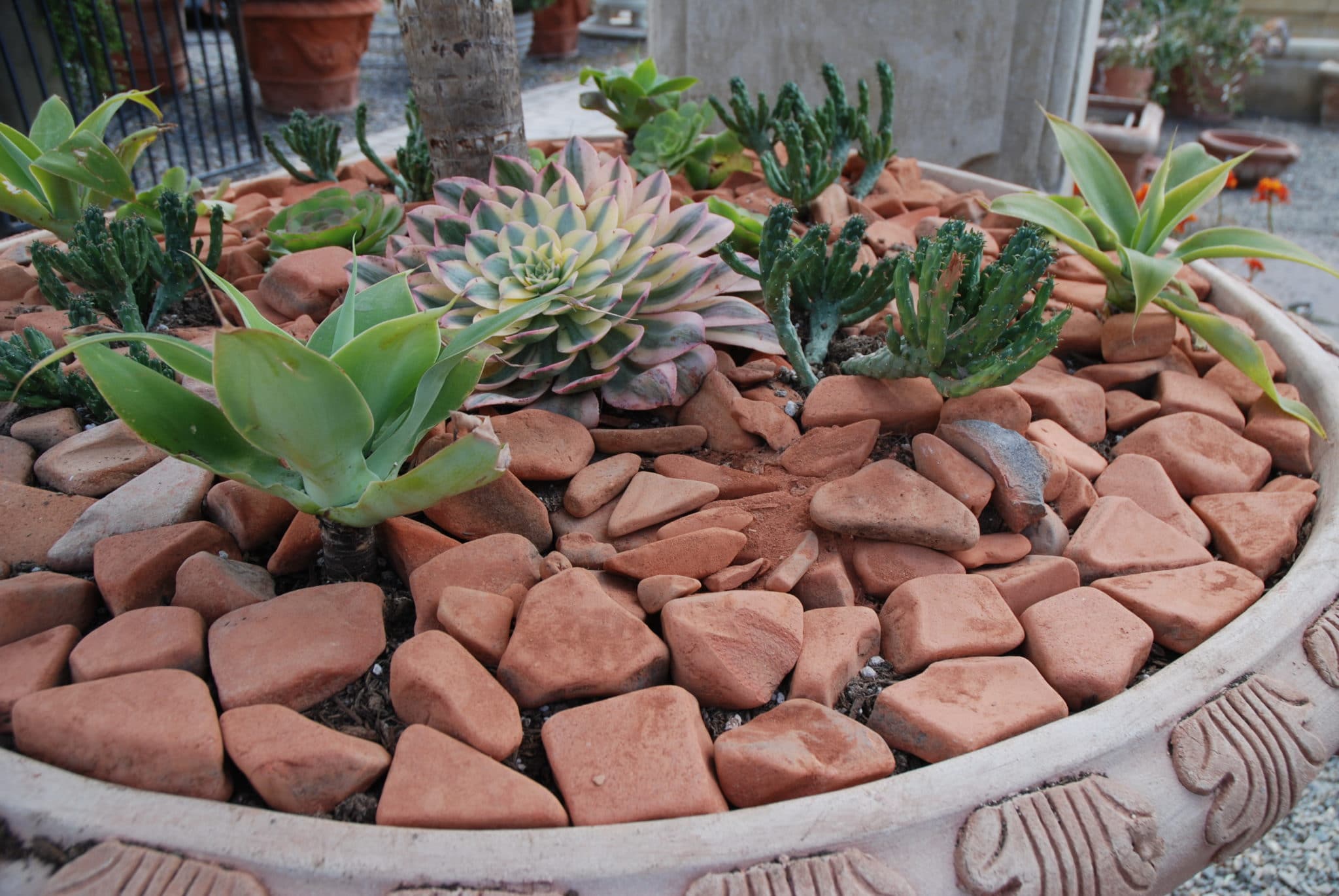
This new product is Tumbled Terracotta, produced from Italian terracotta fragments, tumbled to soften the edges.  Succulents, cactuses and aloes can also be planted between the pieces for a more carpeted effect further enhancing the design and beauty of container planting.

Our Tumbled Terracotta is available in pieces categorized into three sizes, small at $3 per pound, medium and large at $2 per pound.  The next time you visit Eye of the Day, we’ll show you how using Tumbled Terracotta Pot Toppers adds beauty and practicality to your container planting.