
Groundskeeping: The Art of Showing Up on Site

Eye of the Day

As a professional designer you have to visit your clients and job sites. You cannot put together a credible working document without physically walking the site.

Eye of the Day
Here I am, arriving on a job site in Beverly Hills yesterday.

That said, when my clients (landscape designers, architects and builders) are surprised to see me get out of the truck when their orders arrive on their job sites, I’m always just as surprised by their surprise. There’s no better way to understand what they have created and how Eye of the Day was included in that process than to be there walking their design. Without the in-person visit, there’s a disconnect.

By the time the containers and other decor elements are placed, the rest of the garden is close to completion. That means Eye of the Day’s delivery puts the finishing touch on the garden. I call it the jewelry.

When the Tommy Bahama store designer for their new flagship location on 5th Avenue in Manhattan specified our Greek Terracotta done in a custom whitewash, I decided to fly to New York to meet the shipment. Because delivery is the trickiest part of my business, I wanted to be there to answer questions in person and sort out any problems if there was breakage en route, for example. In the more likely event that there were no shipping problems at all, I just wanted to show my face and make sure my clients knew I stood by my products in the most literal sense.

Eye of the Day
Greek Terracotta, in the process of being whitewashed for Tommy Bahama.

The man who held the door open for me at Tommy Bahama turned out to be the company’s CEO. When he found out that I was the owner of Eye of the Day and had made the special effort to come all the way from California, well, to say the least, he was impressed. It’s rare for vendors of custom, authentic products in niche industries to be so present, and it must have been a welcome change because we got the job for their Chicago store, too.

I won’t lie: travel isn’t only a sacrifice. I enjoy the perks, too. It didn’t hurt that I got to have lunch at one of my favorite restaurants, Gramercy Tavern. I just wish Cooperstown and the Baseball Hall of Fame was closer, but such is a traveling man’s plight.
Book Worm: A Review of Fine Foliage

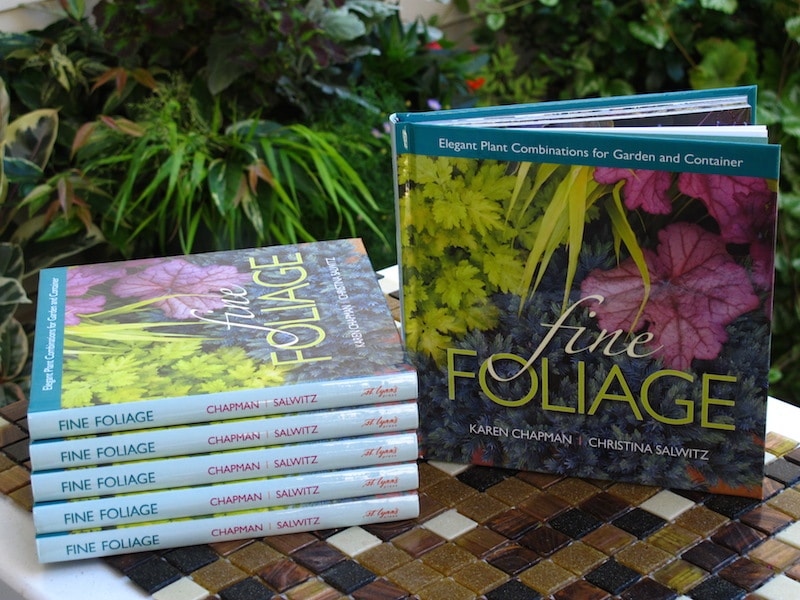
I like to think of Karen Chapman and Christina Salwitz’s new book as the stylist’s guide to plant combinations. That’s not a leap, as a combination of plants devised by Salwitz—who is known for couture plants—graced the cover of this year’s March issue of Better Homes and Gardens. Serving Seattle clientele through her company Le jardinet, Chapman’s container designs have been described as transformative.

Fine Foliage: Elegant Plant Combinations for Garden and Container does much more than celebrate gorgeous foliage specimens, which by now are enjoying the popularity once reserved for blooming plants. The book groups foliage plants (and the occasional bloomer) that have complementary and contrasting features–and can live together happily in the climate they were meant for.

If you are looking for groupings based on color, texture, light needs, zone or any other characteristic, Fine Foliage makes it easy to find what you need. More importantly, these combinations have been proven successful by the authors themselves, who have tried many mixes before narrowing to these ones.

Breaking boundaries

Designers needing for inspiration will find it here, especially in the busiest seasons when time is of the essence. Sometimes a bright idea from a book has the power to crystalize a designer’s approach to a client’s garden, or at least launch a solid vision board. Fine Foliage is a reference of that type, and should be kept within arm’s reach during client meetings and office hours.


Why Shopping Here is a Pleasure

Eva Powers at Creative Garden Design shared this post about us on Facebook earlier in the week:


Post by Creative Garden Design.

We appreciate your kind words Eva! And we hope to see you at the showroom soon.


la Madeleine of Anduze visits

Guillaume Bimar, the dynamic son and partner of Vincent Bimar, founding owner of Poterie de la Madeleine, is a proud man.  The Anduze Vase, long considered THE representational icon of French pottery is the foundation of his business, which actually produces pottery in a variety of designs and colors at their factory in the community of Anduze in the Languedoc-Roussillon region of France.

Poterie de la Madeleine was founded by Vincent Bimar over thirty years ago when he decided to produce the classic vase first made in the 18th century by the potter, Henri Gautier. During this time, there were many “free markets” in the South of France, near Marseilles.  In one of these markets, Monsieur Gautier saw Italian pottery decorated with garlands of flowers and fruit which inspired him to design his own interpretation which included the macaron gracing every Anduze Vase today. Extensive gardens in Vauvert and Anduze were decorated with Gautier pottery and soon they were being replicated throughout the area, used primarily as citrus planters.  After a time, the “Gautier” pot fell out of fashion,  and for a few centuries were made sporadically throughout Southern France by artisan potters.   When the “Anduze Vase” once again started reappearing, small family-run factories sprang up in the village of Anduze, some of which survive today.

Poterie de la Madeleine was the first Anduze manufacturer to export to the U.S. and is now the largest producer of the classic vase.  Guillaume and his father employ 46 people, thirty of whom are making pots in ten different styles and 33 different finishes.  If you were to visit the factory, Vincent Bimar might be one of those working on the pots,  he is a quiet man and stays out of the spotlight.  His son, Guillaume graduated from San Diego State University and received his Masters Degree in International Business at the University of Madrid before becoming a partner to Vincent.  Father and son share their infectious enthusiasm for their work, designing both traditional and contemporary lines of pottery.  The traditional Anduze Vase, available in classic colors, is being used in garden design throughout the United States, lending its inherent grace to a multitude of applications, but new, ultra-modern designs in exciting colors developed by Guillaume and Vincent  provide sheer compliment to mid-twentieth design.

Guillaume is proud of his family’s success in preserving a traditional French product and proud that he and his father have made it available to those of us living outside the foothills of the Cevennes.  He has his father and himself to thank.


la Madeline of Anduze visits

Guillaume Bimar, the dynamic son and partner of Vincent Bimar, founding owner of Poterie de la Madeleine, is a proud man.  The Anduze Vase, long considered THE representational icon of French pottery is the foundation of his business, which actually produces pottery in a variety of designs and colors at their factory in the community of Anduze in the Languedoc-Roussillon region of France.

Poterie de la Madeleine was founded by Vincent Bimar over thirty years ago when he decided to produce the classic vase first made in the 18th century by the potter, Henri Gautier. During this time, there were many “free markets” in the South of France, near Marseilles.  In one of these markets, Monsieur Gautier saw Italian pottery decorated with garlands of flowers and fruit which inspired him to design his own interpretation which included the macaron gracing every Anduze Vase today.   Extensive gardens in Vauvert and Anduze were decorated with Gautier pottery and soon they were being replicated throughout the area, used primarily as citrus planters.  After a time, the “Gautier” pot fell out of fashion,  and for a few centuries were made sporadically throughout Southern France by artisan potters.   When the “Anduze Vase” once again started reappearing, small family-run factories sprang up in the village of Anduze, some of which survive today.

Poterie de la Madeleine was the first Anduze manufacturer to export to the U.S. and is now the largest producer of the classic vase.  Guillaume and his father employ 46 people, thirty of whom are making pots in ten different styles and 33 different finishes.  If you were to visit the factory, Vincent Bimar might be one of those working on the pots,  he is a quiet man and stays out of the spotlight.  His son, Guillaume graduated from San Diego State University and received his Masters Degree in International Business at the University of Madrid before becoming a partner to Vincent.  Father and son share their infectious enthusiasm for their work, designing both traditional and contemporary lines of pottery.  The traditional Anduze Vase, available in classic colors, is being used in garden design throughout the United States, lending its inherent grace to a multitude of applications, but new, ultra-modern designs in exciting colors developed by Guillaume and Vincent  provide sheer compliment to mid-twentieth design.

Guillaume is proud of his family’s success in preserving a traditional French product and proud that he and his father have made it available to those of us living outside the foothills of the Cevennes.  He has his father and himself to thank.


A Malibu Getaway | Design by Wendy Harper

We recently had the pleasure of photographing a Malibu garden design by landscape architect Wendy Harper.

Brooks Color Plan ViewHidden in a canyon perched on a point overlooking the Pacific, the property owned by Harper’s clients is a perfect weekend getaway. The experience begins on the winding narrow road leading you around a bend where you get your first glimpse of the ocean. To enter the property you must then cross over a babbling creek on a beach cobble bridge. Harper used natural beach cobble and Santa Barbara stone to connect with the surrounding environment. Large Monterey Cypress and towering California Sycamores, planted when the home was built in the mid 1900s, create an inviting canopy over the site.

2014-01-22

“The property is long and narrow with many constraints and challenges,” says Harper. “My goal was to make all of the spaces in the garden feel like living spaces, even the parking court, which is incorporated into the yard by introducing a weeping wall water feature, grass ribbons in the beach cobble paving, lush plantings with antique urns dripping with succulents and colorful blooms most of the year.”

2014-01-22

The entertaining patio outside of the kitchen is warmed by an outdoor fireplace decorated with Eye of the Day’s Antique French mantel and surround. Select cut Santa Barbara stone set on sand paves this outdoor room. Eye of the Day’s containers planted with succulents and citrus decorate the space.

2014-01-22

A curved stone staircase leads you up to the pool area. Tuscan-style molded brick columns support the long pavilion framing the pool. Taking a swim in the pool is a musical experience where you can listen to your favorite songs…underwater. Sigis cut glass tile compliments the spa and waterline, and colored pool lights transform the water into a kaleidoscope at night. The ipe hardwood deck ties to the railings which mimic the turned wood railings of the home’s balconies. Interestingly, the use of ipe was the only specification from the homeowner for this project. Everything else was left to Harper’s creativity and expertise.

2014-01-22

“I wanted it to feel like it had all been here from the start, so bringing the turned railings onto the deck was a natural choice,” explains Harper.

2014-01-22

Chisel-cut Santa Barbara Stone walls hold olive trees and sycamores on the upper slope as a lazy hammock swings between the trees. Three small ancient church windows from Eye of the Day’s antique collection inspired the changing room with outdoor shower. The pilaster planters are purposely understated with simple succulent plantings so as not to crowd or overshadow, just to compliment the space.

About the Designer:
Wendy Harper is a landscape architect based in Moorpark, California. To view more of her work, visit the Wendy Harper Landscape Architecture Facebook page.