A Mile High in Denver

In late Spring the opportunity to sell a complete container of Terrecotte San Rocco came our way.  Kitchell Construction was managing the building and development of a large estate in the greater Denver area and because of Eye of the Day’s past and current collaborations with them, we were recommended by their Santa Barbara team.

Denver trip photo 2
Starting construction on the site in Denver

Everyone knows it snows at a mile high in the sky and when you’re building a large Mediterranean style house and need frost-proof terracotta pottery, who do you call? Sound the trumpets please: Eye of the Day, of course. As an authority on clay, we were able to help them select a large and diverse range of Italian terracotta pottery made from Galestro clay which comes with a ten-year warranty to minus 15 degrees Fahrenheit. Many people, including design professionals, incorrectly refer to this Italian clay as “Impruneta,” a village commune near Florence, Italy.

The container of Terrecotte San Rocco offloaded and ready for the site

It has been 35 years since I was last in Denver, Colorado—what a vibrant and exciting place. I arrived to meet the container of our great Italian terracotta pottery for the project and took public transportation into the city center for far less than a shuttle, cab, or using Über. Two stops after stepping on the bus, I stepped off at the new, super organized terminal right in downtown, not far from the ballpark where the Rockies play. Across the street I stepped on the free Mall Shuttle, which took me to the other end of 17th Street and dropped me off outside the Sheraton Hotel.  Because I got there a day before the container was being delivered from the port in Houston, I walked the downtown, my pedometer said almost seven and a half miles in a day and a half which is about what I walk each day at the store.

The mixture of old and new architecture is very simpatico in Denver. I’ll bet there are dozens of brick buildings that are made from Gladding McBean bricks and they look even more beautiful today almost a hundred years later.

Groundskeeping  Oct 2014
A light feature in downtown Denver

The development of downtown Denver looks more like Manhattan than Los Angeles with multiple high-rise residential buildings and projects throughout the city. Gleaming steel and glass buildings shadowing older low-rise buildings like a six-foot grandson might put his arm around his grandpa. They go together well in Denver. The ballpark on one side of downtown and Mile High Stadium on the other with an extreme amount and variety of great microbrews in between.

Here’s to being a Mile High!

Inside the Pieces: Why We Love Authentic Pottery

Inside the Pieces: Why We Love Authentic Pottery
Baked Earth series with Scott Semple

Hello to all and nice to be here again. It’s a classic Fall morning here on the Central Coast. I am currently walking around the Eye of the Day showroom, sipping Mint tea, trying to keep Shorty the dog at bay and writing to an enthusiastic yet invisible audience about my favorite messy, muddy medium: clay.

So, I’ve been thinking about this word “authentic.”

The first time I stepped foot into this showroom, I’m pretty sure what came out of my mouth was, “Wow, finally, authentic pieces.” I feel blessed to have traveled a good part of the world. I have not only seen, but intentionally sought out traditional pottery in villages from the foothills of Guatemala to Pokhara Nepal, from the backside of Cuba, to the historic potteries of Crete and mainland Greece. Knowing a thing or two about pottery and what it takes to build large format ceramic vessels, I walk in to Eye of the Day and immediately I’m transported to the smell of Turkish coffee in the Mediterranean, or the intense glow of a Native American dung firing.

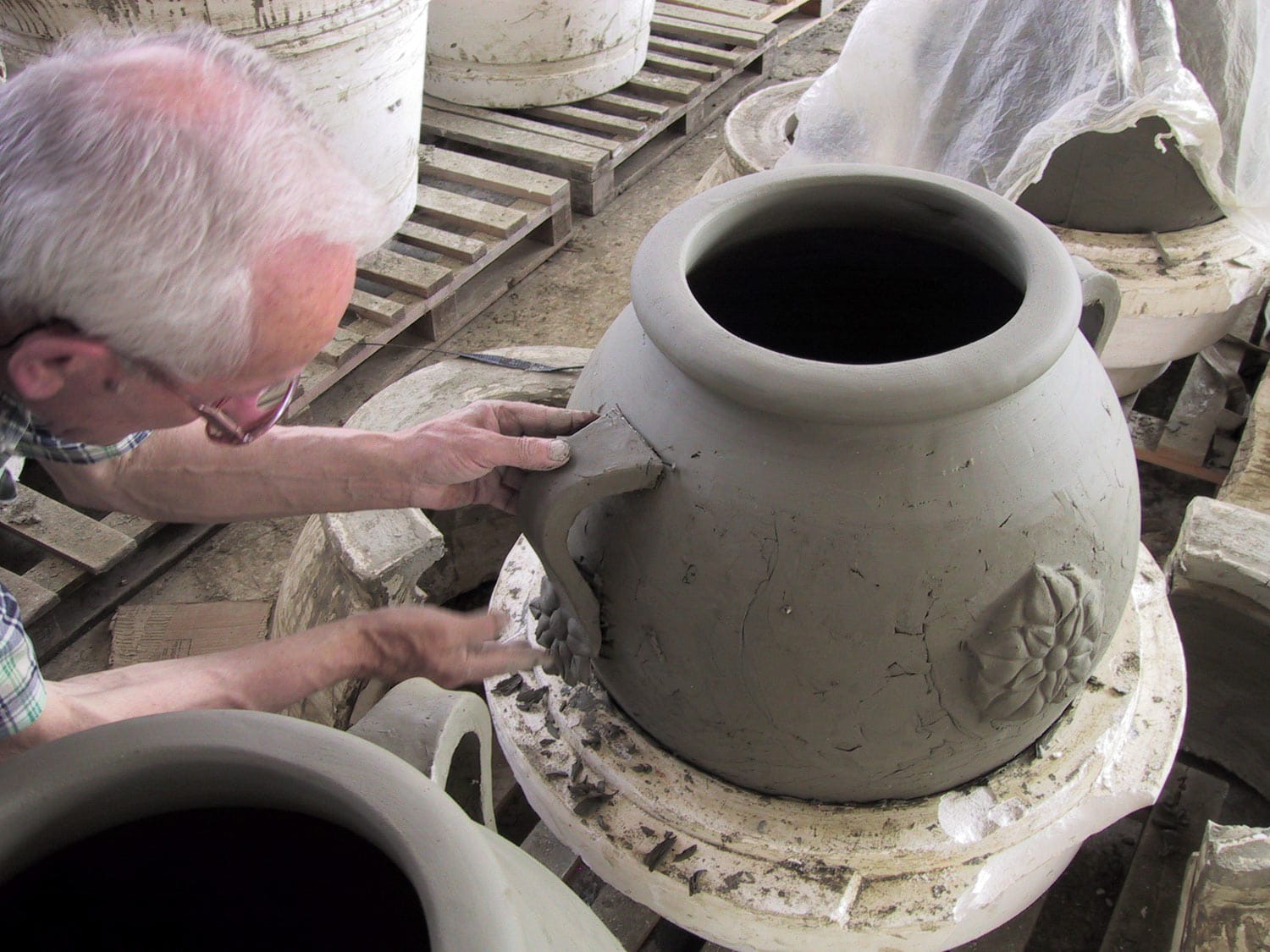
This showroom is the gathering place of authenticity. You can look down inside these big pots and see what it took to make them, the marks that the sponge leaves while it spins on the wheel, the throw lines, and where sections of the piece were connected and not only joined, but adorned. The Greek ware in particular is notorious for actually celebrating the area on a vessel, like this one, where sections of spun clay were joined together to make a much larger form. I can see handles on pots that at first glance seem just like handles but are actually an integral part of how the artist moves the piece from the kiln to the customer. Or all these pots that have tool marks inside them from popping the occasional, yet inevitable air bubble. It’s all there, inside the pieces.

I’m talking about form—the mark of what it took to create the form, the container, not the decoration or the way the fire has licked it here or there on the surface. I tell my students almost daily, there is a form and there is a surface. Learn to treat each as a separate component, and you will be successful in clay. The form by itself should stand up to serious critique.

The work for sale at Eye of the Day is authentic. Not overly decorated or gaudy, not borrowed to look like it’s from some other culture. It is Authentic Classicism, coming from some of the few places in the world that are still producing wares that are handmade, timeless classical forms. We end up longing for these pieces, like touchstones from a place and time in history.

My last stop on the showroom tour has brought me to the Italian terracotta. Eye of the Day has the largest collection of authentic Italian terracotta containers from Terrecotte San Rocco in the entire country. There is so much handmade information in these vessels, I could talk and talk about it (as you probably guessed). But for now, I promise to revisit this topic of Italian Terrecotte San Rocco. How it is built, where the clay comes from, why it is frost resistant and more.

But until then, get to know what is inside a vessel, not just its outer reveal.
See you next month!


Rosette Succulents for the Garden

Succulents are all the rage and for several good reasons: many have a unique make-up that puts them ahead of the game in extreme heat. Succulents are composed of spongy tissue capable of storing water in dry times. And they maintain their good looks without a lot of maintenance.

Some of my favorite succulents are in the plant family known as the houseleek family. Many form rosettes of leaves, giving them a floral quality, but without the need for deadheading and other pruning. The other great part about this family is that there are a variety of shapes and forms to choose from. Their main requirement is a bright sunny spot, though some will even take a spell of shade if they have to.

The stone crops are all in the genus Sedum and most are low-growing perennials. Sedum acre is grayish with leaves that form small, whorled rosettes. Two other diminutive species are S. brevifolium and S. dasyphyllum.

“Live Forever” is just an English translation of the botanical Latin Sempervivum. All form densely star-like rosettes composed of many pointed leaves. Two commonly available species are S. tectorum and its many varieties and S. arachnoideum, called the cobweb houseleek because of the white filaments that cross from leaf tip to leaf tip.

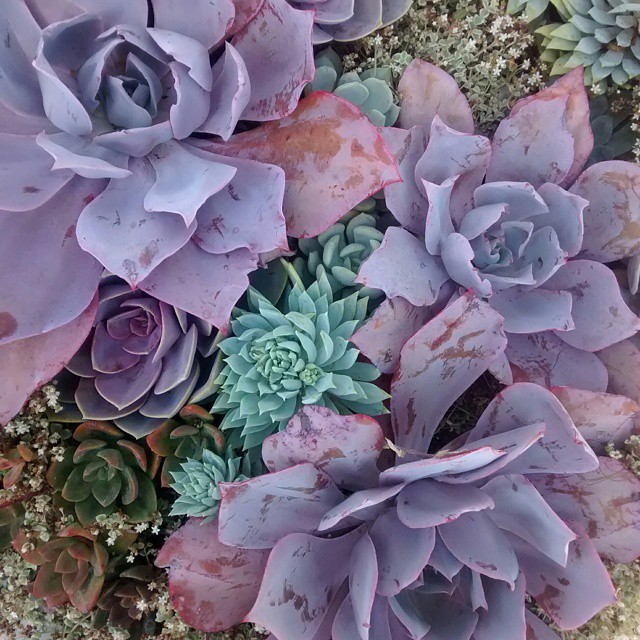
Another group of ground-hugging plants are in the genus Echeveria and many are commonly called hens and chicks. Their leaves come in simple or densely whorled bunches that look like fleshy roses and the colors and forms are mind-boggling. From pale whitish green through bluish, to purple, bronze, red, and even yellowish tones, collectors can go wild accumulating them all. Then, there are the leaf shapes and textures; edges may be smooth to wavy to elaborately crimped and top surfaces may be cupped and smooth or bowed and covered with warty bumps (or both!).

Last are the many forms of Aeonium. From flattened dinner plate sized A. tabuliforme to the more tree-like forms such as the nearly black A. ‘Zwartkop’ and colorfully variegated A.‘Sunburst’, there are many selections for bold color and form.

Tough, sculptural, colorful—what more could you ask for in a plant family?


Container Gardening: Finding Joy in Scarcity

Author Brené Brown stated in her now famous Ted Talk, “The opposite of scarcity is not abundance, it is enough.” As we deal with the drought in our gardens, let’s not respond by grabbing more water from others or becoming despondent about losing lawns that are largely unsustainable in our climate.

Use your creativity and discover how container gardening can enliven your landscape while using little water. Let go of those garden images where plants luxuriate in 95% humidity and weekly rainfall. Let’s get started.

Destination Inspiration

Why do we love love love Italy, Mexico, Spain, or Morocco? Courtyards and shade. It’s not the turf. Most of our residences have outdoor living spaces that are too small or too close to the house to be truly enjoyed. If you are considering what to do with your thirsty landscape, think about expanding or adding terraces or courtyards adjacent to your home. Add new gathering areas in other parts of the garden. Even in a very small garden, you can create a new space at the back or side of the property and discover a new view into your landscape.

Planters: The Versatile Garden Feature

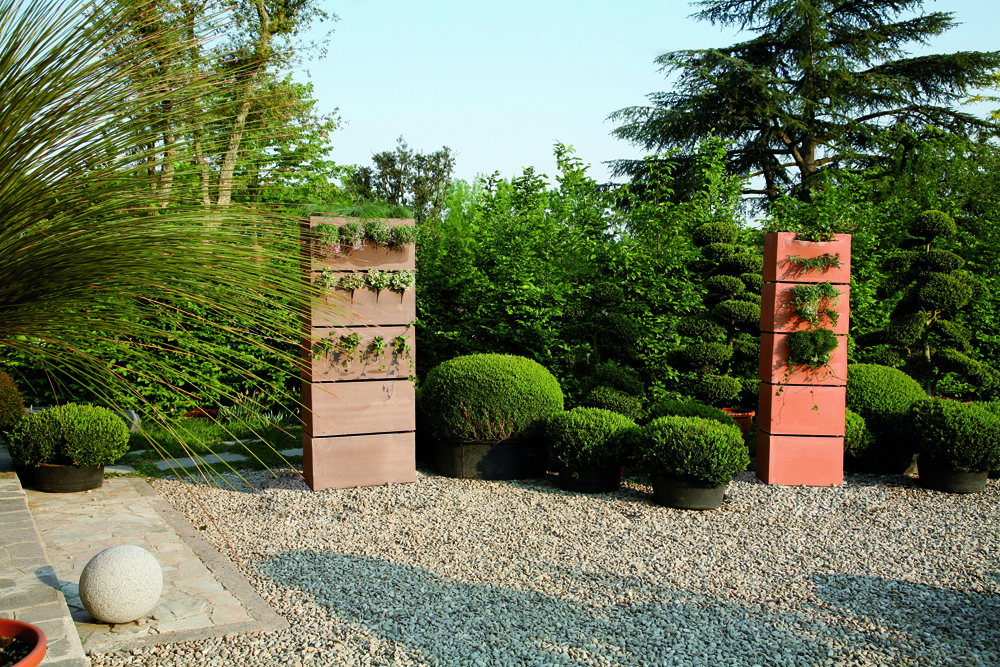
These new spaces can be paved with a variety of materials such as gravel, recycled concrete, stone or pavers. A grouping of planters can serve a variety of functions. Need some shade? Find a large pot, 42” diameter plus and add a drought tolerant small tree such as a fruitless olive. Add smaller pots with succulents or color and you have quickly filled your new garden space with pattern and detail, two aesthetic qualities that enliven our living spaces.

Planters can be adapted or reinforce the visual quality of any type of garden. If you have young children, add lots of color and tuck in a few edibles to share at the table. If you are looking for a place to escape the pace of work and family, discover the cool palette of succulents. Be brave, take a risk. Planter gardening is a great way to play with plants without breaking your budget.

So let go of some of the old ideas and embrace the challenge to live with ‘enough.’ Take a fresh look at that existing landscape and find joy in a new direction for your garden.

To view more of Puck Erickson’s work, please visit Arcadia Studio.


Detour to Europe: How El Nino Led Us to Francesco del Re

In February of 1998 our lives were changed forever by El Niño. Eye of the Day was in its infancy, just two and a half years old and we became a statistic as the worst damaged business in Santa Barbara County. The federal government declared a disaster area and we lost nearly everything. But…what we didn’t know was that our journey was about to take us on a brilliant detour.

From its inception, the Eye of the Day plan was to sell pottery, fountains, statuary and other garden products. There were a lot of nurseries but not many focusing on accouterments for the garden. We began by selling wine barrel planters, Mexican pottery, American made concrete fountains, benches, bird baths and lots of colorful pots. At Christmas we sold only the Noble Fir. But then the forces of nature randomly decided to take us out.

There is a saying that when a door closes a window opens; I was looking for a window and it turned out to be FEMA. With a new FEMA loan and a lot of help from friends, Eye of the Day quickly found a new home in a bigger market, picked ourselves up off the very wet pavement and began again.

After we opened our doors in our new (and current) location in the small beach town of Carpinteria, we sensed a great opportunity to grow in a way that the pre-disaster Eye of the Day would not have been able to fulfill. Our business model was limited and we needed to think bigger, so we decided that the gift shows in Los Angeles, San Francisco and Atlanta just didn’t provide what we needed anymore. It makes me laugh when I remember how quickly my wife, Suzi, agreed that we needed to go to Paris and check out the gift show there. We didn’t realize at the time just how prescient we were.

The first day of the show was the ultimate shopping experience but only if you were buying at least ten of everything. Included was an area for outdoor garden decor and when we walked into Francesco del Re’s booth, I knew I had found something special:  the finest handmade terracotta pottery on planet Earth. His containers were classics and many were models of forms and shapes still in service after hundreds of years, including pots or “vasi”, urns and amphorae adorning villas and palaces throughout Europe. Francesco’s display screamed CLASSIC ITALIAN TERRACOTTA to me. I vowed right then that Eye of the Day would sell Francesco del Re, just as soon as I figured out how I could afford a container.

The following year we returned to Europe, this time to Italy. Something drives me to wander and explore and I knew Francesco del Re was somewhere around Florence and I knew I would find him. I scoured the small, famous hill town of Impruneta, walking into some fabulous artisan workshops. No one knew who and where FDR was, but I learned later that in Italy, few are willing to promote someone else and everyone in that famous commune was challenged by him. The hunt was on. I didn’t travel in order to give up. It was hard work, but over our excellent lunch in Greve, the proprietor of the restaurant told me how to find the factory. By the way, we selected the restaurant for lunch because there was a pair of classic Francesco del Re Vaso Lessona urns at the front door.

I have returned to the FDR factory every year for the last sixteen years. This May I flew there for three days to help load a forty-foot container and to see Signora Elettra Brancollini, Francesco’s partner and sculptor. Sadly, our friend Signore del Re passed away two years ago, but his classics will live on for centuries in our gardens.


Stylish and Sustainable Garden Design

Stylish and Sustainable Garden Design

Living and designing in California, the ongoing and severe drought we’re experiencing is on everyone’s minds. And as such, drought-tolerant gardens are rapidly replacing outdated water-thirsty landscapes. While everyone is on board with the concept of a drought-tolerant garden I inevitably hear the same hesitation from clients – they don’t want their low-water garden to look like their neighbor’s new garden down the street. They want to make sure their new garden still reflects their personality and individual style.

This is a valid concern as it seems many drought-tolerant gardens seem to focus on the same twenty plants over and over again, with the end result being one of uninspired predictability. Luckily, there are a few simple ways to avoid this common trap.

For my clients who want a more traditional East Coast feeling in their garden, color is key. It’s important that I include low-water plants that contain a higher proportion of greens, maroons, blues and purples to mix along with the more common gray tones. The effect will be the same – a reduction in water use – but the garden will appear cool and lush.

For my clients who prefer a Mediterranean feel in their gardens, I tend to use a larger amount of warm colors, such as oranges, golds and reds mixed in with the greens and grays. The result is a garden that appears to glow in our perpetually sunny days.

But just because I’m reducing the use of water in these gardens doesn’t mean I’m eliminating it all together. On the contrary, it’s important to include a source of water in the garden as the sight and sound of it not only reinforces that we’re not living in the Sahara Desert but it also provides a much-needed source of water for wildlife during these thirsty times.

And depending on the style chosen, the fountain is one more way to help further define the character of the garden. For my East Coast inspired gardens, a traditional, stately three-tiered fountain is right at home, nestled among the Corsican hellebore, lavender and native penstemon.

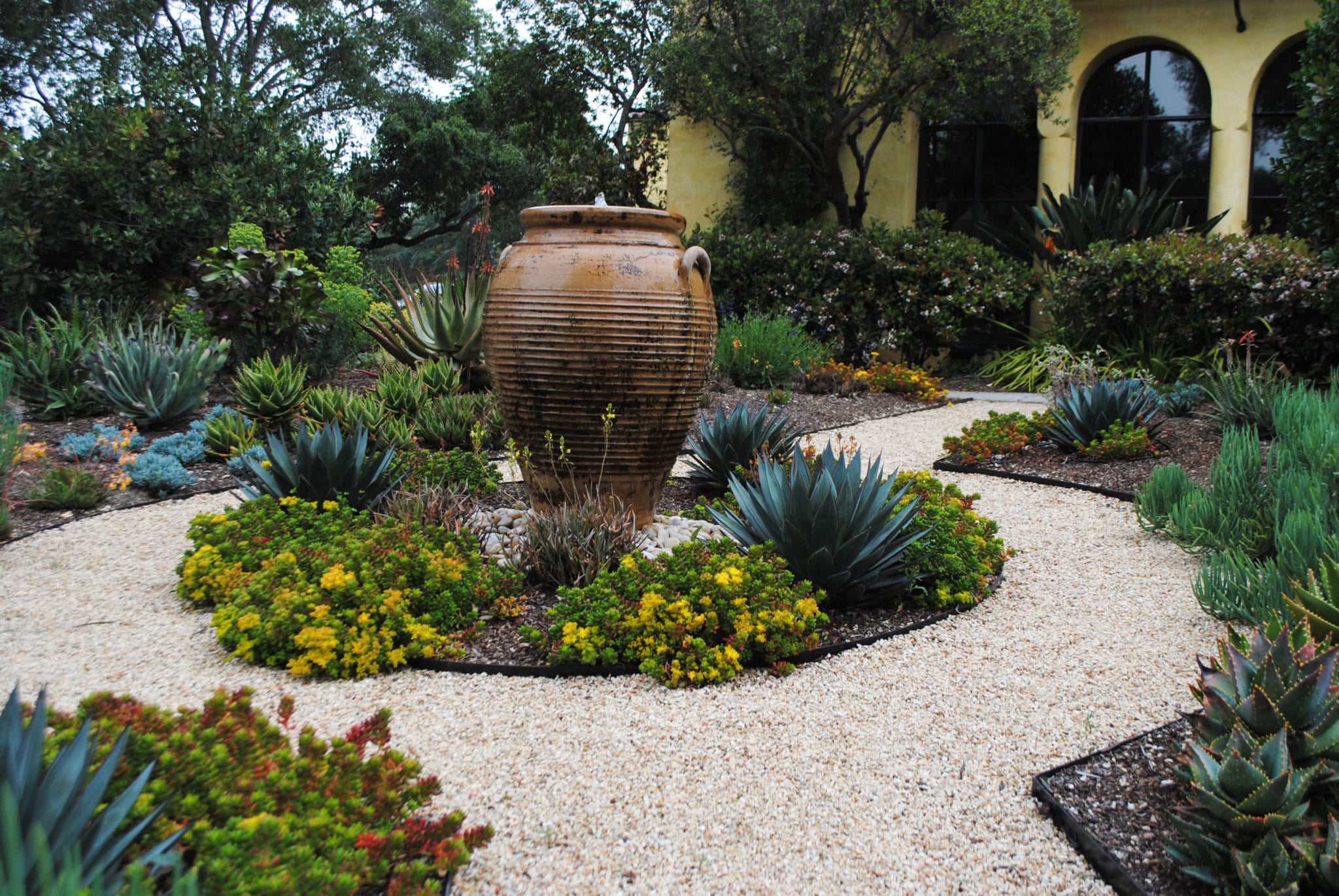
And for my Mediterranean-inspired gardens, a simple antique olive jar blends seamlessly into the surrounding garden filled with succulents, salvias and grasses.