Party at the Fire Bowl

Throughout the summer and into the fall, sitting outside near a fire evokes summer camp, a perfect ending to a long day enjoying nature, bee stings and muscle strain. A song around the campfire, s’mores and stick-roasted sausages perform a prelude to a night sleeping under the stars. But why stop when the trees are bare and cold night air nips the nose? Gathering around a fire forges friendship. Time spent at the computer, scanning Facebook, watching movies or shopping online should be cast aside for a warm fire, friends, a mug of spiked hot chocolate and ok, stick-roasted sausages.

Fire pits were originally used by nomadic people to cook and to provide heat. Pits were dug in the ground (an option today, too), and when it was time to move on, the pit was closed and sealed. As time progressed, the communal fire also became a social focal point. Today a typical home fire pit, or fire bowl, is constructed from metal, stone, brick, clay or concrete.

Eye of the Day Garden Design Center|Musings Un Design|concrete Fire bowl
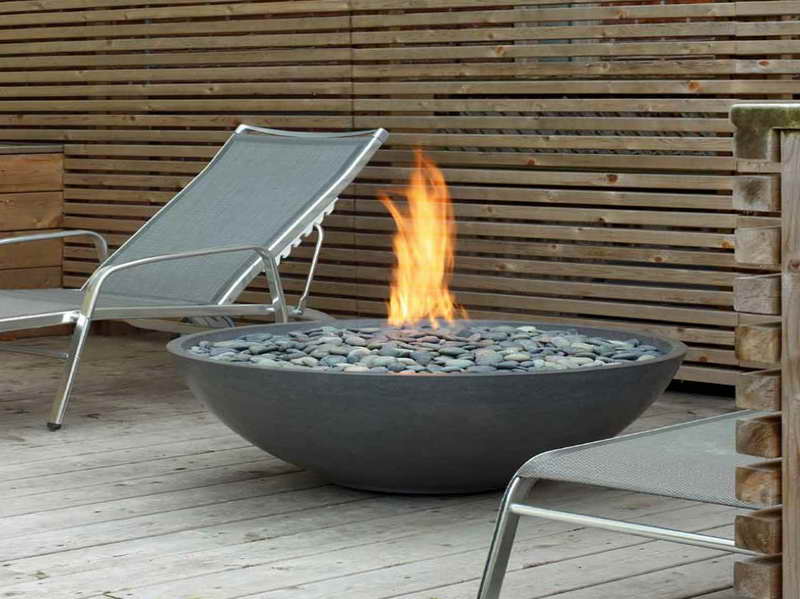
A concrete bowl converted into a fire bowl

According to Landscape Architect and Eye of the Day newsletter contributor Sally Farnum, in the early days of her career during the 70s and 80s, fire pits were out of fashion and most all of her clients wanted them removed. Now and for the last several years, almost every one of her clients has requested either a fire pit or an outdoor fireplace be included in the landscape design.

As the weather begins to chill, we have more and more customers asking about fire bowls. Low, round concrete planters are available in a number of sizes and can be easily converted to a gas-flamed or wood-fired fire bowl. The same is true for terracotta planters, especially low bowls. For both, some precautions must be taken to prepare them for life as a fire bowl. A large “bonfire” will most likely crack the bowl, so it is best to start with a small fire, at least the first few times, to temper the bowl. It is also important to have a bed of sand in the bottom of the bowl to absorb some of the heat. Smooth stones or glass rock (available in a multitude of colors) can also be placed in the bowl for a decorative effect and to diffuse the heat.

Eye of the Day Garden Design Center|Musings Un Design|stones in a Fire bowl
Stones fill out this fire bowl.

Don’t spend your winter at your indoor fireplace, or glued to a screen, treat yourself and your family and friends to a party around your outdoor fire enjoying the nip of the air layered clothing, hot drinks, and those sausages.


Terracotta Transformations: The Fire Behind Baked Earth

As the days grow shorter, and we inch toward the certainty of a cold winter, it seems fitting to talk about fire. I love fire. It takes a deep understanding of this primary element to master the process of “firing” clay. In my last installment we talked about frost proof ceramics and even that conversation must begin with a discussion about fire.

Clay begins as granite, decomposes and compressed for a millennia, then becoming a sticky, malleable mud with memory. When it passes through human hands, turning it into functional art… the real fun begins: the firing. Once the clay morphs all the way back to stone, it changes from stone to mud and back to stone again, transformed by fire. I feel lucky to be in the middle of this cycle, the one that gets to instruct the clay. Kind of a big responsibility really, manipulating the earth while it regenerates itself.

It takes a lot of heat to fire ceramics and even more heat to fire clay to vitrification (refer to Baked Earth installment How It Works: Frost proof Terracotta). Firing clay depends on what material we burn. This is why so many ceramic wares are under-fired: limited combustibles. In the developing world many traditional peoples have to travel further and further to harvest the wood or brush. As the forest recedes, they begin to use less fuel to burn the clay, because transportation is more difficult. Travel can take three or four times what it used to for procuring wood, or other combustibles, to fire the pottery, cook and heat their homes.

In the US, you will see many types of firings: wood, salt, recycled automobile oil, sawdust, dung, natural gas, propane, passive solar, and electricity. We are fortunate to have so many options within reach when it comes to firing pottery. Regardless of how the work is fired, some basic transformations occur on the clay’s long journey back to stone.

At 212°F the water in the clay converts to steam and is slowly released. At approximately 400 °F, all organic matter in the clay has burned out, and the cristobalite (a crystalline form of silica found in all clays) suddenly shrinks. Between 1000°F and 1100°F the quartz crystals change from an alpha crystal structure to a beta structure. Referred to as Quartz Inversion, the temperature must increase gradually.

From 1500°F to 1650°F, “sintering” begins. This is the stage where clay particles begin to cement themselves together to form a hard material called ceramic. From this point on, depending on the temperature range of the clay, vitrification occurs. For earthenware clays, this happens at approximately 2050°F. For stoneware clay, about 2300°F, and for porcelaneous clay, 2500°F.

The transformation of clay from stone and full circle back to stone is a long, hot journey that no other material makes. And here’s a little point of reference: Kilauea, the volcano on the big island of Hawaii, spewing lava into the Pacific Ocean was recently tested for temperature. The orange lava is only 1800°F—low fire in the world of clay!

See you next month!


Groundskeeping: Exploring Urban Landscapes and Frederick Law Olmsted

GROUNDSKEEPING is about my travels for my life’s work, keeping Eye of the Day fresh and exciting not just for me, but our clients and customers. I am always trying to find what others are seeking for their designs.  Like a chef experimenting with ingredients and flavors to interest his public, I look for those things that different places and cultures want and need, and that architecture requires for exteriors to be in harmony with structures.

Recently I decided to return to the East Coast, which is the market we ship to more and more frequently. While walking throughout New York and Boston my goal was to come up with new ideas and directions.

Revisiting and walking the length of Central Park, one of my favorite urban places on earth, was a specific goal.  It is 2.9 miles long (in a straight line), but my meandering probably added another half mile or so.  Fredrick Law Olmsted was a remarkable genius and I marvel at his accomplishments. The Ramble is still my favorite area of all.  It is hard to believe you’re in the city at all.

As I approached the northern end I came to the Conservatory Garden, the only formal garden in the Park. It’s truly an intense, wonderful experience for garden lovers. I recommend that you go to Google images for more wonderful photos. From the corner of 110th Street I took the bus down 5th Avenue to my reward, lunch at Gramercy Tavern. I needed plenty of oysters to soothe my soul and rest my sore feet.

Next, I traveled to Boston ($ one-way bus ticket) to compare cities and get a better feel for this historic place and the homes and offices of its famous residents. Boston is to NYC as Santa Barbara is to LA; while it is a major city and urban center, it feels much more intimate.

Boston Public Garden, like Central Park, is right in the center of the city; it’s smaller, but very dynamic. The 24-acre park was the first public botanic garden in the USA, established in 1837. My favorite site is the magnificent bronze statue of George Washington on his horse.

Boston Garden Lake & Bridge - Brent Travel Photo

Across the street from the Park is Beacon Hill. The word “historic” doesn’t begin to do justice to this neighborhood. Walking its narrow streets is not for those of weak ankle. I immediately saw what I was looking for, something you rarely see in the West: window boxes.  They were everywhere and many decorated for Halloween.

Boston Window Box 7 Boston Window Box 3 Boston Window Box 5I could have walked all day through the streets of Beacon Hill, taking pictures of the Federal style homes packed side by side sporting window boxes below every wonderfully fenestrated opening.  San Francisco, Pasadena, and Brentwood: why don’t you have any window boxes?  They are jewelry for the home. Designers, what are you afraid of?  I want window boxes.  I have window boxes.

Next, my pilgrimage led me to the unassuming home office of Frederick Law Olmsted in Brookline, Massachusetts. This is the location where The Master worked on his brilliant, timeless designs. The Park Rangers and volunteers were wonderful, helpful and spunky. It is moments from downtown Boston, just a short cab ride.

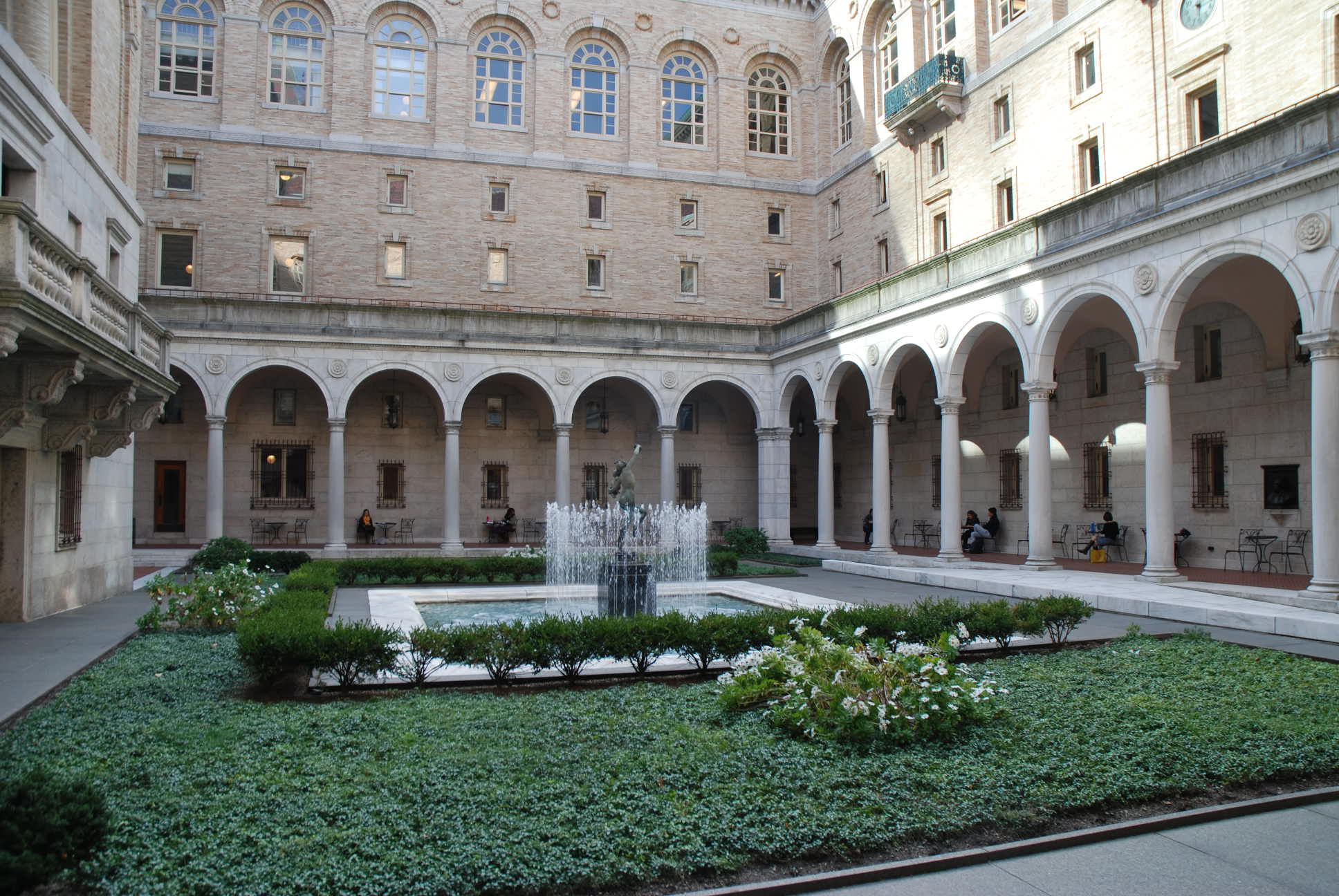
20459367-F2BB-45CB-9071-4C8F2EAC083FFinally: the fountain I stumbled upon when I walked through Boston’s main library.  In the courtyard is a fountain that replaces my favorite for many years, The Electric Fountain at the corner of Wilshire Boulevard and Santa Monica Boulevard in Beverly Hills.  In the courtyard of Boston’s public library is the most wonderful fountain, Frederick MacMonnies’ Bacchante and Infant Faun.

Boston Library Fountain 1

In its unique setting it is difficult to think of another fountain I’ve seen in my travels that could make me smile more.

Where to next??


Books to Read by the Fire and a Hot Cocoa and Book Giveaway!

BOOKS TO READ BY THE FIRE THIS WINTER

Suzi Freitas gives her recommendations for books to cozy up to this winter. For our readers, we’re also doing a special giveaway. Enter below by visiting our Facebook page or following us on Twitter  to win a copy of The Drunken Botanist and cocoa powder from famed French luxury baker and sweets maker, Laduree. The perfect treat while reading a book this winter.*


Amy Stewart Wicked Plants image

1. Wicked Plants: The Weed That Killed Lincoln’s Mother and Other Botanical Atrocities, By Amy Stewart

Stewart takes on over two hundred of Mother Nature’s most appalling children in an A to Z description of plants that kill, maim, intoxicate, and otherwise offend. Scary botanical illustrations create a portrait of the evildoers that may be living in your own backyard. This collection of bloodcurdling botany will frighten, entertain and educate even the most courageous gardeners. This book would provide perfect fireside reading on a cold winter evening.

 2. The Drunken Botanist, By Amy Stewart

Also by Amy Stewart (can’t get enough of her), The Drunken Botanist details the botanical history, science and chemistry of over 150 plants, flowers, trees and fruits. Many surprising and somewhat odd plants have been fermented or distilled, in fact every great drink starts with a plant. For example, Sake: rice, Scotch: barley, Gin: juniper. One of the most interesting sections regards the thirty-year court battle over Angostura bitters and its “secret” recipe, which technically may not even contain bark from the Angostura tree. The book includes over fifty drink recipes along with growing advice for gardeners, making it a great gift for gardeners/cocktail lovers or gardeners or cocktail lovers.


Carol Wall Mr. Otwita image

3. Mister Owita’s Guide to Gardening: How I Learned the Unexpected Joy of a Green Thumb and an Open Heart, By Carol Wall

The author’s neighbor, Mister Owita, helps her to transform her outlook on life following a series of personal misfortunes, and to allow herself to appreciate her lush backyard oasis. Through Owita’s extensive horticultural education, kindness and a variety of mutual interests, the pair becomes inseparable while they perform miracles on Wall’s property and her life.


a Rafflecopter giveaway

1. Sign Up through Rafflecopter
2. Like Us on Facebook or Follow us on Twitter. Each one is an entry to the giveaway*

*Giveaway Open to U.S. Residents Only, 18 Years Old and Over.

Giveaway Ends December 31, 2014.


Garden Design Magazine Offer for Eye of the Day Readers

Have you seen the new Garden Design magazine yet? Now’s the time because we’ve arranged for Eye of the Day readers to get a FREE issue of Garden Design magazine when you subscribe!!!


Log on to  and when you order, you’ll get five issues of Garden Design magazine for the price of four. The beautiful Autumn issue is your first free issue and will be sent to you right away, so you could even give it as a gift for the holidays!!

Every issue of Garden Design magazine is 132 pages with NO advertising. Its stunning photography and in-depth articles feature:

• Showcase gardens across America designed by top landscape designers and garden enthusiasts!
• Detailed “how-to-grow” information on specific plants used in design!
• Chic furnishings, fixtures, and decor that embellish the garden!
• Profiles of innovative leaders in garden design, established designers, and makers of artistic products!
• In-depth look at how design techniques resolve specific landscape problems!
• Topics of local interest to design conscious readers in various regions of the U.S. and Canada, plus much more!

Order today!!
Go to

To order by phone, call Dayna at (855) 624 5110 (Monday-Friday 8am-5pm PST).


How to Bring Warmth to Your Winter Garden

Baby, it’s cold outside! Now is the time for snuggling up, hunkering down and staying in. The garden may be a little drab to look at with deciduous trees going bare and flowers and grasses fading into muted tones. It‘s a good time to put a little warmth and brightness back into the landscape.


One way to do that is with plants whose foliage is aflame with gold, yellow, orange and red. Here are a few eye-catching plants to add pop to a dreary corner. For an accent, or even a hedge alternative, there are several bright selections of mirror bush, Coprosma to choose from. In this case, their cultivar name often says it all. ‘Inferno’, ‘Pina Colada’, and ‘Tequila Sunrise’ give you an idea of what their creators were seeing in the variegated foliage they sport. All are medium-sized shrubs, about four feet by three feet and require only moderate water and partial shade, or as the garden guide calls it “cool sun”. There is also a low, spreading version called ‘Evening Glow’ that can act as a groundcover.

The ever-popular flax plants also have some dazzling variegations: ‘Cream Delight’ is striped with creamy yellow, ‘Jester’ has a bright pinkish-range mid-rib and green leaf margins, ‘Sunset’ sports shades of apricot, pink and green, and ‘Yellow ‘Wave’ has a sunny yellow center stripe.

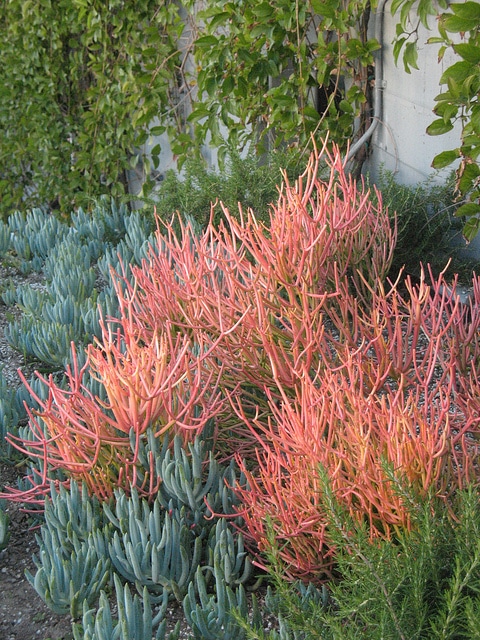
For really low water use areas there are a number of succulents that will provide that sunset glow. One is a selection of euphorbia (Euphorbia tirucalli) called ‘Sticks on Fire”. As you can imagine, it is flaming yellow and orange. Keep it as a container specimen or put it in the background where it could grow into a sizeable shrub (remember that its sap is irritating!). Most everybody knows the jellybean plant, Sedum rubrotinctum, which can eventually provide unbroken cover in the planting bed or add interest at the edge of a mixed container garden. Just as colorful is Crassula capitella ‘Campfire’ whose pointed little leaves look like flames racing across the ground.

One last group to consider for winter color includes those shrubs that produce red or orange fruits at the end of the season. Most will hold the berries for months (if the birds don’t get them all first). Cotoneaster horizontalis ‘Perpusillus’ grows only one or two feet high, but spreads to seven feet wide and is covered with bright red berries. Larger shrubs in the firethorn genus of Pyracantha include P. koidzumii ‘Victory’ and P. coccinea ‘Kasan’. Both may be left in a natural fountain shape, but take well to espaliering on fences or against walls. And lastly, don’t forget our native Christmas berry, Toyon heteromeles for handsome dark green foliage festooned with cheery red fruits.

Image licenses: Christmas Berry, Sticks on Fire