Musing on Design: Bonsai – Tiny Landscaping Using Very Little Water

Eye of the Day|musing on design|Joe Kalina bonsai

Musing on Design: Bonsai – Tiny Landscaping Using Very Little Water

Eye of the Day’s interest in gardening, plants and outdoor living goes beyond residential and commercial landscape architecture and into a special type of gardening—almost a form of intellectual gardening—with Joe Kalina, a man who is certainly musing on design.

Eye of the Day|musing on design|Joe Kalina bonsai
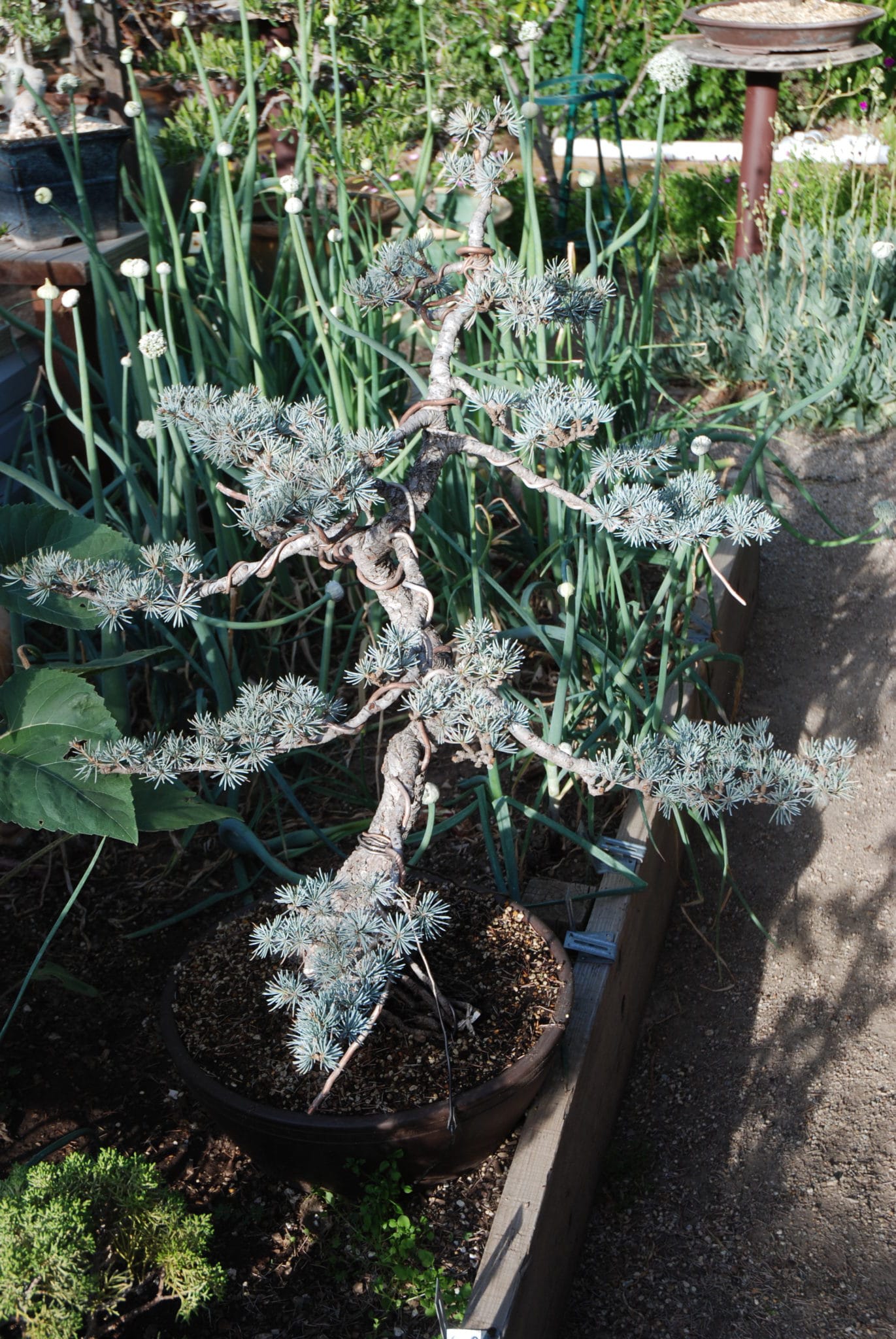
An older bonsai with many branches.

Joe is always interested in a challenge and always interested in intellectual probing.  He received his degree in Fine Arts, worked as a draftsman and then pursued a degree in Business Administration while working as a designer at Northrup Grumman.  Now “retired,” Joe has a million projects, but one has held his attention since 1977.

Eye of the Day|musing on design|Joe Kalina bonsai
There is something inherently peaceful about bonsai

With his knowledge of the elements of design, the art of Bonsai became a challenge and a love for him.  He first chooses a potential tree by looking at the size of the trunk based on how he envisions the outcome in the distant future. He then examines how the roots are dispersed around the base of the trunk to give structure and visual pleasure. The optimum plant has many branches which in traditional Bonsai practice are numbered.

Eye of the Day|musing on design|Joe Kalina bonsai
Mini landscape in a container. Bonsai are also water friendly.

Practicing the art of Bonsai is a true form of meditation and has helped Joe to gain the discipline to learn patience, as many of his projects have been ongoing for decades. For a few hours almost every day, tiny leaves are pulled and even tinier pine needles are removed with tools that are almost surgical.  Copper wires and wooden spacers are used to coax the tree into shapes that are traditionally sound as well as pleasing to the eye.

Eye of the Day|musing on design|Joe Kalina bonsai
Special plants require special care– some of the precise tools for bonsai

Many of the same methods that are used in landscape design are used in Bonsai: planning, strategy, use of sculptural elements, linear design, visual significance and personal style.  Joe has become genius at planning his unique landscapes, but he acknowledges there is time to learn even more patience.  He is a patient man.
Eye of the Day|Joe Kalina bonsai| garden design
Joe visiting Eye of the Day and one of his favorite people, Suzi.


How a Landscape Architect Approaches Garden Design During California Drought

Eye of the Day|Sally Farnum Landscape Architect|garden design drought

Having a sister with a long, successful career as a landscape architect has made it easy to have an ongoing conversation with Sally Farnum about design, client concerns and current issues. We are all especially interested in California’s water problem and wanted to find out how Sally is helping her clients address the issue.

Suzi: What have your clients have been asking about when it comes to water and their gardens?
Sally: Most of my clients are trying to be responsible when it comes to water usage in their landscape. They want to know if they need to take out their lawns, replace their flowering plants with desert plants and if it will still look pretty.

Suzi: How do you approach designing a plan that reflects water-consciousness but is still pretty?
Sally: I really work to combine good elements of design in all my plans: scale, balance, variety, form, line, texture and color. I like to use California natives, salvias, lavenders along with containers, sculpture and fountains.  I suggest using decomposed granite and gravel and, really important, an extra-efficient irrigation system.

Suzi: How do you convince them that a huge, green lawn isn’t the best plan anymore
Sally: Most people are visually oriented, so to describe an idea in words alone doesn’t always convince them. I show them photos or have them visit other projects I have completed.  But I don’t feel that it’s necessary to remove ALL lawn. Only 5% of residential water is used to keep lawns green and it contributes to cooling an area, cleaning the air and reduces noise. Grass in a front yard, used to fill space, should be eliminated.

Suzi: Do you have a favorite or most challenging project which incorporated water-wise elements?

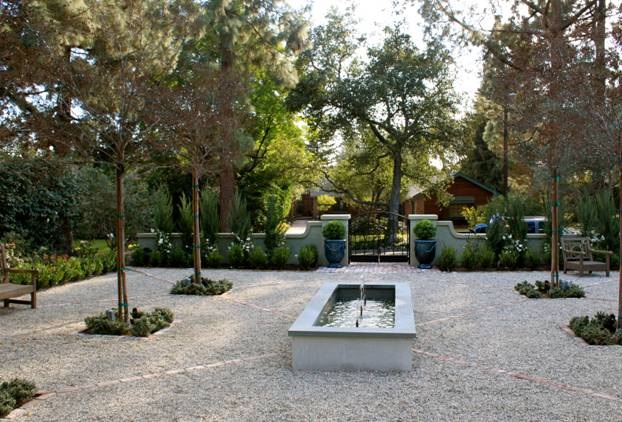
Sally: One of my favorite and most challenging designs is right across the street from my own home.  Challenging because the home belongs to a friend and because I look at it most every day. My favorite because of the transformation from a front yard with a large asphalt driveway and lawn, to a garden with a walled-in gravel courtyard with a fountain and pots planted with flowering plants on the street side of the wall.

Suzi: How have you managed to change the way you designed in the past to meet the new challenges presented by the drought?
Sally:  The challenges are mainly in working with my clients and helping them accept new plants and watering habits.  Most plants will adapt to using less water, but people tend to water more than necessary.  I haven’t changed the way I design, but I have changed the materials and plants I use.


Suzi: Thanks, Sal.  You’re always such a wealth of information, and a fine sister, too.
Sally: You’re not so bad yourself.


Masterpiece: Virginia Robinson Gardens 27th Annual Garden Tour

Eye of the Day|Virginia Robinson Garden Tour|Masterpiece Garden tour

FRIENDS OF ROBINSON GARDENS

Cordially invite you to our twenty-seventh annual

“…into the garden Benefit Tour”

Saturday, May 16, 2015, 10:00 a.m. to 4:00 p.m.

Grand Marshal
Victoria Tennant

New this year – Valet Parking
Valet parking must be purchased prior to the day of Garden Tour.

Eye of the Day|Virginia Robinson Garden Tour|Masterpiece Garden tour

Eye of the Day|Virginia Robinson Garden Tour|Masterpiece Garden tour


Virginia Robinson Estate and Tours of Four Exquisite Beverly Hills Gardens

The Garden Tour is a multi-faceted day, considered “…. the most glamorous (event) of its kind in Southern California.”   For the only time during the year, the entire Robinson residence is open for the day, decorated by the finest florists and designers.

The Beverly House:  William Randolph Hearst’s mini-castle, where he lived with Marion Davies, is an architectural masterpiece with its famous gardens laid out by Paul Thiene in the 1920s.  The property includes lavish reflecting pools, old-growth trees and expansive grounds.

Hernando’s Hideaway:  Originally built by the owner of the Beverly Hills Hotel and occupied by hotelier Hernando Courtwright, a frequent guest of Virginia Robinson, this Gable and Wyant treasure has charm to spare:  hanging gardens, passion fruit vines lining the tennis court fence, a playhouse courtyard and a secret garden lined with bottle art.

A Hilltop With A View:  an Italianate villa with recirculating water that feeds three waterfalls into a placid lake, a grand lawn with colorful flowers and citrus borders, manicured hedges that include a maze and a glorious pool with a view of the canyon.

 The Best Exotic Bel Air Estate:  Climb deep into this 8-acre canyon that boasts a series of garden rooms, from koi ponds to Balinese sundecks to terraced vegetable gardens.  There is even an art studio and a hillside amphitheater.

PLEASE NOTE:  Due to parking limitations, this house is a BONUS for all Concierge and VIP Van ticket holders only.

To purchase by mail please CLICK HERE to print response card and mail to:

Robinson Gardens, 1008 Elden Way, Beverly Hills, CA  90210

Friends of Robinson Gardens
1008 Elden Way
Beverly Hills, California 90210
(310) 550-2068


Arugula Sauté: A Weed of the People

Eye of the Day|Arugula Saute Recipe| garden weed cook

A Weed of the People

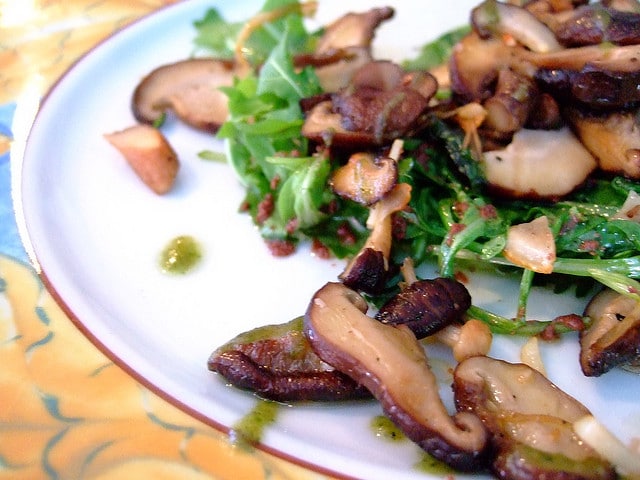
We find vegetable gardening is a little difficult when we can’t water. This is why you need to grow ARUGULA  in your garden. It is actually a weed that doesn’t need much water, it grows wild in many parts of Europe, especially Mediterranean areas and it will grow wild in your garden, too. People in Europe pick it wild and throw it in their salads. Arugula is a weed of the people.

And it’s good for you, high in vitamin A, folic acid, iron, potassium, calcium. It’s a veritable miracle. The small, young leaves are our salad of choice (see previous recipe for Freitasalad), but as the leaves grow larger and stronger in flavor, sauté them like spinach and they lose their bite and take on an entirely different flavor and texture, not as slimy as spinach can be.

ARUGULA SAUTE

1 T olive oil

½ LB mixed wild and cultivated mushrooms

1 small red onion, slivered

4 garlic cloves, minced

1/3 c dry vermouth

¼ t coarse sea salt

A pinch of red pepper flakes

8 c washed, dried arugula

parmigiano

Heat olive oil in a large pan over medium heat and add mushrooms , onions and garlic for about 4 minutes.  Add vermouth and continue to sauté until liquid is mostly absorbed.  Add salt, red pepper flakes and arugula and stir until the arugula is wilted, about 3 additional minutes.  Sprinkle with a little cheese and never eat spinach again.

Image Credit:
Arugula – Creative Commons, Mushrooms with arugula by yosoynuts is licensed under CC by 2.0


Planting in the Edges and Cracks of a Garden

Eye of the Day| succulents rock wall garden |garden

Planting in the Edges and Cracks of a Garden

For several years I tried to get a lovely, drought tolerant plant established in my garden. Lychnis coronaria is a perennial that forms low-growing rosettes of gray-green leaves that in late spring and summer sends up glorious stalks of dark magenta flowers. It just refused to grow in my nice fertile beds, but it is now flourishing, all on its own, between the cracks of my brick path. Like many plants, it apparently doesn’t want coddling and can find the moisture and nurture it needs at the edges of the more cultivated part of the garden. Even the Gaillardia seems to do just as well in the gravel terrace outside of the confines of the bed I originally planted it in.

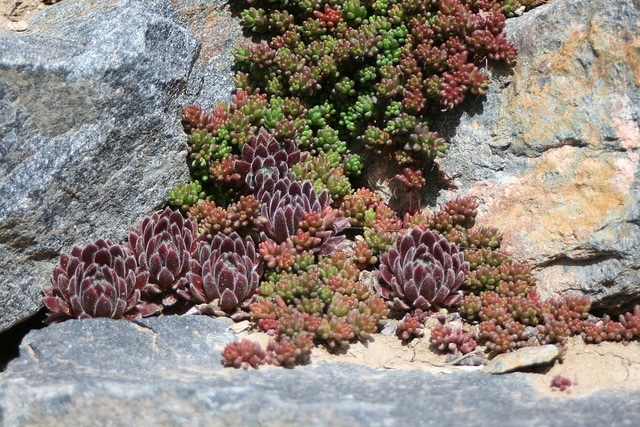
There are plenty of other species that also seem to thrive on the margins. Many succulents, for example, will multiply in the cracks of a wall or at the edge of the walkway. The stones provide a heat sink as well as a barrier to evaporation so that the root zone of these castaways is protected. Succulents such as sedums, sempervivums, and portulacas are particularly suited for this lifestyle. But other, tough plants like the herbs rosemary, oregano, creeping thyme, and even sage can fend for themselves in these microzones.

You may already have a dry-laid stone wall, or a flagstone or brick path that can accommodate a few plants tucked in the crevices. But, if you are planning such a feature, imagine leaving a wider gap in a few places. Some landscape material suppliers even have broken concrete or tile that has been salvaged from former gardens that make ideal patterns to include a few hardy plants to complete the patio, path or wall with the re-used paving.

And if some plant escapes the confines of your established garden bed, give it a chance and see if it is one of the hardy survivors that can lend softness and charm to the margin.


Image Credits:
Rose Campion – Creative Commons, Rose campion by Ruth Hartnup is licensed under CC by 2.0
Herb Garden- Creative Commons, Herb Garden1 by theoldpanther is licensed under CC by 2.0
Rock Wall Garden – Creative Commons, Rock Wall Garden by Patrick Standish is licensed under CC by 2.0


Book Review – Sun Drenched Gardens: The Mediterranean Style

Eye of the Day|Sun Drenched Gardens Book Cover|Mediterranean style garden

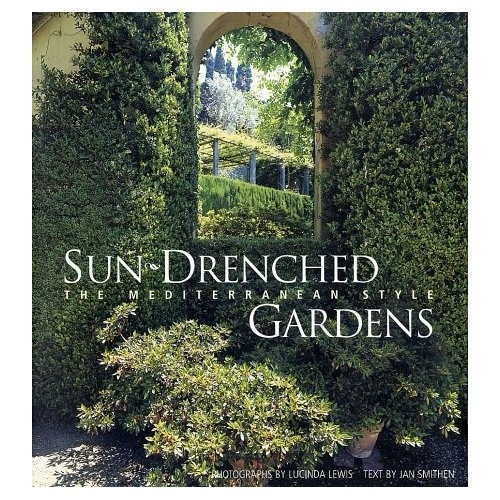
Sun Drenched Gardens: The Mediterranean Style by Jan Smithen 

 Author Jan Smithen and photographer Lucinda Lewis have put together a beautiful and pertinent book that is even more noteworthy today than it was when it was published in 2002. Mediterranean-style gardens offer easy maintenance as well as water-saving planting that is environmentally sound and enormously appealing.

Sun-Drenched Gardens; the Mediterranean Style features gardens from France, Italy, Spain and California that employ drought-tolerant plants such as agaves and other succulents, wisteria, lavenders, geraniums and even some roses. Design features such as terraces, arbors, hedges, pergolas, topiary, statuary, decorative tile, and terracotta containers are used in the gardens.

While paging through the book, Californians and especially those familiar with Santa Barbara will recognize landscape designs and terracotta containers so familiar that it seems the photos were taken in our backyards, or even at Eye of the Day. The eight chapters include one entitled “Endless Sunshine – Precious Water” which has great information and design ideas.  Another entitled “Living Outdoors” highlights our need to be in the open air and how to plan and enjoy our gardens even during a drought.

If you have difficulty finding this amazing book, the next time you visit Eye of the Day, ask to see our house copy, it’s truly worth seeing.