This is Part 2 of our interview with Jeffrey Gordon Smith Landscape Architecture with the principal architect himself. To read the first part, please visit here.
EOD: Based on your portfolio that definitely seems to be a case. It can be difficult to make sure all work in harmony, but your clients must know who you are and seek you out for those specific reasons.
JGS: Right, I don’t think I want to be the landscape architect for everyone. I tend to be a pleaser, but I’ve realized you can’t make everyone happy (laughs). I’ve been very fortunate, I feel, that we created this signature or style that people gravitate towards. I’m sure there are people who know they don’t like this style and I’ve learned this is okay. It’s kind of a Buddhist approach that hey, there’s always going to be change and not everyone is going to like you. So, looking back the one thing that has tied a lot of our work—that three-prong approach—is really hard to put a finger on. One of the things we are fortunate in the area we are working in is these amazing sites and getting to derive power from those places and turn that volume up. It’s almost like place making and tuning into the site. Being sensitive to the offsite: the colors, environment, and extract out and almost paint with plants and materials that feel that are of the place where it doesn’t feel contrived.
We had a project in Garden Design magazine and someone from Minnesota emailed me who were inspired by my work and wanted to make their backyard like the one in the magazine. They ended up having to bring most of it inside for the winter and I felt it missed the point. That’s what’s difficult with print; you only get a small sliver of the whole project. So much of the true nature and heart of project gets stripped out and they lose what’s really behind the project. They lost the whole impact of what the project was about: Using what you got, living where you are and celebrate where you are. I love the idea of a regionalism philosophy like that. The whole idea is to celebrate where you are even if you like a Mediterranean climate and landscape and you live in Minnesota. You can celebrate Minnesota.
EOD: That’s really about respect of location. You’re based in California and drought has been a concern the last few years. But based on your work, the projects continue to still feel lush. There’s water features, flowers, trees. How do you keep designs sustainable and still incorporate all these features despite the California drought.
JGS: I’m not a big sustainable, green flag waver. I’ve always believed we should tread on the Earth with the smallest footprint possible. I’ve kind of always done that in my work by playing up where you live and work with what you’re given. Paying homage to understanding the soil, climate, sun and wind exposure and work within those parameters rather than shoving something that doesn’t quite belong. We’re always trying to pay attention to the soil and guess what would be the happier plant environment. First understand the soil then the water you’re given. Most of our landscapes are drought tolerant just by working off with what we’re given. Sometimes we get requests for a tropical garden in an oak woodland. How would that work? We really try to open up their appreciation for where they’re at and try to get them to celebrate their location. We definitely have conflicts and I do tell them I’m not a “Yes person” but I’m not a “No person”. I’ll give them what they want but at least tell them what I think. And hopefully through that I hope we’ve educated clients, or at least pushed them outside their comfort level. I think again, it’s about becoming more sensitive to what’s around you.
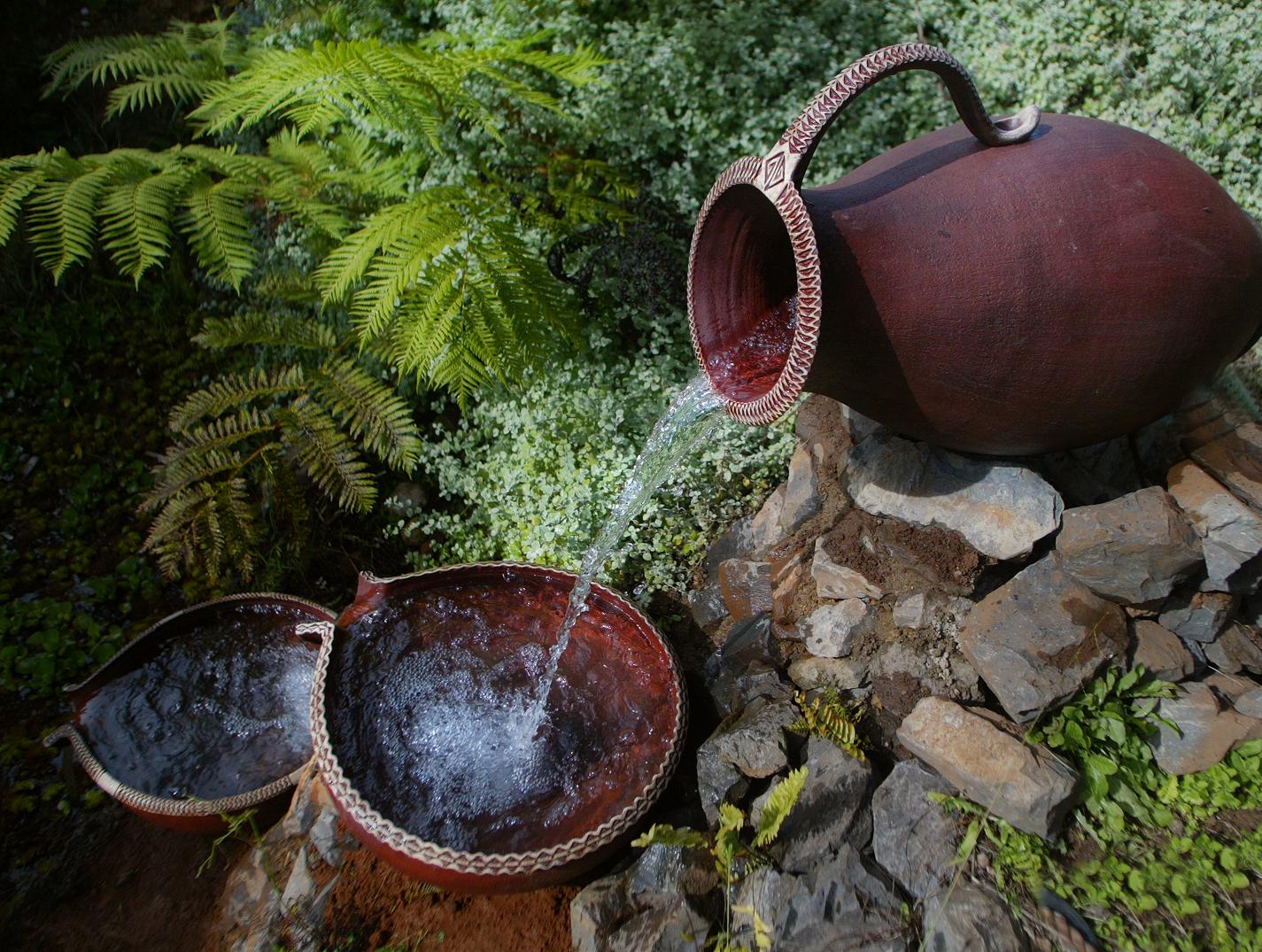
With the drought, I’ve had lots of clients request water features and what not, but I’m not a big default water feature person. If a client requests it, we try to design something unique. The big thing I’m worried about is, Is this just a blip or will this be the next environment that California will be? I try to forecast it, looking at new plants and pushing the next edge. I’m always looking for plant material that works here and we can use as a new medium to transition into. I’m looking at Arizona for a lot of plants and similar areas that require almost no water and trying to push further out from the current environment.
We’re constantly probing and testing new plants to see how successful they are in certain projects.
EOD: When you do designs outside of California do you bring some of that sensitivity to the environment or do you judge each space on its own?
JGS: It really is trying to tie into place. We’re not always using strictly native—the cat’s out of the bag on that one. The true California landscape was let out when invasive European species were introduced. It would be unrealistic at this point to create a true California landscape. But I do like to rely on natives. I did a golf course in China and met a botanist there. The only common language we shared was Latin and we could discuss plants with Latin descriptors. They essentially had to create a nursery for the golf course. I suggested they use a roadside weed and they probably thought I was nuts. They saw it as a weed where I saw it as a native plant that grew very well and looked like it was at home. They thought I was completely crazed for wanting to use that weed but it could have propagated well. Working in another climate can be a challenge, even within California with all the different zones. If I were to work somewhere else I’d put the time in researching plant material and who is growing it. It’s not an easy profession to do well in many locations (laughs). If I was an architect I could grab a window, a door, or roofing material from any place and ship it across the globe it would be fine. But the plant material is the thing that could make or break it.
EOD: Are there any personal favorite projects of yours? And finally, what is your hope for the future of Jeffrey Gordon Smith Landscape Architecture?
JGS: I sometimes fear, how are we going to do better than what we’ve done in the past? But each year I look back there’s always another project that one ups one of the last ones. But it’s not really about one upping but there are qualities of that project that resonate and hold for itself. There was a perfect poetry of this project that connects to that space. Then you get another project and wonder how you’re going to pull that off in this one but you find some other element or other aspect to it that you can pull that kind of power as well.
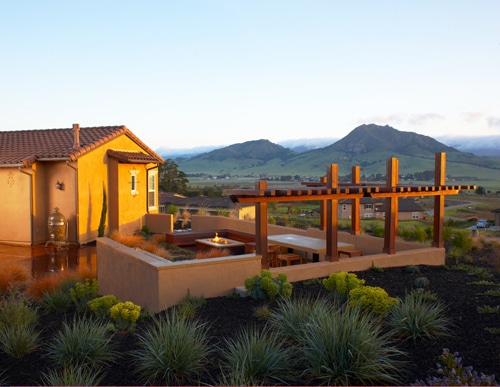
A lot of projects we’re looking at we’re trying to develop a narrative. An example is Seven Sisters. There are geologic features that surround this area called the Seven Sisters which are volcanic plugs. They’re two mountains that are part of the chain of mountains—they say seven but there’s technically eleven—that are in the background of the project. That’s where we got the different heights for the seven posts in the pergola. They’re sort of talking to place and kind of telling the story of the Seven Sisters. There’s a spa area just beyond here with another four which would be the missing sisters. One of the sisters is more of a rock, Morro Rock which is out to sea, but beyond that is the Davidson Seamount which sits about a mile out underwater and they’re smaller mounts along the chain which aren’t as well know. It is a little tongue in cheek story, but it’s how we create these unique spaces by trying to come up with a narrative or purpose for how things are made.
It’s a story the client might not even know about. What I love about this project, it’s kind of poking you in the side. Neighbors and friends who come to see the fabulous backyard might wonder what happened with the carpenter today, like what happened? Everyone wants to cut them off to the same level. But that’s the thing that makes the garden unique to this place and is celebrating the place. Someone could have torn this image out of a magazine and built it somewhere but it wouldn’t relate to that place.
Another project, Pacific Rim, the client wanted a Japanese garden. I had studied Japanese gardens but to avoid the kitsch aspects we instead try to reflect back on Japan from California. The idea was to use plants that work in this coastal stress with salt laden air that goes in this dune area with the nearby Pacific Ocean. One amazing thing about Japanese gardens is the borrowed landscape and how they create a reflection of their surroundings. Like a rock garden that represents Mt. Fuji. So here we are painting the landscape beyond. That deck is done in a parquet pattern which reflects the farm fields below. We designed raised planters which I call bonsai planters and are planted in crop rows like the farm fields. This landscape is reflecting and has references. There’s even a spirit walk which you would see in a typical Japanese garden, but not so kitschy. We’re still celebrating and having a nod towards Japanese style in some details.
Finally, there’s Backbay Retreat, which I kid around that we could have taken a Yahtzee cup and thrown plants out there and anywhere they landed would have been perfect. It was a really amazing setting. The client bought an empty property next to theirs and instead of building another house extended their garden. We spent a lot of time out at this site. It’s pretty sacred and we wanted to understand what the space wanted to be. We borrowed this curve of the bay’s shoreline and designed the deck around this curve—it’s kind of mimicking it. For the deck we used polished concrete so we could get a really glassy, super reflective quality because it relates to the water. The client had requested a fence for their dog so we disguised that fence as backing for the bench which is also designed with a nautical theme to connect back to the water.
We used Mexican pebble between the stone because it’s the same color of the dunes. The estuaries which are like fingers feeding into the bay match the stone and pebbles. Connections are being made with the side including the selection of materials. Even the rock that terminates the bench is a small version of Morro Rock. I don’t think anyone is going to the site saying this means this and that but you can leave a site or place with an experience that it just feels good or right and you’re not analyzing why that is, but it just feels like it is. We’re hoping as designers we’re evoking and tapping into those feelings to make connections to place. That’s what I’m trying to do when working on a project.
EOD: And what was your hope for the future?
JGS: World domination (laughs.)
EOD: That would require a lot of research.
To view more of the work of Jeffrey Gordon Smith Landscape Architecture, please visit their site here.